

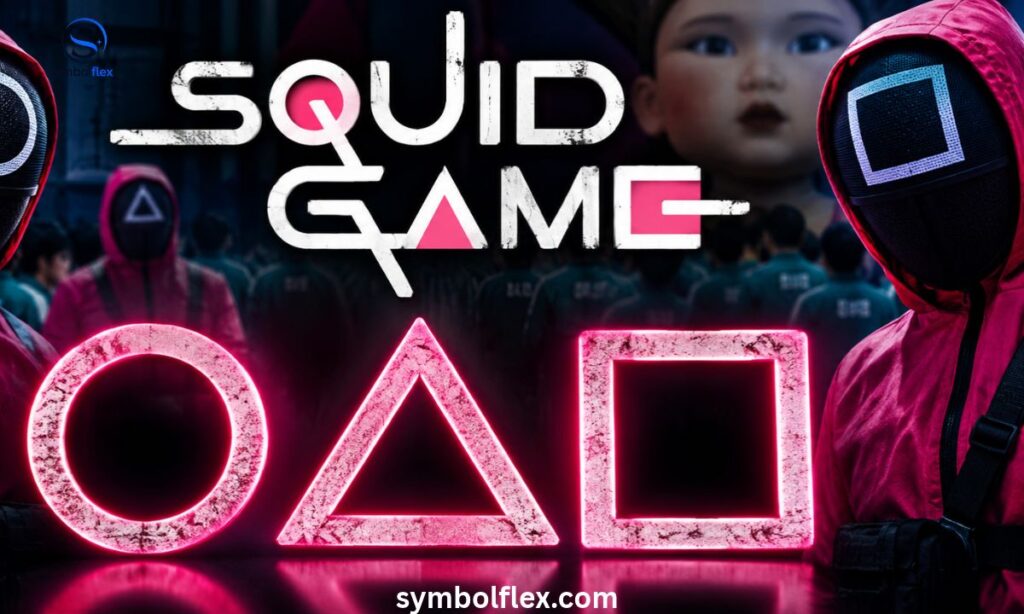
Squid Game isn’t just a survival thriller, every detail on screen is a clue. The circle, triangle, and square quietly map out who holds power and who doesn’t.
Masks, colors, and numbers strip away identity long before the games even begin. Even childhood objects like dolls and candy shapes turn nostalgia into a warning sign.
This guide breaks down 105+ symbols, exactly what each one means, and why they still hit so hard.
The Direct Answer: What Do Squid Game Symbols Mean?

At the core, Squid Game’s symbols represent a hierarchy of power. The circle, triangle, and square stand for the three tiers of the guard system, worker, soldier, and manager.
Beyond that, the show layers in color coding (pink vs. gray vs. black), numbered identities instead of names, and childhood-game objects that turn nostalgia into menace.
Together, these symbols tell the story of a system where people are stripped of identity and sorted into ranks.
The Three Core Geometric Symbols
These are the most recognized Squid Game symbols, and they anchor everything else in the show.
1. Circle
Worn by the lowest-ranked guards, the circle represents the base level of the enforcement hierarchy — workers who manage logistics and cleanup rather than direct confrontation.
2. Triangle
The triangle marks armed soldiers, the guards who carry weapons and enforce the games directly. It signals authority backed by force.
3. Square
The square is worn by managers, the guards who give orders rather than take them. It’s the visual shorthand for command.
4. The Circle-Triangle-Square System as a Whole
Together, the three shapes form a closed hierarchy with no way up and no names attached just rank. It mirrors real organizational charts stripped of humanity.
5. The Shapes as a Childhood Reference
All three shapes appear in ddakji, the folding-paper game played at recruitment. Using a children’s game as the visual key to an adult power structure is intentional — it reinforces the show’s theme of innocence corrupted.
Mask and Hierarchy Symbols
The masks do more than hide identity — they encode status.
- Guard masks (all ranks) — total anonymity for all enforcers, removing individual accountability.
- The Front Man’s mask — a solid black mask that outranks every shape-based guard, symbolizing a hierarchy above the hierarchy.
- Uniform black eye-slits — used across guard masks to deny eye contact, a classic dehumanization technique in visual storytelling.
- VIP masks — ornate, animal-inspired coverings worn by the wealthy observers, symbolizing predator-and-spectator status over the contestants.
- The gap between guard masks and VIP masks — guards are anonymous tools; VIPs are anonymous spectators. Same device, opposite power position.
- Doctor’s mask (rogue organ-harvesting staff) — corruption existing even within the enforcement system itself.
- Staff badge or ID system — a reminder that even guards are replaceable, ranked, and monitored.
Uniform and Color Symbols

Color does heavy narrative lifting throughout the series.
- Pink guard uniforms — an intentionally soft, almost harmless color assigned to figures who commit violence, creating unease through contrast.
- Green tracksuits (contestants) — evokes gym class and childhood PE uniforms, reinforcing the “children’s games” theme.
- Gray/beige staff uniforms — neutral, low-status coloring for background workers.
- Black VIP robes — associated with wealth, secrecy, and detachment from consequence.
- White presentation, red accents (staff spaces) — clinical, sterile visuals used in “back office” areas to contrast the chaos of the games.
- Color-coded doors — pink doors typically mark restricted or staff-only areas, subtly separating contestant spaces from control spaces.
Number Symbols
Names disappear the moment contestants enter the game — numbers replace them entirely.
- Numbered tracksuits — the core symbol of dehumanization; a person becomes a statistic.
- Descending numbers as players die — the shrinking pool is visualized constantly, keeping mortality present on screen.
- Player 001 — the lowest number, symbolically tied to the game’s origin and its first participant.
- Player 456 — the protagonist’s number, notably close to the total prize structure, tying identity to money throughout.
- The number board/tally system — a literal scoreboard for human lives, reinforcing the game’s transactional logic.
- Prize money ticker (the giant piggy bank) — money accumulating with every death, turning grief into a countdown of gain.
Game and Object Symbols
Each game brings its own object-based symbolism.
- Red Light, Green Light doll — a giant childhood figure turned executioner; innocence weaponized.
- The doll’s rotating head/eyes — surveillance disguised as play, foreshadowing that the entire game is always watching.
- Dalgona candy shapes (umbrella) — associated with shelter and protection, ironically the hardest shape to carve safely.
- Dalgona candy shapes (star) — represents ambition or aspiration, a harder-to-reach outline under pressure.
- Dalgona candy shapes (circle) — the simplest shape, tied back to the base-level hierarchy symbol.
- Dalgona candy shapes (triangle) — mirrors the guard rank symbol, linking contestant struggle to the same shapes controlling them.
- The honeycomb needle — a tool of precision under pressure, symbolizing survival through careful, controlled effort.
- Tug-of-war rope — collective effort and the fragile nature of alliances under threat of elimination.
- The elevated tug-of-war platform — a literal fall from grace, visualizing loss as a physical drop.
- Marbles — small, ordinary objects turned into instruments of betrayal, symbolizing how survival games corrode trust.
- Marble pouches — personal, intimate items repurposed for a brutal transaction, heightening the tragedy of the game.
- Glass bridge panels — represent chance and class luck; where you stand in line determines your odds, mirroring real-world privilege.
- The glass bridge’s transparency — you can see the danger and still have to risk it, a metaphor for informed but forced risk-taking.
- The squid game arena drawing (final game) — returns to the show’s title and the original childhood game, closing the symbolic loop.
- Gganbu bracelet/concept — a symbol of trust that the game exploits rather than rewards.
- The recruitment ddakji tiles — the very first symbol shown to contestants, foreshadowing everything that follows.
Environment and Set-Design Symbols
The spaces themselves carry meaning.
- The dormitory bunk staircase — literal class stratification; higher bunks came from advantage within the game.
- The hanging piggy bank above the dorm — a constant visual reminder that survival is being converted into currency in real time.
- Pastel, playground-colored stairwells — nostalgic, candy-colored architecture contrasted against violence, a signature visual irony of the show.
- The M.C. Escher-style staircases — disorientation by design, symbolizing a system built to confuse and trap.
- Coffin-shaped gift boxes — death is wrapped like a reward, blending celebration with mourning.
- The circular observation window (VIP viewing room) — voyeurism formalized into architecture, watching suffering as entertainment.
- Locked doors between contestant and staff areas — reinforces that information and safety are unevenly distributed.
- The “outside world” flashback settings — deliberately drab, debt-ridden spaces that make the game’s twisted appeal make sense.
Symbols Tied to Korean Culture and Society

Some symbols carry extra weight for audiences familiar with Korean context.
- Ddakji as a real childhood game — genuinely played by generations of Korean kids, giving the recruitment scene cultural authenticity.
- Dalgona/ppopgi as a real street snack game — a nostalgic, low-stakes tradition turned into a life-or-death test.
- Debt culture as backstory — reflects real anxieties around personal debt and economic pressure in modern Korean society.
- Honorifics and address in dialogue — status language throughout mirrors the same hierarchy the shapes represent visually.
- Traditional games as a unifying device — using games rather than weapons as the core threat taps into shared cultural memory across age groups.
Psychological and Universal Symbolism
Beyond culture, the symbols tap into broad human psychology.
- Anonymity (masks) → reduced empathy — a well-documented psychological pattern the show dramatizes visually.
- Numbers replacing names → dehumanization — removing identity markers is a known way fiction (and history) shows systems justify cruelty.
- Childhood games → false safety — using familiar, “safe” games lowers guard before revealing the stakes, mirroring how real exploitative systems often present as opportunity.
- Color softness paired with violence — the pink guard uniforms specifically play on the psychological dissonance between color and harm.
- Descending numbers → mortality salience — constantly visible death counts keep viewers (and characters) aware of stakes without needing dialogue.
- The countdown piggy bank → greed conditioning — visualizes how quickly moral discomfort can be offset by visible reward.
Voting and Consent Symbols
- The O and X voting cards — the mechanism contestants use to vote to continue or end the games, a rare moment of agency inside an otherwise coercive system.
- The majority-vote rule — the games can legally stop if most players agree, symbolizing how systems build in “consent” that’s technically real but practically impossible to use.
- The signed contestant contract — represents manufactured consent, where desperation makes exploitative terms feel like a free choice.
- The re-entry clause — players who leave can return, showing how the system counts on outside conditions being worse than the game itself.
- The live vote tally display — turns a moral decision into a visible scoreboard, adding public pressure to a private choice.
Sound and Music Symbols

- The Red Light, Green Light rhyme — a real Korean children’s chant that turns instantly sinister once tied to sudden death.
- Mugunghwa (the hibiscus) in the rhyme — Korea’s national flower appears in the deadliest game’s title phrase, quietly tying national identity to the show’s harshest imagery.
- The doll’s mechanical hum before “green light” ends — an auditory warning cue that trains both players and viewers to associate sound with danger.
- Calm, classical-style music over violent scenes — creates emotional distance for the VIPs and the audience alike, reflecting how spectacle can numb horror.
Recruitment and Outside-World Symbols
- The recruiter’s business card — a small, ordinary object that functions as the entry point into an extraordinary trap.
- The ddakji wager during recruitment — cash exchanged per win or loss previews the game’s core logic before players even know what they’re joining.
- The briefcase of cash — used to bait desperate people, symbolizing how visible wealth can override caution.
- Debt collectors and loan sharks — represent the real-world “game” contestants are already losing before they ever enter the arena.
- Neon city signage — the flashy, consumer-driven backdrop of the outside world mirrors the false promise of easy money inside the game.
- The subway recruitment scene — blends the anonymity of city life with targeted predation, showing how easily desperation is spotted and exploited.
Weapons and Enforcement Objects
- Guard rifles — a visible, constant reminder that participation is enforced, not optional, despite the “consent” framing.
- Guard batons — used for crowd control among contestants, reinforcing physical dominance beyond just weapons.
- Watchtowers over the dormitory — surveillance architecture that never lets players forget they’re being observed even at rest.
- Guard riot gear and visors — an extra layer of anonymity stacked on top of the mask system.
- Body bags — the show’s most blunt symbol of how quickly a person becomes processed material inside the system.
Staff and Class Contrast Symbols
- Separate staff cafeteria and food quality — even among employees, privilege is tiered and visible.
- Guard housing vs. contestant dormitory — physical space itself is used to reinforce rank.
- Staff rank patches and embroidery — small design details that mirror the shape hierarchy in a more mundane, bureaucratic form.
- Cleaning crew equipment — represents the bottom rung that exists even within the staff hierarchy, not just among contestants.
- The incinerator — the literal erasure point, symbolizing how the system disposes of evidence and identity together.
- Player intake photographs — taken at entry and referenced after elimination, showing how identity is captured only to be discarded.
The Doll “Younghee”
- The doll’s design, based on a familiar illustrated schoolbook character — deliberately blends childhood nostalgia with horror.
- Her fixed painted smile — a static, cheerful expression that never changes regardless of what she’s doing, heightening the wrongness of her role.
- Her rotation mechanism — functions as a stand-in for constant, impersonal surveillance rather than human judgment.
Architectural and Overview Symbols
- The panoramic model of the facility — shown to staff, symbolizing total top-down control over the entire operation.
- The elevator system — physically connects dorm, arena, and VIP areas, mapping the show’s class structure in literal vertical space.
- Guard-only catwalks above the arena — elevate enforcers physically above the players they watch.
- The VIP viewing room’s one-way glass — allows observation without exposure, the architecture of consequence-free spectating.
- The corridor between games — a disorienting, dreamlike transition space that gives players no time to process what just happened before the next threat begins.
Betrayal and Relationship Symbols

- The gganbu handshake — represents a bond the game’s structure eventually forces players to break.
- Shared food between players — a small, human gesture of solidarity within a system designed to erase it.
- Alliance formation — shows how people improvise trust systems even under extreme threat.
- Betrayal scenes — demonstrate how scarcity, not character, is often what dismantles cooperation.
Prize and Reward Symbols
- The transparent piggy bank above the dorm — fills visibly with each death, converting grief into a countdown.
- The cash/coin visual during prize reveals — turns loss directly into spectacle and gain.
- The final prize transfer — money changing hands as the story’s true, cold “reward structure.”
- The bank transfer scene — a bureaucratic, unemotional process that contrasts sharply with everything endured to reach it.
Broader Interpretive Symbols
- The “game as capitalism” metaphor — reflects competition without a safety net, where losing has permanent consequences.
- Childhood vs. adulthood imagery throughout — represents lost innocence and how survival systems repurpose it.
- Pastel, playful colors used as a visual Trojan horse — lower the viewer’s guard the same way they lower the players’ guard.
- The closed-loop symbol system — shapes lead back to shapes, games lead back to games, reinforcing that there’s no real exit from the structure — only re-entry.
Positive vs. Negative Symbol Interpretations
| Symbol | Negative Reading | Positive/Alternate Reading |
| Circle | Bottom-tier control, powerlessness | Unity, equality, the “everyman” |
| Triangle | Aggression, enforced order | Direction, ambition, upward focus |
| Square | Rigid authority, bureaucracy | Stability, structure, fairness (ironic) |
| Masks | Dehumanization, loss of self | Anonymity as protection from consequence-seeking |
| Numbers | Erasure of identity | A rare, brutal form of equality — everyone is just a number |
| Marbles | Betrayal, broken trust | Childhood memory, simplicity, shared history |
Why These Symbols Resonate With Viewers Worldwide
The shapes, colors, and games aren’t uniquely Korean in feeling, most cultures have some version of playground games, debt anxiety, and class hierarchy.
That’s part of why the symbolism travels so well internationally: viewers don’t need footnotes to feel what a locked door, a shrinking number, or a soft pink uniform hiding a weapon means.
The show translates economic inequality into a visual system anyone can read at a glance, which is exactly what strong symbolism is supposed to do.
Frequently Asked Questions
Why do guards wear masks instead of showing their faces?
Anonymity removes personal accountability, making it psychologically easier for guards to follow violent orders without individual guilt.
What does the pink uniform color symbolize?
The soft, non-threatening color deliberately contrasts with the guards’ violent role, creating unease through visual irony.
Why are contestants given numbers instead of using their names?
Numbers strip away identity, turning people into statistics, a symbolic and literal step in the show’s dehumanization process.
What’s the significance of the glass bridge panels?
They symbolize luck and class privilege, your position in line, not your skill, largely determines your odds of survival.
Final Takeaway
Squid Game’s genius isn’t just its plot, it’s how thoroughly its visual details reinforce the same message: shapes, colors, numbers, and objects all point back to a system built on rank, control, and the erasure of identity. Once you notice the pattern, it’s hard to watch the show the same way again.
