

Ever seen NSFW in a message and wondered what it means? NSFW stands for “Not Safe For Work” a warning label placed before links, images, or videos that may be inappropriate to open in public or at work.
It does not always mean adult content, it covers anything that could embarrass you if the wrong person sees your screen. People use it every day in texts, group chats, Reddit, Discord, and social media to give others a heads-up before they click.
In this guide, you will learn exactly what NSFW means, where it is used, and how to handle it the right way.
Competitor Content Gaps & Differentiation Strategy
This article covers 5 angles competitors completely missed:
- No one explains the emotional or social cost of skipping the warning — embarrassment, trust damage, HR risk
- Competitors skip the “fake NSFW” problem — content mislabeled as NSFW as clickbait or a prank
- Platform policy differences are ignored — NSFW tagging rules differ significantly on Reddit vs. TikTok vs. Discord
- No one addresses professional context nuance — when NSFW is okay in work chats vs. when it’s a career risk
- Reply tactics are generic — competitors say “just ignore it” with no real-world response strategy
What Does NSFW Mean in Text?
NSFW means “Not Safe For Work.” It started as a simple heads-up on early internet forums and email chains. Back in the late 1990s and early 2000s, people started sharing links and images online without knowing where or when the other person would open them. There were no content filters, no auto-blur tools. So internet users invented their own warning system: NSFW.
The label spread fast. Reddit adopted it as an official post tag in the mid-2000s, which turned it from casual slang into a widely recognized internet standard. Today, it appears in text messages, social media captions, Discord servers, gaming chats, and even workplace messaging apps.
What Kind of Content Gets Labeled NSFW?
People attach the NSFW tag to a wide range of content. It does not always mean adult or explicit material. Here is what typically gets flagged:
- Adult or sexual content (the most common use)
- Graphic violence or disturbing imagery
- Crude humor or offensive language
- Shocking or controversial topics
- Content that could be embarrassing if seen by coworkers, teachers, or family
The key idea is context. A photo that is completely fine to view at home alone might be genuinely problematic if your manager or a client sees it on your screen. NSFW is about protecting you from that situation, not judging the content itself.
Does NSFW Always Mean Adult Content?
No and this is a point most people get wrong. NSFW does not automatically mean 18+ or explicit material. It can cover anything that would cause discomfort, embarrassment, or a professional problem if viewed in public. A graphic accident photo, a dark meme, a heated political rant all of these can carry an NSFW label even with zero sexual content.
That said, in casual texting and on many social platforms, NSFW is most commonly associated with sexual or explicit content. Context matters. If a close friend sends it, they probably just mean “open this privately.” If a stranger sends it, treat it with more caution.
Where Is NSFW Used? (Platform-by-Platform Breakdown)
Reddit uses NSFW as an official built-in tag. Posts marked NSFW are blurred by default and require users to confirm their age or account settings before viewing. Communities that focus on mature content operate under strict NSFW rules enforced by both moderators and the platform itself.
Discord
Discord allows servers to designate specific NSFW-only channels. Users under 18 are blocked from accessing those channels by default. The platform actively enforces this separation and can remove servers that misuse the tag.
TikTok
TikTok does not use the NSFW tag officially, but creators add it in captions or comment sections as a self-applied warning. Platform rules are strict, so truly explicit content gets removed rather than tagged. Here, NSFW is more of a community signal than a platform feature.
Instagram has similar rules: truly explicit content violates community guidelines. Users sometimes add NSFW in captions for suggestive or provocative content that technically stays within policy limits. Think of it as a soft warning, not an official label.
WhatsApp and iMessage
These are private conversations, so the NSFW tag in texting is purely a personal courtesy. It tells the person on the other end to find a private moment before opening what you sent. There are no platform enforcement systems — it is entirely based on mutual trust.
Gaming Communities
Twitch, Steam forums, and Discord gaming servers use NSFW warnings for violent game content, gore clips, or conversations that shift into adult territory during streams or group chats. Gaming culture is comfortable with the term and uses it frequently.
Workplace Chats (Slack, Teams)
This is the trickiest context. Even in creative industries where edgy content gets discussed, sending something NSFW in a professional channel without proper warning can create HR issues. Adding the label does not make the content appropriate — it just draws more attention to the problem. When in doubt, keep it out of work tools entirely.
The Risk Competitors Never Cover: Fake NSFW Labels
Here is something you will not find in other guides: some people misuse the NSFW tag as clickbait or a prank. They label something NSFW when it is completely harmless, specifically to make you curious and get you to click. On the flip side, some genuinely harmful content gets shared with no warning at all.
This means you cannot fully trust the tag. Use your judgment about who is sending it and whether the source is reliable. A link from a trusted friend is very different from an unsolicited message from a stranger. If something feels off, do not open it — no matter what label it carries.
Real Conversation Examples
Example 1 — Casual Texting
“Sending you that meme I mentioned. NSFW so don’t open at work lol”
What’s happening: The sender is being considerate. They are flagging the content so you can decide when and where to open it. This is the standard, responsible use of NSFW in personal texting.
Example 2 — Social Media Post
“NSFW: this clip from last night’s stream is wild”
What’s happening: The poster is warning followers before they tap play. This is appropriate and responsible content labeling on a public platform.
Example 3 — Red Flag Usage
“Click this link NSFW trust me it’s hilarious [unknown link]”
What’s happening: Be cautious here. Unknown sources using NSFW to create urgency or curiosity should be treated as suspicious. This is the classic clickbait pattern — the label is being used to tempt you, not warn you.
NSFW vs. SFW: What Is the Difference?
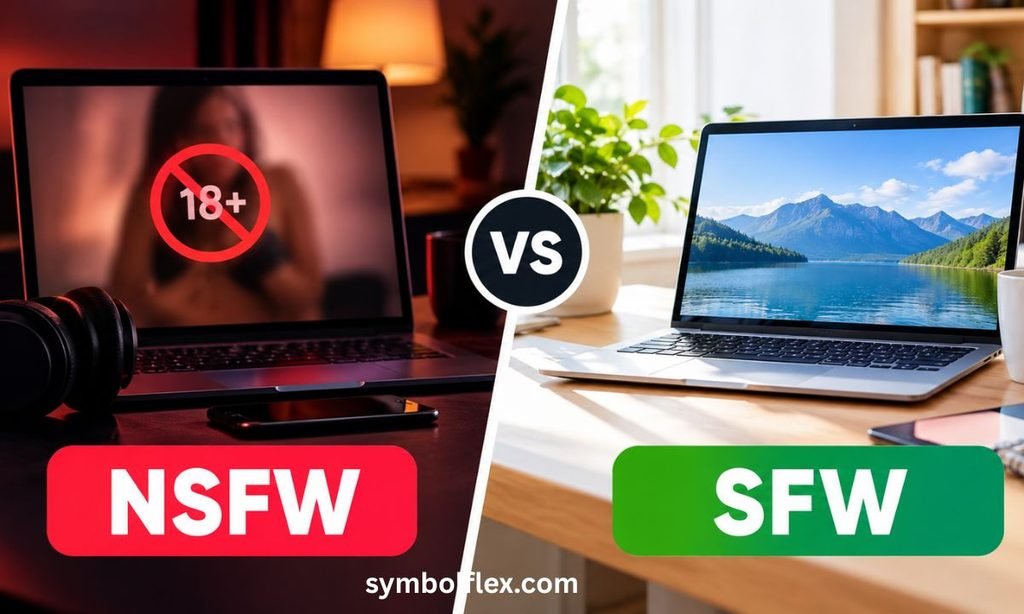
SFW stands for “Safe For Work.” It is the direct opposite of NSFW and is used to reassure people that content is fine to open anywhere. You will often see SFW used in response to an NSFW post or when someone wants to share a clean version of something.
| Term | Meaning | When Used |
| NSFW | Not Safe For Work | Before risky or explicit content |
| SFW | Safe For Work | To confirm content is appropriate |
| NSFL | Not Safe For Life | Extreme or deeply disturbing content |
Some people also use NSFL (Not Safe For Life) for content that is deeply disturbing or traumatic — well beyond standard adult content. If you see NSFL, take it very seriously.
When Should You Use NSFW?
Use it any time you are sharing something that could create an awkward or inappropriate moment for the other person. Specifically:
- Before sending explicit images or videos
- When sharing graphic news stories or disturbing visuals
- Before posting content in group chats where not everyone knows each other well
- When sending something to someone who might be at work or in a public space
The golden rule: If you would hesitate to open it yourself in a crowded room, add the NSFW tag before you send it.
When Should You Avoid Using NSFW?
Do not use NSFW in formal professional communications. If your content requires an NSFW warning, it probably does not belong in a work email, client message, or team meeting thread at all. Adding the label does not make it appropriate — it just flags a bigger problem.
Also avoid using it sarcastically or as a joke label unless you are very sure the person will find it funny. It is a content warning, not a punchline. Overusing it also makes people stop taking it seriously, which defeats the entire purpose.
How to Respond When Someone Sends You an NSFW Message
Most guides skip real tactics here. This is a practical response framework:
If you trust the sender: Save it for a private moment. Open it when you are alone or at home. No need to panic.
If you are unsure about the content: Ask before you open. “Hey, what is this exactly?” is a completely normal question.
If it came from a stranger or unexpected source: Do not open it. Report or block if it seems predatory or spammy.
If you accidentally opened something inappropriate at work: Close it quickly, do not share it further, and do not make a big scene. If it was sent by a coworker, document it — unsolicited NSFW content in the workplace can be a serious policy violation and should be reported to HR.
Common Mistakes People Make With NSFW
- Skipping the warning because they assume the other person “can handle it” — always tag it, you do not know their situation
- Using NSFW on everything to seem edgy — it loses meaning fast and people start ignoring it
- Opening NSFW content at work or school and hoping no one notices
- Assuming NSFW means illegal it does not. NSFW content can be completely legal; it just needs to be viewed privately
Related Internet Slang Worth Knowing
| Term | Full Form | Meaning |
| SFW | Safe For Work | Content is appropriate anywhere |
| NSFL | Not Safe For Life | Extremely disturbing content |
| TW | Trigger Warning | May cause emotional distress |
| CW | Content Warning | Broader warning for sensitive topics |
| 18+ | Adults Only | Restricted to people 18 and over |
Frequently Asked Questions
Does NSFW always mean 18+ content?
No. NSFW covers anything inappropriate for a public or professional setting, including graphic violence, crude humor, or disturbing images — not just adult content.
Can NSFW appear in text messages?
Yes. It is used in private texts as a courtesy warning before sending something the other person might not want to open in public.
Is NSFW a bad word?
No. The abbreviation itself is completely neutral. It is just a warning label. The content behind it may or may not be inappropriate depending on the platform and context.
What is the opposite of NSFW?
SFW Safe For Work. It signals that content is appropriate to open anywhere.
Should I open NSFW links from strangers?
Generally, no. NSFW links from unknown sources carry a higher risk of being harmful, spammy, or malicious. Always verify the source first.
Is NSFW allowed on social media?
It depends on the platform. Reddit and Discord allow NSFW content in designated spaces. TikTok and Instagram have stricter policies and may remove flagged content altogether.
Conclusion
NSFW meaning in text is simple: Not Safe For Work. But knowing what it stands for is only half the picture. The real skill is knowing when to use it, when to avoid it, and how to handle it when someone sends it your way.
It is a tool for digital courtesy, a heads-up that protects both the sender and the receiver from awkward, embarrassing, or professionally damaging moments.
