

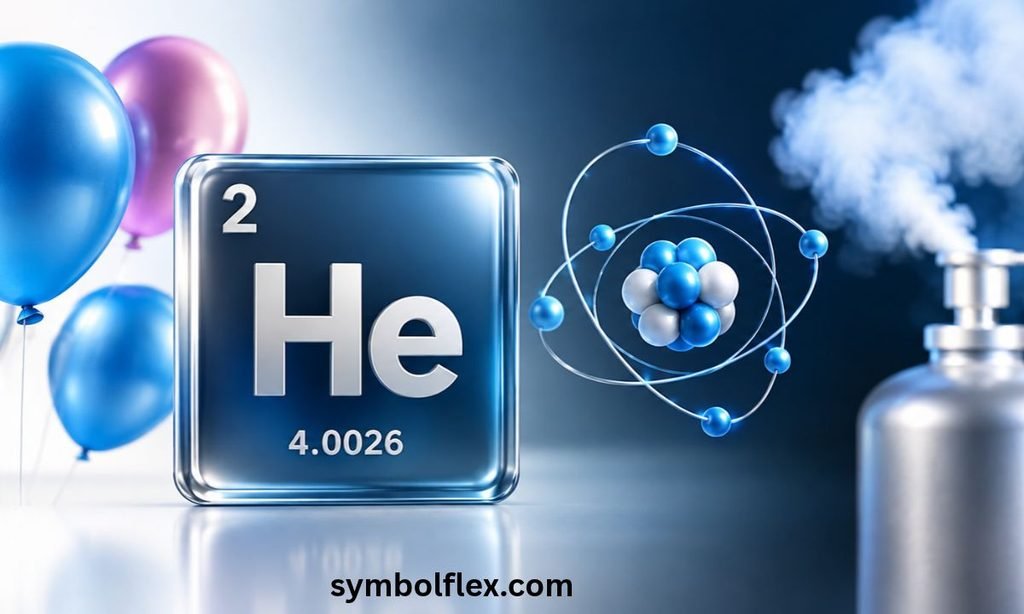
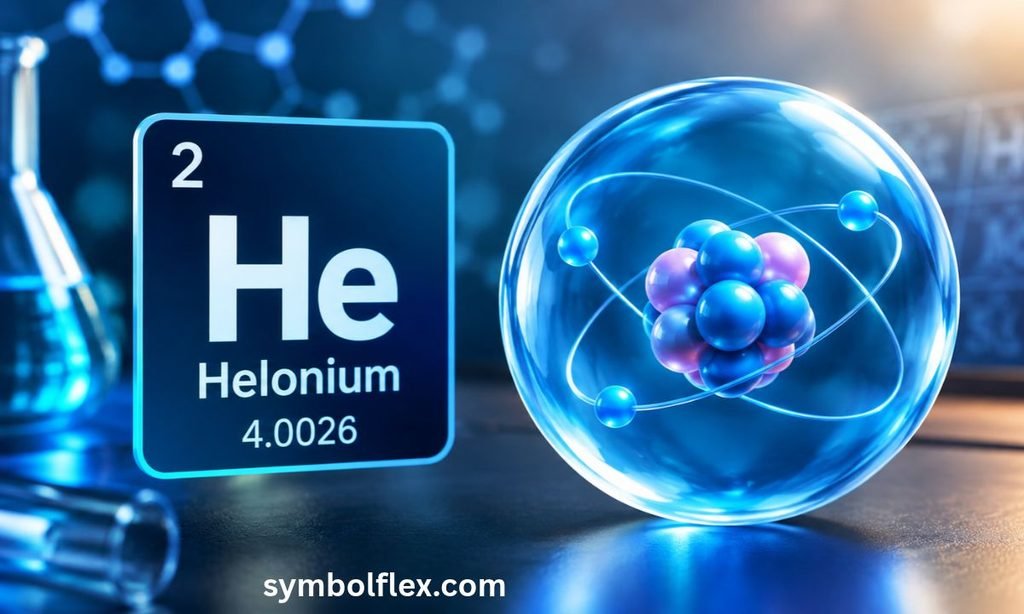
Helonium (HeH+) is helium bonded with hydrogen, forming a charged molecule. It’s not a real element, just a molecular ion.
Scientists believe it was the first molecule in the universe. First made in a lab in 1925, confirmed in space in 2019. It has no medical or industrial use.
What Is Helonium?
Helonium is another name for the helium hydride ion, a molecule with the chemical formula HeH+. It forms when a helium atom bonds with a single proton, creating a positively charged particle.
This isn’t a random internet term. It’s an actual entry in chemical databases, sitting right alongside helium and hydrogen on reference charts. The name simply blends “helium” with a suffix used for similar ionic compounds.
Is Helonium a Chemical Element?
No. Helonium is not an element. It’s a molecular ion, meaning it’s built from two existing elements (helium and hydrogen) that have combined and lost an electron in the process. There is no separate entry for it on the periodic table.
Helonium vs. Helium: What’s the Difference?
People often assume helonium is just another word for helium, but the two are chemically distinct.
| Feature | Helium (He) | Helonium (HeH+) |
| Type | Element | Molecular ion |
| Charge | Neutral | Positively charged |
| Composition | One atom | Helium + hydrogen bonded |
| Reactivity | Nearly inert | Extremely reactive |
| Found in balloons? | Yes | No |
Helium is the noble gas you know from party balloons. Helonium is what forms when that same helium grabs onto a hydrogen atom under extreme conditions.
Origin and Etymology of the Word “Helonium”
The name follows a naming pattern used for other charged noble-gas hydrides, like neonium and argonium. Chemists add “-onium” to signal a positively charged ion formed from a base element.
So “helonium” literally breaks down as helium + onium, a cation built from helium’s base structure. It’s a systematic label, not a branded or invented term.
Historical Background of Helonium
Helonium has a surprisingly long research history. It was first created in a laboratory back in 1925, decades before scientists confirmed it existed anywhere in nature.
For most of the 20th century, it stayed a lab curiosity. Researchers suspected it existed in space, but proving that took nearly a century of searching.
The Scientific Context Behind Helonium
To understand why helonium matters, it helps to picture the early universe right after the Big Bang. At that point, only a few simple elements existed: mostly hydrogen and helium.
Helium was the first element with enough spare electrons to bond with something else. That made helonium the very first molecule believed to exist in the universe, formed roughly 100,000 years after the Big Bang.
Chemical Properties of Helonium
Helonium behaves unlike almost anything else in chemistry. It’s classified as the strongest known acid, even stronger than fluoroantimonic acid, which is often cited as the harshest acid on Earth.
Because it’s so reactive, it can’t be stored or bottled. The moment it touches almost any other substance, it reacts instantly.
Key Scientific Facts About HeH⁺
- It has a molar mass of about 5.01 g/mol, making it one of the lightest known ions.
- It carries a permanent dipole moment, which makes it easier to detect using spectroscopy.
- Around 80% of its electron charge sits closer to the helium nucleus than the hydrogen nucleus.
- It’s isoelectronic with molecular hydrogen, meaning it has the same number of electrons.
Physical Properties and Behavior of Helonium
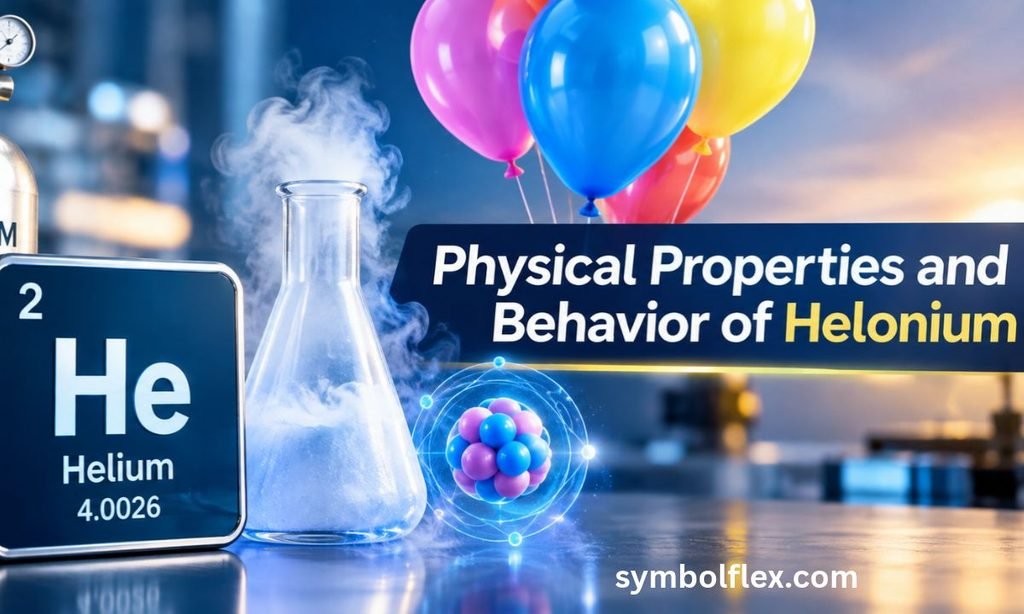
Helonium exists as a gas-phase ion under lab and space conditions. It’s stable when isolated, but that stability disappears the instant it contacts other matter.
Its bond length between the helium and hydrogen atoms measures about 0.772 angstroms, an extremely short and tight connection.
Does Helonium Occur Naturally?
Yes, but only in very specific environments. Helonium doesn’t occur naturally on Earth because our atmosphere is full of reactive molecules it would instantly bond with and destroy.
It does occur naturally in space, particularly in regions with extreme heat and low density, like the space around dying stars.
How Is Helonium Produced or Formed?
Laboratory Formation
In a lab, scientists typically create helonium using radioactive decay methods. A tritium atom decays into helium, and that new helium ion grabs a hydrogen atom from a nearby molecule.
Because it can’t be stored, chemists study it in situ, meaning they observe it the instant it forms rather than trying to collect it.
Formation in Space
In space, helonium forms when a helium atom encounters a lone proton in extremely hot, low-density regions. This process mirrors what likely happened in the early universe.
The best-documented natural formation site is a planetary nebula, the glowing remains of a dying star, where temperatures and particle density create ideal conditions.
Uses of Helonium
Helonium isn’t something you’ll find in commercial products, but it plays an important role across a few specialized scientific fields.
Astrophysics
Astronomers use helonium detections to test theories about how the early universe cooled and formed its first structures. Its presence (or absence) in certain regions helps confirm or challenge existing models.
Laboratory Chemistry
Chemists use helonium as a testing ground for studying extreme acid behavior and ion reactivity. It helps researchers understand chemical bonding limits.
Cosmology
Cosmologists reference helonium when modeling the “dawn of chemistry,” the earliest period when atoms began combining into molecules after the Big Bang.
Is Helonium Used in Medicine?
No. Helonium has no medical applications. It’s too unstable and too reactive to exist in any biological or pharmaceutical context. If you’ve seen a wellness product or supplement using this name, it’s unrelated to the actual chemical compound.
Is Helonium Used in Industry?
No. Because it cannot be stored, transported, or handled in bulk, helonium has no industrial uses. Unlike helium, which fills balloons and cools MRI machines, helonium exists only briefly in labs or space.
Helonium in Scientific Literature
Helonium appears regularly in astrochemistry and physical chemistry journals, usually in studies about ion reactivity, interstellar chemistry, or early-universe modeling. It’s a well-established research subject, even if it’s unfamiliar to most people outside chemistry circles.
Helonium and the First Chemistry of the Universe
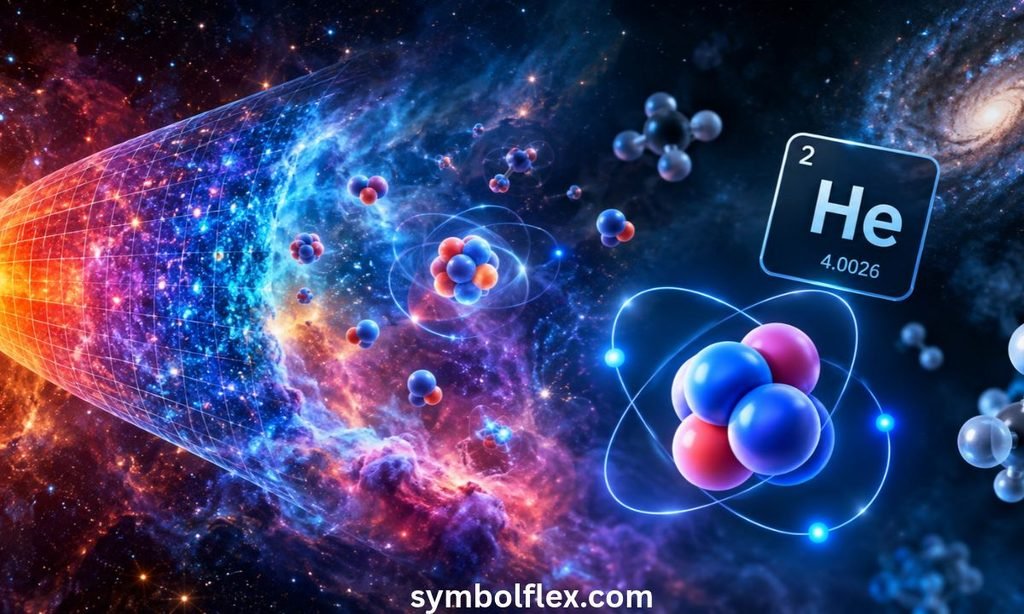
Before helonium formed, the universe contained only free-floating protons, electrons, and neutrons. Once things cooled enough, helium and hydrogen atoms formed first, and helonium followed shortly after as the first true chemical bond in cosmic history.
That single bond kicked off a chain reaction. Helonium eventually reacted with hydrogen atoms to create molecular hydrogen, the gas that later formed stars and galaxies.
The 2019 Space Detection: A Scientific Case Study
For decades, scientists predicted helonium should exist in space but couldn’t prove it. That changed in April 2019, when researchers using NASA’s SOFIA airborne telescope detected its signature in NGC 7027, a planetary nebula about 3,000 light-years away.
The discovery confirmed a 40-year-old theory and gave scientists direct evidence supporting long-standing models of early-universe chemistry. It’s considered one of the more satisfying “we were right all along” moments in modern astrochemistry.
Common Misconceptions About Helonium
Helonium Is a New Chemical Element
False. It has existed in scientific literature since 1925 and is not listed as an element anywhere.
Helonium and Helium Are the Same Thing
False. Helium is neutral and inert. Helonium is charged and extremely reactive.
Helonium Has Its Own Atomic Number
False. It’s a combination of helium and hydrogen, so it doesn’t get a separate atomic number.
Helonium Is a Stable Gas
False. It’s only stable when isolated from other substances, which almost never happens outside a lab or deep space.
Helonium Has Widespread Industrial Uses
False. It has no commercial or industrial applications whatsoever.
Helonium Is Fictional
False. It’s a real, documented ion studied in chemistry and astrophysics for nearly a century.
Helonium vs. Related Scientific Terms
| Term | What It Is | Related to Helonium? |
| Helium hydride | Same compound, different name | Yes, identical |
| Neonium | Neon-based ion | Similar structure, different element |
| Hydronium | Water-based ion (H3O+) | Different base element |
| Protonated helium | Descriptive name for HeH+ | Yes, identical |
Scientific Facts About Helonium
- It’s the strongest known acid in chemistry.
- It was detected in space 94 years after first being made in a lab.
- It’s believed to be the first molecule in the history of the universe.
- Its bond breaks apart almost instantly outside controlled conditions.
Why the Term “Helonium” Can Be Confusing
Part of the confusion comes from unofficial naming. Since “helonium” isn’t the primary IUPAC name (that’s hydridohelium), some sources use it inconsistently or skip it entirely, which makes it feel less “official” than it actually is.
Add to that the fact that scientific slang often gets repurposed online in usernames, gaming tags, or chat etiquette contexts, and the original chemistry meaning can get lost.
If you saw the word used casually in a message or platform bio, it’s likely just a stylistic pick, not a reference to actual chemistry. Digital safety tip: unusual scientific-sounding usernames are common and rarely carry hidden meaning, so there’s no need to treat the word itself as a red flag.
How to Verify Whether a Scientific Term Is Legitimate
- Check if it appears in peer-reviewed journals or databases like ChemSpider or ChEBI.
- Look for a CAS number, which confirms official chemical registration.
- Cross-reference the term with university or research institution sources.
- Be cautious of health or wellness products using unfamiliar scientific names as marketing.
Frequently Asked Questions
What does helonium mean in simple terms?
It’s the name for helium hydride (HeH+), a charged particle made of helium and hydrogen bonded together.
Is helonium dangerous?
Not in daily life. It only exists briefly in labs or space, so it poses no real-world exposure risk.
Can you buy or find helonium anywhere?
No. It can’t be stored, sold, or collected because it reacts instantly with almost everything it touches.
Why was the 2019 discovery important?
It confirmed decades-old predictions about the early universe’s first chemical bond, giving direct observational proof for the first time.
Final Takeaway
The Helonium meaning comes down to one core idea: it’s helium hydride (HeH+), a highly reactive molecular ion, not a new element, not a fictional term, and not related to any medical or industrial product.
It holds a special place in science as the likely first molecule ever formed in the universe, confirmed by a landmark 2019 space detection. Whether you encountered the word in a chemistry class or saw it used casually online, now you know exactly what it means and why it matters.
