

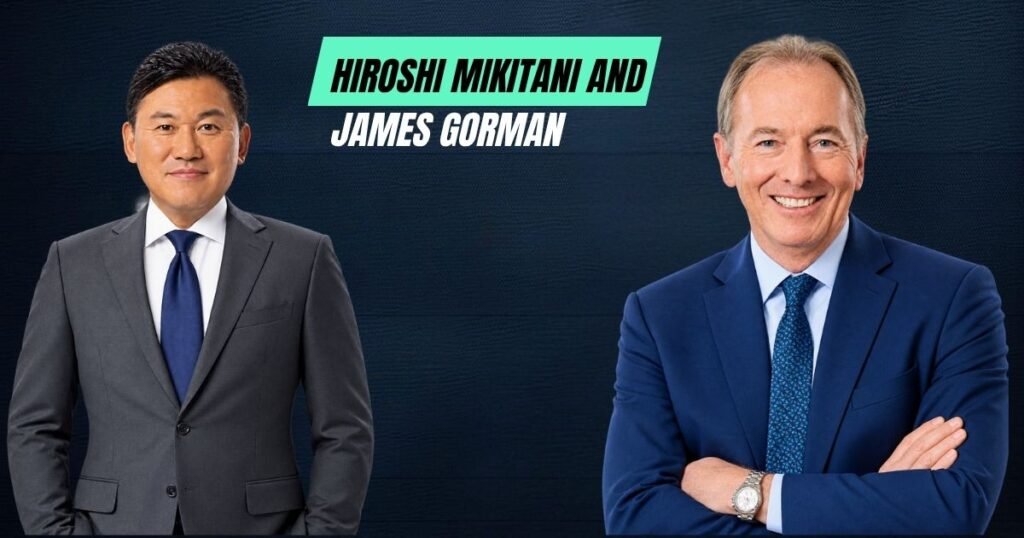
Two names often come up together in business searches: Hiroshi Mikitani and James Gorman. One built a Japanese internet giant from a small startup.
The other led a Wall Street bank through a full rebuild and now chairs one of the biggest media companies in the world.This guide gives you the facts people search for most.
You will find net worth, age, height, education, career milestones and the lessons their paths offer.
All numbers were checked against recent public sources as of October 2026. Net worth figures are estimates, so treat them as ranges, not exact totals.
Quick Bio: Hiroshi Mikitani and James Gorman
Here is a profile summary table to give you the key facts at a glance.
| Detail | Hiroshi Mikitani | James Gorman |
| Full name | Hiroshi “Mickey” Mikitani | James Patrick Gorman |
| Born | March 11, 1965 | July 14, 1958 |
| Age (Oct 2026) | 61 | 68 |
| Birthplace | Kobe, Japan | Melbourne, Australia |
| Nationality | Japanese | Australian and American |
| Known for | Founder, Chairman and CEO of Rakuten Group | Former CEO of Morgan Stanley, Chairman of Disney |
| Education | Hitotsubashi University, Harvard Business School (MBA) | University of Melbourne (BA, LLB), Columbia Business School (MBA) |
| Spouse | Haruko Mikitani | Pendleton Dedman |
| Net worth (estimate) | About $3.6 billion to $4.3 billion | About $116 million or more from reported shares |
| Height | Not publicly confirmed | Not publicly confirmed |
| Current main role | Rakuten Group leader since 1997 | Disney board chairman since January 2, 2025 |
A quick note on height. Neither man has shared an official height in a source I could verify. Many sites list random numbers with no proof, so it is better to avoid guessing.
Who Is Hiroshi Mikitani?
Hiroshi Mikitani is the founder, chairman and CEO of Rakuten Group. People close to him call him “Mickey.” He is among the most recognized Japanese billionaires and a leading voice in ecommerce, fintech and mobile services.
Rakuten today runs more than 70 services. These cover online shopping, credit cards, banking, travel, digital content and mobile networks. The company says it serves well over a billion members worldwide.
Education and Early Professional Experience
Mikitani was born in Kobe. He studied commerce at Hitotsubashi University in Tokyo and graduated in 1988.
His first job was at The Industrial Bank of Japan, where he worked from 1988 to 1996. The bank later sent him to study in the United States, and he earned his MBA from Harvard Business School in 1993.
That time in the US mattered. He saw how fast the internet was changing business, and he came home with a plan to bring small shops online.
Years later, Harvard honored him with its Alumni Achievement Award in 2012. That is one of the school’s top honors.
The Founding of Rakuten
Mikitani left banking in 1996 and started a company in February 1997. Reports say the startup money was about $250,000. The first online mall, Rakuten Ichiba, opened in May 1997 with just a handful of shops.
The model was simple and smart. Big department store malls charged high monthly fees to sellers. Rakuten offered a low flat fee and an easy tool that let shop owners build their own stores without coding skills.
The company dropped the early name and became Rakuten, Inc. in 1999. Small merchants loved the approach, and the marketplace grew fast across Japan.
Expanding Rakuten Beyond E-Commerce
Mikitani never wanted Rakuten to stay a single shop window. He built what he calls an ecosystem, where one member account works across many services.
Key steps in that growth include:
Acquisitions abroad: Rakuten bought Buy.com in the US and Play.com in the UK, then added Viber and Ebates.
Financial services: Rakuten Card, Rakuten Securities and Rakuten Bank grew into major arms of the group. Rakuten Bank went public in 2023.
Mobile network: Rakuten Mobile launched as Japan’s newest carrier in 2019. Total subscriptions passed 10 million in December 2025.
Sports and culture: He owns the Rakuten Golden Eagles baseball team and Vissel Kobe football club. In 2017, Rakuten became the first jersey partner of the NBA’s Golden State Warriors.
Healthcare: Rakuten Medical works on cell targeting cancer therapy. Mikitani has said his father’s illness pushed him to back this work.
Not every bet has paid off yet. For fiscal 2025, Rakuten reported revenue near 2.5 trillion yen but a net loss, mostly because of heavy mobile network spending. The long term test is whether that spending turns into steady profit.
Mikitani’s Leadership Approach
Mikitani is known as a bold, fast moving leader. Three ideas define his style:
- Englishnization: In 2010 he made English the working language of Rakuten, even though most staff were Japanese. Critics laughed at first. Harvard later wrote a case study on it.
- Empowerment: He pushes staff and merchants to take ownership and grow.
- Long bets: He accepts years of losses when he believes a market will pay off later.
His net worth comes mostly from his stake in Rakuten, which stood near 18.5 percent in recent filings. Because Rakuten’s share price moves, his wealth moves too.
Estimates in 2026 range from about $3.6 billion (an early May 2026 tracker) to about $4.3 billion (a figure cited from Forbes data in late 2025). Some older sites still show $9 billion, but that number is outdated.
Who Is James Gorman?
James Gorman is an Australian born banker and one of the best known leaders in modern finance. He ran Morgan Stanley as CEO for 14 years and is now the chairman of The Walt Disney Company.
He is also seen as one of the strongest voices on succession planning, a skill that now shapes his work at Disney.
Education and Early Career
Gorman was born in Melbourne and studied arts and law at the University of Melbourne. He then moved to the US and earned an MBA from Columbia Business School.
He started his career at McKinsey & Company, where he became a senior partner in the financial institutions practice. He later joined Merrill Lynch and ran its global private client business.
That background in wealth management became the base for his later strategy.
Leading Morgan Stanley
Gorman joined Morgan Stanley in February 2006 and became co-president in December 2007. The 2008 financial crisis nearly broke the firm, but it also gave him an opening. He helped build a joint venture with Citi’s Smith Barney, which Morgan Stanley fully owned by 2013.
He became CEO in January 2010 and chairman in 2012. His strategy was clear. Rely less on risky trading and more on steady fees from wealth management and asset management.
His biggest moves were:
- E*Trade: An all stock deal worth about $13 billion in 2020.
- Eaton Vance: A deal worth about $7 billion in late 2020.
Under his watch the share price almost tripled, and filings show he was paid about $301 million across 13 full years as CEO.
Transition From CEO to Board Leadership
In May 2023, Gorman told shareholders he planned to step down. Ted Pick took over as CEO on January 1, 2024, while Gorman stayed on as executive chairman.
Pick then became chairman at the end of 2024. Since January 2025, Gorman holds the title of chairman emeritus at Morgan Stanley.
Many observers called the handover a clean one. Gorman had planned it for years and even named finalists openly before the choice.
Gorman’s Role at The Walt Disney Company
Gorman joined Disney’s board in 2024 and led its succession planning committee. On January 2, 2025, he became chairman of the board, replacing Mark Parker.
His main job was helping choose the next CEO after Bob Iger. Disney then named Josh D’Amaro as Iger’s successor in 2026. Gorman continues to lead the board through this change.
He also serves with groups such as the Council on Foreign Relations and Columbia Business School’s board of overseers.
His net worth is harder to pin down because he is not a founder. A filings based estimate sits at at least $116 million, mostly from about 568,000 Morgan Stanley shares plus Disney shares.
One higher estimate from an insider trading site puts it near $296 million. The gap exists because sites count shares, past sales and other assets in different ways.
What Connects Hiroshi Mikitani and James Gorman?
Here is the honest answer: there is no known joint company or direct partnership between the two men.
People search them together mostly because both are famous chairmen, both built their names through bold deals, and both work at the crossroads of technology and finance.
Rakuten and the Wider Financial Services Industry
Rakuten is not only a shopping site. Its banking, credit card, brokerage and insurance units make it a real force in Japanese finance. That is where its story meets Gorman’s world.
Morgan Stanley pushed hard into retail investing with E*Trade. Rakuten built a similar customer base by linking shopping rewards to banking and investing. Both firms learned the same thing: a customer who uses many services is worth more over time.
Different Leadership Models, Shared Business Challenges
Their styles differ, yet their problems look alike.
- Both had to grow through acquisitions and then blend new teams.
- Both had to balance growth with risk, especially after big deals.
- Both had to plan for who leads next.
Mikitani is a founder who still runs his company after nearly 30 years. Gorman is a professional manager who stepped aside on purpose. These are two very different answers to the same question.
Hiroshi Mikitani and James Gorman: Key Differences
| Area | Hiroshi Mikitani | James Gorman |
| Path to the top | Founded the company himself | Rose through large firms |
| Main industry | Internet services, ecommerce, mobile | Banking, wealth management, media board work |
| Leadership style | Bold, hands on, founder driven | Disciplined, planned, board focused |
| Wealth source | Ownership of Rakuten shares | Pay, shares and board roles |
| Company stage | Still leads at the top | Handed over CEO role in 2024 |
| Global strategy | Pushes English across the firm | Pushes wealth and asset management |
| Net worth range | Billions | Tens to hundreds of millions |
Lessons From Their Business Careers
You do not need to run a global company to use these ideas. Each lesson below comes straight from their careers.
Innovation Must Be Supported by Strategy
Rakuten Mobile shows that a bold idea needs a plan and patience. Building a new carrier costs a lot, and the losses have been heavy. A clear long term goal keeps a team steady while results catch up.
Acquisitions Require Long-Term Planning
Buying a company is the easy part. Gorman’s E*Trade and Eaton Vance deals worked because they fit a clear plan for wealth and asset management. Mikitani’s overseas buys had mixed results, which shows that fit matters more than size.
Leadership Must Evolve as Organizations Grow
A founder who opens a small online mall cannot lead a group with 70 services the same way. Mikitani kept changing his role as Rakuten grew. Gorman moved from builder to chairman and gave daily control to someone new.
Succession and Governance Matter
Gorman treated the CEO handover as a project, not an event. He picked finalists early, stayed on as chairman for a short period, then stepped back fully. That same skill is now in use at Disney.
International Growth Requires Local Understanding
Englishnization helped Rakuten hire talent and work across borders. Yet Rakuten also learned that each country has its own habits.
Many global firms fail by copying a home model without checking local needs. Gorman’s Australian roots and years in New York also gave him a wide view of global markets.
Frequently Asked Questions
What is Hiroshi Mikitani’s net worth in 2026?
Estimates range from about $3.6 billion to $4.3 billion, mostly from his Rakuten stake. Figures change with Rakuten’s share price.
What is James Gorman’s net worth?
Filings based estimates start at $116 million or more, while one site shows about $296 million. The difference comes from how each site counts assets.
How tall are Hiroshi Mikitani and James Gorman?
Neither has shared a verified height. Reliable sources do not list one, so any exact number you see online is a guess.
What does James Gorman do now?
He is chairman of The Walt Disney Company and chairman emeritus of Morgan Stanley. He has held the Disney chair since January 2, 2025.
How did Hiroshi Mikitani start Rakuten?
He left The Industrial Bank of Japan and launched Rakuten Ichiba in 1997 with about $250,000. The low fee online mall helped small shops sell online.
Conclusion
Hiroshi Mikitani and James Gorman took very different roads. Mikitani is a founder who turned a small online mall into a global ecosystem of shopping, banking, mobile and healthcare. Gorman is a banker who rebuilt Morgan Stanley, then moved to the board and now guides Disney through a major leadership change.
On the numbers, Mikitani is far wealthier, with an estimated $3.6 billion to $4.3 billion, while Gorman’s reported holdings start near $116 million. Their heights are not public.
