

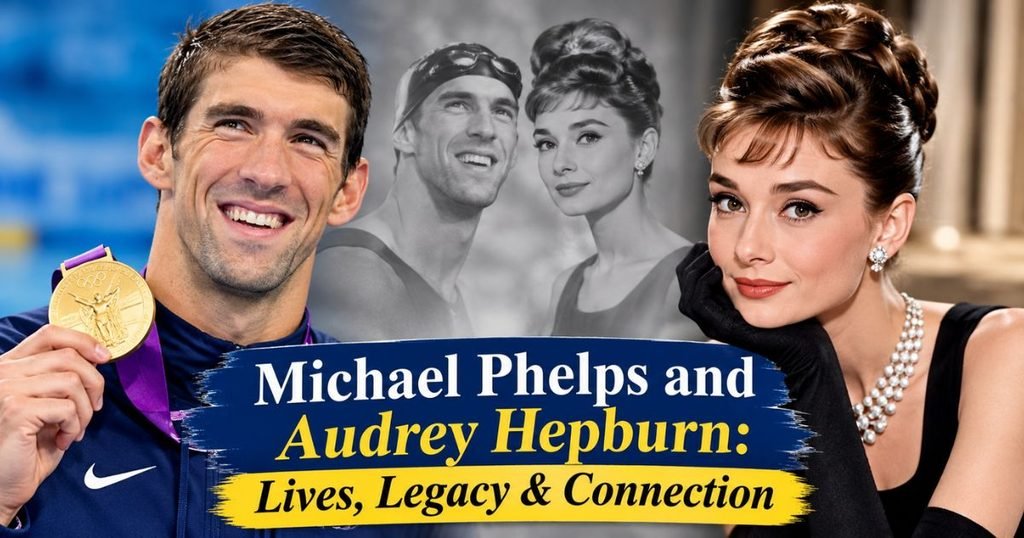
One was a Baltimore swimmer who turned the pool into a record book. The other was a Brussels-born actress who became a Hollywood film icon and later a champion for children in crisis.
So why do people search for Michael Phelps and Audrey Hepburn together? The short answer is that there is no family tie, no known meeting, and no joint project between them.
What links them is a shared place in popular culture: both reached global fame in very different fields, and both used it for something bigger than their careers. This guide covers their lives, legacies, and the real story behind the connection.
Quick Answer: Is There a Connection Between Michael Phelps and Audrey Hepburn?
No documented personal, family or professional connection exists between them. They are not related, there is no record of them meeting, and they never worked together. Audrey Hepburn died in January 1993, when Michael Phelps was a seven-year-old child. He did not reach the Olympic stage until 2000.
The pairing appears to come from search behavior and “celebrity comparison” curiosity: an Olympic swimming champion and a Hollywood film icon, two famous people from different generations who both used fame for something larger than themselves.
Fast Facts: Michael Phelps and Audrey Hepburn Compared
| Detail | Michael Phelps | Audrey Hepburn |
| Born | June 30, 1985, Baltimore, Maryland | May 4, 1929, Ixelles, Brussels, Belgium |
| Died | Living | January 20, 1993, Tolochenaz, Switzerland |
| Known for | Most decorated Olympian in history | Hollywood film icon, fashion influence, humanitarian |
| Peak era | 2000s to 2016 | 1950s to 1960s (film); 1988 to 1993 (UNICEF) |
| Signature achievement | 28 Olympic medals, including 23 gold | Academy Award for Roman Holiday (1953 film, Oscar won in 1954) |
| Humanitarian focus | Mental health, water safety, youth swimming | Child welfare, UNICEF fieldwork |
| Foundation or organization | Michael Phelps Foundation | UNICEF Goodwill Ambassador |
Are Michael Phelps and Audrey Hepburn Related?
No. Nothing in public biographies, interviews or official records points to a family relationship. Phelps grew up in the Baltimore area with his mother, Debbie, and two older sisters. Hepburn was born into a Anglo-Dutch family in Belgium and raised in England and the Netherlands.
The confusion is easy to explain. Searches such as “Michael Phelps Audrey Hepburn relationship” often come from people who saw both names in one list, quiz or social media post and assumed a link. A shared surname-style pattern or a shared “famous person” category does not make two people related.
Did Michael Phelps Ever Meet Audrey Hepburn?
There is no evidence that they met. The timeline makes it nearly impossible in any professional sense. When Hepburn passed away in 1993, Phelps was a child who had not yet begun competing internationally. His Olympic debut came at the 2000 Sydney Games, seven years after her death.
Could they have crossed paths as a child and a famous star? Nothing credible supports that, and this article does not speculate beyond what is documented.
Did Michael Phelps and Audrey Hepburn Work Together?
No. They never shared a project, a film, a charity campaign or an endorsement. Hepburn’s humanitarian work ended with her death, and Phelps’s foundation work began years later.
How Old Was Michael Phelps When Audrey Hepburn Died?
Phelps was seven years old. He was born on June 30, 1985, and Hepburn died on January 20, 1993, about five months before his eighth birthday.
Who Was Audrey Hepburn?
Audrey Hepburn was a Belgian-born British actress, fashion figure and humanitarian who became one of the most recognized women of the twentieth century. She is remembered for a graceful screen presence, a distinctive style and a second career devoted to children in crisis.
Early Life and Rise to Stardom
Hepburn spent part of her childhood in the Netherlands during the German occupation of World War II, and she later spoke about the hunger and hardship of those years. After the war she trained in dance and moved into stage and screen work in London, then Hollywood.
Audrey Hepburn’s Film Career
Her breakthrough came with Roman Holiday (1953), in which she played a princess who slips away from royal duties for a day in Rome. The role earned her the Academy Award for Best Actress. She also won a Tony Award for the Broadway play Ondine in 1954.
Other defining films include:
- Sabrina (1954)
- Funny Face (1957)
- The Nun’s Story (1959)
- Breakfast at Tiffany’s (1961)
- Charade (1963)
- My Fair Lady (1964)
Breakfast at Tiffany’s in particular made her a fashion icon, with a style that still shapes how people think about classic cinema and timeless design. Her long working relationship with the designer Hubert de Givenchy is well documented.
Audrey Hepburn and UNICEF: A Second Career
Hepburn had supported UNICEF for years, but in 1988 she became a UNICEF Goodwill Ambassador. From then until her death she traveled to some of the world’s hardest-hit regions, including Ethiopia, Bangladesh, Sudan, Somalia and Vietnam, to draw attention to child welfare, hunger, clean water and vaccination.
What made her advocacy effective was that it was not decorative. She visited communities, spoke publicly and pushed donors and governments to act. She often said that people could help children by simply showing up and paying attention, a message consistent with her record of fieldwork.
Honors and Audrey Hepburn’s Legacy
- Presidential Medal of Freedom (1992): the highest civilian honor in the United States.
- Jean Hersholt Humanitarian Award (Academy Awards, awarded posthumously): recognition of her charitable work.
- Posthumous Emmy and Grammy awards: these, together with her Oscar and Tony, place her among the small group of entertainers who have achieved the “EGOT.”
Today her legacy includes the Audrey Hepburn Children’s Fund, created by her sons, and the lasting influence of her image on fashion and film culture.
Who Is Michael Phelps?

Michael Phelps is an American swimmer widely regarded as the greatest Olympian of all time. He holds the all-time record for Olympic medals and Olympic gold medals, and his career spans five Olympic Games.
Early Life and Family Background
Phelps was born in Baltimore, Maryland, and started swimming as a child, partly encouraged by his older sisters, who were also competitive swimmers. His coach Bob Bowman worked with him for most of his career and played a central role in his development.
How Did Michael Phelps Become an Olympic Champion?
Phelps stood out early. At 15 he qualified for the Sydney 2000 Olympics, becoming the youngest male U.S. swimming Olympian in decades. He did not win a medal there, but the experience set the stage for what followed.
His rise came through a combination of factors:
- Versatility: he excelled in butterfly, freestyle and individual medley events.
- Training volume: long years of structured, high-intensity pool and dry-land work.
- Race strategy: strong underwater work and stroke efficiency.
- Consistency: he stayed at the top across multiple Olympic cycles.
Michael Phelps’s Olympic Career by the Numbers
| Olympics | Outcome |
| Sydney 2000 | First Olympics at age 15 |
| Athens 2004 | Six gold and two bronze medals |
| Beijing 2008 | Eight gold medals in one Games |
| London 2012 | Four gold and two silver medals |
| Rio 2016 | Five gold and one silver medal |
| Career total | 28 medals, including 23 gold |
Phelps and the 2008 Beijing Olympics
The Beijing Olympics of 2008 remain his signature moment. He won eight gold medals at a single Games, breaking the single-Games record of seven set by Mark Spitz in 1972. Several of those victories came by extremely thin margins, and the 100-meter butterfly final, decided by a hundredth of a second, is still among the most famous finishes in the sport.
Beyond the Pool: Foundation and Advocacy
Phelps created the Michael Phelps Foundation to promote water safety and to encourage children to learn to swim, and he has become a public advocate for mental health awareness. He has also been inducted into the International Swimming Hall of Fame.
What Do Michael Phelps and Audrey Hepburn Have in Common?
Despite living in different eras and professions, there are genuine parallels:
They Became Global Names
Hepburn was an international film star at a time when Hollywood cinema reached audiences around the world. Phelps became an international sports figure at a time when Olympic broadcasts and social media amplified his achievements. Both names are recognizable far beyond their original fields.
They Achieved Exceptional Success
Each reached the top of an extremely competitive field: Hepburn with an Oscar, a Tony and enduring classics, Phelps with an unmatched Olympic record.
Their Legacies Extend Beyond Their Original Professions
Hepburn’s later years are often described as her most meaningful work, and Phelps has spoken openly about mental health to reduce stigma. In both cases, fame was used as a platform for causes involving young people and wellbeing.
The Biggest Difference Between Their Stories
The most important contrast is how their fame worked.
- Hepburn’s fame was built on performance and image. Her screen roles, style and public persona shaped culture. Her humanitarian role then converted that public trust into aid advocacy.
- Phelps’s fame was built on measurable results. His records can be counted: medals, times and Games. His public advocacy came after his athletic peak and was shaped by his personal experiences.
Put simply, Hepburn moved from art to activism, while Phelps moved from competition to advocacy. Their paths mirror each other in structure, but not in subject matter.
Why Do People Search for Michael Phelps and Audrey Hepburn Together?
There is no single official reason. Common explanations include:
- Trivia and quiz content that pairs unrelated famous people.
- Social media lists of icons across sports and entertainment.
- Curiosity about “famous people from different generations.”
- Search autocomplete effects, where two names appear together simply because other users searched them together.
Understanding this pattern is useful. A search pairing alone is not evidence of a real relationship.
A Timeline Makes the Difference Clear
| Year | Event |
| 1929 | Audrey Hepburn is born in Brussels |
| 1953 | Roman Holiday is released |
| 1954 | Hepburn wins the Academy Award for Best Actress and a Tony for Ondine |
| 1961 | Breakfast at Tiffany’s is released |
| 1985 | Michael Phelps is born in Baltimore |
| 1988 | Hepburn becomes a UNICEF Goodwill Ambassador |
| 1992 | Hepburn receives the Presidential Medal of Freedom |
| 1993 | Hepburn dies; Phelps is seven |
| 2000 | Phelps competes at his first Olympics in Sydney |
| 2008 | Phelps wins eight gold medals in Beijing |
| 2016 | Phelps competes at his final Olympics in Rio |
The timeline shows that their public careers did not overlap at any point.
What Made Both Figures Memorable?
Three qualities stand out:
- Distinct identity. Hepburn’s look and Phelps’s wingspan-and-butterfly dominance became shorthand for their fields.
- Records and moments. Hepburn’s Oscar-winning breakthrough and Phelps’s Beijing finishes are both cultural reference points.
- Purpose beyond the spotlight. Their later work with children’s welfare and public wellbeing gave their fame lasting meaning.
Frequently Asked Questions
Are Michael Phelps and Audrey Hepburn related?
No. There is no documented family relationship between them.
Did Michael Phelps meet Audrey Hepburn?
There is no record that they ever met. Hepburn died in 1993 when Phelps was seven, years before he began competing at the Olympic level.
Did Michael Phelps and Audrey Hepburn work together?
No. They never collaborated on a film, charity effort or public campaign. Their careers and causes were separate.
How old was Michael Phelps when Audrey Hepburn died?
Phelps was seven. He was born June 30, 1985, and Audrey Hepburn died on January 20, 1993.
What was Audrey Hepburn best known for?
She was best known as a Hollywood film star, with Roman Holiday and Breakfast at Tiffany’s among her most famous films, and as a fashion icon.
Final Thoughts
There is no documented connection between Michael Phelps and Audrey Hepburn. They are not related, and they never met or worked together. Hepburn turned film fame into humanitarian service with UNICEF.
Phelps turned Olympic glory into advocacy for mental health and water safety. Their legacies show that real greatness goes beyond trophies and screen credits.
