

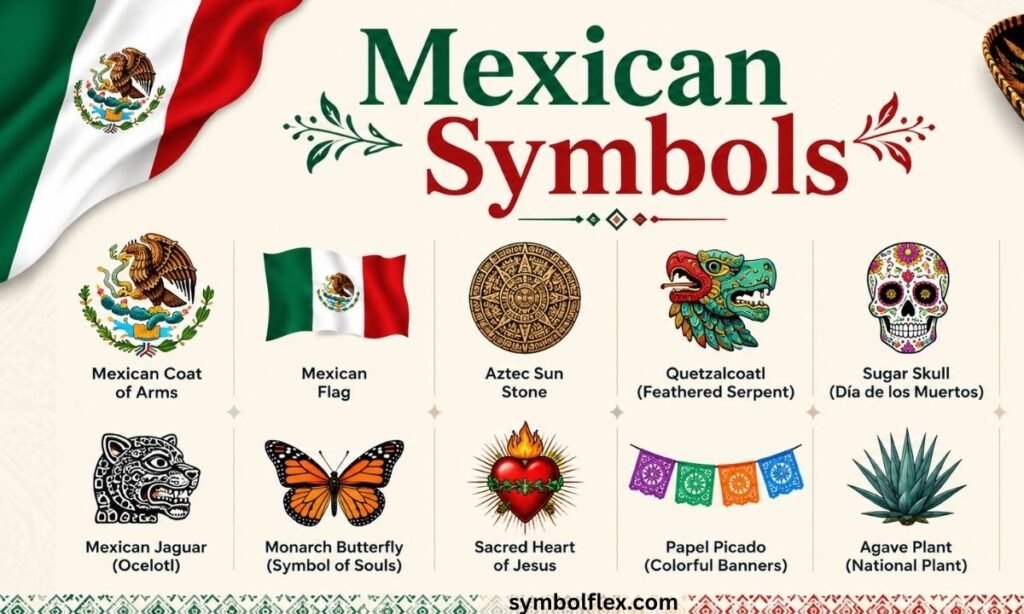
Mexican symbols carry centuries of history, faith, and identity in a single image — from the eagle and serpent on a cactus that founded Mexico City, to the marigold flowers that guide spirits home during Día de los Muertos.
Rooted in Aztec and Maya mythology and shaped by Spanish colonial and Catholic influence, these symbols reflect life, death, protection, and love.
This guide breaks down 100+ Mexican symbols and their meanings, organized by category for quick, clear answers. By the end, you’ll understand not just what these symbols look like, but why they still matter today.
What Do Mexican Symbols Represent?
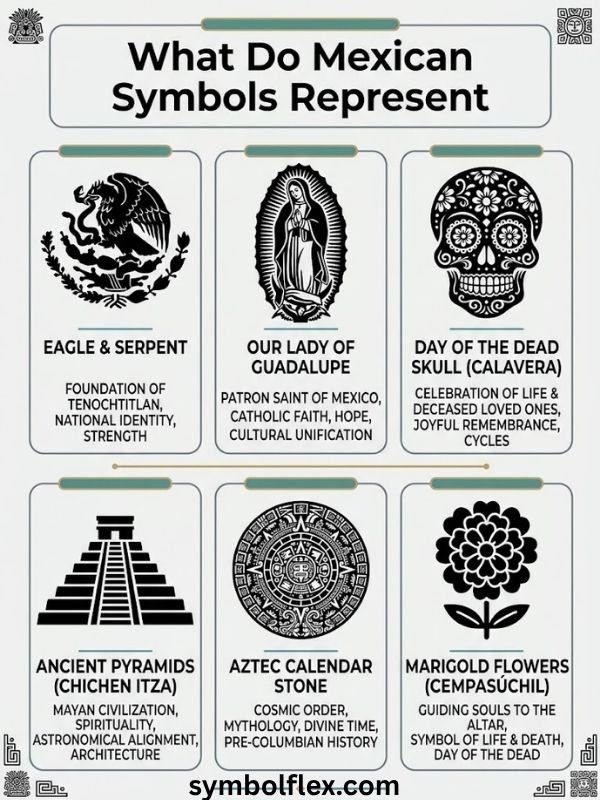
Mexican symbols generally fall into a few broad categories:
- National identity — the flag, the eagle and snake, the coat of arms
- Ancient spirituality — Aztec and Maya gods, calendars, and sacred animals
- Religious and colonial influence — the Virgin of Guadalupe, the cross, Catholic imagery blended with indigenous belief
- Life, death, and remembrance — sugar skulls, marigolds, ofrendas, and Día de los Muertos imagery
- Folk art and daily life — papel picado, alebrijes, mariachi imagery, and traditional textiles
Most Mexican symbols aren’t purely decorative. They come from real historical events, origin myths, or religious practices, and many are still used the same way today as they were generations ago.
The Most Iconic Mexican Symbols and Their Meanings
The Mexican Flag
The flag has three vertical stripes, green for hope, white for unity, and red for the blood of national heroes, with the national coat of arms in the center. It’s the clearest, most immediate symbol of Mexican identity anywhere in the world.
The Eagle and Serpent on a Cactus
This image, found at the center of the flag, comes from the Aztec founding legend of Tenochtitlan.
According to the story, the wandering Mexica people were told by their gods to build their city wherever they found an eagle perched on a nopal cactus, devouring a serpent.
They found this exact scene on a small island in Lake Texcoco — the site that became Mexico City. The symbol represents divine guidance, destiny, and the birth of a nation.
Quetzalcoatl, the Feathered Serpent
Quetzalcoatl was one of the most important deities across Mesoamerica, worshipped by both the Aztecs and earlier cultures.
Part bird, part serpent, he represented the union of earth and sky, wisdom, creation, and the wind.
He’s often linked to learning, agriculture, and the arts, making him a symbol of knowledge and balance rather than destruction.
The Aztec Sun Stone
Often mistaken for a calendar used to track days, the Aztec Sun Stone was actually a ceremonial monument dedicated to the sun god Tonatiuh.
It represents cosmic order, the cycles of creation and destruction the Aztecs believed the world had passed through, and humanity’s relationship with time itself.
Marigold Flowers (Cempasúchil)
Known as the “flower of the dead,” bright orange marigolds are used to guide spirits back to the world of the living during Día de los Muertos.
Their strong scent and vivid color are believed to lead ancestors home along a path of petals laid from the street to the family altar.
Sugar Skulls (Calaveras)
Sugar skulls are decorated with bright colors, icing, and the name of a deceased loved one written across the forehead.
Rather than symbolizing fear, they represent a celebration of life and a way of honoring death as a natural part of existence, not something to mourn quietly.
Ancient and Indigenous Mexican Symbols
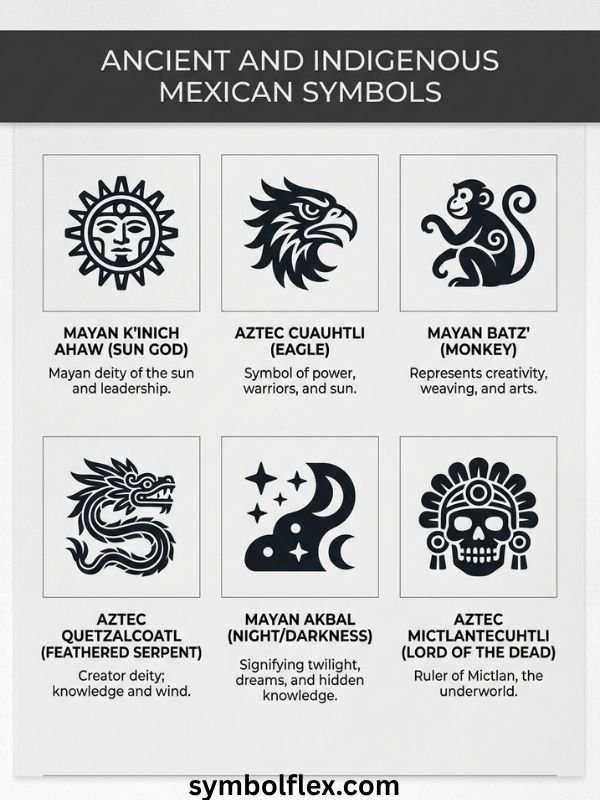
These symbols come directly from Aztec and Maya belief systems, long before Spanish colonization.
| Symbol | Meaning |
| Tonatiuh (Sun God) | Life force, energy, daily renewal |
| Tlaloc (Rain God) | Fertility, agriculture, water |
| Huitzilopochtli | War, the sun, protection of the Aztec people |
| Tezcatlipoca | Night, fate, transformation |
| Coyolxauhqui | The moon, family conflict, sacrifice |
| Xolotl | Death, guide to the underworld, twin spirit |
| Ehecatl | Wind, breath, movement |
| Centeotl | Maize, sustenance, growth |
| Ometeotl | Duality, balance of opposing forces |
| Jaguar | Power, the night, the underworld |
| Eagle Warrior imagery | Courage, the sun, elite status |
| Obsidian mirror | Self-reflection, divination |
| Turquoise mosaic mask | Royalty, sacred protection |
| Nahual (spirit animal) | Personal guardian spirit |
| Kukulkan (Maya) | Feathered serpent, creation, kingship |
| Maya Long Count calendar | Time, cosmic cycles |
| Ceiba tree | The World Tree, connection between earth, sky, and underworld |
| Chaac (Maya rain god) | Rainfall, agricultural abundance |
| Itzamna | Wisdom, healing, writing |
| Ah Puch | Death, the underworld (Xibalba) |
| Maya glyphs | Recorded history, storytelling |
| Corn god imagery | Life cycle, sustenance, rebirth |
| Copal incense | Purification, communication with spirits |
Mexican Symbols of Protection and Strength
| Symbol | Meaning |
| Nopal cactus | Resilience, survival in harsh conditions |
| Maguey (agave) plant | Strength, sustenance, endurance |
| Golden eagle | Vision, courage, national pride |
| Serpent | Transformation, earthly power |
| Ojo de Dios (God’s Eye) | Protection and watchful guidance, especially for children |
| Milagros (charms) | Healing, protection over a specific body part or concern |
| Red string bracelet | Warding off negative energy |
| Horseshoe (herradura) | Luck and protection over the household |
| Aztec shield | Defense, warrior identity |
| Volcano imagery (Popocatépetl & Iztaccíhuatl) | Enduring love, sacrifice, protection of the land |
| Jaguar warrior emblem | Fearlessness in battle |
| Sun rays / solar disc | Divine strength and vitality |
Mexican Symbols of Love, Life and Family
| Symbol | Meaning |
| Hummingbird | Fallen warriors and loved ones returning in spirit form |
| Red rose | Passion and devotion |
| Sacred Heart (Corazón) | Deep, enduring love |
| Dove | Peace, family harmony |
| Doves in pairs | Loyalty and partnership |
| Ofrenda (altar) | Honoring family and ancestors |
| Photographs on an altar | Keeping memory of loved ones alive |
| Pan de muerto | Sharing life with those who have passed |
| Intertwined hands | Unity and marriage |
| Milagro heart charm | A wish or prayer for someone’s wellbeing |
Mexican Symbols of Death and Rebirth
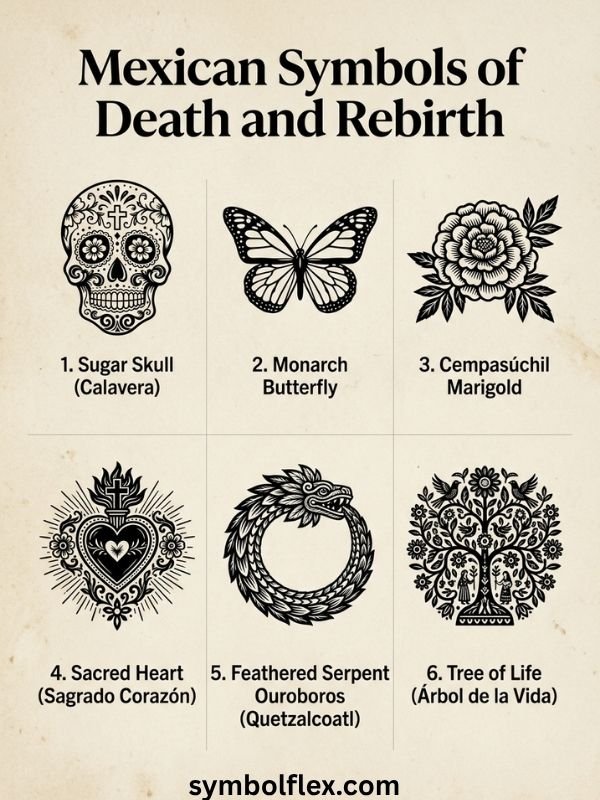
Día de los Muertos (Day of the Dead) is where Mexico’s symbolism around death is most visible, blending indigenous belief with Catholic tradition introduced during Spanish colonization.
| Symbol | Meaning |
| La Catrina (Calavera Catrina) | Death as equalizer — a reminder that everyone, rich or poor, faces the same end |
| Sugar skull (calavera) | Celebrating an individual life after death |
| Marigolds (cempasúchil) | Guiding spirits home |
| Monarch butterflies | Returning souls of ancestors |
| Candles on an altar | Lighting the path for spirits |
| Papel picado banners | The fragility of life |
| Skeleton figures in celebration poses | Death without fear |
| Copal smoke | Cleansing the space for spirits to visit |
| Bread shaped like bones | Honoring the physical body after death |
| Water on the ofrenda | Quenching a spirit’s thirst after a long journey |
Mexican Symbols in Art, Culture and Everyday Life
Beyond religion and mythology, plenty of Mexican symbols are part of daily cultural expression.
| Symbol | Meaning |
| Papel picado | Celebration, the wind carrying wishes and prayers |
| Alebrijes | Spirit guides, imagination, folk art identity |
| Mariachi sombrero | Musical tradition, festivity |
| Charro suit | Regional pride, horsemanship heritage |
| Talavera pottery patterns | Craftsmanship, regional identity (especially Puebla) |
| Huichol yarn art | Spiritual storytelling through color and pattern |
| Rebozo (shawl) | Womanhood, tradition, practicality |
| Mexican muralism | National memory and social identity |
| Loteria cards | Shared cultural memory, games, folklore |
| Piñata | Celebration, breaking through obstacles for reward |
| Woven textiles (huipil) | Regional and indigenous identity |
| Guitarrón (mariachi bass guitar) | Musical heritage |
Mexican National and Cultural Symbols
| Symbol | Meaning |
| Mexican flag | National unity and identity |
| Coat of arms (eagle, snake, cactus) | Origin story of Mexico City |
| Virgin of Guadalupe | Faith, protection, national devotion |
| National anthem imagery | Patriotism, historical struggle |
| Zócalo (main square) | Civic life and gathering |
| Sombrero | Recognizable global symbol of Mexican identity |
| Nopal cactus (standalone) | Resourcefulness, native landscape |
| Chile pepper | Culinary identity, boldness |
| Corn (maize) | The foundation of Mexican food and ancient agriculture |
| Aztec calendar stone (popular use) | Heritage and ancient sophistication |
Spiritual and Psychological Meaning of Mexican Symbols
On a deeper level, Mexican symbols tend to circle back to a few core themes:
- Duality — life and death, sun and night, creation and destruction are treated as connected, not opposites. This mirrors the Aztec concept of Ometeotl.
- Cyclical time — rather than a straight line from birth to death, many Mexican and Mesoamerican symbols reflect a circular view where death leads back to renewal.
- Connection to nature — animals like the eagle, jaguar, and serpent aren’t just decorative; they represent qualities people aspire to embody, like courage or adaptability.
- Memory as an active practice — symbols like the ofrenda and sugar skull aren’t just about looking back. They’re built around actively keeping someone’s memory alive in the present.
Psychologically, this is part of why these symbols resonate outside Mexico too — they offer a framework for facing loss without pretending it doesn’t exist.
How Mexican Symbols Are Used Today
- Tattoos — the eagle and snake, Quetzalcoatl, sugar skulls, and the Virgin of Guadalupe are among the most requested Mexican tattoo designs, often chosen for their meaning around strength, faith, or family memory.
- Home decor — Ojo de Dios weavings, Talavera tiles, and alebrijes are common in Mexican households as both decoration and protection.
- Festivals — Día de los Muertos, Independence Day, and regional festivals bring these symbols into public celebration through altars, parades, and street art.
- Fashion and design — embroidery patterns from huipiles and rebozos regularly appear in modern Mexican fashion, keeping indigenous textile traditions visible.
Positive and Negative Interpretations
Most Mexican symbols carry a positive meaning by design, but context can shift how they’re read.
Positive meanings:
- Eagle and serpent — destiny and national pride
- Marigolds — remembrance and love
- Ojo de Dios — protection and care
Negative or cautionary meanings:
- Serpent (in some contexts) — deception or hidden danger, depending on the myth being referenced
- Skull imagery, when stripped of its cultural context — can be misread as purely morbid rather than celebratory
- Jaguar — power, but also unpredictability or aggression in certain stories
Understanding the full story behind a symbol matters more than judging it by appearance alone.
Conclusion
Mexican symbols aren’t just visually striking, each one is tied to a real story, belief system, or tradition that’s still alive today.
From the eagle and serpent that gave birth to a nation, to the marigolds that guide spirits home every November, these symbols work as a living connection between Mexico’s ancient past and its present-day identity.
Understanding the meaning behind them offers a much richer way to appreciate Mexican culture than treating them as simple decoration.
