
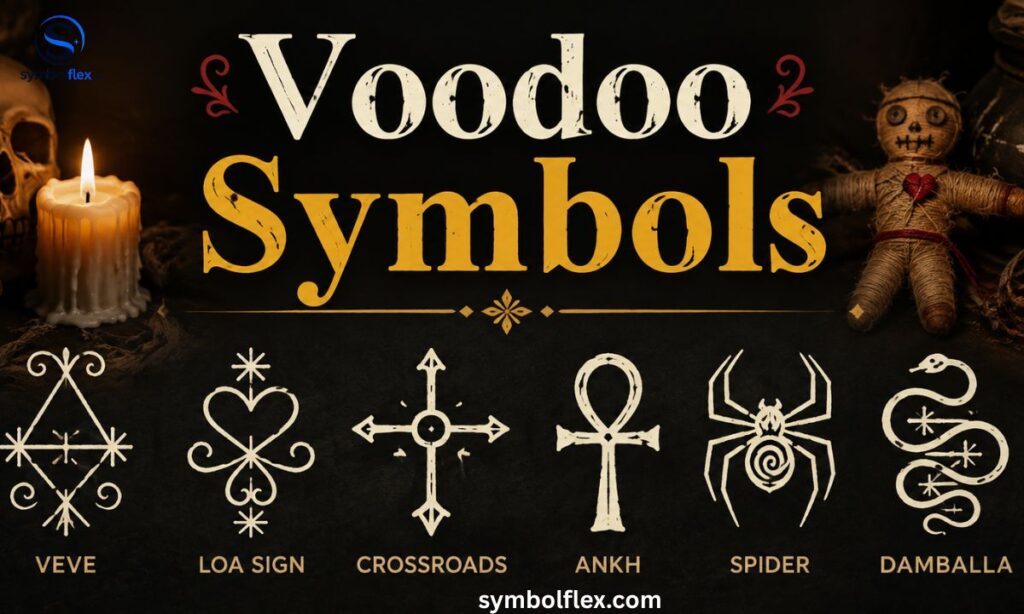
Voodoo symbols are sacred drawings, called veve, used in the Vodou religion to represent spirits, ancestors, and spiritual forces in real ceremonies still practiced today across Haiti, West Africa, and Louisiana.
Interest in voodoo symbols has grown fast, fueled by tattoo trends, design searches, and pop culture moments like Hazbin Hotel‘s Alastor. But most search results either repeat the same shallow facts or lean on horror movie stereotypes. Vodou is an organized religion practiced by millions of people worldwide, with real priests, ceremonies, and beliefs, not a Halloween prop.
This guide covers 85+ voodoo symbols and their meanings, including Papa Legba, Erzulie Freda, protection charms, death symbols, and the differences between Haitian Vodou, African Vodun, and Louisiana Voodoo.
What Are Voodoo Symbols?

Voodoo symbols are sacred images used to represent spirits, called lwa (sometimes spelled loa), and to communicate with them during ceremonies. They function almost like a spiritual alphabet, where each shape, line, or pattern carries specific meaning.
The most well known category of voodoo symbols is the veve, a ceremonial drawing made on the ground, traditionally with cornmeal, ash, or brick dust. Each veve corresponds to a specific lwa. A houngan (priest) or mambo (priestess) draws the veve at the start of a ceremony to invite that spirit’s presence.
This isn’t decoration. It’s an invitation, almost like a formal request written in symbolic language.It helps to clear up a common mix up early on. “Voodoo” is the popularized Western spelling, often associated with Louisiana folk practice and pop culture.
“Vodou” or “Vodun” refers more precisely to the actual religion as practiced in Haiti and West Africa. Both terms describe related traditions, but scholars and practitioners generally prefer “Vodou” for accuracy. Throughout this article, we’ll use “voodoo” for search familiarity while respecting the deeper term “Vodou” where it matters.
Voodoo Symbols | Meanings, Uses and Types
There isn’t one single voodoo symbol. There are dozens of them, each tied to a different spirit, purpose, or life event. Below, we’ll break down the major categories people search for most, from death and protection to love and good luck.
Voodoo Symbols for Death
Death in Vodou isn’t treated as an ending to fear. It’s viewed as a transition, guided by specific spirits who oversee the passage between the living and the dead. The most recognized symbol here is the veve of Baron Samedi, the lwa of death, cemeteries, and resurrection. His symbol typically includes a cross, a skull, and sometimes a coffin shape, reflecting his role as guardian of the graveyard.
Baron Samedi belongs to a spirit family called the Ghede, who govern death and fertility together. This pairing might seem odd at first, but it reflects a core idea in Vodou cosmology: death and life are two points on the same cycle, not opposites.
The Ghede spirits are often depicted with skull imagery, top hats, and dark glasses, a look that has heavily influenced Halloween and horror aesthetics in American pop culture.
Cemetery crosses, called croix, also appear frequently as death related symbols. Unlike a purely Christian cross, these crosses in Vodou practice represent the crossroads between worlds, a concept borrowed and adapted from Papa Legba’s own crossroads symbolism.
Voodoo Symbols PDF
Many people search for a voodoo symbols PDF because they want a printable reference chart they can study or keep for spiritual practice. A genuinely useful PDF should include the major veve drawings, the name of the associated lwa, a short meaning for each symbol, and a note on which tradition (Haitian, African, or Louisiana) it comes from.
If you’re building your own reference sheet, organize it by spirit family rather than alphabetically. Grouping Papa Legba with other crossroads spirits, or grouping the Ghede together, makes the relationships between symbols much easier to understand and remember.
One tip worth mentioning: avoid downloading random PDFs from unverified sites, since misinformation about Vodou symbolism spreads easily online. Cross reference any chart against academic sources or writings by respected Vodou scholars before treating it as accurate.
Voodoo Symbols for Good Luck
Good luck symbolism in Vodou centers heavily around Papa Legba, the guardian of the crossroads and the spirit who opens the gate between the human world and the spirit world. His veve often includes a cane, a crossroads shape, or a gate, representing opportunity and new beginnings.
This idea isn’t so different from other cultures’ luck symbols. Just as a four leaf clover represents good fortune in Irish folklore, Papa Legba’s symbol represents the chance to move forward, to find the right path, or to have a door opened for you. Practitioners often make offerings to Papa Legba first in any ceremony, since nothing else can proceed until he grants passage.
Prosperity focused veves, tied to spirits associated with abundance and trade, are also used for luck in business or financial matters. These symbols are less universally recognized than Papa Legba’s, but they matter deeply within specific practitioner communities.
Voodoo Symbols Meaning
If you’re short on time and just want the core answer: voodoo symbols meaning refers to what each drawing represents spiritually, usually a specific lwa, a natural force, or a life event like birth, love, or death. Here’s a quick reference list of some frequently searched symbols and their general meaning:
- Veve of Papa Legba – crossroads, opportunity, communication with spirits
- Veve of Erzulie Freda – love, beauty, femininity
- Veve of Baron Samedi – death, humor, resurrection
- Veve of Damballa – wisdom, creation, the serpent spirit
- Veve of Ogou – strength, war, iron, protection
Every symbol’s meaning depends heavily on context. The same veve drawn slightly differently, or combined with other symbols, can shift meaning based on regional tradition and the specific ceremony being performed.
Voodoo Symbols Images
When people search for voodoo symbol images, they’re usually picturing intricate line drawings made up of geometric shapes, stars, hearts, crosses, and flowing curves. Veve designs often look almost like elegant calligraphy, blending religious symbolism with striking visual art.
Traditional veve are drawn using natural materials like cornmeal, wood ash, coffee grounds, or brick dust, poured carefully onto the ground in patterns that can take real skill to execute well. Photographs of authentic ceremonies show priests working with focused precision, since a poorly drawn veve is believed to fail at properly inviting the intended spirit.
If you’re looking at voodoo symbol images online for creative or educational purposes, it helps to know the difference between authentic ceremonial veve and commercialized, simplified versions sold as jewelry or tattoo designs. The commercial versions often borrow visual elements without preserving their original spiritual accuracy.
Voodoo Symbols Alastor

Fans of the animated series Hazbin Hotel often search for Alastor voodoo symbols, referring to the character’s radio static imagery, deer antlers, and eerie smile motifs. This is a piece of modern pop culture reinterpretation, not an authentic representation of real Vodou practice.
Alastor’s design draws loosely on New Orleans folklore and general “voodoo” aesthetic tropes rather than specific, documented veve or lwa symbolism. It’s a good example of how mainstream media often borrows the visual language of Vodou without engaging with its actual religious meaning.
That said, this kind of pop culture interest has genuinely driven more people to research the real religion behind the aesthetic, which is a positive outcome even when the source material itself takes creative liberties.
Voodoo Symbols for Love
Love and romance symbolism centers on Erzulie Freda, the lwa associated with love, luxury, beauty, and femininity. Her veve typically features a heart, sometimes pierced by a sword or dagger, reflecting both the joy and the emotional pain associated with romantic love.
Erzulie Freda is often described as elegant and a bit vain, drawn to fine jewelry, perfume, and pink or pale blue colors. Practitioners seeking help with romantic matters, whether that’s attracting love or healing heartbreak, may make offerings to her specifically.
It’s worth noting that Erzulie Freda has a counterpart, Erzulie Dantor, who represents a fiercer, more protective form of love, particularly maternal love. The contrast between these two aspects of the same spirit shows how Vodou treats love as complex rather than one dimensional.
Voodoo Symbols for Protection
Protection is one of the most practical and commonly used categories of voodoo symbolism in everyday life. Veves associated with Ogou, the warrior spirit connected to iron and strength, are frequently used for protection against harm, conflict, or negative energy.
Beyond veve drawings, practitioners also use gris-gris bags, small cloth pouches filled with herbs, stones, or personal items, blessed and worn or carried for protection. These are especially associated with Louisiana Voodoo and remain a well known symbol of protective practice in New Orleans culture today.
Protective symbolism in Vodou isn’t about aggression. It’s fundamentally defensive, meant to shield a person, home, or family from harmful spiritual forces, illness, or bad luck, much the way an evil eye charm functions in Mediterranean and Middle Eastern traditions.
Understanding Voodoo Symbols and Their Meanings
To really understand voodoo symbolism, you need to see it as a coherent visual language rather than a collection of random spooky images. Each symbol connects to a specific spirit, purpose, and cultural context.
Voodoo Symbols and Meanings
The clearest way to understand the relationship between symbols and meaning is through a simple comparison table:
| Symbol (Veve) | Associated Spirit | Core Meaning |
| Crossroads and cane | Papa Legba | Opportunity, communication |
| Heart | Erzulie Freda | Love, beauty |
| Skull and cross | Baron Samedi | Death, transition |
| Serpent | Damballa | Wisdom, creation |
| Sword and flag | Ogou | Strength, protection |
This table only scratches the surface. There are dozens of lesser known lwa, each with their own veve and symbolic meaning, many of which vary by region and even by individual houngan or mambo.
Vodou Symbols
Using the more accurate term, Vodou symbols refer specifically to the religious system practiced in Haiti and West Africa, as opposed to the more commercialized “Voodoo” branding often used in tourism and entertainment. Scholars studying Haitian religion generally use “Vodou” to signal academic respect for the tradition.
Symbols of Voodoo
The symbols of Voodoo function as a kind of sacred shorthand. Rather than writing out a spirit’s name or attributes, a priest draws their veve, instantly communicating who is being invoked and why, similar to how a national flag communicates identity without words.
Voodoo Religion Symbols
As religion symbols, veve and related imagery aren’t separate from Vodou theology. They are Vodou theology, expressed visually. Understanding a symbol means understanding a piece of the religion’s cosmology, including how spirits relate to nature, ancestors, and human life.
Voodoo Religion Symbol
If you had to point to one single symbol that represents the entire religion, most scholars and practitioners would point to the veve itself as a concept, the ritual act of drawing sacred ground art to open communication with the spirit world.
Voodoo Symbolism Religion Symbols
Symbolism in Vodou works on multiple levels at once. A single veve can represent a spirit’s personality, their domain of influence, their preferred offerings, and even the geometric shape of their spiritual energy, all within one drawing.
Voodoo Symbols and Their Meanings
Here’s a fact worth citing directly: the veve tradition likely developed from earlier West African ground drawing practices, later influenced by Catholic sacred geometry during the colonial period in Haiti. This blending is a textbook example of religious syncretism, where two traditions merge into something new while retaining elements of both.
Voodoo Symbols and Meaning
To wrap up this section simply: voodoo symbols carry meaning because the community that created and preserved them agreed on what each symbol represents, passed down through oral tradition, apprenticeship, and generations of practicing priests and priestesses.
Types of Voodoo Symbols Around the World
Voodoo symbolism isn’t identical everywhere. It shifted and adapted as the religion spread across continents, shaped by local culture, colonial history, and available materials.
Haitian Voodoo Symbols

Haitian Voodoo symbols represent the most well documented and widely practiced form of the religion today. Haiti’s Vodou tradition blends West African spiritual systems with Catholic saints, a result of enslaved Africans disguising their worship under colonial religious restrictions.
Haitian Voodoo Symbols and Meanings
In Haiti, veve are drawn at the start of nearly every ceremony, and the specific style can vary by region, temple (called an oufo), and even by individual priest. Some communities favor more elaborate, curling designs, while others use simpler geometric forms.
African Voodoo Symbols
African Voodoo symbols, more accurately called Vodun symbols, originate primarily from the Fon and Ewe peoples of Benin and Togo. These symbols predate the Haitian tradition and represent the original spiritual system before diaspora adaptation added Catholic and other cultural influences.
Louisiana Voodoo Symbols
Louisiana Voodoo developed independently along a somewhat different path than Haitian Vodou, blending African spiritual practice with French Catholicism and Indigenous American traditions. Marie Laveau, the famous 19th century Voodoo priestess of New Orleans, remains one of the most historically significant figures associated with this tradition.
New Orleans Voodoo Symbols
New Orleans has become the most commercially visible face of Voodoo in the United States, for better and worse. Tourist shops sell simplified gris-gris bags and Voodoo dolls, while a smaller community of genuine practitioners continues authentic ceremonial practice largely out of public view.
Veve Voodoo Symbols
The veve remains the single most recognizable Voodoo symbol type across all regional variations. Regardless of whether you’re looking at Haitian, African, or Louisiana practice, the veve concept of a ground drawing used to summon a spirit shows up consistently.
Voodoo Veve Symbols and Meanings
Here’s a second standalone fact worth noting: there are believed to be well over 100 documented lwa spirits in Haitian Vodou, each theoretically possessing a distinct veve, though only a few dozen are commonly used in modern practice. This scale shows just how rich and complex the symbolic system really is.
Protection, Signs and Special Voodoo Symbols
Protective symbolism plays a central, practical role in daily Vodou life, far beyond ceremonial use alone.
Voodoo Protection Symbols
Beyond Ogou’s veve, protective charms often combine multiple elements, herbs, specific colors, and written prayers, layered together for stronger spiritual defense. Practitioners believe combining elements increases protective strength.
Voodoo Symbols of Protection
Protection symbols are frequently placed at doorways, worn on the body, or buried near a home’s foundation, reflecting the belief that spiritual defense works best when integrated into daily physical space.
Voodoo Symbol for Death
As covered earlier, Baron Samedi’s imagery dominates death symbolism, though the broader Ghede family contributes additional variations depending on which specific aspect of death or ancestry is being honored.
Voodoo Hand Signs
Hand gestures do appear in some ceremonial contexts, often used by priests to direct spiritual energy or acknowledge a spirit’s presence during possession trance states, though these are far less documented publicly than veve drawings.
Voodoo Signs
“Signs” in casual conversation often refers to omens, a black cat crossing your path, a specific dream, or an unusual natural event, interpreted as messages from spirits or ancestors rather than fixed drawn symbols.
Voodoo Signs and Symbols
The distinction matters: symbols are intentionally created (veve, charms), while signs are naturally occurring events interpreted through a spiritual lens. Both play a role in how practitioners read the world around them.
Unique and Modern Voodoo Symbol Uses
Modern culture has taken traditional Voodoo symbolism and adapted it for entirely new purposes, from fashion to digital design.
Voodoovoodoo Symbols
This search variant typically reflects casual or repeated typing rather than a distinct concept, but it points to the same growing interest in Voodoo symbolism across blogs, social media, and design communities.
Voodoo Symbols PNG
Designers and content creators frequently search for voodoo symbols PNG files, meaning transparent background images suitable for graphic design, tattoos, or digital art projects. When using sacred imagery this way, it’s respectful to research a symbol’s real meaning first rather than treating it as purely decorative.
Alastor Voodoo Symbols
As mentioned earlier, this reflects fan interest in animated character design rather than authentic religious symbolism, though it demonstrates how pop culture continues to keep Voodoo aesthetics visible in mainstream entertainment.
Deep Symbolic Meaning
Voodoo symbols operate on several layers simultaneously, which is part of why they’ve remained meaningful across centuries.
On a Spiritual Level
At the spiritual level, symbols function as literal communication tools with the lwa, ancestors, and cosmic forces. Practitioners believe the act of drawing a veve genuinely opens a channel to the spirit it represents, not just symbolically but functionally within their belief system.
On a Psychological Level
Psychologically, ritual symbols provide focus points for intention, meditation, and emotional processing. Similar effects are documented across many world religions, where repetitive, symbolic ritual helps practitioners process grief, hope, or fear in structured, community supported ways.
On a Cultural Level
Culturally, Vodou symbolism represents resistance and identity preservation. Enslaved Africans maintained their spiritual practices under extreme oppression, often disguising lwa worship behind Catholic saint imagery. That survival itself carries deep symbolic weight beyond the individual drawings.
Types and Variations of Voodoo Symbols
1. Papa Legba Veve
Papa Legba’s veve centers on crossroads and gate imagery, reflecting his role as the spirit who must be honored first in any ceremony, since he opens communication between humans and all other lwa.
2. Erzulie Freda Veve
Erzulie Freda’s veve features a heart, often pierced, symbolizing romantic love alongside emotional vulnerability and the bittersweet nature of desire.
3. Baron Samedi Veve
Baron Samedi’s veve combines skull, cross, and coffin imagery, representing his authority over death, humor in the face of mortality, and the boundary between life and the afterlife.
4. Damballa Veve
Damballa’s veve depicts a serpent, sometimes two intertwined, symbolizing wisdom, purity, and creation itself, since Damballa is considered one of the oldest and most revered spirits in the Vodou pantheon.
5. Ogou Veve
Ogou’s veve features swords, flags, or iron tools, representing strength, war, and protection, drawing from his association with metalwork and warrior energy.
Voodoo Symbols Across Cultures
West Africa
In West Africa, particularly Benin (once known as the Kingdom of Dahomey), Vodun remains an officially recognized religion, and its symbols form the historical foundation for every later variation found across the Americas.
Haiti
Haiti developed the most codified and widely documented Vodou symbolic system, heavily influenced by the trauma and resilience of the transatlantic slave trade and the Haitian Revolution.
Louisiana
Louisiana’s version blended African spirituality with French Catholic saints and some Indigenous practices, producing a distinct regional tradition centered largely in New Orleans.
Caribbean and Brazil
Related traditions like Santería in Cuba and Candomblé in Brazil share structural similarities with Vodou, including spirit veneration and ceremonial symbolism, though each developed its own distinct symbolic vocabulary.
Modern Global Spirituality
Today, elements of Vodou symbolism appear in broader Western occult and eclectic spiritual movements, sometimes respectfully researched, and sometimes borrowed without proper context or understanding.
Voodoo Symbols in Art, Movies and Pop Culture
Hollywood has shaped public perception of Voodoo far more than any academic source, and not always accurately. Films and television shows have historically leaned on Voodoo dolls, curses, and zombie imagery, most of which reflects sensationalized folklore rather than genuine religious practice.
Voodoo dolls, contrary to popular belief, are largely a Louisiana folk invention with limited connection to authentic Haitian ceremonial practice. Actual Vodou ceremonies focus far more on possession trance, drumming, dance, and veve drawing than on doll based magic.
Music, fashion, and tattoo culture have also embraced Voodoo inspired imagery, often stripped of specific religious meaning and used purely for aesthetic or mysterious appeal. This has created a strange dynamic where the symbols are globally recognizable, yet widely misunderstood.
Spiritual and Dream Meaning of Voodoo Symbols
Within folk interpretation, seeing Voodoo symbols in a dream is often read as a message from ancestors or spirits, particularly if the dream involves a specific lwa’s known imagery, like a serpent (Damballa) or a crossroads (Papa Legba).
Dream interpretation within Vodou belief isn’t standardized the way it is in some other traditions, but practitioners often consult a houngan or mambo to interpret dream symbolism within the context of their personal spiritual life and ancestry.
Some practitioners view recurring dream symbols as a sign that a particular spirit is seeking closer connection with the dreamer, which may lead to deeper ceremonial involvement or initiation over time.
Positive vs Negative Meaning
Most Voodoo symbolism is protective and constructive rather than harmful, though public perception often skews toward fear based interpretation.
Positive Meaning
Positively, Voodoo symbols represent healing, protection, guidance, love, and connection to ancestors. The majority of ceremonial practice focuses on community wellbeing, health, and spiritual balance rather than harming others.
Negative Interpretation
Negative interpretations, largely shaped by Hollywood and colonial era propaganda, framed Voodoo as inherently sinister or associated with curses. Most scholars agree this negative framing stems from historical racism and fear of African spiritual practices during and after slavery, rather than from accurate religious understanding.
Why Humans Are Attracted to Voodoo Symbols
People are drawn to Voodoo symbolism for several overlapping reasons: genuine spiritual curiosity, fascination with mystery, aesthetic appeal, and a desire to connect with ancestral or cultural heritage. Interest in folk spirituality and occult inspired content has grown significantly online over the past decade, reflecting a broader trend of people seeking meaning outside mainstream organized religion.
The visual beauty of veve drawings also plays a role. Their intricate, flowing designs appeal to people interested in art and symbolism independent of religious belief, similar to how mandala or sacred geometry designs attract interest across cultures.
Finally, pop culture exposure through film, television, and social media keeps Voodoo symbolism visible and searchable, even when that exposure doesn’t always represent the religion accurately.
Frequently Asked Questions
What is the most powerful voodoo symbol?
Papa Legba’s veve is considered most powerful since he opens communication with all other spirits first.
Is it disrespectful to use voodoo symbols as tattoos?
Yes, without understanding their meaning, since sacred veve represent specific spirits, not decorative or random artistic designs.
What’s the difference between a veve and a voodoo symbol?
A veve is a specific ceremonial drawing; voodoo symbol is the broader term covering all sacred imagery.
Can anyone learn to read voodoo symbols?
Anyone can study meanings, but drawing veve correctly for ceremonies requires training from an initiated houngan or mambo.
Are voodoo dolls actually used for curses?
No, voodoo dolls are mostly Louisiana folklore; authentic Vodou ceremonies rarely use dolls for cursing purposes.
Conclusion
Voodoo symbols are far more than spooky Halloween decoration. They represent a living religious tradition with roots in West Africa, shaped by centuries of migration, resilience, and cultural blending across Haiti, Louisiana, and beyond.
From Papa Legba’s crossroads to Erzulie Freda’s heart and Baron Samedi’s skull, each veve carries specific spiritual meaning tied to real practitioners and real ceremonies happening today.Understanding these symbols with accuracy and respect matters, both for cultural literacy and for honoring a religion that has survived enormous historical hardship.
Whether you’re researching for creative projects, personal curiosity, or genuine spiritual interest, approaching Voodoo symbolism with care will always serve you better than treating it as a costume or a punchline.
