

Growth navigate funding links each raised dollar to one milestone. No single founder owns the term. Its origin is not publicly disclosed. Many failed raises start with a big number and no target.
This guide flips that order. You will learn six steps, the runway math, and the funding options for each stage.
You will also spot the traps early. Every section ends with something you can act on today. Ready to build a plan that investors respect?
Quick Facts
| Field | Detail |
| Term | Growth navigate funding |
| Type | Planning framework, not a lender |
| Core idea | Capital matched to funding milestones |
| Best for | Startups and small business funding |
| Official finance category | No |
| Creator or founder | Not publicly disclosed |
| Related brand | A consultancy with a similar name reportedly exists |
| Key US bodies to check | SEC, SBA, FTC |
| Audience | US founders and operators |
What Growth Navigate Funding Means, and What It Is Not
Growth navigate funding is a capital plan built around milestones. It is not a loan. It is not a government program. It is a way to think before you raise.
Founders use it to shape a startup growth funding strategy. Business growth financing works best when the goal comes first and the check comes second.
Concept, brand, and product: three different things
The concept, the brand, and the product are three separate things. Mixing them causes bad decisions.
| Item | What it is | What to do |
| Concept | A milestone first planning method | Use it freely |
| Brand | A consultancy with a similar name, reportedly | Research it like any vendor |
| Product | No standalone financial product exists | Never pay to “access” it |
The one sentence definition
Growth navigate funding means raising the right capital type, in the right amount, at the right time, for one measurable milestone.
Think of a road trip. You pick the destination first. Then you budget for gas.
Why timing matters more than amount
Timing sets your price. Raise too early and you give up extra equity. Raise too late and you negotiate from fear.
Here is the stakes. CB Insights reportedly found that about 38 percent of failed startups cited running out of cash or failing to raise new capital. Money arrives late for many teams. A $500,000 raise at the right moment can beat $2 million at the wrong one.
Why founders confuse the phrase with a lender
The word “funding” sounds like a funder. It is not one.
Search results blur advice pages, a similarly named consultancy, and the idea itself. Treat any request for an upfront fee with suspicion. Check the SEC and FTC websites before you share financial records.
Read This: How Long Until 2:10? Countdown & Time Left
The 6 Step Growth Navigate Funding Process
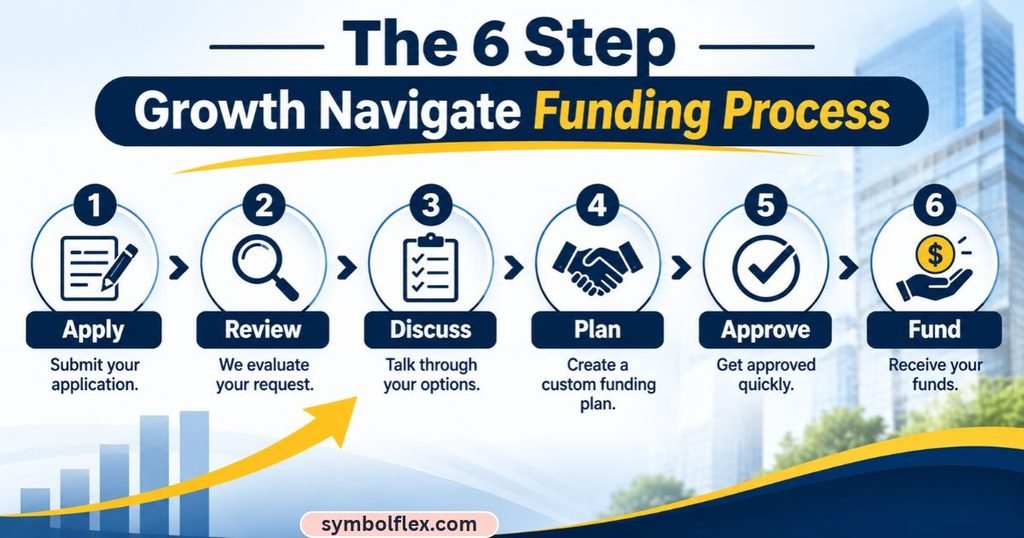
The growth navigate funding process has six steps. Each one feeds the next.
- Set a measurable milestone.
- Calculate the capital needed.
- Choose the capital type.
- Build investor readiness.
- Negotiate terms.
- Deploy, track, and adjust.
Step 1: Set a measurable milestone
A good milestone has one number and one deadline. Examples include $1 million in annual revenue, 100 paying clients, or a first production run.
Weak goals sound like “grow fast.” Strong goals sound like “reach $80,000 in monthly recurring revenue (MRR) by June.” Measurable business growth milestones give investors something to test.
Step 2: Calculate capital to that milestone
Build a bottom up budget. List hiring, tools, marketing, inventory, and legal costs. Then add a buffer of 15 to 25 percent. That buffer is a rule of thumb, not a law.
This is how you calculate startup funding requirements. It also answers a common question: how much capital does a startup need? Enough to hit the next milestone with cash to spare.
Step 3: Choose the capital type that fits
Match the money to the risk. Fast, uncertain bets suit equity financing. Steady cash flow suits debt financing. Predictable revenue may suit revenue based financing.
The best startup funding options depend on your model. A later section shows a full decision matrix.
Step 4: Build investor readiness
Investor readiness means your numbers, documents, and story hold up under questions. Clean books come first. A tidy data room comes next.
Venture capital readiness also needs a clear use of funds. Investors want to see where each dollar goes.
Step 5: Negotiate terms, not just amount
A high valuation with bad terms can hurt you. Read liquidation preference, board seats, and pro rata rights with care. Term sheet negotiation shapes your future control.
Step 6: Deploy, track, and adjust
Review progress every month. Ask one question. Did the spend move the milestone?
If not, shift the money. Startup financial management is a loop, not a one time event.
Rule of thumb: raise for the next proof point, not the next rumor.
Read This: Do Cadillac LYRIQ Driving Modes Affect Range and Battery Usage? A Detailed Guide
Funding by Growth Stage: Pre Seed to Series C
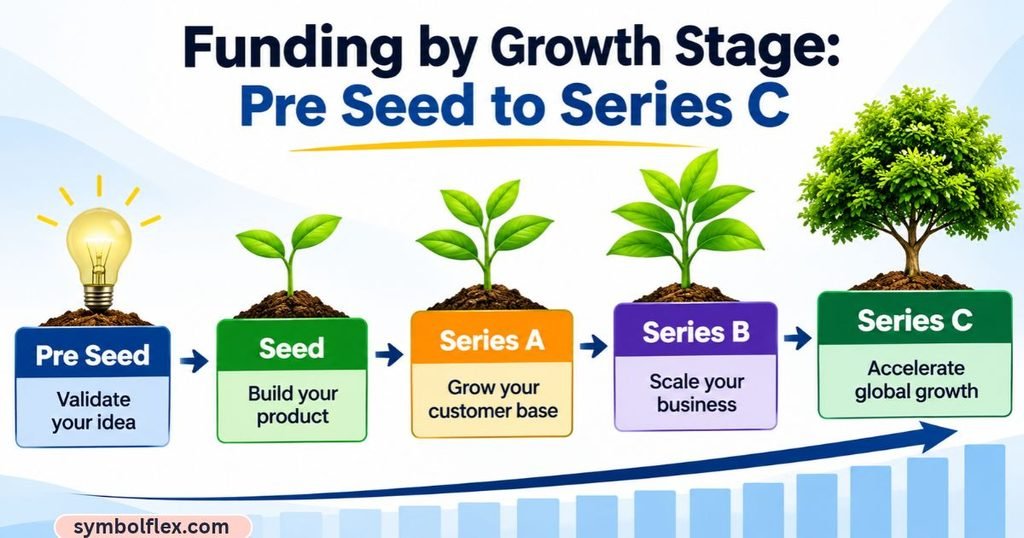
Each stage funds a different proof point. Startup funding stages move from idea to scale.
Stage and milestone table
| Stage | Typical milestone | Common capital |
| Pre seed | Problem and prototype validated | Founders, angels, SAFEs |
| Seed | Early traction, repeatable sales | Angel investors, seed funds |
| Series A | Product market fit, scalable growth | Venture capital funding |
| Series B | Market expansion, healthy unit economics | VC, growth equity |
| Series C | Scale, new markets, acquisitions | Growth equity, venture debt |
What investors expect at each stage
Expectations rise with each round.
- Pre seed: a sharp team and a clear problem.
- Seed stage investment: early usage and customer love.
- Series A investor expectations: strong retention, growing revenue, and a repeatable sales path.
- Series B growth capital: efficient spending and healthy customer acquisition cost (CAC).
- Series C expansion funding: a clear path to profit or market leadership.
Stage amounts: competitor reported, not universal
Reported US round sizes vary by source. One competitor page lists pre seed at roughly $100,000 to $2 million. It lists seed at $2 million to $4 million. It lists Series A at $9 million to $25 million. It also reports a median Series B near $38 million.
Treat these as estimated ranges. Sector, city, and market mood change them. Check current Carta, PitchBook, or NVCA data before you set a target.
Runway Maths Every Founder Must Do
Runway equals cash divided by monthly net burn. This is the core of startup runway planning.
Burn rate, net burn, and runway formula
Gross burn rate is your total monthly spending. Monthly net burn rate is spending minus revenue.
- Net burn = gross burn minus monthly revenue
- Runway in months = cash on hand divided by net burn
That is the cash runway calculation. It also answers how to calculate startup burn rate.
Worked example: 20 months versus 5 months
Two founders hold $600,000 in cash. The numbers below are illustrative.
| Founder | Cash | Net burn | Runway |
| Alex | $600,000 | $30,000 | 20 months |
| Jordan | $600,000 | $120,000 | 5 months |
Same cash. Very different futures. Burn matters as much as the raise.
When to start fundraising
Start when you have 9 to 12 months of runway left. Raises often take longer than founders expect. A startup fundraising timeline of three to six months is common, though it varies.
If you ask when a startup should raise funding, the answer is simple. Raise while you still have leverage.
Runway targets by stage
These targets are guidance, not rules.
| Stage | Suggested runway |
| Pre seed | 12 to 18 months |
| Seed | 18 months |
| Series A | 18 to 24 months |
| Series B and C | 24 months |
Compare Every Funding Type in One Table

Equity trades ownership for cash. Debt trades future repayment for cash. Each fits a different business.
| Type | Dilution | Speed | Main risk | Best fit |
| Equity financing | Yes | Slow | Lost control | High growth startups |
| Debt financing | No | Medium | Repayment pressure | Steady cash flow |
| Revenue based financing | No | Fast | Cash flow drain | Recurring revenue |
| Grants | No | Slow | Competition | Research, climate, health |
| Bootstrapping | No | Varies | Slow growth | Lean teams |
Decision matrix
The best funding options for business expansion depend on how your revenue behaves.
| Business type | Best fit | Runner up | Avoid |
| Pre revenue startup | Angel or pre seed equity | Grants | Heavy debt |
| Recurring revenue | Equity or RBF | Venture debt | Short term loans |
| Inventory heavy | Credit line | SBA loan | Early VC only |
| Service business | Invoice financing | SBA loan | Equity too early |
Equity: angel and venture capital
Angel investors write early checks and often add advice. Venture capital funding comes in larger rounds and expects fast growth.
Equity needs no monthly payment. It does cost ownership. Investors also expect a big exit.
Debt: SBA, bank, online, and venture debt
Debt keeps your ownership intact. It also needs repayment. Banks want collateral and history. Online lenders move faster and often cost more. Venture debt suits startups that already have VC backing.
Compare business loan interest rates and fees across lenders. Rates change often.
Non dilutive and hybrid: revenue based, grants, crowdfunding, bootstrapping
Non dilutive funding lets you keep your equity.
- Revenue based financing: repay a share of monthly revenue.
- Grants: free money with strict rules.
- Crowdfunding: raise from many small backers. In the US, Regulation CF sets the rules for equity crowdfunding.
- Bootstrapping: grow from your own profit.
Dilution, Valuation, and Cap Table Basics
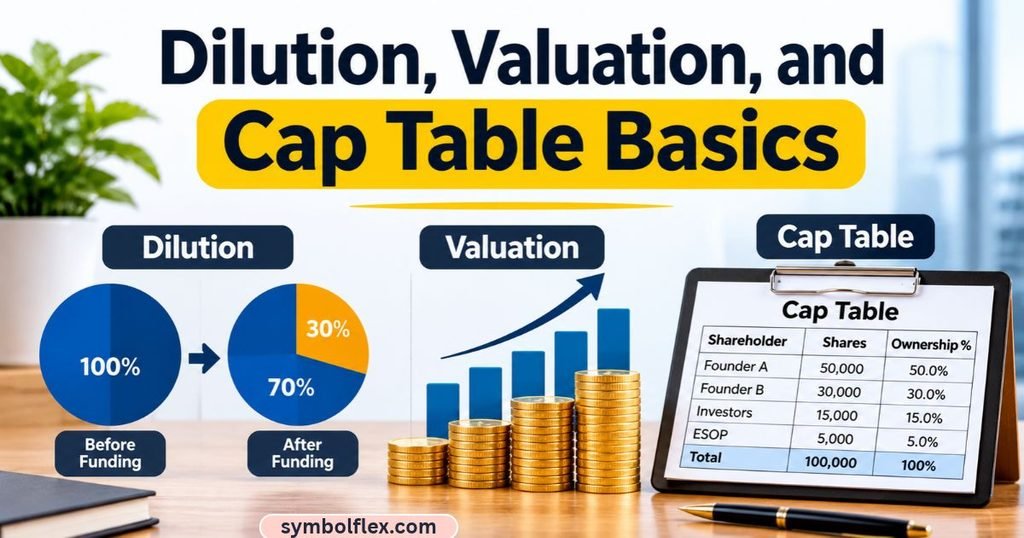
Dilution is the ownership percentage you give up in each round. It shapes your founder ownership percentage over time.
Worked dilution example: labelled illustrative only
This example is illustrative only.
- Pre money valuation: $12 million
- New money raised: $3 million
- Post money valuation: $15 million
- Investor ownership: $3M divided by $15M = 20 percent
Founders who owned 100 percent now own 80 percent. This is how to protect founder equity during fundraising. Model every round before you sign. Good startup cap table management starts early.
Convertible notes and SAFEs delay the price talk. They still convert to shares later. Track them closely.
Down rounds and bridge rounds
A down round sets a lower valuation than the last round. It hurts morale and trust. A bridge round adds short term cash to reach the next milestone.
Term sheet terms in plain language
| Term | Plain meaning |
| Liquidation preference | Investors get paid first in a sale |
| Anti dilution | Protects investors if the price falls |
| Option pool | Shares set aside for employees |
| Pro rata | Right to join later rounds |
| Vesting | Shares earned over time |
SBA Loans in the US: What Founders Must Verify
The SBA guarantees part of a lender’s loan. It does not lend directly in most programs. Always confirm current limits on the official SBA site. Numbers below are reported figures that can change.
7(a), 504, Express, and microloan
| Program | Common use | Reported limit |
| 7(a) | Working capital, equipment, acquisitions | Up to $5 million |
| 504 | Real estate and large equipment | Up to $5 million per debenture |
| Express | Faster, smaller loans | Up to $500,000 |
| Microloan | Very small needs | Up to $50,000 |
SBA 7(a) loan requirements usually include a for profit US business, good credit, and proof of repayment ability.
The SBA 504 loan program works through certified development companies. These are among the best SBA loans for small businesses, depending on your need.
What SBA guarantees and what it does not do
The SBA reduces the lender’s risk. For 7(a) loans, the guarantee is reportedly up to 85 percent on smaller loans and 75 percent on larger ones.
It does not guarantee your approval. It does not cancel your debt.
Personal guarantee and eligibility warnings
Owners with a significant stake typically sign a personal guarantee. Your home or savings may be at risk. Startup funding eligibility also depends on size, industry, and credit. Be wary of any broker promising guaranteed SBA approval.
Revenue Based Financing: When It Helps, When It Hurts
Revenue based financing gives upfront cash. You repay it as a share of monthly revenue. It suits businesses with steady sales.
How revenue share repayment works
You receive, for example, $100,000. The provider sets a repayment cap, such as 1.3 times. You owe $130,000 in total. Revenue based funding repayment is a fixed percentage of sales until you reach that cap.
Slow months mean smaller payments. Fast months mean faster payoff.
RBF before a VC round: the revenue leak problem
RBF payments drain cash every month. A later investor may see lower cash and slower growth. That is the revenue leak problem. Plan the order of your raises.
Cost comparison: fee versus interest versus equity
This comparison is illustrative, not a quote.
| Option | You raise | Cost |
| RBF at 1.3 times | $100,000 | $30,000 fee |
| Bank loan, 10 percent, 3 years | $100,000 | About $16,100 interest |
| Equity at $5M post money | $100,000 | 2 percent ownership |
If the company later sells for $50 million, that 2 percent equals $1 million. Cheap today can be costly later.
Investor Readiness Checklist
Investors want clean books, clear metrics, and a believable plan. This is how to prepare for startup fundraising.
Numbered investor readiness checklist
Here is how to create an investor readiness checklist you can use today.
- Current financial statements
- Clean cap table
- Three to five core KPIs
- Defined milestone and budget
- Legal entity and IP records
- Customer proof and references
- Startup financial forecasting for 12 to 24 months
- Business cash flow projections
- Pitch deck
- Target investor list
Pitch deck and use of funds
Investor pitch deck preparation should stay short. Cover the problem, solution, market, traction, team, and ask. Then show the funding use of funds. For example: 40 percent product, 30 percent sales, 20 percent operations, and 10 percent reserve.
Due diligence pack
Startup due diligence documents prove your claims. Gather these:
- Financial statements and tax filings
- Customer contracts
- Employment and contractor agreements
- IP assignments
- Insurance and compliance records
Sector Playbooks: SaaS, eCommerce, Services, Capital Intensive
The best capital depends on how your revenue behaves.
SaaS and recurring revenue
SaaS investors track MRR, customer retention rate, and net revenue retention. They also compare customer lifetime value (LTV) with CAC. A 3 to 1 ratio is a common rule of thumb. Equity, RBF, and venture debt often fit.
eCommerce and inventory
Inventory ties up cash. Watch inventory turns and gross margin. A credit line or inventory loan often beats early equity. Good business cash flow management matters most here.
Services and receivables
Service firms wait for clients to pay. Track days sales outstanding. Invoice financing or an SBA loan can bridge the gap. This is startup working capital in action.
Capital intensive: hardware, climate, defence
Hardware, climate, and defence ventures face long timelines. Grants, strategic investors, and project finance often help. Government programs vary, so verify each one.
Mistakes, Traps, and Scam Warnings
Most funding failures come from poor timing, not poor ideas. Startup financial risk management starts with knowing the traps.
Common mistakes to avoid
- Raising with no milestone
- Ignoring burn
- Overvaluing the company
- Chasing the wrong investor type
- Skipping legal review
Case study (illustrative composite): A founder raised $1.5 million at a high valuation. Growth slowed. The next round priced lower. Trust dropped and the team shrank. A smaller early raise tied to one milestone would have protected both cash and credibility.
Traps: down rounds, bridges, and RBF leaks
Down rounds follow inflated valuations. Endless bridge rounds hide weak traction. RBF payments can strain cash before a VC round. Spot each trap early and plan around it.
Scam warnings for US founders
- Upfront fee demands before any funding
- Guaranteed funding claims
- Fake investor emails
- Unregistered securities offers
- Pressure to wire money fast
Report suspected fraud to the FTC or SEC. Verify every lender and investor before sharing records.
Numbered Expert Tips
- Fund the bottleneck, not the whole business.
- Track milestone progress monthly.
- Keep six months of buffer cash.
- Meet investors before you need them.
- Compare total cost, not headline rates.
- Model the next round before you take this one.
- Protect control, not just percentage.
- Have a lawyer review every term sheet.
- Verify every lender before sharing data.
- Review your plan every quarter.
Frequently Asked Questions
How does growth navigate funding work?
It ties each raise to one milestone. You size the capital, pick the type, and track results monthly.
Is growth navigate funding a loan or a lender?
No. It is a planning method. It is not a lender or program.
What are the best funding options for startup businesses?
It depends on stage and revenue. Equity suits high growth. Debt suits steady cash flow. Grants suit research.
What is equity financing vs debt financing for startups?
Equity sells ownership with no repayment. Debt keeps ownership and needs repayment.
How does revenue based financing work?
You receive cash now. You repay a share of revenue until a set cap.
What do investors expect from Series A startups?
Product market fit, strong retention, growing revenue, and a repeatable sales path.
Conclusion
Growth navigate funding rewards founders who plan before they pitch. Pick one milestone. Price it. Match the capital to it. Then prove you can hit it. Investors, lenders, and grant teams all respond to that clarity.
Run your runway math this week. Fix your books next. Build your data room after that. You do not need hype. You need a number and a date. Start today. Your next raise will feel like a choice rather than a rescue.
