

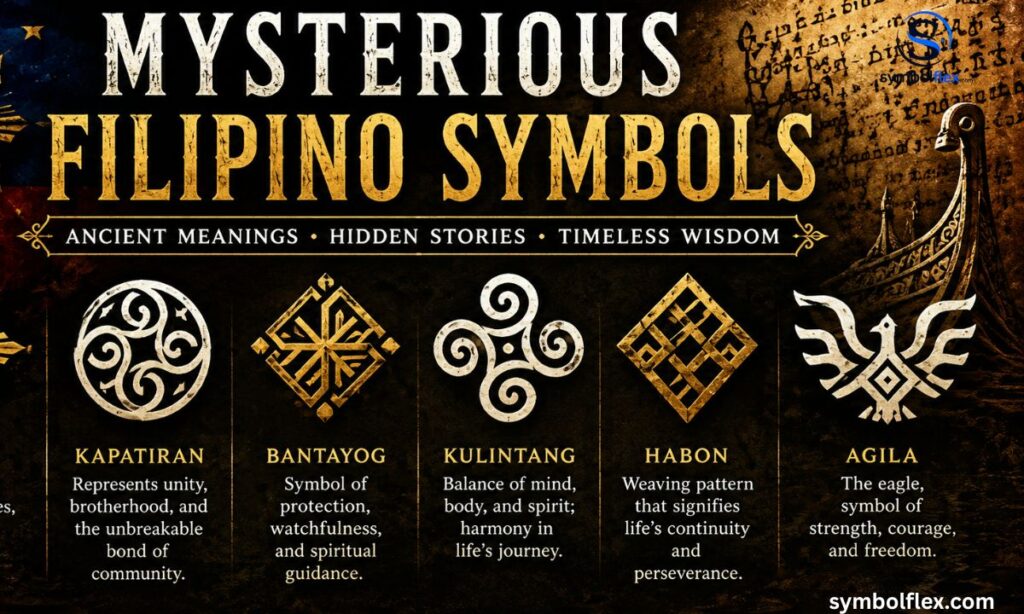
Filipino symbols carry thousands of years of history, culture, and identity. They show up in tattoos, flags, carvings, and everyday life. Most people see them but never really understand what they mean.
That’s what this guide is for. Whether you’re Filipino-American reconnecting with your roots or just curious about one of Asia’s richest cultures, you’re in the right place.
What Are Filipino Symbols?

Filipino symbols are visual or written representations that carry cultural, spiritual, or national meaning. They range from official government-designated icons to ancient markings used by indigenous communities for centuries.
What makes them special is how layered they are. One symbol can carry spiritual meaning, social status, regional identity, and protective power all at once. A Kalinga tattoo, for example, isn’t just art. Each mark tells the wearer’s life story and serves as spiritual armor.
Three quick facts worth knowing: The Philippines is one of the only countries with a legally defined wartime flag variation. Baybayin, the ancient Filipino script, was in active use before Spanish contact in 1565. And the Sarimanok comes specifically from the Maranao people of Mindanao, not from all of Philippine culture. Most sources miss that last one entirely.
Filipino Cultural Symbols And Their Meanings
Filipino cultural symbols reflect values that Filipinos across 7,641 islands have shared for generations. Family loyalty. Spiritual connection. Resilience. Community.
Filipino Symbols and Meanings
Filipino symbols fall into three main groups. National symbols are officially designated by law, like the Philippine Eagle and the Narra tree.
Cultural symbols come from everyday practice, like the parol Christmas lantern or jeepney art Ancient symbols come from pre-colonial traditions, including Baybayin script and indigenous tattoo patterns.
The most recognized Filipino symbols include the eight-rayed sun, the sampaguita flower, the carabao, and Baybayin characters. Each one carries a specific meaning rooted in history and lived experience.
Filipino Flag
The Philippine flag packs more symbolism into one design than almost any other flag in the world. The white triangle represents equality. The blue stripe stands for peace and justice. The red stripe represents courage and valor.
When the country is at war, the flag flips so the red stripe is on top. That makes the Philippines one of very few nations with an officially coded wartime flag.
Inside the triangle is a golden eight-rayed sun. Each ray represents one of the eight provinces that first revolted against Spain: Batangas, Bulacan, Cavite, Laguna, Manila, Nueva Ecija, Pampanga, and Tarlac. The three stars represent Luzon, Visayas, and Mindanao.
Filipino Symbols Tattoos
Traditional Filipino tattooing is called Batok. It’s one of the oldest tattoo traditions in the world. The Kalinga people of northern Luzon have practiced it for over a thousand years.
Among the Kalinga, men earned tattoo marks through battle. Women received marks celebrating fertility and beauty. Each design communicates the wearer’s life story and tribal identity.
Today, Filipino-Americans are getting Baybayin tattoos, Kalinga patterns, and Sarimanok designs to reclaim an identity that colonization tried to erase. It’s one of the most powerful cultural movements happening in the Filipino diaspora right now.
Filipino Symbols Letters
Baybayin is the ancient Filipino writing system. Each character represents a consonant-vowel combination. It has 17 basic characters with marks to modify vowel sounds.
When Spanish colonizers arrived, many Filipinos were already literate in Baybayin. They wrote on bamboo and leaves. The Spanish eventually suppressed it in favor of the Latin alphabet. The script nearly disappeared.
Philippines Symbols and Meanings
Filipino symbols vary significantly by region. The symbolic vocabulary of Mindanao’s Islamic communities differs from Cordillera indigenous traditions and Visayan coastal cultures. No single summary captures all of it.
What connects them all is this: symbols aren’t decorative. They do something. They protect, identify, honor, or connect the person to something larger than themselves.
National Symbols Of The Philippines

The Philippines has officially designated national symbols through legislation. These are legally recognized emblems of Philippine identity, not just cultural preferences.
What Are the 10 National Symbols of the Philippines
| Symbol | Official Designation |
| Philippine Eagle | National Bird |
| Sampaguita | National Flower |
| Narra | National Tree |
| Carabao | National Animal |
| Mango | National Fruit |
| Bangus (Milkfish) | National Fish |
| South Sea Pearl | National Gem |
| Anahaw | National Leaf |
| Arnis | National Martial Art |
| Noli Me Tangere | National Novel |
The carabao was chosen because it embodies the hardworking, patient spirit of the Filipino people. Arnis, the traditional martial art using sticks and knives, is now taught in Philippine schools as living cultural heritage.
Philippines National Bird
The Philippine Eagle is one of the largest eagles in the world. It lives only in the Philippines. Fewer than 800 remain in the wild, making it critically endangered.
Indigenous communities in Mindanao have long considered it sacred. The Bagobo people call it “Agila” and see it as a messenger between humans and the spirit world. Choosing this eagle as the national bird was a statement: the Philippines is wild, majestic, and irreplaceable.
National Tree of the Philippines
The Narra tree (Pterocarpus indicus) has golden-yellow flowers and extraordinarily hard wood. Cut it down, and new growth often sprouts from the stump. That regenerative quality mirrors how Filipinos have rebuilt their culture after centuries of colonization and natural disasters.
Ancient And Traditional Filipino Symbols
Before the Spanish arrived, Filipino communities had rich symbolic traditions that encoded spiritual beliefs, social rank, and tribal identity.
Ancient Filipino Symbols
The oldest confirmed Filipino symbols come from gold artifacts at burial sites. The Golden Tara of Agusan, found in Mindanao and dating to around the 9th or 10th century CE, shows Hindu-Buddhist influence. This proves Philippine symbolic traditions were already in conversation with other Asian cultures long before Spanish contact.
Cave petroglyphs in Palawan and Samar show symbolic markings that predate written history. They follow consistent patterns, suggesting intentional communication rather than random marks.
Filipino Good Luck Symbols
Filipino good luck symbols blend three traditions: indigenous animist beliefs, Chinese folk religion, and Spanish Catholic symbolism. The result is something uniquely Filipino.
Common good luck symbols include:
- Bamboo: Resilience and flexibility. It bends but doesn’t break.
- The number 8: Adopted from Chinese-Filipino culture. Represents prosperity.
- Sampaguita garlands: Purity and divine favor. Used at celebrations and religious events.
- Anting-anting: Sacred amulets that confer protection and supernatural power.
Filipino Protection Symbols
The anting-anting is one of the most fascinating elements of Filipino folk spirituality. These protective amulets can be carved wood, specific stones, cloth with sacred writing, or even tattoos. What makes something an anting-anting isn’t the material. It’s the belief invested in it.
During the Philippine Revolution in the 1890s, many Filipino soldiers wore anting-anting believing they were invulnerable in battle. Revolutionary fighters combined Catholic symbols, indigenous markings, and Baybayin script into their amulets. It was uniquely Filipino and belonged fully to no single religion.
Filipino Symbols Of Identity, Culture And Strength
For the more than 4 million Filipino-Americans in the United States, these symbols serve as anchors of identity in a country that often flattens immigrant cultures.
Filipino Symbols for Strength
The ancient Visayan pintados (meaning “painted ones”) were warriors whose entire bodies were tattooed. The patterns communicated accomplishments, spiritual protection, and tribal identity. Spanish explorers were so struck by them that they partially named the Visayas region in reference to these tattooed people.
The Kampilan sword used by Mindanaoan warriors is a symbol of strength and sovereignty. It appears in the hands of Lapu-Lapu, the chieftain who killed Ferdinand Magellan in 1521, making it forever a symbol of Filipino resistance to colonization.
Symbols of Filipino Identity
Most Filipino identity symbols encode resistance. The Katipunan revolutionary movement used a sun symbol. The Philippine flag was designed by revolutionaries. Baybayin is being revived because it was suppressed by colonial powers.
For Filipino-Americans, a Baybayin tattoo in Los Angeles or Chicago says something clear: “I know where I come from. I’m proud of it.”
Filipino Culture Symbols
The mano po gesture, where a younger person takes an elder’s hand and touches it to their forehead, is a living symbol of respect. It encodes an entire philosophy of intergenerational relationship in one simple gesture.
Adobo, the beloved national dish, is also a symbol. The technique of preserving meat in vinegar and salt was developed as a response to the tropical climate. It became a symbol of Filipino resourcefulness. Every family has their own version, making adobo a symbol of both national unity and regional diversity.
Types and Variations of Filipino Symbols

Sarimanok
The Sarimanok is a legendary bird from Maranao mythology. It’s depicted carrying a fish and covered in elaborate feathers. It comes from the Maranao epic “Darangen,” one of the oldest oral epics in Asia. It represents good fortune and the connection between earthly and spiritual realms.
Here’s what most sources get wrong: the Sarimanok is a Maranao symbol, not a general Filipino one. Using it as a symbol for all of Philippine culture flattens the specific community it belongs to. That distinction matters.
Baybayin Script
Baybayin is more than a writing system. It’s a symbol of cultural survival. The Spanish initially used it to spread Christianity, then suppressed it entirely. It nearly vanished.
Today’s revival is driven by artists, scholars, and everyday Filipinos who see it as a living inheritance. The Komisyon sa Wikang Filipino promotes Baybayin literacy actively. Its appearance on Philippine passports has introduced it to millions who had never seen it before.
Okir Patterns
Okir is the traditional ornamental art of the Maranao and Tausug peoples of Mindanao. It features flowing, flame-like patterns based on the naga (serpent) and pako rabong (unfurling fern). You’ll find Okir on war boat prows, royal houses, weapons, and textiles.
Okir is where indigenous Filipino design meets Islamic artistic tradition. The Maranao adopted Islam in the 15th century. Their existing symbolic tradition absorbed Islamic geometric principles without losing its indigenous character. The result is uniquely Filipino and authentically Islamic at the same time.
Anito Figures
Anito are both ancestral spirits and the carved figures that represent them. They were kept in homes, consulted during important decisions, and honored with offerings. The babaylan (traditional spiritual leaders, mostly women) served as intermediaries between the living and the anito.
Spanish missionaries identified anito worship as their primary competition and worked hard to destroy it. Many figures were burned. The tradition survived anyway. Contemporary Filipino artists are now actively reviving and reinterpreting anito symbolism.
Deep Symbolic Meaning of Filipino Symbols
Spiritual Level
At the spiritual level, Filipino symbols connect the visible world to an invisible one. The pre-colonial Filipino worldview held that everything in nature carries spiritual energy: rocks, trees, specific animals, weather patterns.
The babaylan were the keepers of this symbolic knowledge. They knew which symbols attracted protective spirits and which repelled harmful ones. When the Spanish arrived, eliminating the babaylan was a strategic priority. They understood correctly that these women held the keys to the entire indigenous symbolic tradition.
Psychological Level
For Filipino-Americans, these symbols provide psychological grounding. Cultural symbols serve as identity anchors that reduce the disorientation of living between two cultures.
Filipino psychologist Virgilio Enriquez developed Sikolohiyang Pilipino (Filipino Psychology) to explain how Filipino values and symbols function in ways that Western frameworks miss. Concepts like kapwa (shared identity), hiya (shame), and utang na loob (debt of gratitude) all connect directly to Filipino symbolic traditions.
Cultural Level
At the cultural level, Filipino symbols encode history that colonizers tried to erase. Every Batok tattoo, every Baybayin inscription, every Sarimanok carving is a statement: pre-colonial Filipino culture was sophisticated, beautiful, and worth remembering.
The National Commission for Culture and the Arts (NCCA) plays a central role in preserving these traditions. But equally important is the grassroots work of community artists and practitioners who keep living traditions alive outside institutional frameworks.
Why Humans Are Attracted to Filipino Symbols
Filipino symbols tap into universal human themes: family, spiritual protection, connection to ancestors, the beauty of nature. These values resonate across cultures, not just within the Filipino community.
As Filipino-Americans gain cultural visibility (they’re the second-largest Asian-American group in the United States), their symbols enter mainstream awareness. Filipino tattoo artists trained in Batok traditions now work in cities across America. Their clients come from all backgrounds, drawn to designs that carry genuine meaning.
Frequently Asked Questions
What is the most important Filipino symbol?
Most historians point to the Philippine flag. It combines pre-colonial solar symbolism, revolutionary history, and geographic identity in one design.
What does the 8-rayed sun mean?
Each ray represents one of the eight provinces that first revolted against Spain in 1896: Batangas, Bulacan, Cavite, Laguna, Manila, Nueva Ecija, Pampanga, and Tarlac.
Is Baybayin still used today?
Yes. Republic Act 11106 (2018) officially recognized it as the national writing system of the Philippines. It appears on passports, clothing, tattoos, and public art.
What are Filipino tattoo symbols called?
Traditional Filipino tattooing is called Batok. Practitioners are called mambabatok. The Kalinga tribe of the Cordillera region is most associated with keeping this tradition alive.
What is the Sarimanok?
A legendary mythical bird from Maranao culture in Mindanao. It symbolizes good fortune and the connection between humans and the spirit world.
Conclusion
Filipino symbols are a compressed archive of one of the world’s most resilient cultures. They carry stories of ancient warriors, spiritual traditions, revolutionary movements, and the daily lives of millions of people across thousands of islands.
From the eight-rayed sun on the flag to anting-anting amulets, from Okir carvings to Baybayin script, these symbols speak a language worth learning.
