

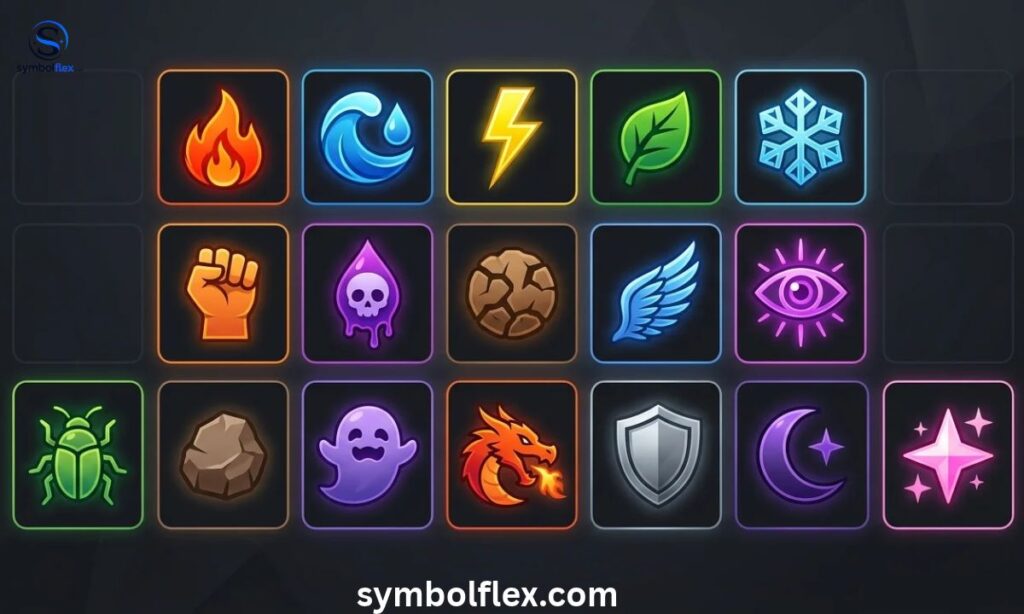
Every Pokémon battle starts with a tiny icon that tells you everything you need to know. That’s the Pokémon type symbol, the small graphic showing whether a Pokémon is Fire, Water, Psychic, or one of the other 18 official types.
These symbols decide who wins a fight before a single move is thrown, because type controls damage, resistance, and immunity. Some Pokémon carry two symbols at once, known as dual types, which stack strengths and weaknesses together.
This guide breaks down 45+ type symbols and combinations, what they mean, and how to use them to win.
What Are Pokémon Type Symbols?

Pokémon type symbols are the small icons used in the games, anime, and Trading Card Game to represent each of the 18 elemental categories a Pokémon can belong to — Fire, Water, Grass, Electric, and so on.
Every Pokémon has at least one type, and many have two (called dual types), which combine strengths and weaknesses from both.These symbols exist for one practical reason: to let players instantly recognize a Pokémon’s type advantages and weaknesses without reading a full description.
A flame icon means Fire type. A water droplet means Water type. Once you recognize the icon, you already know roughly how that Pokémon will perform in battle.
The 18 Pokémon Types and Their Symbols Explained
Here’s a breakdown of every type, its symbol design, and what it tells you at a glance.
| Type | Symbol Design | Quick Meaning |
| Normal | A plain circle/star | Balanced, no special resistances or immunities of note |
| Fire | A flame | Aggressive, burn-based offense |
| Water | A water droplet | Fluid, versatile, common early-game type |
| Grass | A leaf | Nature-based, often paired with healing moves |
| Electric | A lightning bolt | Fast, paralysis-focused offense |
| Ice | A snowflake | Powerful but fragile, freeze potential |
| Fighting | A fist | Raw physical power, strong against Normal/Rock/Steel |
| Poison | A skull or droplet | Status-focused, whittles opponents down |
| Ground | A crack in the earth | Strong against Electric, weak to Water/Grass/Ice |
| Flying | A wing/feather | Mobility-focused, immune to Ground |
| Psychic | An eye or spiral | Special-attack heavy, confusion effects |
| Bug | An insect silhouette | Early-game utility, strong against Psychic/Dark/Grass |
| Rock | A jagged stone | High defense, weak to common attacking types |
| Ghost | A mask or spirit | Immunities to Normal/Fighting, strategic pick |
| Dragon | A dragon head/claw | High stats, only weak to itself, Ice, and Fairy |
| Dark | A crescent or eye | Immune to Psychic, strong against Ghost |
| Steel | A gear or shield | Best defensive typing in the game, many resistances |
| Fairy | A flower or star | Counters Dragon, immune to Dragon damage |
Each icon is intentionally simple. Game designers needed symbols that read clearly at a small size on a Game Boy screen decades ago, and that same design logic carries through to modern games and the Trading Card Game today.
How Pokémon Type Symbols Work in Battle
Super Effective, Not Very Effective, and No Effect
Every type interaction in a battle falls into one of these outcomes:
- Super effective (2x damage): Fire moves against Grass, Water against Fire, and similar type advantages.
- Not very effective (0.5x damage): Water moves against Grass, Fire against Rock, and other type mismatches.
- No effect (immunity): Ground moves can’t hit Flying types, Normal and Fighting moves can’t hit Ghost types, and Electric moves can’t hit Ground types.
- Neutral (1x damage): No advantage either way — most matchups fall here.
Knowing these outcomes before you attack is the single biggest factor in winning battles, especially in competitive play where one wrong move can cost you a Pokémon.
How to Read the Type Chart Quickly
You don’t need to memorize all 18 types at once. Start with these shortcuts:
- Learn the triangle rivalries first — Fire beats Grass, Grass beats Water, Water beats Fire. This pattern repeats in other trios like Fighting, Flying, and Bug.
- Memorize the immunities — there are only a handful (Ghost vs. Normal/Fighting, Ground vs. Electric, Flying vs. Ground, Dark vs. Psychic, Fairy vs. Dragon, Steel vs. Poison). These matter more than most players realize.
- Treat Normal type as the baseline — it has no special advantages and only one weakness (Fighting), making it a useful reference point when comparing other types.
Dual-Type Symbols: Understanding Type Combinations
Most Pokémon aren’t single-typed — they combine two symbols, which stacks strengths and weaknesses from both types. This is where team-building gets interesting, because a dual type can either cover weaknesses or accidentally double them.
Some of the most common and strategically important dual-type combinations include:
- Water/Ice
- Fire/Flying
- Grass/Poison
- Electric/Steel
- Psychic/Fairy
- Dark/Ghost
- Rock/Ground
- Bug/Flying
- Steel/Dragon
- Fire/Fighting
- Water/Ground
- Grass/Dark
- Fairy/Flying
- Poison/Dark
- Ghost/Fairy
- Ice/Ground
- Steel/Fairy
- Dragon/Flying
- Bug/Steel
- Water/Fairy
- Fighting/Dark
- Normal/Flying
- Rock/Steel
- Grass/Flying
- Ice/Flying
- Poison/Flying
- Dragon/Ground
Each combination changes the math entirely. For example, a Water/Ice Pokémon looks tanky against Fire, but its Ice typing quadruples incoming damage from Fighting or Rock moves — a common trap for newer players. Before committing a dual-type Pokémon to your team, it’s worth checking both of its type weaknesses together, not just each one separately.
Full Pokémon Type Matchup Chart

Use this as a fast reference for planning attacks or defending your team.
| Type | Strong Against | Weak Against | Resistant To | Vulnerable To |
| Fire | Grass, Ice, Bug, Steel | Water, Rock, Ground | Fire, Grass, Ice, Steel, Fairy | Water, Rock, Ground |
| Water | Fire, Rock, Ground | Grass, Electric | Water, Fire, Ice, Steel | Grass, Electric |
| Grass | Water, Rock, Ground | Fire, Ice, Poison, Flying, Bug | Water, Grass, Electric, Ground | Fire, Ice, Poison, Flying, Bug |
| Electric | Water, Flying | Ground | Electric, Flying, Steel | Ground |
| Ice | Grass, Ground, Flying, Dragon | Fire, Fighting, Rock, Steel | Ice | Fire, Fighting, Rock, Steel |
| Fighting | Normal, Ice, Rock, Dark, Steel | Flying, Psychic, Fairy | Bug, Rock, Dark | Flying, Psychic, Fairy |
| Poison | Grass, Fairy | Ground, Psychic | Grass, Fighting, Poison, Bug, Fairy | Ground, Psychic |
| Ground | Fire, Electric, Poison, Rock, Steel | Water, Grass, Ice | Poison, Rock | Water, Grass, Ice |
| Flying | Grass, Fighting, Bug | Electric, Ice, Rock | Grass, Fighting, Bug | Electric, Ice, Rock |
| Psychic | Fighting, Poison | Bug, Ghost, Dark | Fighting, Psychic | Bug, Ghost, Dark |
| Bug | Grass, Psychic, Dark | Fire, Flying, Rock | Grass, Fighting, Ground | Fire, Flying, Rock |
| Rock | Fire, Ice, Flying, Bug | Water, Grass, Fighting, Ground, Steel | Normal, Fire, Poison, Flying | Water, Grass, Fighting, Ground, Steel |
| Ghost | Psychic, Ghost | Ghost, Dark | Normal, Fighting, Poison, Bug | Ghost, Dark |
| Dragon | Dragon | Ice, Dragon, Fairy | Fire, Water, Electric, Grass | Ice, Dragon, Fairy |
| Dark | Psychic, Ghost | Fighting, Bug, Fairy | Ghost, Dark, Psychic | Fighting, Bug, Fairy |
| Steel | Ice, Rock, Fairy | Fire, Fighting, Ground | Many types (best defensive typing) | Fire, Fighting, Ground |
| Fairy | Fighting, Dragon, Dark | Poison, Steel | Fighting, Bug, Dark, Dragon | Poison, Steel |
| Normal | — | Fighting | — | Fighting |
The Meaning Behind Each Type Symbol’s Design
Type symbols aren’t random — most are drawn from real-world elements, natural imagery, or visual metaphors that make them easy to recognize instantly:
- Fire, Water, and Grass draw directly from classical elemental symbolism, similar to systems used in ancient philosophy and folklore.
- Electric and Ice use literal physical phenomena (a bolt, a snowflake) rather than abstract icons, keeping recognition instant.
- Ghost, Dark, and Psychic lean into more abstract, mysterious shapes since these types represent less tangible forces.
- Fairy and Dragon were both introduced later in the series and use more ornate, stylized icons compared to the simpler original 15 types.
- Steel uses an industrial, mechanical icon to separate it visually from Rock, since both types share some defensive overlap.
This design logic is also why the icons translate so well across the games, anime, and Trading Card Game — a player who learns the symbol in one format instantly recognizes it in another.
Type Symbols Across Games, Anime, and the TCG
- Main series games: Type icons appear next to a Pokémon’s name in battle menus and in the Pokédex, letting players check type matchups instantly without needing external tools.
- Trading Card Game: Each type has a corresponding “Energy” card with its own symbol, and matching a Pokémon’s type to its Energy card is a core part of deckbuilding.
- Anime and merchandise: Type symbols show up on badges, trainer gear, and promotional art, often used as a shorthand to signal a character’s specialty (a Gym Leader’s Fire-type badge, for example).
Across all three formats, the symbols stay visually consistent, which is part of why they’re so widely recognized even by people who don’t actively play the games.
Building a Winning Team Using Type Symbols

A strong team isn’t just six powerful Pokémon — it’s six Pokémon whose types cover each other’s weaknesses. A few practical guidelines:
- Avoid shared weaknesses. If three of your Pokémon are all weak to Ice, one well-placed Ice-type opponent can wipe out half your team.
- Prioritize types with fewer weaknesses. Steel and Fairy types tend to resist more than they’re weak to, making them reliable defensive anchors.
- Balance offense and defense. A team full of glass-cannon attackers (like pure Electric or Psychic types) can struggle against bulky defensive types like Steel or Rock.
- Check dual-type math before adding a Pokémon. Combined weaknesses can stack — a Grass/Ice Pokémon, for instance, ends up weak to an unusually long list of types.
Common Mistakes Players Make With Type Matchups
- Forgetting immunities exist. Sending a Ground-type move against a Flying-type Pokémon does nothing, no matter how strong the move is.
- Ignoring the defending Pokémon’s second type. A Fire-type move might look strong against a Grass-type opponent, but if that opponent is also Water-type, the advantage disappears.
- Overvaluing offense, undervaluing resistance. A Pokémon that resists five types is often more valuable long-term than one with slightly higher raw power.
- Assuming type advantage guarantees a win. Stats, move power, and held items still matter — type is one factor, not the whole equation.
Frequently Asked Questions
How many Pokémon types are there in total?
There are 18 official Pokémon types in total, with Fairy being the most recently added type category.
What’s the strongest type in Pokémon?
No single type is strongest overall, but Steel and Fairy generally resist the most incoming attacks defensively.
Can a Pokémon have more than two types?
No, every Pokémon has either one type or exactly two types combined together in the official games.
What happens when a move hits an immune type?
The attacking move deals zero damage instantly, regardless of the Pokémon’s stats or overall move power level.
Why do type symbols matter outside battles?
They mostly matter within battles and Pokédex reference, though they also shape Trading Card Game deck design.
Conclusion
Pokémon type symbols look simple, but they carry the entire logic of the battle system inside them.
Once you understand what each icon represents, and how dual types combine strengths and weaknesses, team-building and battling stop feeling like guesswork and start feeling like strategy.
Keep the type chart handy, watch for immunities, and you’ll make sharper decisions in every matchup.
