

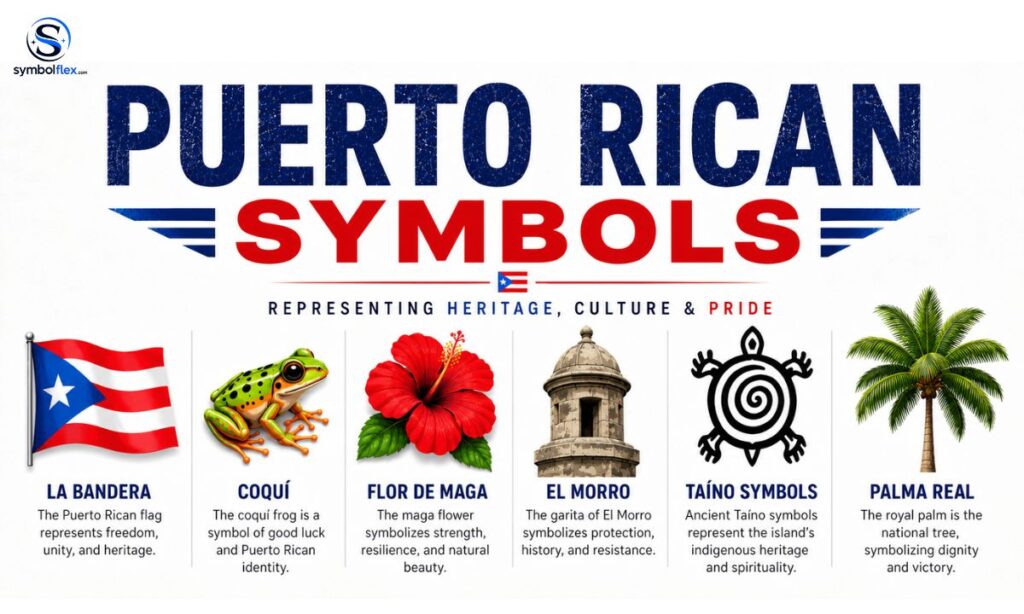
Puerto Rican symbols are the images, animals, and emblems, like the coquí frog and the Puerto Rican flag, that capture the island’s identity, history, and pride. They come from three cultures blending together: the Taíno people, Spanish colonial rule, and Puerto Rico’s modern political ties to the United States. That’s why a tiny frog carries so much emotional weight, and why an ancient carved spiral still shows up on jewelry today.
This guide covers over 100 Puerto Rican symbols and their meanings, from Taíno petroglyphs to official national emblems. You’ll learn what the coquí really represents, why the flag’s colors matter, and which symbols people pick most for tattoos. We’ll also clear up common myths, like the hibiscus vs flor de maga mix up, that most articles get wrong.
What Are Puerto Rican Symbols?

What makes Puerto Rican symbols unique is their layered origin. Most islands in the Caribbean draw from a mix of indigenous and colonial history, but Puerto Rico’s symbolism reflects three distinct cultural threads woven tightly together.
The Taíno people, the original inhabitants of the island, contributed nature based imagery like the sun, spirals, and frogs, often carved directly into stone. Spanish colonization added Catholic iconography, heraldic design (like the coat of arms), and Castilian language elements.
Later, the island’s political relationship with the United States shaped modern national symbols, from the official flag to more recent additions like the manatee, which was named Puerto Rico’s national mammal in 2011.One clear fact worth remembering: Taíno symbols predate European contact by centuries, with petroglyphs and carvings found at ceremonial sites like Caguana Ceremonial Ballcourts Site dating back roughly 800 years or more.
Puerto Rican Symbols And Their Cultural Meanings
Puerto Rican cultural symbols each carry their own layer of meaning, shaped by the specific historical moment or community that created them. Some come from indigenous spiritual practice, others from resistance movements, and others simply from everyday island life.
Puerto Rican Symbols And Meanings
Here’s a quick reference table covering some of the most searched Puerto Rican symbols and what they represent.
| Symbol | Origin | Meaning |
| Coquí frog | Taíno/folk | Identity, home, belonging |
| Flag (La Monoestrellada) | 1895 exile movement | Sovereignty, sacrifice, hope |
| Flor de maga | Native flora | Official national flower since 2019 |
| Ceiba tree | Taíno sacred tree | Strength, spiritual connection |
| Taíno sun | Petroglyph art | Life, guidance, energy |
| Pava hat | Jíbaro tradition | Humility, rural pride |
| Vejigante mask | Carnival tradition | Folklore, playful defiance |
| Piña colada | National drink | Hospitality, island flavor |
Each of these symbols shows up in different contexts, from tattoos to festival parades, and each one answers a slightly different question about what it means to be Puerto Rican. Some speak to nature and land, while others speak to political history and personal pride.
Puerto Rican Symbols Tattoos

Tattoos have become one of the most popular ways Puerto Ricans, both on the island and in the diaspora, express their Puerto Rican identity permanently. The most requested designs blend national pride with ancestral imagery, and many people choose combinations rather than a single symbol.
The Puerto Rican flag remains the single most common tattoo choice, often rendered in black and grey or full color, sometimes wrapped around an arm or paired with a map outline of the island. Right behind it is the coquí frog, which tattoo artists in San Juan and in cities like Orlando and New York report as a consistently requested design because of its emotional pull for people who grew up hearing its nightly call. Taíno tribal patterns, including sun faces and spiral motifs, round out the top three categories.
When getting a Taíno inspired tattoo, it’s worth taking a moment to learn the actual meaning behind the design rather than picking something purely for looks. Many Puerto Ricans see these tattoos as a way of honoring ancestry that colonization tried to erase, so treating the imagery with respect matters, whether you’re Puerto Rican yourself or getting the design as an outsider who appreciates the culture.
Taino Symbols And Meanings
Taíno symbols and meanings center almost entirely on nature, cosmology, and daily survival. The Taíno people, an Arawak speaking indigenous group, lived throughout the Caribbean including Puerto Rico before Spanish colonization, and they left behind a rich visual language carved into rock, pottery, and wooden objects.
The most recognized Taíno symbols include the sun (representing life and divine energy), the frog (fertility and rain), the spiral (cyclical time and water), and the cemí, a three pointed stone figure believed to represent gods or ancestral spirits. Cemís were considered physical vessels for spiritual power, and Taíno communities used them in ceremonies tied to agriculture, healing, and protection.
Beyond these well known figures, Taíno art also included carved faces, turtles, and bat imagery, each tied to specific deities or natural forces. Archaeologists studying sites across Puerto Rico have documented hundreds of these petroglyphs, giving modern researchers and curious travelers a direct window into a belief system that predates written history on the island.
Puerto Rican Symbols Copy And Paste
If you’re looking for symbols to copy and paste into a caption, bio, or design project, here are some practical options people commonly search for.
- Puerto Rico flag emoji: 🇵🇷
- Sun symbol: ☀
- Star symbol: ★ (echoing the flag’s lone star)
- Tropical accents: 🌺 🐸 🌴
There isn’t a dedicated coquí frog emoji available in standard Unicode, which is a common frustration people run into when searching for this. The closest widely used substitute is the general frog emoji 🐸, though it doesn’t capture the specific cultural weight of the coquí.
Puerto Rico Taino Symbols

Puerto Rico specific Taíno symbols show up most clearly at archaeological parks like Caguana in Utuado, where visitors can see original petroglyphs carved into stone monoliths surrounding a ceremonial ballcourt.
This site is one of the most important pre Columbian locations in the Caribbean and gives a real, physical connection to how Taíno communities on the island expressed spiritual belief through carved imagery.
These symbols weren’t decorative in the way modern people might assume. Each carving likely held ceremonial or communicative purpose, whether marking sacred space, honoring a deity, or recording an important event for a community that had no written alphabet.
Puerto Rico Taino Symbols Tattoos
Tattoo designs based on Puerto Rico’s specific Taíno heritage often reference these exact petroglyph styles rather than generic tribal art. Popular choices include the coquí carved in petroglyph style, the spiral representing water and life cycles, and the sun face associated with Yúcahu, a major Taíno deity connected to cassava crops and the sea.
People choosing these designs frequently describe them as a way to reconnect with ancestry that was suppressed for generations under colonial rule, making the tattoo feel less like decoration and more like reclamation.
Famous Symbols That Represent Puerto Rico
The most famous symbols representing Puerto Rico combine natural icons, like the coquí frog and the sun, with man made emblems, like the flag and coat of arms. Together they form the visual identity most people recognize instantly.
Taino Sun Symbol Meaning
The Taíno sun symbol centers on life force, divine guidance, and cosmic order. In Taíno cosmology, the sun was closely tied to Yúcahu, one of the most important deities, associated with fertility, the sea, and the growth of yuca, a staple crop. Sun imagery appears frequently across petroglyphs and pottery found throughout Puerto Rico.
Today, the sun symbol shows up in modern Puerto Rican jewelry, artwork, and tattoos as a way to represent positivity, ancestral connection, and personal energy, often stripped of its original religious context but still carrying that deep historical root.
Puerto Rico Symbol Frog
The frog, specifically the coquí, stands as arguably the single most beloved Puerto Rico symbol. Named after the sound it makes, a repeated “co quí” call heard almost everywhere on the island after dark, the coquí has become shorthand for home itself among Puerto Ricans living abroad.
One notable fact: the coquí is found natively only in Puerto Rico, and attempts to relocate the frog elsewhere have consistently failed because it can’t reproduce successfully outside its native environment. This uniqueness is part of why the phrase “de aquí como el coquí” (from here, like the coquí) became such a popular expression of authentic island identity.
Puerto Rican Symbols Toa

“Toa” refers to an ancestral Taíno name tied to the island, appearing today in municipality names like Toa Baja and Toa Alta. Historically, some accounts suggest regional Taíno communities used variations of this name before Spanish colonization renamed and reorganized the island’s geography.
While less commonly discussed than the flag or coquí, Toa represents an important piece of linguistic heritage, showing how Taíno words survived colonization and still shape everyday place names across modern Puerto Rico.
Taino Puerto Rican Symbols
Beyond the sun and frog, other Taíno Puerto Rican symbols include carved turtles (associated with longevity and protection), birds (messengers between worlds), and human faces believed to represent specific ancestors or spirits. These motifs commonly appear together on ceremonial objects called dujos, wooden seats reserved for chiefs and spiritual leaders.
Puerto Rican Tattoos
Beyond Taíno themes, broader Puerto Rican tattoos often feature patriotic phrases in Spanish, outlines of the island’s map, or portraits paying tribute to family members who emigrated to the mainland.
Many tattoo studios in cities with large Puerto Rican populations, including parts of New York and Florida, report steady demand for these designs year round, with spikes around Puerto Rican Day Parade season each June.
Puerto Rican Taino Symbols
Lesser covered Taíno symbols worth knowing include the three pointed zemi stones (used in agricultural ceremonies to encourage good harvests) and the batey, the ceremonial ball court itself, which some scholars believe held ritual and social significance beyond simple recreation.
Puerto Rico Symbols
Wider Puerto Rico symbols include the royal palm tree, a common sight across the island’s landscape and a frequent subject in local art, along with the piragua (shaved ice cart), a beloved street food symbol tied to everyday island culture rather than official government recognition.
Symbols Of Puerto Rico
Officially recognized symbols of Puerto Rico include the flag, the coat of arms, the anthem “La Borinqueña,” the flor de maga as national flower, the ceiba as national tree, and the coquí as national amphibian.
Some sources also cite the Puerto Rican spindalis as a de facto national bird, though the Puerto Rican Amazon parrot and the Puerto Rican tody have both been discussed in various legislative and cultural contexts over the years.
Puerto Rican Protection Symbols
Puerto Rican protection symbols blend Taíno spiritual practice with Spanish Catholic folk tradition. Many families historically used azabache bracelets, a black stone charm believed to ward off “mal de ojo” (the evil eye), especially for infants. This tradition arrived with Spanish colonization but merged naturally with existing indigenous beliefs about spiritual protection tied to nature and ancestral spirits.
Certain Taíno cemí figures were also believed to protect households and crops, reinforcing how deeply intertwined spiritual safety and daily survival were in pre colonial Puerto Rican life.
Traditional Puerto Rico Symbols And National Identity
Traditional Puerto Rico symbols reinforce national identity by connecting everyday Puerto Ricans, especially those living far from the island, back to a shared sense of heritage and belonging.
Things That Represent Puerto Rico
Things that represent Puerto Rico go well beyond official emblems. Food, like mofongo and arroz con gandules, music genres like salsa and bomba y plena, and even baseball, recognized as the national sport, all carry cultural weight equal to any formal symbol.
Puerto Rico Symbols And Meanings
Symbols and their meanings often shift depending on historical context. The flag, for example, once represented pure independence sentiment in 1895 but took on new resilience related meaning after events like Hurricane Maria in 2017, when it became a widely shared image of survival and collective strength.
Puerto Rico National Symbols
Puerto Rico’s officially documented national symbols include the flag, seal, coat of arms, national anthem “La Borinqueña,” the flor de maga flower, the ceiba tree, the coquí amphibian, and the manatee as national mammal, designated in 2011. The piña colada is also recognized as the island’s official national drink, adopted in 1978.
Puerto Rico Symbol
If forced to choose just one Puerto Rico symbol as the most representative, most people would point to either the flag or the coquí. The flag carries political and historical weight tied to sovereignty debates, while the coquí carries emotional weight tied purely to home and belonging, making the debate less about accuracy and more about what kind of connection resonates most with the individual.
Deep Symbolic Meaning
Puerto Rican symbols carry meaning that goes far beyond decoration, often reflecting themes of resilience, resistance, and survival across generations. Understanding this deeper layer requires looking at the island’s full historical arc.
From the Taíno era, through centuries of Spanish colonization, into the current political relationship with the United States, Puerto Rican symbolism has consistently adapted to reflect the moment.
The flag’s ban under the Gag Law between 1948 and 1957 turned it into an act of resistance simply by displaying it. The coquí’s uniqueness to the island became a metaphor for Puerto Rican identity itself, something that can’t survive or be replicated anywhere else in the world.
This pattern, where symbols absorb new meaning during moments of political or natural crisis, explains why Puerto Rican iconography still feels alive and relevant rather than locked into museum display cases.
Types and Variations of Puerto Rican Symbols
Puerto Rican symbols fall into several clear categories: natural icons, official national emblems, and ancient Taíno motifs, each with its own variations and history.
The Coquí Frog
Beyond its role as an emotional symbol, the coquí is scientifically notable because it skips the tadpole stage entirely, developing directly inside the egg into a fully formed miniature frog. This unusual biology adds another layer to why the species feels so specifically tied to Puerto Rico’s identity.
The Sun Symbol (Taíno Sun)
Variations of the Taíno sun symbol include a simple radiating design and a more complex spiral sun, both found across petroglyph sites on the island. Modern jewelry designers frequently borrow these patterns for pendants and earrings marketed toward people seeking a connection to Taíno heritage.
The Puerto Rican Flag
The current flag design was first adopted in exile on December 22, 1895, in New York City, created by reversing the red and blue colors of the Cuban flag as an act of solidarity between the two independence movements.
It became the official flag of the Commonwealth of Puerto Rico on July 25, 1952, though the original light blue triangle shade has since been replaced in most official reproductions with a darker navy blue, a change that remains politically debated among independence supporters and statehood advocates alike.
The Coquí Taíno Symbol
While the coquí as a pop culture icon is a relatively modern phenomenon, frog imagery does appear in some Taíno era artifacts, suggesting the animal held at least some symbolic value related to fertility and rain long before it became the beloved mascot it is today.
The Hibiscus Flower
Here’s a correction worth making clearly: many articles online mistakenly call the hibiscus Puerto Rico’s national flower. The actual official flower, designated by law in 2019, is the flor de maga (Thespesia grandiflora), a native species. The hibiscus is a closely related, widely grown plant, which explains the common confusion, but it holds no official designation.
The Taíno Spiral
The Taíno spiral, carved as concentric circles or a swirling line into stone, represents the cycle of water, life, and cosmic movement, closely tied to the rivers and hurricanes that shaped Taíno understanding of the natural world.
Puerto Rican Symbols Across Cultures
Puerto Rican symbols share deep roots with those of neighboring islands like Cuba and the Dominican Republic, since all three share Taíno ancestry, but each island’s modern symbolism diverged based on its distinct colonial and political path. Cuba’s flag directly inspired Puerto Rico’s design, while the Dominican Republic developed its own separate national iconography despite similar indigenous origins.
Within the United States, Puerto Rican symbols take on renewed life through diaspora communities. The Puerto Rican Day Parade in New York City, one of the largest cultural celebrations in the country, turns flags, coquí imagery, and jíbaro inspired clothing into a massive, visible display of pride each June, reinforcing identity for a population living far from the island itself.
Puerto Rican Symbols in Art, Movies and Pop Culture
Puerto Rican symbols appear consistently across murals in San Juan neighborhoods like Santurce, where local artists frequently incorporate the coquí, flag colors, and Taíno motifs into large scale public art. These murals often double as tourist attractions and statements of cultural pride simultaneously.
In film and music, Puerto Rican imagery has become more visible on the mainland over recent decades, with the flag frequently appearing in music videos, merchandise, and public performances tied to Puerto Rican artists. This visibility has helped fuel a broader market for Puerto Rican themed clothing and accessories sold both on the island and across US cities with large Puerto Rican populations.
Spiritual and Dream Meaning of Puerto Rican Symbols
Spiritually, many Puerto Rican symbols trace back to Taíno cosmology, where cemís served as physical connections between the human and spiritual world. Some folk traditions suggest that dreaming of symbols like the sun or a frog carries meaning tied to renewal, guidance, or an upcoming change, though these interpretations come from folk belief rather than documented Taíno religious texts, since much of that original spiritual system was lost or altered under colonization.
It’s worth approaching these spiritual interpretations with respect rather than certainty. They represent a blend of surviving indigenous belief and later folk tradition, shaped by centuries of cultural mixing rather than a single, unbroken spiritual doctrine.
Positive vs Negative Meaning
Most Puerto Rican symbols carry overwhelmingly positive associations tied to pride, resilience, and heritage. However, a few carry more complicated histories. The coat of arms, for instance, includes Catholic and Spanish colonial imagery that some view as a reminder of conquest rather than pure celebration.
Political context also shapes meaning. The flag can represent unity and pride to one person while symbolizing an unresolved question about Puerto Rico’s political status, whether that’s statehood, independence, or continued commonwealth status, to another.
Why Humans Are Attracted to Puerto Rican Symbols
People are drawn to Puerto Rican symbols because they offer a clear, visual anchor for identity, especially valuable for diaspora communities trying to maintain a connection to a homeland they may not live in daily. Nature based symbols like the coquí and hibiscus also tap into a broader human tendency to find meaning in the natural world around us.
There’s also a growing interest across the United States in ancestry and heritage exploration generally, which has pushed more people, Puerto Rican and otherwise, toward heritage tattoos and cultural symbol research as a way of grounding personal identity in something bigger than themselves.
Frequently Asked Questions
What is the most important symbol of Puerto Rico?
The flag stands as the most important symbol, representing sovereignty, sacrifice, and national pride for Puerto Ricans everywhere.
What does the coquí frog symbolize?
The coquí symbolizes home, identity, and belonging, since it’s found nowhere else in the world naturally.
Is the hibiscus really Puerto Rico’s national flower?
No, the official national flower is the flor de maga, designated by law in 2019, not hibiscus.
What do Taíno spiral symbols mean?
Taíno spirals represent water cycles, life, and cosmic movement, reflecting rivers and hurricanes central to their beliefs.
What is the meaning behind the Puerto Rican flag’s colors?
Red represents bloodshed and sacrifice, white symbolizes victory and peace, blue represents liberty and government.
Conclusion
Puerto Rican symbols carry far more weight than simple decoration. From ancient Taíno petroglyphs carved centuries before European contact to the modern flag that survived decades of legal suppression, these symbols tell the story of a people who’ve held onto their identity through colonization, political uncertainty, and natural disaster alike.
Whether you’re drawn to the coquí’s unmistakable call, the deep spiritual roots of the Taíno sun, or the quiet pride carried in a well worn flag, exploring these symbols offers a genuine window into Puerto Rican culture and history.
