

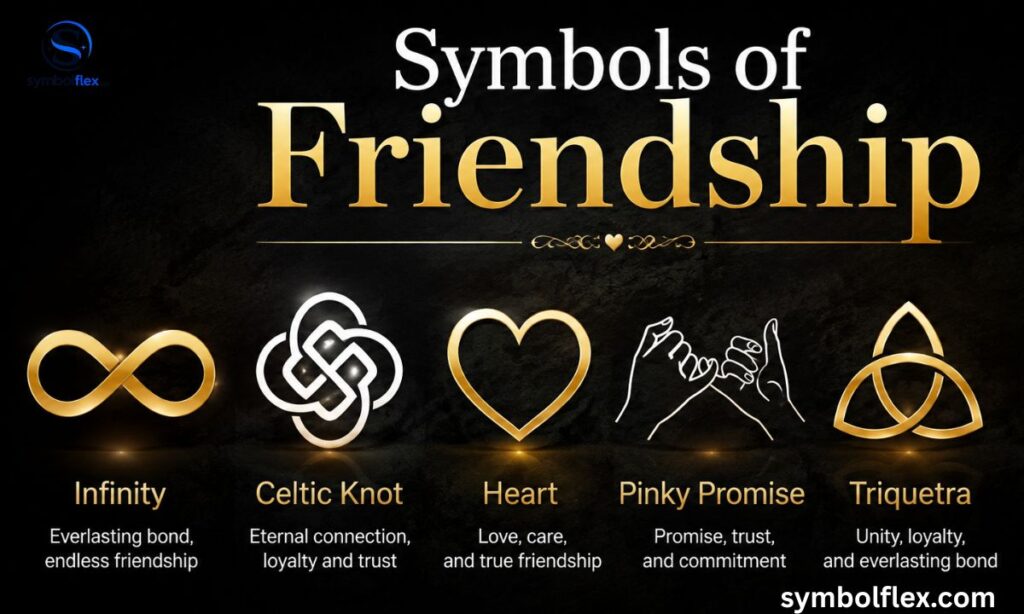
Symbols of friendship are objects, images, and gestures, like the yellow rose, the Claddagh ring, and the infinity sign, that people use to turn an invisible bond into something you can actually see and hold onto. Think about the last time a small gift meant way more than its price tag.
Maybe it was a bracelet, a ring, or a plant you and a friend picked out together. That object became a stand in for years of memories, inside jokes, and quiet support. This guide walks through more than 57 of these symbols, pulling from ancient history, world cultures, spiritual traditions, and the trends shaping how people express friendship today.
Here’s one fact worth remembering: the National Cherry Blossom Festival in Washington, D.C. exists because Japan gifted the United States thousands of cherry trees in 1912 as a gesture of friendship between the two nations. That single event shows how a natural symbol can carry both diplomatic and deeply personal weight at the same time, something worth keeping in mind as you read through the rest of this list.
What Are Symbols of Friendship?

A symbol of friendship is any image, object, or gesture that represents trust, loyalty, and emotional connection between two people. These symbols exist because words alone often fall short when you’re trying to describe a bond that took years to build.
Humans are visual creatures, and we’ve relied on symbols long before most people could read or write. A shared meal, a handshake, or an exchanged token could communicate loyalty across a language barrier in ways a spoken promise couldn’t always guarantee. That’s part of why friendship symbols show up so consistently across ancient civilizations that never had contact with each other. The instinct to physically represent a bond seems to be universal rather than culturally specific.
Today, these symbols show up everywhere: in jewelry stores, on tattoo parlor walls, in greeting cards, and even in emojis on your phone. A friendship symbol can be as simple as a daisy chain made by kids at summer camp or as formal as an Irish Claddagh ring passed down through generations. What connects all of them is intention. Someone chose that object specifically because it said something a plain “I appreciate you” couldn’t fully capture.
Beautiful Symbols Of Friendship And Their Meanings
The most beautiful friendship symbols tend to come from nature, since flowers, trees, and natural pairings have represented loyalty and companionship for centuries. This category covers everything from garden flowers to entire trees planted as diplomatic gestures.
Nature offers something that manufactured objects can’t always match: a living, growing reminder of a relationship. A tree planted the year two friends met keeps growing right alongside the friendship itself. That kind of parallel growth is part of why natural symbols feel so emotionally resonant, and why they show up again and again in gift-giving traditions across the United States and beyond.
Beyond flowers and trees, this category also includes small, everyday objects that don’t require any special meaning to be assigned to them by scholars or historians. A matching keychain, a shared houseplant, or a friendship bracelet made from embroidery floss all qualify. What they share is accessibility. You don’t need money or rare materials to create a symbol of true friendship; you just need intention.
Symbols Of Friendship In Nature
Nature has offered humans some of the oldest symbols of friendship, long before jewelry or written language existed. Birds that mate for life, trees with intertwined roots, and even bees working together in a hive have all been used as metaphors for loyal companionship.
Intertwined trees, sometimes called “husband and wife trees” in some regions when they grow wrapped around each other, are also used to represent close friendships that have grown together over time. The image of two separate trunks becoming one visual form as they mature is a powerful, almost literal picture of what a lifelong friendship looks like from the outside.
Bees are another interesting case. A single bee can’t survive alone, and an entire hive depends on cooperation to function. That’s why some cultures use bee imagery, including bee shaped jewelry, as a nod to friendship symbols in nature that emphasize teamwork and mutual support rather than individual achievement.
Flowers That Symbolize Friendship
Several flowers, including the yellow rose, chrysanthemum, and zinnia, are widely recognized in the United States as flowers that symbolize friendship rather than romance. Each one developed its meaning through a slightly different cultural path.
The table below breaks down some of the most common friendship flowers and what they typically represent:
| Flower | Meaning | Common Occasion |
| Yellow rose | Warmth, joy, platonic loyalty | Congratulations, thank you gifts |
| Chrysanthemum | Long life, cheerfulness | Friendship anniversaries |
| Zinnia | Lasting affection between friends | General gifting |
| Ivy | Fidelity and enduring bonds | Housewarming or milestone gifts |
Chrysanthemums are especially interesting because in several Asian cultures they also represent longevity, which adds another layer of meaning when given between friends: not just “I value you,” but “I hope we know each other for a long time.” That kind of double meaning is common across flowers that symbolize friendship, and it rewards a little research before you choose one as a gift.
Friendship Flowers
The tradition of assigning specific meanings to flowers, known as floriography, became especially popular in Victorian England and later shaped American gift-giving customs around friendship. During the Victorian era, people used flower arrangements to send messages they couldn’t say aloud, since open displays of emotion were often considered improper.
That coded language eventually simplified over time, but the core idea stuck around: certain flowers are “supposed” to mean certain things, and giving the right one shows thoughtfulness. In the U.S. today, florists and gift shops still market friendship flowers using this same logic, even if most customers don’t know the full Victorian backstory.
This history also explains why flower meanings can vary slightly depending on the source you check. Floriography was never fully standardized, so different guidebooks from the 1800s sometimes disagreed on details. What has remained consistent, though, is the general idea that soft yellow and white flowers tend to represent friendship, while deep red tends to stay associated with romance.
Because Cherry Blossoms Are Symbols Of Friendship
Cherry blossom trees became one of the most famous symbols of friendship in American history after Japan gifted more than 3,000 trees to Washington, D.C. in 1912. The gesture, arranged between the mayor of Tokyo and officials in the U.S. capital, was meant to represent the growing bond between the two nations.
First Lady Helen Taft and the wife of the Japanese ambassador at the time planted the first two trees along the Potomac River, and some of those original trees are still alive today. That level of longevity adds real weight to the symbolism: this wasn’t just a one-time gesture, it was something that continued to bloom, quite literally, for over a century afterward.
This history is also why the National Cherry Blossom Festival is held every spring in Washington, D.C., drawing over a million visitors who come specifically to see this symbol of friendship in full bloom. It’s a rare example of a natural symbol being used on a national, diplomatic scale rather than just between individuals, and it shows how the same symbolism that applies to two best friends can scale up to represent friendship between entire countries.
Easy Symbols Of Friendship

If you’re looking for simple, low-cost ways to represent friendship, options like matching bracelets, handshakes, puzzle piece pendants, and shared playlists all qualify as easy, modern symbols. None of these require deep historical knowledge or expensive materials to feel meaningful.
Puzzle piece jewelry has become especially popular in the U.S. because it offers a visual metaphor almost anyone understands immediately: two pieces that only make sense when they’re together. It’s a modern invention rather than an ancient one, but it fits neatly into the same emotional category as older symbols like the Claddagh ring.
Other easy symbols of friendship include things like handwritten notes tucked into a friend’s bag, a specific song two people consider “theirs,” or even a recurring inside joke that only makes sense to the two of you. These informal, personal symbols don’t show up in history books, but they matter just as much emotionally as the ones with centuries of tradition behind them.
Popular Friendship Symbols In Culture
Popular culture has taken older friendship symbols, like knots and infinity signs, and turned them into some of the most requested tattoo designs and gift ideas in the United States today. This section covers how symbolism moves from tradition into everyday self-expression.
Tattoos, jewelry, and literature all serve a similar function: they let people carry a symbol with them permanently, or at least for a long time, rather than just using it once during a single gift exchange. That permanence is part of why so many people search specifically for tattoo ideas tied to friendship rather than just gift ideas.
This category also reflects how quickly symbolism can evolve. Something that felt niche just a decade ago, like matching internet meme tattoos, can become mainstream within a few years as social media spreads the idea faster than word of mouth ever could.
Symbols Of Friendship Tattoos
Some of the most requested friendship tattoo designs in the U.S. include the infinity symbol, small matching stars, anchors, and simple line drawings that split into two halves. These designs are popular specifically because they’re small, meaningful, and easy to place discreetly.
Tattoo artists often report that clients getting symbols of friendship tattoos want something that won’t look dated in ten years, which is part of why simple geometric designs, like a single infinity loop, tend to outperform more elaborate or trend-based imagery in terms of long-term satisfaction.
Placement matters here too. Wrist, ankle, and behind-the-ear tattoos are common choices for friendship ink specifically because they’re personal and visible mainly to the wearer, rather than being a large, public statement piece the way a sleeve tattoo might be.
Friendship Symbols Tattoo

A popular twist on friendship tattoos involves splitting one image into two halves, so each friend gets one half and the design only looks complete when the two are placed side by side. Broken heart designs, half-moon and sun pairings, and split coordinate tattoos all fall into this category.
This approach adds a layer of meaning beyond just matching designs. It visually represents the idea that each person is only “whole” in the sense of the artwork when they’re together, which resonates strongly with people describing their closest friendships as feeling incomplete without the other person around.
Shared date tattoos are another common variation, often marking the day two people met or a significant shared memory. Unlike more symbolic designs, these are deeply personal and don’t carry a universal meaning outside of the two people who chose them, which is exactly the appeal for a lot of people getting this kind of friendship symbol tattoo.
Symbol About Friendship
Beyond tattoos, common symbols about friendship that show up in cards, gifts, and social media include linked hearts, clasped hands, and the classic “BFF” heart split in two. These are less permanent than tattoos but just as widely recognized.
Greeting card companies and gift retailers in the U.S. lean heavily on this kind of visual shorthand because it communicates instantly, without needing any explanation. A card with two interlocking hearts on the front doesn’t need to say “friendship” anywhere in the text; the image already does that work.
Social media has added its own layer here too, with certain emoji combinations becoming informal, widely understood symbols about friendship among younger generations, even though none of them existed even fifteen years ago.
Symbols Of Friendship In Literature
Authors have long used physical objects, shared meals, and recurring imagery to represent friendship bonds between characters, often letting the object carry emotional weight that dialogue alone couldn’t. This literary device shows up across genres and eras.
A shared object passed between characters, whether it’s a piece of jewelry, a specific book, or even a simple childhood toy, often functions as a stand-in for the entire relationship. When that object reappears later in a story, often after a falling out or a long separation, its return usually signals that the friendship itself is being repaired or remembered.
This technique works because readers pick up on symbolism instinctively, even without a lecture explaining it. Symbols of friendship in literature rely on the same psychological principle as symbols in real life: an object becomes meaningful because of the relationship attached to it, not because of anything inherent in the object itself.
Symbols Of Friendship And Love
The line between symbols of friendship and symbols of love is often thinner than people expect, since the same flower, color, or gesture can shift meaning depending on context. Roses are the clearest example of this overlap.
Red roses are almost universally tied to romantic love in Western culture, while yellow roses shifted over time to represent platonic warmth and friendship instead. That single color change carries an entire different emotional message, which is why florists in the U.S. will often ask directly what kind of relationship a bouquet is meant for before making a recommendation.
This overlap isn’t a flaw in the symbolism system, it’s actually part of what makes symbols of friendship and love so flexible. The same base symbol, like a heart or a ring, can be adjusted slightly (through color, wording, or design) to communicate exactly the kind of relationship being represented.
Smiling Critters Symbols Of Friendship
Character-based friendship symbolism has become especially popular with younger audiences through media franchises built around cute, expressive characters designed to represent loyalty and companionship. This is a distinctly modern category compared to the historical symbols covered elsewhere in this guide.
These character-driven symbols work differently than traditional ones. Instead of relying on centuries of shared cultural meaning, they build meaning quickly through repeated exposure, merchandise, and online communities that form around shared fandom. A plush toy or a character keychain can become a genuine symbol of friendship between two people simply because they both love the same show or game.
This trend reflects a broader shift in how younger Americans express friendship: increasingly through shared fandoms and digital culture rather than through the flowers, jewelry, and knots that dominated earlier generations. It’s a reminder that friendship symbolism isn’t frozen in the past; it keeps evolving alongside culture itself.
Ancient And Global Friendship Symbols
Friendship symbolism isn’t a modern invention. Ancient civilizations across Egypt, Greece, Rome, and Celtic Europe all developed their own specific tokens and traditions to represent loyal bonds between people. This section looks at where a lot of today’s symbols originally came from.
What’s striking when you look across these ancient traditions is how similar the underlying instinct was, even though these civilizations had no contact with each other. Shared meals, shared drinking vessels, and exchanged tokens all appear independently across cultures separated by oceans and centuries, suggesting this need to physically represent friendship is close to a universal human trait rather than something one culture invented and others copied.
Understanding these ancient roots also helps explain why certain modern symbols, like the Claddagh ring or the Celtic knot, still feel meaningful today rather than arbitrary. They’re not marketing inventions; they’re the tail end of traditions that have been carried forward, sometimes with modifications, for hundreds or even thousands of years.
Ancient Symbols For Friendship
In ancient Rome, the concept of “amicitia” described a formal, almost contractual type of friendship, and Romans sometimes exchanged rings or tokens to mark these bonds publicly. This wasn’t just casual companionship; amicitia carried real social and even political weight.
Shared meals also carried enormous symbolic weight in many ancient societies. Breaking bread together wasn’t just a practical way to eat; it was often understood as a public declaration of trust, since sharing food with someone implied you weren’t worried about being poisoned or betrayed by them.
These early ancient symbols for friendship set a pattern that’s still visible today: physical acts (sharing something, exchanging something, or wearing something) carry more emotional weight than words alone. That pattern hasn’t really changed in thousands of years, even though the specific objects and gestures have evolved.
Ancient Symbols Of Friendship
Ancient Greek philosophy, particularly through the concept of “philia,” treated friendship as one of the highest forms of love, distinct from romantic or family love. This philosophical framing shaped how symbols of friendship developed differently in Greek culture compared to more transactional traditions elsewhere.
Greek pottery and artwork from this era occasionally depicted friends sharing a drinking cup or reclining together at a shared table, visual scenes meant to represent trust and closeness rather than just documenting a meal. These images functioned almost like early advertisements for the values a society wanted to promote.
Looking at these ancient symbols of friendship side by side with Roman traditions shows an interesting contrast: Rome treated friendship somewhat like a social contract with obligations attached, while Greek philosophy treated it as something closer to a moral virtue worth pursuing for its own sake. Both approaches still influence how friendship gets symbolized today, sometimes through formal gestures and sometimes through purely emotional ones.
Symbols Of Friendship Around The World
Different regions of the world developed distinct friendship symbols independently, from African beadwork to Chinese red string traditions to Native American ceremonial objects. No single culture holds a monopoly on this kind of symbolism.
In parts of West Africa, specific bead colors and patterns have historically been used to signal social bonds and relationships within a community, functioning almost like a visual language readable by anyone familiar with local customs. In China, the idea of a red thread connecting people, most often discussed in the context of fated relationships, has also been applied more broadly to close friendships that feel destined rather than accidental.
Looking at symbols of friendship around the world side by side makes one thing clear: while the specific objects differ wildly, from beads to threads to rings, the underlying purpose stays remarkably consistent across every culture examined. People everywhere seem to need a physical, visible way to mark an emotional bond that would otherwise remain invisible.
Celtic Symbols Of Friendship

The Celtic knot is one of the most recognizable Celtic symbols of friendship, representing an unbroken, continuous line with no clear beginning or end. That endless loop design has made it a natural fit for representing bonds meant to last a lifetime.
Celtic knots appear throughout early medieval manuscripts and stone carvings, long before they became popular in modern jewelry. Historians generally agree the knot patterns were originally decorative and spiritual rather than specifically designed to represent friendship, but over time the symbolism attached to their unbroken structure became strongly associated with loyalty and eternal connection.
This is a good example of how symbolism can shift over centuries. The people carving these knots into stone crosses weren’t necessarily thinking “this represents my best friend,” but the visual logic of an unending line was flexible enough that later generations naturally applied it to any relationship meant to be permanent, friendship very much included.
Irish Symbols Of Friendship
The Claddagh ring is the most well-known Irish symbol of friendship, featuring two hands holding a heart topped with a crown, representing friendship, love, and loyalty respectively. It originated in the small fishing village of Claddagh, just outside Galway city on Ireland’s west coast.
According to the most commonly told origin story, a Galway man named Richard Joyce was captured and sold into servitude as a young man, and while training under a goldsmith during his captivity, he designed the ring for the woman he loved back home. After eventually winning his freedom, Joyce returned to Ireland and presented her with the ring, and the design has been passed down and reproduced ever since.
What makes the Claddagh especially interesting compared to other Irish symbols of friendship is how much detail its wearing customs carry. Traditionally, wearing the ring on the right hand with the heart facing outward signals you’re single, while wearing it on the left hand with the heart facing inward signals you’re married. Few friendship symbols come with that level of built-in nuance.
What Are Some Symbols Of Friendship?
Some of the most recognized symbols of friendship include the yellow rose, the Claddagh ring, the infinity symbol, friendship bracelets, the Celtic knot, and interlocking circles. Each carries slightly different cultural roots but communicates a similar underlying message.
If you’re searching for a quick answer rather than a deep historical dive, these six examples cover most of what people typically mean when they ask this question. They span nature (the rose), craftsmanship (the ring and bracelet), mathematics inspired imagery (infinity), ancient design (the knot), and modern minimalism (interlocking circles).
Beyond these six, dozens of smaller, more personal symbols exist too, from matching keychains to shared tattoos to specific songs. What ties every answer to “what are some symbols of friendship” together is the same core idea: an object or image chosen specifically to represent trust and connection between two people.
Bff Symbols Of Friendship
Modern BFF symbols popular among American teens and young adults include split heart necklaces, matching bracelets, and paired keychains that only look complete when both halves are together. These designs took off heavily in the 2000s and 2010s and remain popular today.
Unlike older traditions like the Claddagh ring, BFF symbols of friendship tend to be mass produced, affordable, and widely available at shopping malls rather than tied to a single specific cultural origin. That accessibility is a big part of their appeal; a group of friends can each buy a matching piece for just a few dollars.
Despite being commercially produced rather than steeped in centuries of history, these symbols still hold real emotional weight for the people wearing them. The meaning doesn’t come from ancient tradition in this case; it comes entirely from the relationship the object represents, which is really true of most friendship symbols regardless of their origin.
Symbols Of Friendship Gifts
Popular symbols of friendship gifts include Claddagh rings, potted ivy plants, custom friendship knot bracelets, and yellow rose bouquets. Choosing the right one usually depends on the tone of the relationship and the occasion.
A potted plant, like ivy, works particularly well as a gift because it grows over time, mirroring the way the friendship itself is expected to grow. It also carries less romantic weight than flowers like roses can sometimes imply, making it a safer choice for newer friendships or professional relationships that are still developing.
For closer, longer-standing friendships, something more personal like a custom bracelet or a small piece of jewelry tends to land better than a generic gift. The goal with any symbol of friendship gift is matching the weight of the object to the actual weight of the relationship; an elaborate gift for a brand new friendship can feel oddly intense, while a thoughtful, simple gift for a decades-long friendship can feel exactly right.
Friendship Symbols
Taken together, the ancient and global symbols covered so far show that friendship symbolism is remarkably consistent across history, even when the specific objects vary widely by region and era. From Roman amicitia to Irish claddagh rings to Chinese red string traditions, the core purpose never changes.
This consistency matters because it suggests something bigger than coincidence. Humans across completely disconnected societies arrived at similar solutions to the same problem: how do you make an emotional bond visible and lasting? That’s a strong argument for why these symbols still resonate today, even in a culture as digitally connected and fast moving as the modern United States.
As we move from these historical and global roots into deeper symbolic meaning, it’s worth keeping this consistency in mind. The specific friendship symbols change, but the human need behind them really doesn’t.
Deep Symbolic Meaning
Friendship symbols operate on more than just a visual level; they carry spiritual, psychological, and cultural meaning that shapes why certain images resonate so strongly with people. Understanding these layers helps explain why a simple object, like a ring or a knot, can feel so emotionally significant.
Most people don’t consciously think through all three of these layers when they choose or receive a friendship symbol, but all three are usually operating at once. A gift might feel spiritually meaningful, psychologically comforting, and culturally recognizable all at the same time, even if the person giving it only consciously thought about one of those layers.
Breaking these layers apart individually makes it easier to understand why some symbols land more powerfully than others, and why the same object can mean something slightly different depending on who’s receiving it.
Spiritual Level
On a spiritual level, many traditions treat friendship symbols as protective or soul connecting, suggesting a bond that goes beyond the physical relationship itself. This framing shows up in various belief systems that treat close friendship as something closer to a spiritual partnership.
Some traditions describe deep friendships using language usually reserved for family or even spiritual guides, suggesting that a true friend serves a protective, almost guardian like role in a person’s life. Symbols meant to represent this kind of bond, like protective charms or paired amulets, lean into that idea directly.
This spiritual layer also explains why some people feel drawn to specific symbols without being able to fully articulate why. A spiritual friendship symbol doesn’t always need a logical explanation to feel meaningful; sometimes the pull toward a particular image is more intuitive than analytical.
Psychological Level
Psychologically, humans bond meaning to physical objects because doing so reinforces social identity and strengthens feelings of belonging. This is a well documented pattern in how people relate to meaningful possessions generally, not just friendship symbols specifically.
When two friends both wear a matching bracelet, the object itself becomes a kind of anchor for the relationship. Every time either person sees or touches it, they’re reminded of the bond it represents, which reinforces the relationship even when the two people aren’t physically together.
This is part of why friendship symbols tend to be worn or displayed rather than hidden away. Visibility matters. A ring tucked into a drawer doesn’t reinforce anything, but a ring worn daily becomes a constant, quiet reminder of a specific relationship and everything it represents.
Cultural Level
On a cultural level, the meaning behind a friendship symbol can shift significantly depending on region, religion, and local tradition, which is why context matters when choosing or interpreting one. A gesture that reads as warm and appropriate in one culture might carry a completely different meaning elsewhere.
The Claddagh ring is a good example of this cultural specificity. Outside of Ireland, most people don’t know the wearing customs tied to which hand and which direction the heart faces, so the deeper meaning can get lost entirely if you’re not familiar with the tradition behind it.
This is why doing a little research before choosing a symbol of friendship, especially one borrowed from a culture outside your own, is worth the extra effort. Understanding the cultural context turns a nice looking object into something with real, informed meaning behind it.
Types of Symbols of Friendship
The most recognized types of symbols of friendship include the infinity symbol, the Claddagh symbol, the yellow rose, the friendship knot, interlocking circles, and the anchor symbol. Each one communicates a slightly different aspect of what friendship means.
Looking at these six side by side helps clarify why people gravitate toward different symbols depending on what specific quality they want to highlight, whether that’s permanence, loyalty, warmth, or stability.
Infinity Symbol
The infinity symbol represents an endless, unbreakable connection, making it one of the most popular modern choices for friendship jewelry and tattoos. Its shape, a continuous loop with no start or end point, communicates permanence without needing any additional explanation.
Part of the infinity symbol’s popularity comes from its simplicity. Unlike more elaborate designs, it works at almost any size, which makes it especially popular for small, discreet tattoos and minimalist jewelry pieces.
This symbol also works well specifically for symbols of friendship and love together, since it doesn’t specify what kind of relationship it represents. That flexibility is part of why it shows up across so many different types of gifts, from platonic friendship bracelets to romantic engagement rings.
Claddagh Symbol
The Claddagh symbol combines a heart, two hands, and a crown to represent love, friendship, and loyalty in a single design. Originating in Ireland, it has become one of the most detailed and layered friendship symbols still in common use today.
What sets the Claddagh apart from simpler symbols is its specificity. Rather than representing one general idea, it breaks friendship down into three distinct components, giving it a richness that a single icon, like a heart or a knot, doesn’t quite match on its own.
Because of this layered meaning, the Claddagh works especially well as a symbol of friendship gift for people who want something with real depth behind it rather than just a generic, decorative piece of jewelry.
Yellow Rose
The yellow rose has become a widely recognized symbol of platonic friendship, specifically chosen to avoid the romantic connotations tied to red roses. This distinction developed gradually through floral gifting traditions rather than through any single defining historical event.
Because yellow is generally associated with warmth, joy, and sunshine, the color carries a naturally upbeat, friendly tone that fits well with the emotional register most people want when celebrating a friendship rather than a romance.
This makes the yellow rose one of the safest, most universally understood flowers that symbolize friendship in the United States today, especially for situations where you want to celebrate someone without any risk of the gesture being misread as romantic interest.
Friendship Knot
The friendship knot represents intertwined lives and unbreakable loyalty, drawing on both Celtic and Chinese knot tying traditions that developed independently of each other. Both cultures arrived at similar symbolism through different craft traditions.
In Chinese culture, decorative knots have long been used in gift giving and ceremonial contexts, often symbolizing good fortune and strong bonds between people. Combined with the Celtic tradition of unbroken, continuous knotwork, the modern friendship knot draws on two entirely separate cultural lineages that happen to communicate a nearly identical message.
This dual origin makes the friendship knot a particularly rich symbol to explore if you’re interested in how similar ideas can emerge independently across very different parts of the world.
Interlocking Circles
Interlocking circles represent two separate lives overlapping, visually similar to a Venn diagram, symbolizing shared experiences between otherwise independent people. This is one of the more modern, minimalist entries on this list.
The appeal of this design lies in its honesty. Unlike symbols that suggest two people becoming fully merged into one, interlocking circles acknowledge that both people remain distinct individuals while still sharing a meaningful overlap of time, memories, and experiences.
This makes interlocking circles a popular choice specifically for adult friendships, where both people usually have separate lives, careers, and families, but still maintain a genuinely close bond within that overlap.
Anchor Symbol
The anchor symbol represents stability, often used to describe a friend who provides steady emotional support during difficult times. Its nautical origins tie it to the idea of something solid and dependable, holding steady even when conditions around it are rough.
This symbol has become especially popular in tattoo culture, often paired with a friend’s name, initials, or a significant date, reinforcing the idea that this particular person serves as a grounding presence in someone’s life.
Compared to some of the other symbols on this list, the anchor symbol carries a slightly different emotional tone: less about celebration and more about reliability, which makes it a fitting choice for friendships defined more by steady support than by shared adventure.
Symbols of Friendship Across Cultures
Symbols of friendship look strikingly different depending on the culture you examine, from ancient Egyptian amulets to Native American ceremonial objects to modern Western jewelry trends. Comparing these traditions side by side reveals both fascinating differences and surprising overlaps.
Ancient Egypt
In ancient Egypt, protective amulets were often exchanged between people to represent loyalty and shared protection, tying friendship symbolism closely to spiritual belief. Egyptian culture placed enormous emphasis on symbols generally, given how central symbolic imagery was to their religious and afterlife beliefs.
Objects exchanged between close companions in this era often carried dual purposes, representing both the relationship itself and a form of spiritual protection extended from one person to another. This blending of the spiritual and the personal is a recurring theme throughout ancient friendship symbolism more broadly.
Celtic Culture
Celtic culture contributed the knot pattern discussed earlier, an unbroken design found in stonework and manuscripts that later became strongly associated with unbreakable friendship. The visual logic of these knots, an endless line with no clear start or finish, made them naturally suited to representing lasting bonds.
What’s notable about Celtic contributions to friendship symbolism is how much of it survived through decorative art and craftsmanship rather than through written philosophy or formal customs, unlike Roman or Greek traditions.
Chinese Culture
Chinese culture contributed both decorative knot tying traditions and the well known concept of a red thread connecting people whose lives are meant to intertwine. While the red thread is most often discussed in a romantic context, it’s frequently extended to describe close friendships that feel fated rather than accidental.
This idea of a destined connection adds a spiritual layer to Chinese friendship symbolism that goes beyond simple decoration, suggesting that some friendships are meant to happen rather than being purely coincidental.
Native American Traditions
Various Native American traditions have used shared ceremonial objects, including talking sticks and exchanged tokens, to represent trust and cooperation between individuals or groups. These practices vary significantly across different tribes and nations, each with their own specific customs and meanings.
Shared ceremonial objects in these traditions often served practical social functions too, such as regulating who had the right to speak during a gathering, blending symbolism with genuine community function rather than treating the symbol as purely decorative.
Modern Western Culture
Modern Western culture, especially in the United States, has moved toward mass produced friendship symbols like matching bracelets, split pendants, and social media based icons. This is a notable shift from older traditions rooted in scarcity and craftsmanship.
Where a Claddagh ring once required a skilled goldsmith and the Celtic knot required careful hand carving, today’s friendship symbols are often designed for accessibility and affordability first. That shift reflects broader changes in how Americans express relationships generally, favoring quick, visible gestures over rare, heavily crafted ones.
Symbols of Friendship in Art, Movies and Pop Culture
Art, film, and popular culture regularly use visual shorthand, like matching accessories or recurring shared objects, to represent friendship between characters without needing to spell it out through dialogue. This technique lets audiences understand a bond almost instantly.
Recurring visual motifs between characters, whether it’s a shared piece of clothing, a specific handshake, or a repeated inside joke, function exactly like real world friendship symbols do. They give the audience something concrete to attach the abstract idea of “these two are close” to, which is often more effective than dialogue alone.
Fashion and music have picked up on this too, frequently incorporating classic symbols like infinity signs and knot patterns into merchandise and design specifically because audiences already recognize what those symbols mean. This cross pollination between pop culture and traditional symbolism shows just how deeply these older ideas have embedded themselves into everyday modern life.
Spiritual and Dream Meaning of Symbols of Friendship
In spiritual and dream interpretation contexts, symbols of friendship, like seeing a ring, bracelet, or knot in a dream, are often associated with themes of loyalty, support, and a need for connection. Interpretations vary significantly depending on the specific belief system being referenced.
Dream interpretation isn’t a precise science, and different traditions assign different meanings to the same imagery. That said, a common thread across many interpretive frameworks is that dreaming about a shared object with a friend often points to feelings around trust, whether that’s reassurance about an existing bond or an unconscious desire for more connection in waking life.
Spiritually, some traditions treat a strong pull toward a specific friendship symbol as meaningful in itself, suggesting the person is being drawn toward a relationship or a quality, like loyalty or protection, that they currently need more of. Whether or not you personally subscribe to that kind of interpretation, it’s a useful lens for reflecting on why certain symbols resonate with you more than others.
Positive vs Negative Meaning
Most symbols of friendship carry overwhelmingly positive meanings, like loyalty and trust, but a few carry complicated or negative associations depending on historical context or misuse. Understanding both sides gives a more complete, honest picture.
Positive Meanings
The positive meanings tied to friendship symbols generally center on loyalty, trust, unity, and emotional support. These are the associations most people think of immediately, and they make up the vast majority of how these symbols get used and understood today.
Warmth and belonging also show up frequently as positive associations, particularly with symbols like the yellow rose or matching bracelets, which tend to communicate an easy, uncomplicated kind of affection rather than anything more formal or heavy.
Negative Meanings
A smaller number of friendship symbols carry negative or complicated associations, often because of historical misuse or concerns around cultural appropriation when a symbol is borrowed without understanding its original context. This is worth acknowledging honestly rather than ignoring.
Borrowing a symbol from a culture you don’t belong to, like wearing a Claddagh ring without any understanding of Irish tradition, or misusing sacred imagery from a spiritual practice, can strip a symbol of its original meaning or, in some cases, cause genuine offense. Being aware of a symbol’s origin before adopting it is a simple way to avoid this kind of misstep.
Why Humans Are Attracted to Symbols of Friendship
Humans are drawn to symbols of friendship because our brains are wired for connection, and a physical object makes an abstract emotional bond feel concrete and permanent. This isn’t just sentiment, it reflects a deeper social need built into how people form and maintain relationships.
Loneliness and disconnection are widely recognized as significant challenges in modern life, and shared symbols offer a small, tangible counterweight to that isolation. Wearing a bracelet that matches your best friend’s isn’t just decoration; it’s a quiet, constant reminder that you’re not alone, even on days when that friend isn’t physically nearby.
This pull toward symbolism also explains why these traditions have survived for thousands of years across completely unrelated cultures. The specific objects change with fashion and technology, but the underlying human need, to make connection visible and lasting, hasn’t gone anywhere. If anything, in an increasingly digital world where many friendships exist partly online, physical symbols of friendship may matter more than ever as a way of grounding those relationships in something real.
Frequently Asked Questions
What is the most universal symbol of friendship?
The infinity symbol is the most universal choice, since its endless loop needs no cultural translation to understand.
What flower means friendship, not love?
The yellow rose means friendship, not love, since its warm color was chosen specifically to avoid romantic connotations entirely.
What does the Claddagh ring actually represent?
The Claddagh ring represents love through its heart, loyalty through its crown, and friendship through its two clasped hands.
Is the Celtic knot only about friendship?
No, the Celtic knot originally symbolized eternity and faith, later becoming linked to unbreakable, lifelong friendship bonds to
What’s a modern symbol of friendship among younger people?
Matching bracelets, split heart pendants, and shared fandom merchandise now represent friendship for younger, digitally connected generations today.
Conclusion
Friendship symbols aren’t just decoration. They’re a shorthand humans have relied on for thousands of years to represent one of our oldest and most important values: genuine, lasting connection with another person. Whether it’s a yellow rose, a Claddagh ring passed down through generations, or a simple matching bracelet bought at a mall, the object itself matters far less than what it represents.
As you think back through this list of symbols of friendship, consider which ones actually resonate with your own relationships. Maybe it’s the steady reliability of an anchor, or maybe it’s the endless loop of an infinity symbol. Whatever you choose, the real meaning will always come from the friendship behind it, not the symbol itself.
