

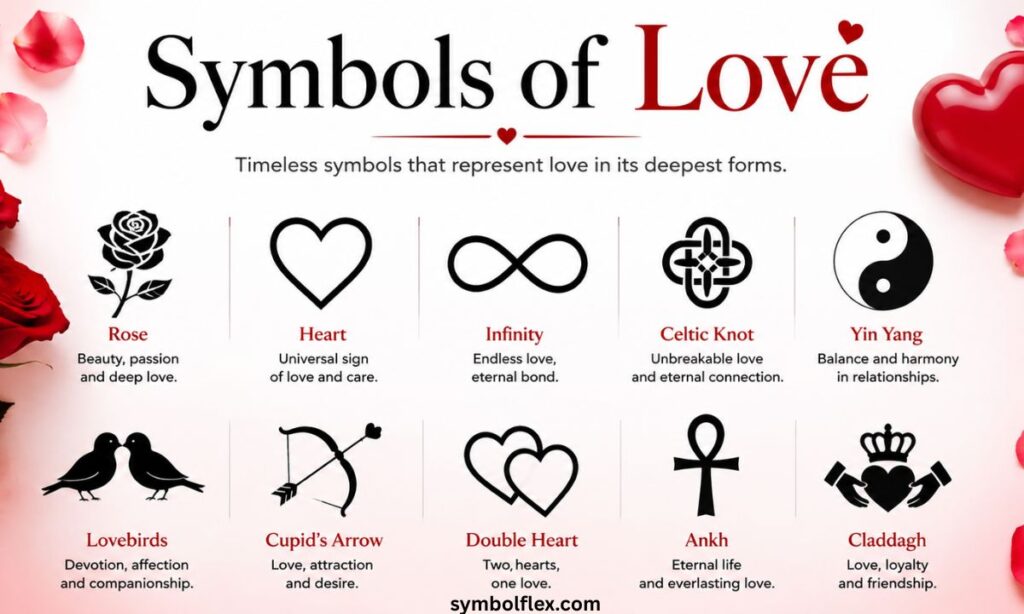
Love has never been an easy thing to put into words, so humans built symbols of love instead. From the timeless heart symbol and red rose to deeper icons like the infinity symbol and doves, each carries its own emotional meaning.
Different cultures add their own touch, the ankh in Egypt, mandarin ducks in China, and the Claddagh ring in Ireland, all representing devotion and eternal love.
Many of these symbols also hold spiritual and psychological significance, tied to compassion and connection. This guide reveals 100+ symbols of love and the hidden meanings behind each one.
What Are Symbols of Love?
A symbol of love is any image, object, animal, gesture, or figure that represents affection, romance, devotion, or emotional connection.
Some symbols are universal, nearly every culture recognizes the heart shape. Others are deeply local, tied to a single mythology, religion, or tradition.
Together, they form a visual language that lets people express feelings words often fail to capture.
Symbols of love generally fall into a few broad groups:
- Physical symbols – hearts, rings, knots, locks
- Natural symbols – flowers, animals, celestial bodies
- Mythological symbols – gods, goddesses, and legendary figures
- Cultural symbols – traditions specific to a region or belief system
- Modern symbols – emojis, gestures, and pop-culture icons
The Deeper Meaning Behind Symbols of Love
Spiritual Meaning
In spiritual traditions, love symbols often represent something bigger than romance — they point to unity, compassion, and connection with the divine. The lotus, the sacred heart, and the ankh all carry this dual meaning: earthly affection paired with something eternal.
Psychological Meaning
From a psychological lens, humans are drawn to symbols because the brain processes images faster than language. A heart shape or an intertwined knot instantly triggers feelings of safety, attachment, and belonging — the same emotional circuitry activated during real bonding.
Cultural Meaning
Every civilization has developed its own shorthand for love. Ancient Egyptians used the ankh, the Chinese used mandarin ducks, and Celtic communities carved eternity into knotwork. These symbols weren’t decorative — they were used in ceremonies, jewelry, and burial rites to mark love as something worth preserving.
The Complete List: 100+ Symbols of Love by Category
Here is a comprehensive collection of love symbols, grouped so you can find exactly the kind you’re looking for.
Universal & Iconic Symbols
- Heart symbol – the most recognized emblem of love and emotion
- Infinity symbol – love with no beginning or end
- Celtic love knot – interwoven, unbreakable devotion
- Claddagh ring – love, loyalty, and friendship combined
- Wedding ring – an unbroken circle of commitment
- Lock and key – one person holding the key to another’s heart
- Puzzle piece – two people who complete each other
- Interlocking rings – two lives joined as one
- Sacred Heart – divine, self-sacrificing love
- Cupid’s arrow – sudden, fated attraction
- Ribbon or bow – tenderness and a gift of the heart
- Padlocks on bridges – love meant to last forever
Flowers & Plants
- Red rose – passionate, romantic love
- Tulip – perfect and declared love
- Forget-me-not – true love and remembrance
- Daisy – innocent, loyal love
- Red camellia – deep longing
- Peony – romance and honor
- Sunflower – adoration and loyalty
- Ivy – fidelity and eternal attachment
- Myrtle – marital happiness
- Lily of the valley – return of happiness
- Orchid – rare, refined love
- Lotus flower – purity and spiritual love
Animals & Birds
- Doves – peace and everlasting love
- Swans – lifelong partnership and grace
- Lovebirds – devotion between couples
- Japanese cranes – fidelity and long life together
- Butterflies – transformation through love
- Bees – community, labor, and devotion
- Wolves – loyalty, as wolves mate for life
- Penguins – monogamous, patient love
- Elephants – protective, family-centered love
- Foxes – cleverness paired with quiet devotion
- Cats – companionship, especially in Egyptian symbolism
- Nightingale – romantic longing, especially in poetry
Mythological & Divine Figures
- Cupid – Roman god of desire and attraction
- Eros – Greek god of romantic love
- Aphrodite – goddess of beauty and love
- Venus – Roman counterpart of Aphrodite
- Freya – Norse goddess of love and fertility
- Kama – Hindu god of love and desire
- Rati – Hindu goddess of love and passion
- Hathor – Egyptian goddess of love and joy
- Psyche – the human soul united with love
- Scallop shell of Aphrodite – birth of romantic love
Ancient & Cultural Symbols
- Ankh – eternal life and love (Egypt)
- Scarab beetle – renewal and devotion (Egypt)
- Ouroboros – love as a continuous, self-renewing cycle
- Yin and Yang – balance between two souls (China)
- Double Happiness symbol – marital joy (China)
- Mandarin ducks – lifelong marital devotion (China)
- Triquetra – threefold eternal bond (Celtic)
- Claddagh – heart, hands, and crown of loyalty (Ireland)
- Mangalsutra – sacred marital bond (India)
- Rudraksha beads – spiritual devotion in relationships (India)
- Henna patterns – blessings for love and marriage (India)
- Red thread of fate – destined soulmates (East Asia)
Jewelry & Objects
- Wedding band – lifelong union
- Engagement ring – a promise of marriage
- Locket – carrying a loved one close to the heart
- Heart-shaped pendant – devotion worn openly
- Friendship bracelet – bonded affection
- Promise ring – a pledge before marriage
- Charm bracelet – collected memories of love
- Love beads – symbolic tokens of affection
- Anniversary band – celebrating years of commitment
- Signet ring with initials – a personal mark of belonging
Colors of Love
- Red – passion and desire
- Pink – tenderness and affection
- White – purity and new beginnings
- Deep maroon – mature, lasting love
- Gold – precious, valued love
- Rose gold – romantic warmth
Numbers & Gestures
- Number 2 – partnership and duality
- Number 8 – luck and prosperity in love (China)
- Holding hands – comfort and unity
- A kiss – intimacy and affection
- A hug – warmth and reassurance
- Linked pinky fingers – a private promise
- Exchanging vows – a spoken commitment
- Clinking glasses in a toast – celebrating a bond
Modern & Pop-Culture Symbols
- Heart emoji (❤️) – digital-age shorthand for love
- XOXO – hugs and kisses in writing
- Matching tattoos – permanent, shared devotion
- Couple rings – modern take on commitment jewelry
- Split-heart necklaces – two halves making a whole
- Love letters – written proof of feeling
- Valentine’s card – a tradition of declared love
- Heart-shaped balloons – celebratory affection
- Candlelit dinner – romance through ritual
- Couple silhouettes – togetherness in visual form
Nature-Inspired Symbols
- Moon and stars – constancy and guidance
- Sun and moon pairing – two opposites drawn together
- Rainbow – hope and joyful love
- Ocean waves – love that returns again and again
- Mountains – steadfast, unmovable devotion
- Tree roots – deep, grounded connection
- Intertwined vines – growth shared between two people
- Anchor – a love that keeps you steady
- Apple – temptation and desire, rooted in Greek and biblical stories
- Pomegranate – fertility and romantic abundance in Persian and Greek tradition
The Most Powerful Symbols, Explained
A few symbols deserve a closer look because of how often they appear across cultures and centuries.
The Heart Symbol – Its rounded, symmetrical shape has represented love since medieval times. It shows up on wedding invitations, tattoos, jewelry, and now billions of times a day in text messages.
The Red Rose – Ancient Greeks linked the rose to Aphrodite, and it has stayed the default gift of romance ever since — appearing in bouquets, perfumes, and wedding décor worldwide.
The Infinity Symbol – Borrowed from mathematics, the sideways figure-eight became a love symbol because it visually has no end, making it popular in engagement rings and couple tattoos.
Doves and Swans – Doves represent peaceful, gentle love, often released at weddings. Swans, known for staying with one mate, symbolize graceful, lifelong partnership.
The Love Knot – Found in Celtic art, this symbol has no visible start or finish, representing a bond that cannot be undone.
Cupid – Depicted as a winged child with a bow, Cupid represents love that strikes suddenly and without warning — the origin of the phrase “struck by Cupid’s arrow.”
Symbols of Love Across Cultures
| Culture | Symbol | Meaning |
| Ancient Egypt | Ankh | Eternal life and love |
| Ancient Greece | Aphrodite’s rose | Divine romantic love |
| China | Mandarin ducks | Lifelong marital loyalty |
| Celtic | Triquetra | Threefold unbreakable bond |
| India | Mangalsutra | Sacred marital devotion |
These symbols weren’t just artistic choices — they were embedded into weddings, religious ceremonies, and even burial customs, showing how deeply love was tied to identity and belief.
Symbols of Love in Art, Movies, Tattoos & Fashion
- In movies: Roses, locked hands, and rain-soaked reunions have become visual shorthand for romantic climax scenes.
- In paintings: Renaissance art frequently placed doves, cherubs, and intertwined hands to signal devotion.
- In books: Poets have used hearts, red roses, and eternal flames as recurring metaphors for centuries.
- In tattoos: Infinity symbols, love knots, and matching designs are popular ways couples permanently mark their bond.
- In fashion: Heart motifs, red accents, and couple-coordinated outfits echo the same symbolism in everyday style.
Spiritual and Dream Meaning of Love Symbols
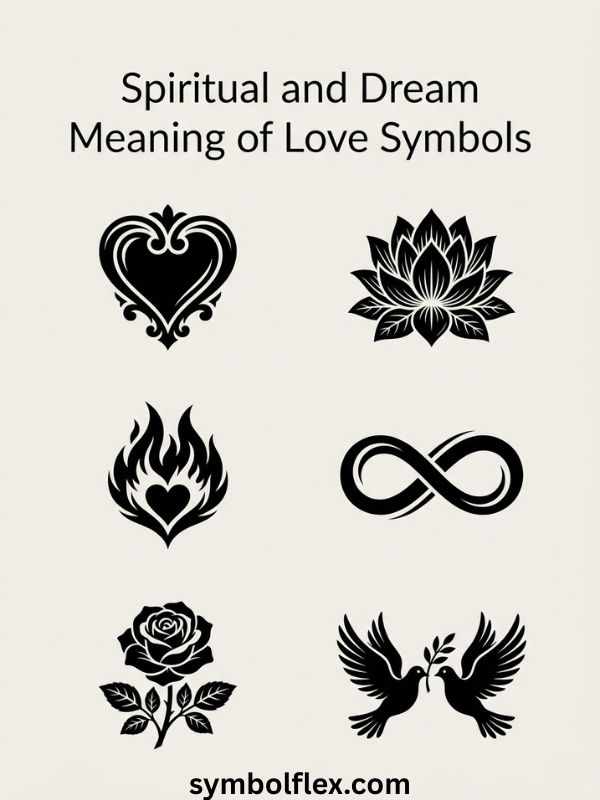
Seeing love symbols in dreams, a heart, a ring, doves, or a rose, is often interpreted as a sign of emotional readiness, a need for connection, or unresolved feelings toward someone.
In spiritual practice, symbols like the lotus or sacred heart are used during meditation to open the heart chakra and encourage compassion, both toward others and oneself.
Positive and Negative Meanings of Love Symbols
| Symbol | Positive Meaning | Negative Meaning |
| Broken heart | Growth through heartbreak | Loss, grief, betrayal |
| Red rose | Passion, romance | Possessiveness (in excess) |
| Lock and key | Trust and devotion | Control or dependency |
| Apple | Desire, attraction | Temptation, forbidden love |
| Snake (some cultures) | Rebirth of love | Deceit within a relationship |
Symbols aren’t fixed — the same image can mean devotion in one context and warning in another, depending on culture and personal experience.
Why Humans Are Attracted to Symbols of Love
People gravitate toward love symbols because they simplify complex emotions into something shareable and lasting.
A ring can say “I choose you” without a single word. A tattoo can outlast a memory fading with time. Symbols also create a sense of belonging, wearing or displaying one signals identity, values, and connection to something bigger than the individual.
Famous Love Symbols People Often Misunderstand
- Broken Heart Symbol – Not only a sign of heartbreak; in some contexts, it represents love so intense it becomes painful, or the human capacity to keep loving despite past hurt.
- Lock and Key – Often mistaken as purely romantic, but historically it also symbolized trust between close friends and family, not just couples.
- Apple Symbol – Frequently linked only to temptation (as in the Adam and Eve story), yet in Greek mythology the golden apple was a gift representing desirability and chosen love.
- Moon and Stars – People assume this only means “dreamy romance,” but traditionally it represented constancy — a love that remains visible even in darkness.
Frequently Asked Questions
What is the oldest symbol of love?
The ankh from Ancient Egypt is among the oldest documented symbols tied to love and eternal life, dating back thousands of years.
Why do hearts symbolize love?
The heart was historically believed to be the seat of human emotion, long before science identified the brain’s role, the symbolism simply stayed.
Which flower symbolizes true love?
The red rose is the most widely recognized flower for true, passionate love, though the forget-me-not represents love that endures memory and time.
What animal symbolizes eternal love?
Swans are the most common answer, largely because they’re known to form long-term, often lifelong, pair bonds.
Are love symbols spiritual?
Many are. Symbols like the lotus flower or sacred heart carry meanings that go beyond romance, touching on compassion, unity, and divine connection.
Conclusion
Symbols of love exist because feelings are hard to hold onto, and images make them easier to remember, share, and pass down.
Whether it’s a rose left on a doorstep, a ring exchanged in a vow, or a tattoo inked as a permanent reminder, these 100+ symbols show that love, in every culture and era, has always needed a way to be seen, not just felt.
