

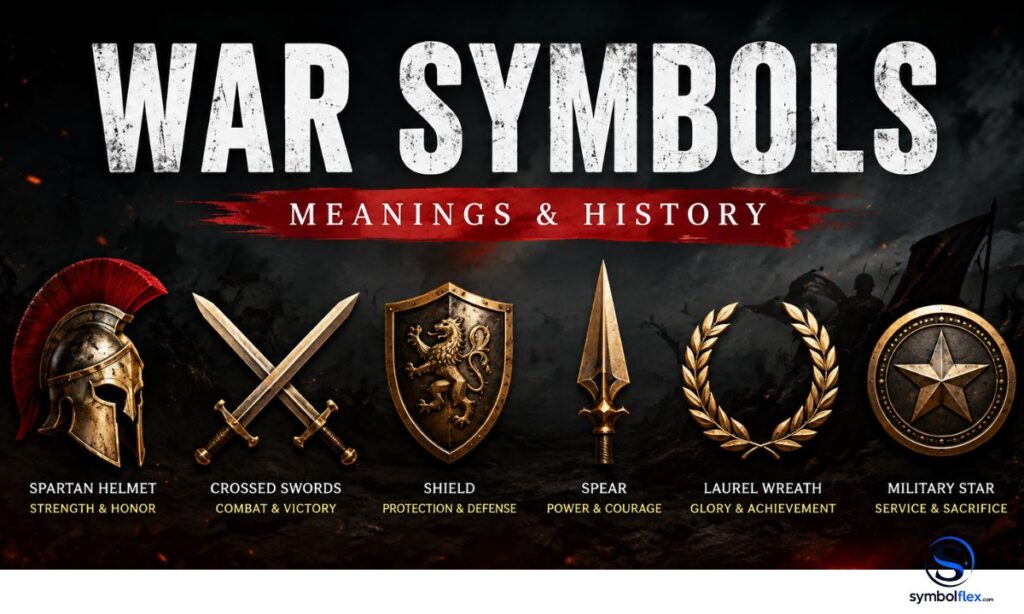
War symbols are images, objects, and colors that represent conflict, power, courage, sacrifice, or loss. From the ancient Roman eagle standard to the red poppy of remembrance, these symbols have shaped how humans express bravery and battle for thousands of years. Even today, you’ll spot them everywhere: in tattoos, military insignia, movies, and even emoji.
This guide breaks down over 82 war symbols and their meanings, covering everything from ancient war symbols and Greek mythology to WW2 imagery and modern war symbols tattoos. Whether you’re researching history, hunting for tattoo ideas, or just curious what a symbol really stands for, you’ll find clear, accurate answers below.
What Are War Symbols?

War symbols are visual or conceptual representations of conflict, military power, or the human experience of battle. They can be objects (a sword), animals (an eagle), colors (red), or even gestures (a raised fist).
Every culture in recorded history has created its own set of war symbols. That’s not a coincidence. Warfare has been a constant part of human civilization, and people have always needed shorthand ways to communicate ideas like courage, protection, victory, and loss without writing an essay every time. A single image on a flag or shield could tell an entire army who they were fighting for.
What makes war symbolism fascinating is how flexible it is. The same symbol, say a skull, can mean danger in one context and honor in another. A sword can represent violence or justice depending on how it’s drawn. This flexibility is part of why war symbols have survived so long. They adapt to whatever a culture needs them to say.
It also helps to understand that war symbols aren’t only about literal battle. Many represent inner conflict, spiritual struggle, or the fight for survival in everyday life. That’s part of why these images still resonate with people who have never set foot on a battlefield.
Symbols Of War And Their Deep Meanings
War symbols carry meaning on at least three levels: literal, cultural, and emotional. A shield literally blocks a blow, culturally represents a nation or family, and emotionally signals protection and safety.
Understanding these layers helps explain why war symbolism feels so powerful even to modern audiences. You don’t need to know Latin to feel something when you see a Roman eagle. You don’t need to have served in the military to understand what a folded flag at a funeral means. These symbols work on instinct as much as knowledge.
Symbols Of War
The most recognized symbols of war include crossed swords, shields, spears, battle axes, war flags, and skulls. Each one developed independently across different civilizations, yet many share strikingly similar meanings, which suggests something universal about how humans process the idea of conflict.
Weapons themselves are the most obvious category. A sword, an axe, or a bow doesn’t just represent fighting. It represents the warrior spirit behind the fighting: discipline, sacrifice, and readiness.
Animals form the second major category. Eagles, wolves, dragons, and lions all appear repeatedly in war symbolism because they represent traits armies wanted to project: strength, cunning, ferocity, and dominance.
War Symbolism
War symbolism is the broader practice of using imagery to communicate ideas connected to conflict, honor, and sacrifice. It’s different from simply depicting a weapon. Symbolism adds a layer of meaning beyond the literal object.
For example, a broken sword doesn’t just mean “damaged weapon.” In most cultures, it symbolizes defeat, the end of a battle, or peace achieved through struggle. Context changes everything in war symbolism, and understanding that context is the key to reading these images correctly.
Military organizations still use symbolism today for exactly this reason. Military insignia, unit patches, and medals all rely on symbolic shorthand to communicate rank, achievement, and identity at a glance.
Symbols That Mean War

If you’re looking for a quick reference, these are among the most universally recognized symbols that mean war:
- Crossed swords or spears
- Red color (blood, urgency, danger)
- Skull and crossbones
- Clenched fist
- Broken chains (rebellion or resistance)
- Drawn bow
- Battle drums
- Shields with a crest or coat of arms
- Flags planted on high ground
- Trumpets or horns (a call to arms)
These symbols share a common thread. They all communicate conflict and destruction or the response to it, whether that response is defense, resistance, or victory.
War Symbols Copy And Paste
If you need quick war symbols emoji and Unicode characters for social media, texts, or captions, here’s a simple copy and paste list:
⚔️ 🛡️ ☠️ 🏹 💣 🔫 🗡️ 🪖 🎖️ 🏴 🚩 ⚡ 🔱 🐉 🦅 💀 🩸 ⚰️ 🎯 🪓
These characters have become the modern shorthand for war symbolism. It’s a fascinating shift when you think about it. Symbols that once took skilled artisans hours to carve into stone or metal are now available with a single tap on a keyboard. The meaning hasn’t changed much though. A crossed swords emoji still signals conflict, just like it did on ancient banners.
War Symbols Tattoos
War symbols tattoos remain some of the most requested designs in tattoo studios across the United States, and it’s not hard to see why. They combine visual power with personal meaning, often honoring military service, family history, or a personal battle the wearer has overcome.
Popular choices include the sword, shield, skull, Valknut, spear, and battle axe. Veterans frequently choose designs tied to their branch of service or unit insignia, turning a military tattoo into a permanent record of experience and brotherhood.
Placement matters too. Forearm and chest placements tend to favor bold, symmetrical designs like crossed swords or shields, while smaller symbols like the Valknut or a single arrow often end up on wrists or behind the ear. Whatever the placement, these tattoos almost always carry a story the wearer is proud to tell.
Symbols For War
Some readers search specifically for “symbols for war” rather than “symbols of war,” usually looking for design inspiration or historical reference material. The distinction is subtle, but the answer overlaps heavily with everything above: weapons, protective gear, animals, and colors associated with conflict.
Designers working on logos, game assets, or historical recreations often pull from this same well of imagery. What separates a strong design from a generic one is understanding the why behind each symbol, not just copying the shape.
Famous Ancient And Historical War Symbols

The most famous historical war symbols include the Roman eagle standard, the Spartan lambda shield, the Viking Valknut, and the Nazi and Allied emblems of World War II. Each one tells a distinct story about the culture that created it.
History is full of moments where a single symbol changed how a war was remembered. These aren’t just old pictures. They’re artifacts of how entire civilizations understood conflict, and studying them gives real insight into human psychology across centuries.
War Symbols Emoji
Modern emoji have quietly become the newest chapter in the history of war symbolism. The crossed swords (⚔️), shield (🛡️), and skull (☠️) emoji trace their visual language directly back to heraldry and military insignia from centuries ago.
What’s interesting is how emoji strip away complexity while keeping meaning intact. A medieval coat of arms might take a trained herald years to design and interpret correctly. An emoji delivers a similar emotional punch instantly, which says a lot about how efficient symbolic communication has become.
War Symbols WW2
World War II produced some of the most recognizable and, in some cases, most disturbing symbols in modern history. The Allied powers used imagery like the V for Victory sign, popularized by Winston Churchill, to boost morale and signal unity among civilians and soldiers alike.
On the other side, Axis powers used propaganda imagery extensively to project strength and instill fear. It’s worth noting plainly that some WW2-era symbols, particularly Nazi Germany’s imagery, remain banned or heavily restricted in several countries today because of their association with genocide and war crimes. This is an important distinction most articles on war symbolism gloss over.
Military insignia from WW2 also gave rise to lasting cultural icons, including the Rosie the Riveter poster and various squadron nose art designs painted on American bombers. These images blended patriotism with personal identity in a way that still influences military tattoos and merchandise today.
War Symbols And Meanings

| Symbol | Origin | Core Meaning |
| Eagle | Rome, USA | Power, vigilance, freedom |
| Sword | Global | Honor, justice, conflict |
| Shield | Global | Protection, defense |
| Skull and crossbones | Medieval Europe | Danger, mortality, piracy |
| Red poppy | WWI Britain, USA | Remembrance, sacrifice |
| Dragon | China, medieval Europe | Power, chaos, protection (varies by culture) |
| Valknut | Norse | Death in battle, Odin’s protection |
| Lambda | Sparta | Courage, unity, discipline |
This kind of side by side comparison makes it easier to see how similar objects carry wildly different meanings depending on where and when they originated.
Ancient War Symbols
Ancient war symbols predate written language in some cases. Early tribal societies used spears, shields, and war drums not just as tools but as spiritual objects believed to carry protective or aggressive power in battle.
Egyptian war imagery often centered on gods like Sekhmet, a lioness deity associated with warfare and destruction. Mesopotamian cultures used lion and bull imagery on their standards, connecting royal and military power to the strongest animals they knew.
War drums deserve special mention here. Nearly every ancient culture, from West Africa to East Asia, used drums to coordinate troop movements and intimidate enemies before a single weapon was drawn. Sound itself became a war symbol.
War Symbols Greek
Greek war symbolism centers heavily on mythology and military discipline. Ares, the god of war, represented the brutal, chaotic side of conflict, while Athena’s shield, known as the Aegis, symbolized strategic and protective warfare guided by wisdom.
The Spartans took symbolism further than almost any other ancient culture. Their soldiers carried shields marked with the lambda, the Greek letter representing Lacedaemon, the formal name for Sparta. This single letter told every enemy exactly who they were facing.
Greek helmets and armor also carried symbolic weight beyond function. The crested helmet wasn’t just for intimidation. It marked rank and unit, functioning almost like a modern military insignia system built entirely out of bronze and horsehair.
Symbols Of War In Mythology
Mythology across nearly every culture assigns war its own dedicated deity and symbolic language. Norse mythology gives us the Valknut, a symbol of three interlocking triangles associated with Odin and the fate of warriors who died in battle. The Helm of Awe, another Norse symbol, was believed to grant protection and induce fear in enemies.
Roman mythology built its war symbolism around Mars, the god of war, whose spear and shield became recurring motifs in Roman art and coinage. Hindu mythology contributes the Chakra, a spinning discus weapon associated with the god Vishnu, symbolizing both destruction and cosmic order.
These mythological symbols share a common purpose. They gave soldiers something bigger than themselves to believe in, transforming a chaotic, terrifying experience into something with spiritual meaning and structure.
What Symbolizes War?
In short, the objects that most consistently symbolize war across cultures are weapons (swords, spears, arrows), protective animals (eagles, lions, wolves), the color red, and skeletal imagery representing mortality. These four categories appear again and again regardless of geography or time period, which suggests they tap into something close to universal human psychology.
Deep Symbolic Meaning of War Symbols
War symbols operate on spiritual, psychological, and cultural levels simultaneously. They’re rarely just about literal fighting. Most carry meaning about survival, identity, and inner strength.
Spiritual Meaning
Spiritually, many war symbols represent an internal battle rather than a physical one. The sword, for instance, often symbolizes cutting away falsehood or weakness, a theme found in everything from Christian iconography to Buddhist teachings about mental discipline.
Protective symbols like the shield or the Helm of Awe carry spiritual weight tied to divine protection. People wearing these symbols today, whether as jewelry or tattoos, often connect with this older meaning: a belief that the symbol offers real protection against harm, not just visual toughness.
Spiritual war symbolism also shows up in the idea of transformation. Fire, for example, frequently appears alongside war imagery because it represents both destruction and renewal, mirroring how conflict can end one chapter of life and begin another.
Psychological Meaning
Psychologically, humans are drawn to war symbols because they represent control over fear. A skull might seem morbid at first glance, but for many people it functions as a reminder of mortality that motivates them to live boldly rather than something meant to frighten.
Symbols of strength and power, like the eagle or the sword, appeal to a basic psychological need for agency. Wearing or displaying these symbols can create a sense of empowerment, especially for people who feel they’ve overcome significant personal struggles.
There’s also a well-documented psychological pull toward symbols associated with survival. This explains why so many people choose war-related tattoos after surviving illness, addiction, or personal hardship. The imagery becomes a permanent reminder that they fought something and made it through.
Cultural Meaning
Culturally, the meaning of a war symbol depends entirely on context. The same skull that represents danger on a warning label might represent honor and remembrance on a military memorial. Context is everything.
National identity plays a massive role here too. The bald eagle means something very different to an American audience than it does to someone unfamiliar with U.S. history, where it represents freedom, strength, and the founding values of the country.
Cultural meaning also shifts over time. Symbols that once represented pure aggression, like the raised fist, have evolved in many modern contexts to represent resistance and solidarity rather than violence, showing how war symbolism adapts as societies change.
Powerful Types of War Symbols and Their Meanings
Below is a closer look at some of the most influential war symbols in history, broken down by appearance, meaning, and where you’re most likely to encounter them today.
Eagle Symbol
Visual Description
A bird of prey typically shown with wings spread, sharp talons, and a hooked beak, often depicted in mid-flight or perched with a commanding posture.
Meaning
The eagle represents vigilance, power, and freedom. In military contexts, it symbolizes dominance in the skies and the strength to protect one’s territory from above.
Where It Appears
The eagle appears on the Roman military standard known as the Aquila, the Great Seal of the United States, countless national flags, and modern military insignia across dozens of countries.
Sword Symbol
Visual Description
A long bladed weapon, often shown upright, sometimes crossed with a second sword to form an X shape.
Meaning
The sword represents honor, justice, and readiness for conflict. A single sword typically symbolizes strength or authority, while crossed swords represent battle or rivalry.
Where It Appears
Swords appear in coats of arms, military rank insignia, tattoos, and countless works of literature and film as a symbol of a warrior’s identity.
Skull and Crossbones
Visual Description
A human skull positioned above two crossed long bones, historically associated with pirate flags and hazard warnings.
Meaning
This symbol represents danger, mortality, and rebellion. In a military context, it has also been used by certain units to project fearlessness and intimidation.
Where It Appears
It appears on pirate flags, hazard labels, motorcycle club patches, and military unit insignia, particularly among elite or special operations groups.
Red Poppy Symbol
Visual Description
A bright red flower with a dark center, most often shown as a simple, stylized silhouette.
Meaning
The red poppy symbolizes remembrance and sacrifice. Its association with fallen soldiers began after Canadian physician John McCrae wrote the poem “In Flanders Fields” in 1915, inspired by poppies blooming across the WWI battlefields of Belgium. American humanitarian Moina Michael later popularized the poppy in the United States as a tribute to veterans.
Where It Appears
The red poppy appears on Veterans Day and Memorial Day materials, military memorials, and remembrance ceremonies across the United States and several other countries.
Shield Symbol
Visual Description
A flat protective barrier, often rounded or shaped like a triangle, sometimes decorated with a family crest or national emblem.
Meaning
The shield symbolizes protection, defense, and resilience. Unlike weapons, which represent offense, the shield speaks to the instinct to guard what matters most.
Where It Appears
Shields appear in coats of arms, law enforcement badges, corporate logos, and countless military and family crests throughout history.
Dragon Symbol
Visual Description
A large, serpentine creature typically shown with wings, claws, and the ability to breathe fire, though its appearance varies significantly by culture.
Meaning
In Western traditions, the dragon often represents chaos and destruction that must be conquered. In Chinese and broader East Asian traditions, the dragon instead represents power, protection, and good fortune.
Where It Appears
Dragons appear on medieval European coats of arms, Welsh national symbolism, Chinese imperial banners, and modern fantasy media influenced by both traditions.
War Symbols Across Cultures

War symbolism differs dramatically depending on the culture that created it, shaped by religion, geography, and the specific enemies each civilization faced. Comparing these traditions side by side reveals just how creative and varied human approaches to conflict imagery have been.
Ancient Roman Culture
Roman war symbolism centered heavily on discipline and collective identity. The Aquila eagle standard stood at the heart of every legion, carried by a soldier called the aquilifer. Losing this standard in battle was considered so disgraceful that Rome spent years, sometimes decades, trying to recover lost eagles.
Roman shields, known as scuta, were often painted with unit-specific designs, functioning much like modern military insignia to identify which legion a soldier belonged to at a glance. Roman military culture also embraced the wolf as a symbol, tied to the founding myth of Romulus and Remus.
Viking Culture
Viking war symbolism blended spirituality with battlefield practicality. The Valknut, made of three interlocking triangles, symbolized the fate of warriors chosen to join Odin in the afterlife. The Helm of Awe was believed to instill fear in enemies and offer protection to the wearer.
Raven imagery also played a significant role, connected to Odin’s two ravens, Huginn and Muninn, who represented thought and memory. Viking shields were often painted in bold geometric patterns, both for intimidation and to identify allies during chaotic battles.
Japanese Samurai Culture
Samurai culture developed one of the most sophisticated systems of war symbolism through the mon, a family crest used to identify clans on the battlefield. These emblems appeared on armor, flags, and banners, functioning similarly to European heraldry.
The katana itself became deeply symbolic beyond its function as a weapon, representing the samurai’s soul, discipline, and honor code known as bushido. Cherry blossoms, though not a weapon or armor piece, also became tied to samurai symbolism, representing the beauty and brevity of a warrior’s life.
Native American Cultures
Native American war symbolism varied significantly by tribe and region, but common themes included eagle feathers, which had to be earned through acts of bravery, and war paint, applied in specific patterns believed to carry spiritual protection into battle.
The thunderbird, a powerful mythological bird found in many Native American traditions, symbolized strength and control over storms, often invoked before battle for protection. Weapons like the tomahawk carried both practical and ceremonial significance, sometimes used in peace pipe ceremonies as well as combat.
Medieval European Culture
Medieval Europe produced an enormous library of war symbolism through heraldry, a formal system of coats of arms used to identify knights and noble families on the battlefield. Lions, eagles, and dragons appeared constantly, each chosen to project specific virtues like courage or ferocity.
Castles and fortified shields became symbols of defense and territorial power during this period, reflecting a society constantly negotiating between offense and protection. Religious symbolism also merged heavily with war imagery during the Crusades, when crosses became battlefield emblems representing both faith and military purpose.
War Symbols in Art, Movies and Pop Culture
War symbols remain a constant presence in modern entertainment because they instantly communicate conflict, stakes, and character identity without lengthy explanation. A single image can do the narrative work of several lines of dialogue.
In Movies
Films rely heavily on war symbolism to establish tone within seconds. A raised sword, a tattered flag, or a skull painted on a helmet immediately signals danger, rebellion, or military identity to the audience without a single word of dialogue.
Historical war films in particular lean on accurate symbolism to build authenticity, often researching real military insignia and unit crests to ground fictional stories in genuine history.
In Paintings
Classical war paintings frequently used symbolic elements like broken swords, fallen banners, or scattered shields to communicate the aftermath of battle rather than depicting active combat directly. This allowed artists to convey loss and consequence with more emotional weight than a straightforward battle scene.
In Books
Literature has used war symbols for centuries to build tension and foreshadow conflict. A sword hanging above a character’s home, or a raven appearing before a major battle, are classic literary devices rooted directly in the mythological war symbolism discussed earlier in this article.
In Tattoos
As covered earlier, war symbols tattoos remain popular precisely because they translate so well into permanent, personal art. The compact, bold nature of symbols like the shield or sword makes them ideal for tattoo design, balancing visual impact with meaningful storytelling.
In Fashion
War symbolism has also worked its way into mainstream fashion, from military-inspired jackets to jewelry featuring swords, shields, or the Valknut. This trend often blurs the line between historical reverence and pure aesthetic appeal, though the underlying symbolism remains rooted in the same themes of strength and protection.
Spiritual and Dream Meaning of War Symbols
Dreams involving war symbols often reflect internal conflict rather than a literal warning about violence. Dream interpretation traditions across cultures generally agree that battle imagery in sleep points toward unresolved tension in waking life.
Seeing Swords in Dreams
A sword appearing in a dream is commonly interpreted as a sign of decisiveness or the need to cut ties with something harmful, whether that’s a relationship, habit, or belief system. A broken sword, by contrast, often suggests feelings of powerlessness or a recent setback.
Seeing Flags or Banners
Flags and banners in dreams frequently symbolize identity and allegiance. Seeing an unfamiliar flag might represent uncertainty about direction in life, while a torn or falling flag can suggest a loss of confidence or purpose.
Seeing Battles or Armor
Dreaming of full battles or wearing armor often points to a period of significant stress or a feeling that you need to protect yourself, emotionally or otherwise. Many dream analysts view this as the subconscious mind rehearsing resilience rather than predicting actual conflict.
Positive vs Negative Meaning of War Symbols
The same war symbol can carry both positive and negative meaning depending on intent and context. This duality is one of the most important things to understand about war symbolism as a whole.
Positive Meanings
On the positive side, war symbols frequently represent courage, honor, loyalty, protection, and resilience. A shield worn as jewelry often signals a desire for personal strength rather than any interest in actual conflict. A sword tattoo can honor a fallen family member who served in the military.
Negative Meanings
On the negative side, the same symbols can represent fear, intimidation, destruction, and division. A skull used in extremist propaganda carries a completely different weight than the same skull used in a memorial tattoo for a lost loved one.
Understanding this duality matters, especially for anyone considering a war-related tattoo or design choice. Context, intention, and cultural awareness all shape how a symbol will be read by others.
Why Humans Are Attracted to War Symbols
People are drawn to war symbols because they represent extremes: extreme courage, extreme danger, extreme loyalty. Human psychology tends to fixate on high stakes imagery, and few concepts carry higher stakes than survival in battle.
There’s also a strong identity component at play. Choosing to display a war symbol, whether through a tattoo, jewelry, or clothing, allows someone to signal values like strength, resilience, or remembrance without needing to explain their personal history in detail.
Finally, war symbols connect people to something larger than themselves. Whether it’s a shared national identity, a military brotherhood, or a spiritual tradition passed down for centuries, these images offer a sense of belonging that few other symbols can match.
War Symbols In US Military And National Identity
Bald Eagle And The Great Seal
The bald eagle became the national emblem of the United States in 1782, chosen for the Great Seal to represent strength, freedom, and independence. Unlike the Roman eagle, which symbolized military conquest, the American eagle was framed around the ideals of liberty and self governance.
Military Branch Insignia
Each branch of the U.S. military uses its own distinct war symbolism. The Army’s crossed rifles, the Navy’s anchor, the Air Force’s winged emblem, and the Marine Corps’ eagle, globe, and anchor all communicate identity, mission, and pride at a glance, much like ancient unit crests once did on the battlefield.
Flag Symbolism In Wartime
The American flag itself has served as a powerful war symbol throughout U.S. history, from Revolutionary War banners to the iconic photograph of Marines raising the flag at Iwo Jima during World War II. Flags in wartime represent far more than national origin. They represent the collective identity soldiers are fighting to protect.
Frequently Asked Questions About War Symbols
What Is The Most Common Symbol Of War?
The sword and the shield are generally considered the most universally recognized symbols of war, appearing across nearly every culture and time period throughout history.
What Color Represents War?
Red is the color most consistently associated with war, tied to blood, urgency, and danger across cultures ranging from ancient Rome to modern warning systems.
What Animal Symbolizes War?
The eagle, wolf, and dragon are the animals most frequently associated with war, each representing different traits like vigilance, cunning, or destructive power depending on the culture.
Are War Symbols Bad Luck?
Most war symbols aren’t considered inherently unlucky. Interpretation depends heavily on cultural and personal context, with symbols like the skull often representing protection or remembrance rather than misfortune.
What Is The Difference Between A War Symbol And A Peace Symbol?
War symbols typically represent conflict, strength, or defense, while peace symbols represent resolution, unity, and the absence of conflict. Some symbols, like the broken sword or an olive branch, actually bridge both categories by representing the end of war rather than its continuation.
Conclusion
War symbols carry far more weight than most people realize at first glance. They’re not just decoration or shorthand for violence. They’re a record of how humans across every era and continent have processed courage, fear, protection, and loss. From the Roman Aquila to a modern war symbols emoji sent between friends, the underlying human need hasn’t changed much at all.
Whether you’re researching these symbols for a tattoo, a history project, or simple curiosity, understanding the deeper meaning behind each image adds a layer of appreciation that’s easy to miss on the surface. These symbols have survived for centuries because they still say something true about the human experience.
If this guide gave you a new perspective on war symbolism, consider exploring how peace symbols developed in response to the very imagery covered here. The contrast tells its own fascinating story.
