

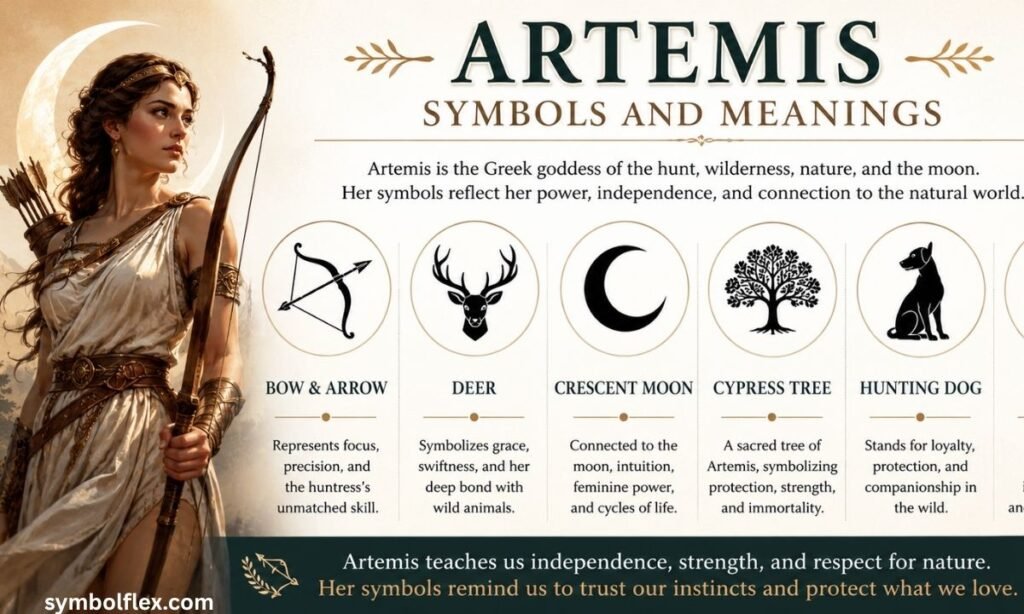
Artemis symbols and meanings reveal one of the most powerful archetypes in world mythology, a goddess of the wild, the moon, and fierce feminine independence.
From her silver bow and crescent moon to her sacred deer and bear, every symbol tells a story of protection, freedom, and untamed power.
Whether you’re exploring for spiritual practice, tattoo inspiration, or pure curiosity, this guide covers everything about what Artemis truly represents.
What Are Artemis Symbols?
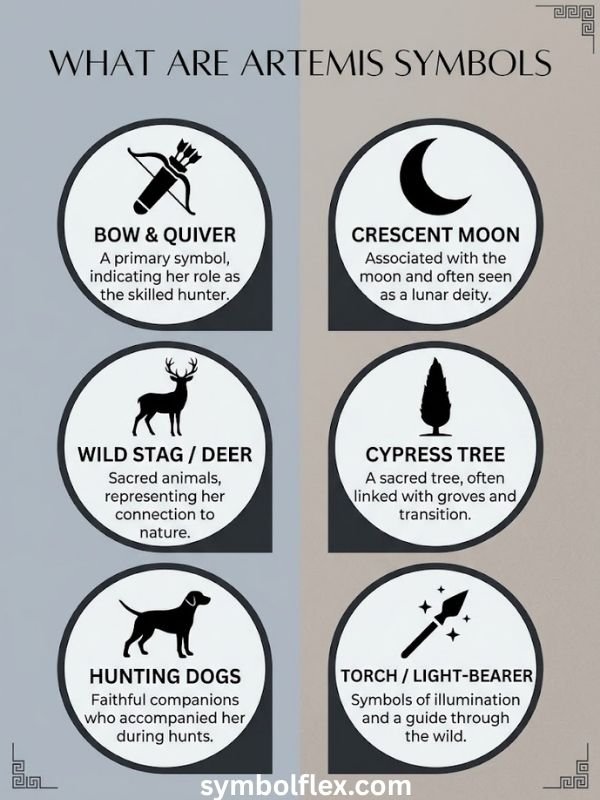
Artemis symbols are the sacred objects, animals, and natural phenomena connected to the Greek goddess Artemis in ancient mythology, religious practice, and art. These weren’t random choices.
Each symbol was a carefully selected representation of her divine domains: hunting, wilderness, the moon, childbirth protection, and the guardianship of young women.In ancient Greece, symbols worked as a visual language.
Artemis Symbols And Meanings
Artemis Goddess
Artemis is the ancient Greek goddess of the hunt, wilderness, wild animals, the moon, and childbirth. She’s the daughter of Zeus and the Titan Leto, and the twin sister of Apollo.
According to myth, she was born first and immediately helped her mother deliver her brother, which is one reason she became associated with midwifery and protecting women during labor.
Artemis Powers
Artemis held a remarkable range of divine powers. As goddess of the hunt, she had perfect archery skills, her silver arrows never missed. She could move invisibly through wilderness and summon or calm wild animals at will.
Artemis Meaning In Bible
The name Artemis appears in the New Testament, specifically in the Book of Acts (chapter 19), in connection with her enormous temple at Ephesus.
The Artemis of Ephesus was a distinct figure more of a mother-goddess associated with fertility and abundance than the Greek hunting deity.
Artemis Roman Name
Artemis’s Roman equivalent is Diana, one of the most beloved goddesses in Roman religion.
Diana absorbed nearly all of Artemis’s characteristics, goddess of the hunt, the moon, nature, and protector of women in labor.
She was worshipped across the Roman Empire, with a famous sanctuary at Lake Nemi in central Italy.
Artemis Personality
Artemis had one of the most vivid personalities in all of Greek mythology. She was fiercely independent, deeply protective, and absolutely uncompromising. She didn’t tolerate disrespect, intrusion, or injustice, and her punishments came fast and hard.
The story of Actaeon captures this perfectly. When the hunter accidentally stumbled upon Artemis bathing, she transformed him into a stag, and his own hunting dogs tore him apart.
From a modern view, that seems extreme. But in the ancient framework, it expressed something real: her domain was sacred and inviolable.
Who Was Artemis In The Bible?
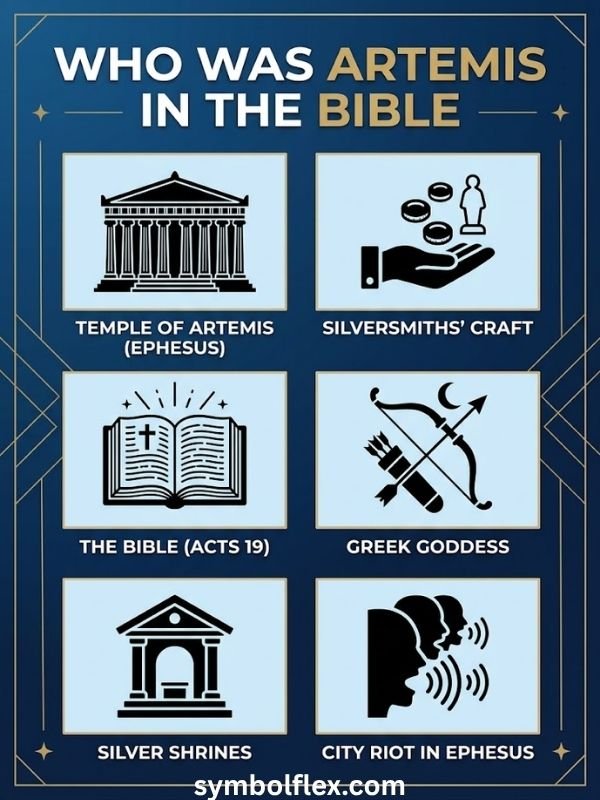
In the Bible, Artemis is presented as the patron goddess of Ephesus, a major city in what is now western Turkey. The Ephesian Artemis was a syncretic deity, a blend of the Greek Artemis with older Anatolian mother-goddess traditions.
Her statues are instantly recognizable, often depicted with multiple rows of what scholars variously interpret as breasts, eggs, or bee pouches, all representing fertility and abundance.
Artemis Constellation
Artemis is connected to several constellations through mythology. Orion, the great hunter, was one of her companions, and depending on the version of the myth, either accidentally killed by her or deeply mourned after his death.
The constellation Canis Major, the Great Dog, also carries Artemis-adjacent mythology through its connection to the hunt.
Deep Symbolic Meaning of Artemis Symbols
Spiritual Level
On a spiritual level, Artemis symbols represent communion with the natural world and the sacred feminine. Her bow and moon together remind us that power and gentleness can coexist, that the same force that lights the night can also strike with lethal precision.
For practitioners of neopaganism and Wicca, Artemis is often invoked as the Maiden aspect of the Triple Goddess.
Her symbols appear in rituals for protection, empowerment, independence, and working with lunar cycles. The crescent moon is especially used in new moon ceremonies to set intentions and welcome new beginnings.
Psychological Level
Psychologist Carl Jung’s concept of archetypes provides a useful lens for understanding why Artemis still resonates so strongly today.
She embodies what Jungian analysts call the Artemis archetype, an independent woman who prioritizes personal goals, values female community, and refuses to define herself through relationships with men.
Jean Shinoda Bolen, in her widely read book Goddesses in Everywoman, describes this archetype as representing focused intent, competitiveness, and a drive to achieve goals in the external world.
Cultural Level
Culturally, Artemis symbols have been powerfully reclaimed as icons of feminist strength and resistance.
Her refusal to marry, her all-female band of companions, and her fierce defense of bodily autonomy make her deeply relevant to contemporary conversations about women’s rights and independence.
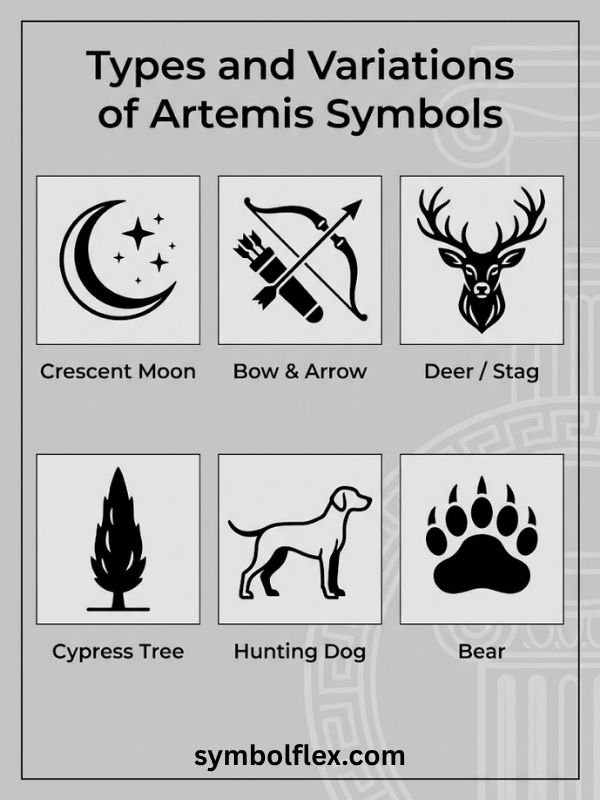
Types and Variations of Artemis Symbols
1. The Silver Bow and Arrows
The silver bow is Artemis’s most iconic symbol, gifted to her by Zeus when she was a child. Silver connects her to the moon, the night, and feminine energy, a direct contrast to Apollo’s golden attributes.
The bow represents focused intention, discipline, and the ability to reach distant goals with precision. As a tattoo or amulet, it speaks to independence, drive, and clarity of purpose.
2. The Crescent Moon
The crescent moon is her lunar crown and her most spiritually potent symbol. It represents growth, transition, and the gathering of new power.
Unlike the full moon (completion) or the dark moon (mystery), the crescent specifically evokes potential and new beginnings. Ancient art frequently shows Artemis wearing a crescent as a diadem in her hair.
3. The Deer (especially the Ceryneian Hind)
The Ceryneian Hind was a magical golden-horned deer sacred to Artemis so swift that capturing it was one of Hercules’s twelve labors.
Deer generally symbolize grace, sensitivity, and the balance between predator and protector in her mythology. She could hunt them and shelter them simultaneously, a paradox that perfectly mirrors the goddess’s nature.
4. The Bear
The bear is one of Artemis’s oldest symbols, deeply tied to her cult at Brauron. Young Athenian girls who served Artemis before marriage were called “arktoi,” meaning bears. The bear represents strength, protective instinct, and the untamed wilderness.
It’s a lesser-known Artemis symbol but carries profound meaning around female community and rites of passage.
5. The Cypress Tree
The tall cypress tree was sacred to Artemis and connected to eternity and mourning. Cypress groves were considered her domain, places where the goddess rested between hunts. The tree’s evergreen nature and its upward-pointing shape linked it to the immortal realm and the moon above.
6. The Quiver and Hunting Boots
Artemis’s quiver full of arrows represents readiness, preparedness, and the capacity to defend what matters.
Her hunting boots ground her in physical reality — she’s not a goddess who floats above earthly life but one who runs through it. These practical symbols speak to competence, skill, and embodied power.
Artemis Symbols Across Cultures
Ancient Greece
In Greece, Artemis was worshipped through temples, seasonal festivals, and ritual offerings. The Brauronia festival involved girls between five and ten years old serving the goddess before marriage, a coming-of-age ceremony marking their transition from childhood to womanhood under her protection.
Ephesus (Asia Minor)
The Ephesian Artemis was dramatically different from her Greek counterpart — more fertility goddess than huntress. Her elaborate statues were among the most copied in the ancient world.
The Temple of Artemis at Ephesus drew pilgrims for centuries and stood as one of the great centers of goddess worship in the ancient Mediterranean.
Roman Empire
As Diana, Artemis was honored throughout the Roman Empire. Her August 13th festival served as a holiday for enslaved people and commoners — a remarkable social function that gave the goddess a genuinely egalitarian character rare among Roman deities.
Modern Neopaganism
Contemporary Wiccan and neopagan practitioners actively work with Artemis as a living deity. She’s invoked in moon rituals, protection ceremonies, and practices centered on female independence. Her symbols appear on altars, in jewelry, and in personal devotional practice worldwide.
Feminist Spirituality
Within feminist spirituality, Artemis represents a model of womanhood that doesn’t require male validation or partnership. Her symbols appear in women’s circles, feminist retreats, and social justice artwork as affirmations of self-determination and collective female strength.
Spiritual and Dream Meaning of Artemis Symbols
Dreaming of Artemis or her symbols often signals a need to reconnect with your authentic instincts and personal boundaries.
A silver bow in a dream may suggest you need to focus your energy and aim clearly toward a specific goal. A crescent moon can point to new beginnings or the early stages of a meaningful creative project.
Dreams featuring deer, especially unusually beautiful or golden-horned ones, are often interpreted as messages about grace, intuition, and following a path that feels sacred rather than imposed.
Positive vs. Negative Meanings of Artemis Symbols
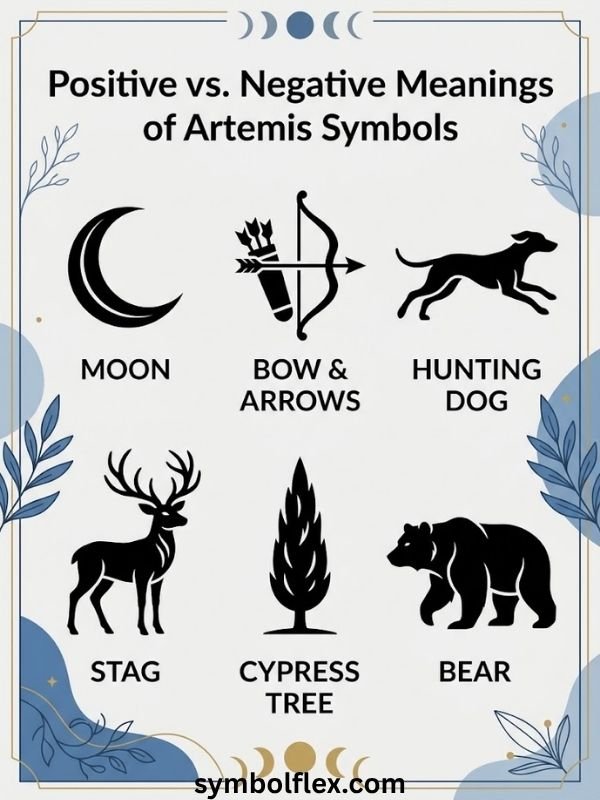
Positive Meanings
- Independence and self-sovereignty — the freedom to live on your own terms
- Protection of the vulnerable — fierce guardianship of children, women, and wildlife
- Precision and focus — the ability to set a goal and pursue it without wavering
- Connection to nature — harmony with the natural world and its cycles
- Female solidarity — the power of community among women
Negative Meanings
- Isolation — the Artemis archetype can tip into emotional unavailability or refusal of intimacy
- Disproportionate punishment — her justice can be severe and unforgiving
- Rigidity — difficulty showing vulnerability or adapting to change
- Exclusivity — in extreme readings, her mythology has been interpreted as hostile toward men
Engaging honestly with both sides creates a more complete and grounded relationship with these symbols.
Why Humans Are Attracted to Artemis Symbols
People are drawn to Artemis symbols for deeply human reasons. In an era of constant digital noise, institutional control, and environmental disconnection, the image of a goddess running free through ancient forests with a bow in hand taps into a powerful longing for freedom and wild authenticity.
For women especially, Artemis offers a mythological model that doesn’t center romance or motherhood as the defining female experience. She’s complete in herself. Her symbols carry that message directly: you are enough, you are powerful, and you belong to no one but yourself.
Frequently Asked Questions
What are the main symbols of Artemis?
Artemis’s main symbols are the silver bow, crescent moon, deer, bear, and cypress tree representing her divine powers.
What does Artemis symbolize in Greek mythology?
Artemis symbolizes independence, protection, wilderness, the moon, hunting, and fierce guardianship of women and nature.
What is Artemis’s Roman name and meaning?
Artemis’s Roman name is Diana, representing the same goddess of hunt, moon, and feminine power in Roman culture.
What does dreaming of Artemis symbols mean spiritually?
Dreaming of Artemis symbols signals a need for independence, self-trust, new beginnings, and reconnecting with your natural instincts.
Why are Artemis symbols still popular in modern culture?
Artemis symbols remain popular because they represent female strength, freedom, nature connection, and timeless spiritual empowerment today.
Conclusion
Artemis symbols and meanings span thousands of years, from ancient Greek temples to NASA spacecraft to contemporary tattoo studios.
Her silver bow represents focus and power. Her crescent moon speaks to cycles and renewal. Her deer and bear reflect the paradox of strength and tenderness.
