

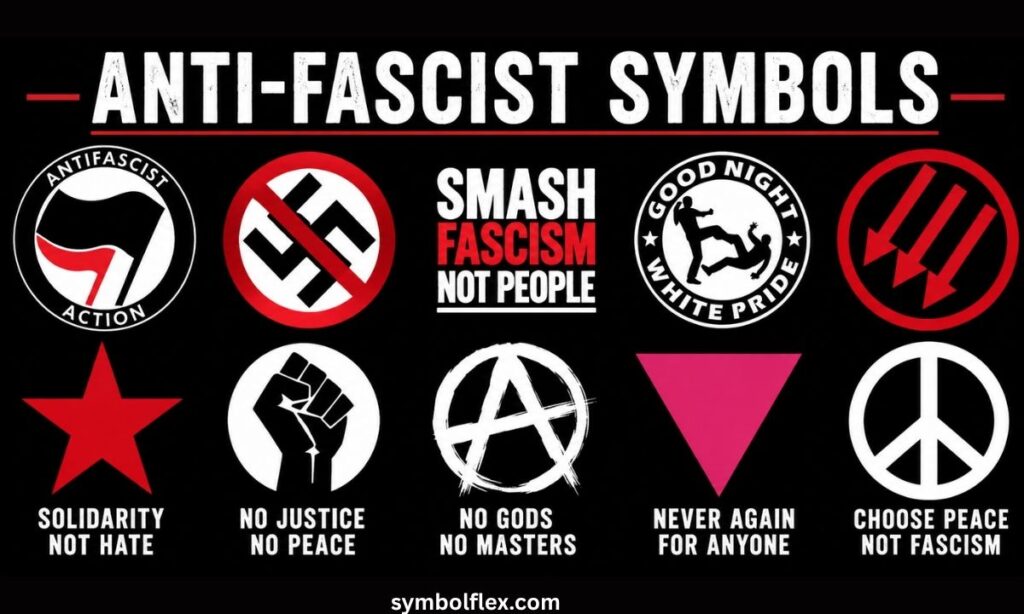
Anti fascist symbols are visual tools of resistance that people use to oppose authoritarianism, fascism, and political oppression.
From the streets of 1930s Germany to today’s protest marches across the United States, these symbols carry deep meaning and a long history.
If you’ve ever wondered what that raised fist or three-arrows logo really stands for, you’re in the right place.
Key fact: Anti-fascist symbolism dates back to the Weimar Republic era of the 1920s, making it nearly 100 years old as an organized visual language of resistance.
What Are Anti Fascist Symbols?
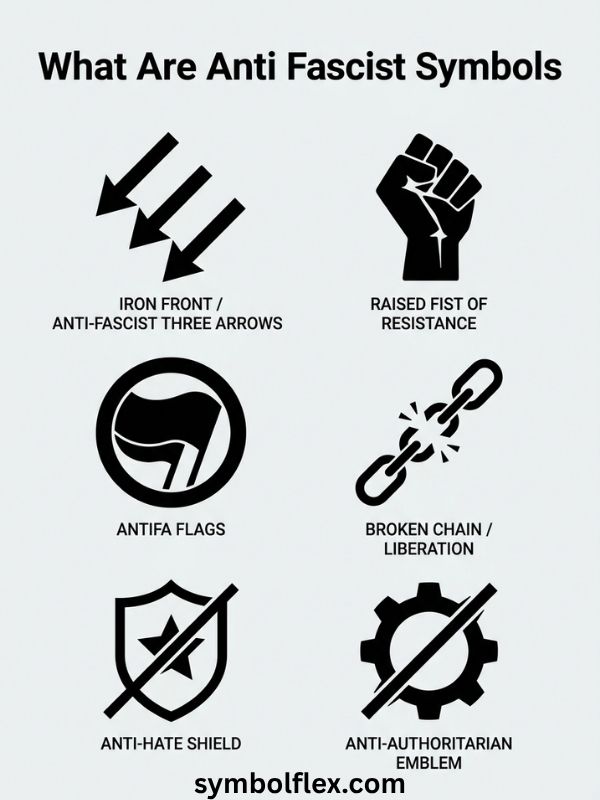
Anti fascist symbols are images, icons, and visual signs used to express opposition to fascism, dictatorship, and authoritarian rule. They serve as rallying points for people who believe in democracy, civil liberties, human rights, and collective freedom.
These symbols don’t belong to a single group or ideology. They’ve been used by labor unions, anarchists, democratic socialists, civil rights activists, and ordinary citizens who simply reject political extremism. Think of them as a shared visual vocabulary for resistance.
Key fact: The three-arrows symbol was originally designed in 1931 by German artist Carlo Mierendorff as a direct counter to the Nazi swastika.
Deep Symbolic Meaning
Anti fascist symbols operate on multiple levels simultaneously, from spiritual to psychological to cultural. That layered meaning is exactly why they’ve lasted so long and spread so far across the world.
Spiritual Level
On a spiritual level, many anti fascist symbols connect to universal human values like dignity, freedom, and justice. The raised fist, for example, echoes imagery found in liberation theology movements across Latin America and Africa. It represents the human spirit’s refusal to be crushed by oppressive power.
Some activist communities view these symbols almost as sacred objects, items you put on your body as a tattoo or carry as a patch because they mean something deeper than politics. They reflect a moral commitment, a declaration of who you are and what you stand against.
Psychological Level
Psychologically, anti fascist symbols create a sense of belonging and collective identity. Research in social psychology consistently shows that shared symbols help groups form stronger bonds and maintain motivation during long-term struggles.
When someone wears an anti fascist symbol at a protest or displays it online, they’re signaling tribal membership. They’re saying: I stand with this group. I share these values. That psychological function is enormously powerful, especially when people feel isolated or outnumbered.
Cultural Level
Culturally, anti fascist symbols function as historical memory. They connect today’s activists to generations of people who fought against fascism, from the Spanish Civil War to World War II resistance movements to post-war anti-dictatorship struggles worldwide.
They also travel across cultures remarkably well. The raised fist means something powerful whether you see it in Detroit, Berlin, or Buenos Aires. That cross-cultural resonance is rare and makes these symbols unusually durable as political imagery.
Key fact: The raised fist symbol appeared on labor union banners in the United States as early as the 1910s, decades before it became widely associated with anti-fascist movements.
Types and Variations of Anti Fascist Symbols
There are dozens of recognized anti fascist symbols, each with its own origin story, design logic, and specific use in resistance movements. Here are the most important ones you’ll encounter.
Three Arrows
The three arrows symbol is one of the oldest and most specifically anti-fascist icons in existence. Designed in 1931 for the Iron Front, a German anti-Nazi organization, the three downward-pointing arrows were meant to symbolize opposition to three threats: Nazism, Communism (Soviet-style), and monarchism.
Today, the three arrows are widely used by democratic socialist and anti-fascist groups across Europe and North America. You’ll see them on protest banners, stickers, and social media profile pictures whenever far-right movements gain ground.
Antifa Flag
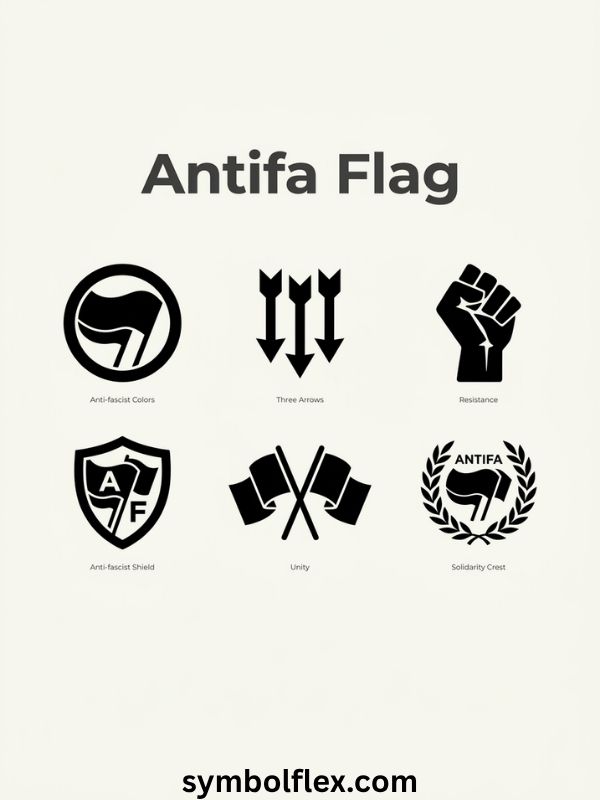
The Antifa flag consists of two flags side by side: one red and one black. The red represents socialist or communist anti-fascism, while the black represents anarchist anti-fascism. Together they symbolize the broad coalition of left-wing forces that united against fascism in 1930s Europe.
This dual-flag design originated with the German organization Antifaschistische Aktion, founded in 1932. The organization was trying to build a united front against the rising Nazi party. The flag was their visual shorthand for that coalition.
Raised Fist
The raised fist is arguably the most universally recognized symbol of resistance in the world. It appears across anti-fascist, civil rights, feminist, labor, and anti-colonial movements on every continent.
In anti-fascist contexts specifically, the clenched fist represents defiance against authoritarian power and solidarity among those who resist. It communicates: we are not submitting, and we are not alone.
Circle A
The Circle A is the classic anarchist symbol. The letter “A” inside a circle stands for “Anarchy” or “Anarchism,” and the circle itself is often interpreted as representing the letter “O,” standing for “Order,” referencing Pierre-Joseph Proudhon’s phrase “Anarchy is the mother of order.”
No Fascism Sign
The No Fascism sign typically shows a fascist symbol (often a swastika, fasces, or raised-arm salute) inside a red circle with a diagonal line through it, similar to a standard prohibition sign. It’s the most visually literal of all anti fascist symbols.
This symbol is effective because it needs no explanation. The prohibition format is universally understood. What’s inside the circle is forbidden, rejected, and opposed.
Anti Fascist Symbols Across Cultures
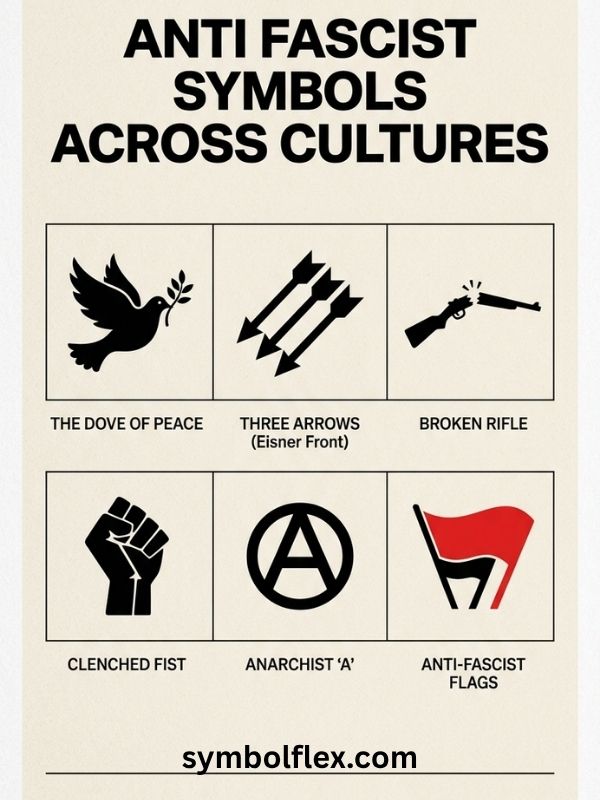
Anti fascist symbols don’t belong to one country or culture. They’ve been adapted and used across the world in response to local forms of authoritarianism and political repression.
Europe
Europe is the birthplace of most organized anti-fascist symbolism, and for obvious historical reasons. The three arrows, the Antifa flag, and the raised fist all originated in response to the rise of fascism in Germany, Italy, and Spain during the 1920s and 1930s.
United States
In the United States, anti-fascist symbols gained mainstream attention after the 2016 election and the Charlottesville protests of 2017. The raised fist, in particular, has deep American roots in labor organizing, the civil rights movement, and Black Power activism.
American anti-fascist groups have adapted European symbols and mixed them with homegrown imagery from labor unions, civil rights marches, and Indigenous resistance movements. This creates a distinctly American visual vocabulary of resistance that draws on multiple traditions.
Latin America
Latin America has its own powerful tradition of resistance symbolism, shaped by decades of military dictatorships, U.S.-backed authoritarian regimes, and grassroots liberation movements. The raised fist appears throughout Latin American revolutionary imagery.
Organizations like Chile’s anti-Pinochet resistance groups and Argentina’s Madres de Plaza de Mayo developed their own visual languages of resistance that overlapped significantly with international anti-fascist symbolism.
Asia
In Asia, anti-fascist symbolism emerged in specific contexts, particularly in South Korea and Taiwan during their transitions from military rule to democracy in the 1980s and 1990s. Labor union movements across the region adopted the raised fist as a symbol of worker solidarity.
In Japan, anti-fascist symbols are used by groups opposing both historical Japanese imperialism and contemporary nationalist movements. The Circle A appears in Japanese punk and protest subcultures.
Middle East
In the Middle East, anti-authoritarian symbolism has been shaped by pro-democracy movements like the Arab Spring of 2010 to 2012. The raised fist became one of the dominant visual symbols of protests in Egypt, Tunisia, Syria, and elsewhere.
Kurdish resistance movements, particularly those with anarchist-influenced ideologies, have used the Circle A and raised fist alongside their own cultural symbols. The combination of international anti-fascist imagery with local tradition creates powerful hybrid visual languages.
Anti Fascist Symbols in Art, Movies, and Pop Culture
Anti fascist symbols have moved far beyond protests and into mainstream art, film, music, and fashion, which is a sign of their deep cultural penetration.
In film, anti-fascist imagery appears everywhere from classic wartime propaganda to modern blockbusters. The Star Wars franchise deliberately uses visual language borrowed from World War II Allied and Axis aesthetics, positioning the Rebel Alliance as anti-fascist resistance fighters. George Lucas has acknowledged this influence directly.
Spiritual and Dream Meaning of Anti Fascist Symbols
When anti fascist symbols appear in dreams or spiritual contemplation, they’re generally interpreted as representing the dreamer’s internal struggle against oppressive forces.
Dream interpretation traditions (particularly Jungian psychology) suggest that symbols of resistance in dreams reflect a person’s inner confrontation with authority, conformity, or suppression of their authentic self.
A raised fist in a dream might represent refusing to comply with something that feels wrong or unjust.
Positive vs Negative Meaning
Anti fascist symbols carry strongly positive associations for those who use them and more complicated or negative associations for those who oppose the movements they represent.
For supporters, these symbols represent courage, solidarity, and the defense of human dignity.
They connect wearers to historical heroes who risked their lives fighting fascism in Europe during World War II. They signal moral commitment and community belonging.
Why Humans Are Attracted to Anti Fascist Symbols
Humans are drawn to anti fascist symbols for the same reasons we’re drawn to any powerful symbol: they communicate complex ideas instantly and create a sense of shared identity.
Psychologists who study political behavior note that symbols satisfy a deep human need to make abstract values visible and concrete. You can’t see “resistance” or “solidarity” directly, but you can see a raised fist or a three-arrows patch. The symbol makes the value real and sharable.
Frequently Asked Questions
What are anti fascist symbols?
Anti fascist symbols are visual icons used to oppose fascism, authoritarianism, and political oppression worldwide.
What does the raised fist symbol mean?
The raised fist represents defiance, solidarity, and collective resistance against oppressive governments and authoritarian political systems.
Where did anti fascist symbols originate?
Most anti fascist symbols originated in 1920s and 1930s Germany as direct responses to rising Nazi movements.
What do the Antifa flag colors red and black mean?
Red represents socialist anti-fascism and black represents anarchist anti-fascism, symbolizing a united front against fascism.
Are anti fascist symbols legal to display in the USA?
Yes, displaying anti fascist symbols in the United States is fully protected under the First Amendment rights.
Conclusion
Anti fascist symbols are more than protest imagery. They’re a living visual language that connects generations of people who’ve stood against authoritarianism, oppression, and fascism.
From the three arrows designed in 1931 to the raised fist that marched through civil rights demonstrations and into 21st-century streets, these symbols have proven remarkably durable because the values they represent are timeless. Freedom, dignity, solidarity, and resistance to tyranny don’t go out of style.
