

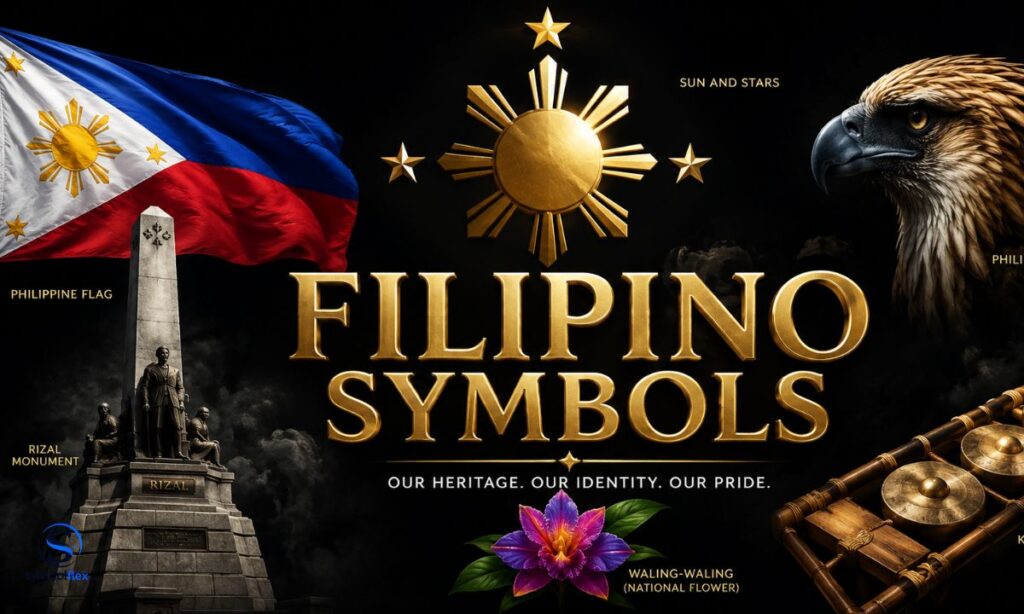
Filipino symbols are trending hard right now, especially among Filipino Americans reconnecting with their roots. Baybayin tattoos are going viral on TikTok, and the Sarimanok is showing up everywhere from jewelry to modern art. Even the Philippine flag hides a wild detail: it’s meant to fly upside down during wartime, red stripe on top instead of blue.
That one fact shows how much meaning sits inside Filipino symbolism. Here, you’ll find 60+ Filipino symbols and meanings, from national icons to ancient tribal marks and today’s most searched tattoo designs.
What Are Filipino Symbols?

Filipino symbols are images, objects, patterns, and words that represent Filipino values and history, generally falling into five categories: national, cultural, indigenous, spiritual, and modern pop culture symbols.
Before Spanish colonization in 1521, the islands held dozens of ethnolinguistic groups, from the Ifugao in the north to the Maranao in Mindanao, each with its own visual language rooted in nature, ancestry, and protection. That is the foundation of ancient Filipino symbols. Spanish and later American influence added new layers, blending Catholic imagery and formal national emblems with existing indigenous belief systems.
For the more than four million Filipino Americans in the United States, these symbols carry extra weight. A Baybayin tattoo or Sarimanok carving often becomes a way to connect with heritage that many second and third generation Filipino Americans were never taught directly, turning Philippine symbols into living bridges between generations.
Filipino Cultural Symbols And Their Meanings
Filipino cultural symbols are the everyday images Filipinos instantly recognize, from the national flag to community traditions like bayanihan.
Filipino symbols and meanings
| Symbol | Meaning |
| Carabao | Hard work, patience, rural life |
| Bahay kubo | Simplicity, family, resourcefulness |
| Jeepney | Post war resilience, creativity |
| Parol | Hope, faith, the Christmas season |
| Bayanihan | Unity, cooperation, neighborly support |
| Barong Tagalog | National pride, heritage |
The jeepney began as a repurposed American military jeep after World War II, and Filipinos decorated them with bright colors until they became a rolling symbol of Filipino ingenuity.
Filipino flag
The blue stripe represents peace and justice, red stands for courage, and the white triangle symbolizes equality. The eight rayed sun represents the first provinces that revolted against Spain in 1896, and the three stars represent Luzon, Visayas, and Mindanao.
Filipino symbols tattoos
Filipino symbol tattoos commonly feature the sun and stars, Baybayin script, and the Sarimanok. In Cordillera tribes, tattoos called batok were historically earned through bravery, each pattern carrying real social meaning rather than pure decoration.
Filipino symbols tattoos
Choosing a respectful design matters. Many artists recommend learning a pattern’s true regional origin, Cordilleran, Visayan, or Maranao, rather than blending unrelated tribal styles, since each developed independently with its own rules.
Filipino symbols letters
Filipino symbols letters usually refers to Baybayin, the pre colonial writing system. It is an abugida using around 14 to 17 core characters, each representing a consonant paired automatically with the vowel sound “a” unless modified.
Philippines symbols and meanings
In short, the sun and stars represent freedom, the carabao represents endurance, the parol represents hope, and Baybayin represents pre colonial literacy, setting up the national symbols covered next.
National Symbols Of The Philippines

Only a handful of Philippine symbols are actually backed by law, which is a common point of confusion online.
What are the 10 national symbols of the Philippines
Legally recognized symbols include the Sampaguita (flower), Narra tree, Philippine Eagle (bird), Philippine Pearl (gem), and Arnis (martial art and sport), alongside the flag and anthem under Republic Act 8491. Popular additions like the carabao, bangus, mango, and nipa hut are widely repeated but have no legal basis, though a pending bill would formalize them.
Philippine national symbols PDF
A printable chart listing each symbol, its legal basis, and the year declared is useful for classrooms and heritage projects, especially for Filipino American students learning this history for the first time.
Philippines national bird
The Philippine Eagle, Pithecophaga jefferyi, was declared national bird in 1995. Once called the “monkey eating eagle,” it was renamed in 1978 since its diet is broader. It is critically endangered, found only on Mindanao, Luzon, Samar, and Leyte.
Philippine national symbols with pictures and description
A strong visual reference pairs each symbol with a clear photo, the flag, the eagle in flight, the Sampaguita blossom, and the Narra tree, supported by descriptive alt text for accessibility.
National tree of the Philippines
The Narra was declared national tree in 1934. Its strong reddish wood is prized for furniture, and symbolically it represents resilience and steady growth.
Ancient And Traditional Filipino Symbols
Long before national proclamations existed, Filipino communities created symbols rooted in nature and survival.
Ancient Filipino symbols
The Angono Petroglyphs, dated to roughly 3,000 BCE, are the oldest known artwork in the Philippines, carved with simple human and animal figures for ritual purposes.
Filipino symbolism
Circles represent unity, triangles represent mountains and protection, and zigzag lines represent rivers and life’s journey, recurring themes across weaving, pottery, and body art.
Traditional Filipino symbols
Maranao Okir carving uses flowing vine and leaf patterns on house beams and boat sails, while the T’boli create sacred T’nalak cloth from patterns said to appear in dreams.
Filipino good luck symbols

The agimat amulet is believed to grant protection, the tuko gecko signals good fortune, and coins near doorways are a folk practice meant to invite prosperity.
Filipino ancient symbols
Spiral motifs in Neolithic pottery are believed to represent life cycles, a theme still echoed in modern Filipino jewelry and textile design.
Filipino indigenous symbols
The Ifugao carve bulul rice deity figures, Cordillera tribes developed batok tattooing, and the T’boli are known for brass ornaments tied to social status.
Filipino protection symbols
The anting-anting amulet, sun imagery, and folk practices like garlic near entryways all serve protective purposes, echoing the tattoos once worn by Visayan warriors called pintados.
Filipino Symbols Of Identity, Culture And Strength
Symbols become most meaningful when tied to personal identity, especially for Filipino Americans exploring heritage from a distance.
Family Filipino symbols and meanings
The bahay kubo reflects extended family living closely together, sharing resources across generations under one roof.
Filipino symbols for strength
The carabao represents endurance, the Narra tree represents resilient growth, and the sun represents constancy, all common Filipino symbols for strength.
Symbols that represent Filipino culture
Bayanihan, neighbors literally carrying a house to help a family relocate, remains one of the most powerful symbols of community cooperation in Filipino life.
Filipino symbols of strength
The Sarimanok also functions as a symbol of strength in Maranao tradition, representing the power of fortune and spiritual connection rather than physical force.
Filipino culture symbols

Lechon at fiestas symbolizes celebration, the parol signals hope, and the barong tagalog marks national pride during formal occasions.
Filipino symbols culture
The gesture of mano po, pressing an elder’s hand to the forehead, shows how symbolism extends into daily behavior, not just objects.
Indigenous Filipino symbols
Ifugao rice terraces, Maranao Okir patterns, and T’boli dream weaving together form one of the most diverse indigenous symbol systems in Southeast Asia.
Symbols of Filipino identity
Wearing a Baybayin tattoo has become a deliberate way for Filipino Americans to claim symbols of Filipino identity amid growing interest in ancestry nationwide.
Symbols of Filipino culture
Together, the flag, the Philippine Eagle, the Sampaguita, the jeepney, Baybayin, and the Sarimanok form the six symbols most readers encounter first.
More Ancient And Cultural Filipino Symbols
Several regional and historical symbols deserve extra attention for deeper knowledge.
Ancient Filipino symbols and meanings
Bakunawa, a giant serpent believed to cause eclipses by swallowing the moon, remains a central figure in pre colonial Filipino cosmology.
Filipino cultural symbols
Regional festivals add their own symbols, including Kalibo’s Ati-Atihan masks and the towering Higantes figures paraded in Angono each year.
Ancient Filipino symbols for strength
Cordilleran warrior shields called kalasag were carved with protective motifs meant to guard against both physical and spiritual harm.
Filipino symbols for family
Kamagong wood symbolizes an unbreakable family bond, while woven banig mats represent shared living and togetherness.
Traditional Filipino symbols and meanings
Across regions, nearly every traditional symbol ties back to protection, prosperity, or connection to ancestors.
Old Filipino symbols for strength
The Katipunan revolutionary society adopted a sun with a stylized letter K, a symbol of resistance still echoed in modern reinterpretations of the flag.
Tagalog family Filipino symbols and meanings
The concept of angkan, or clan lineage, carries symbolic weight tied to family honor, often expressed through shared surnames and inherited land.
Common Filipino symbols
Everyday symbols include the sari-sari store sign, the tricycle, and adobo, often called a culinary symbol of home by Filipinos abroad.
Filipino symbols and practices
Living practices like pagmamano, novena candles, and fiesta traditions blend religious devotion with community celebration.
Warrior Filipino symbols
Visayan warriors carried kampilan swords and kalasag shields, with tattoos marking both status and battle experience.
Philippine Filipino symbols
Symbol traditions shift by region: Luzon leans toward Baybayin and Katipunan imagery, the Visayas carries strong tattoo tradition, and Mindanao is defined by Okir and the Sarimanok.
Ilocano ancient Filipino symbols and meanings
The Ilocano region is known for inabel weaving and burnay pottery, both still produced using traditional methods and carrying community identity.
Deep Symbolic Meaning of Filipino Symbols
Filipino symbols operate on more than one level at once.
Spiritual Level
Many symbols trace back to anito worship, honoring ancestor spirits believed to influence harvests and health, with anito figures serving as physical vessels for those spirits.
Psychological Level
Symbols provide belonging and continuity, especially for people navigating identity across two cultures, giving second and third generation Filipino Americans a tangible anchor to heritage.
Cultural Level
Baybayin’s revival is often framed as a quiet rejection of the idea that Filipino history began with colonization, reinforcing pride in a literate, pre colonial society.
Types and Variations of Filipino Symbols
A few symbols appear so consistently that they deserve individual attention.
Sarimanok
The Sarimanok is a legendary Maranao bird, shown holding a fish in its beak or talons. Its name combines “sari,” meaning colorful, and “manok,” meaning bird, and it is believed to bring good fortune.
Sun and Stars of the Philippine Flag
First raised by General Emilio Aguinaldo in 1898, the sun and three stars were designed to visually unify a nation still forming its identity after independence from Spain.
Anito Figures
Anito figures are carved wooden ancestor spirits used in pre colonial rituals for guidance and protection, still referenced in Filipino art exploring pre colonial spirituality.
Okir Patterns
Okir is the traditional Maranao carving style, visible on panolong house beams and vinta boat sails, marked by flowing vine and leaf motifs.
Baybayin Script
Baybayin remains one of the most recognized Baybayin symbols today, spanning ancient history and a genuine modern cultural revival in a single writing system.
Filipino Symbols Across Cultures
Baybayin tattoos are now requested by non-Filipino clients drawn to the script’s elegance, and the Sarimanok has appeared in international art exhibitions. In the United States, Filipino symbols show up prominently in murals throughout Historic Filipinotown in Los Angeles, keeping these symbols visible across the diaspora.
Filipino Symbols in Art, Movies and Pop Culture
Filipino artists draw on Baybayin, Sarimanok imagery, and Okir patterns in gallery work and street art across Manila and US cities with large Filipino populations. Streetwear brands popular with Filipino American youth have also incorporated Baybayin lettering into clothing, turning ancient script into a modern statement of pride.
Spiritual and Dream Meaning of Filipino Symbols
Filipino folklore assigns meaning to dream symbols, though interpretations vary by region. A snake may signal caution or transformation depending on local belief, while the moon connects back to Bakunawa mythology and themes of change.
Positive vs Negative Meaning
The sun, Sarimanok, and agimat are generally tied to protection and good fortune, while certain owl calls at night or specific moon phases have historically been treated as cautionary omens in rural folklore.
Why Humans Are Attracted to Filipino Symbols
Ancestral symbols offer a tangible connection to identity that feels more personal than abstract history. The geometric precision of Okir carvings and the flowing lines of Baybayin also carry genuine visual appeal, part of why they translate so naturally into tattoo art and modern design, alongside a broader US trend of exploring ancestry through heritage travel and DNA testing.
Frequently Asked Questions
What are the 10 national symbols of the Philippines?
Only a few are legal: the Sampaguita, Narra tree, Philippine Eagle, Philippine Pearl, Arnis, flag, and anthem.
What does the Sarimanok symbolize?
The Sarimanok is a legendary Maranao bird symbolizing good fortune, prosperity, and connection to the spirit world.
Is Baybayin still used today?
Yes, Baybayin is experiencing a revival, appearing on tattoos, banknotes, government logos, and modern Filipino fashion designs.
What do Filipino tattoo symbols mean?
Filipino tattoo symbols often represent strength, protection, family, and identity, drawing from ancient tribal and warrior traditions.
What is the most famous Filipino symbol?
The Philippine flag is the most recognized symbol, followed closely by the Sarimanok and traditional Baybayin script.
Conclusion
Filipino symbols tell the story of a nation shaped by indigenous belief, colonial history, and modern reinvention all at once. From the legally recognized Philippine Eagle and Narra tree to the ancient Angono Petroglyphs and the ever popular Sarimanok, each symbol carries a piece of Filipino identity that continues to evolve.
Whether you are exploring a Baybayin tattoo, researching your own heritage, or simply curious about Filipino culture, these symbols offer a genuine window into one of the most layered and resilient cultures in Southeast Asia.
