

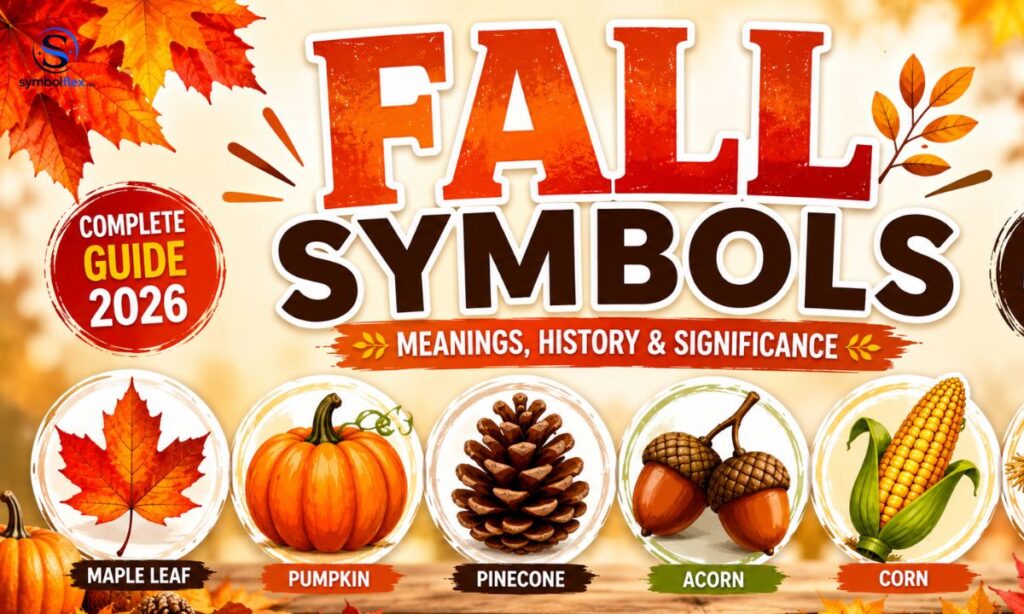
Fall symbols are visual markers, like falling leaves, pumpkins, and harvest wheat, that represent change, abundance, and letting go as summer fades into rest. There are over 39 fall and autumn symbols, from nature icons to modern fall emojis and aesthetic PNGs used daily on Instagram and in journals.
This guide covers it all: fall symbols text and emoji, the spiritual meaning of autumn, ancient roots like Samhain and the Demeter and Persephone myth, and pop culture picks like Destiny 2’s King’s Fall symbols. Autumn’s core symbolism is transformation, and you will see exactly why it shows up everywhere, from ancient farmland to your emoji keyboard.
What Are Fall Symbols?

Fall symbols are objects, colors, and images that visually or emotionally represent the autumn season and everything it stands for, including harvest, change, and the slowing down of nature. They function as shorthand: a single acorn or a maple leaf can instantly communicate an entire mood without a single word.
At their most basic level, fall symbols are drawn directly from nature. Falling leaves, pumpkins, acorns, scarecrows, and harvest sheaves of wheat or corn are the classic visual vocabulary of the season. These are not random choices. Each one reflects something farmers and communities genuinely experienced as summer ended: crops were gathered, fields emptied, trees shed their canopy, and animals prepared for scarcity. The symbol grew out of the lived reality of the season long before it became decorative.
But fall symbols also carry layered meaning beyond the literal. A pumpkin is not just a vegetable, it represents abundance and the reward of hard labor. A falling leaf is not just biology, it represents letting go. This dual nature, practical on the surface and symbolic underneath, is what makes autumn imagery so emotionally resonant compared to symbols tied to other seasons. People do not just decorate with fall symbols, they connect with them.
Modern fall symbols have also expanded into digital spaces. Fall emoji, autumn emoji combinations, and fall symbols PNG files are now searched by millions of people every September, proving that the same imagery farmers once relied on to track survival is now used to caption a coffee photo. The meaning has stretched, but the emotional core, transition and coziness, has stayed remarkably consistent.
Fall And Autumn Symbols For Text, Emojis And Designs
The most searched fall symbols today are not physical objects at all, they are digital ones: emojis, text characters, and downloadable graphics used for captions, journals, and design projects. This shift shows how autumn symbolism has adapted to how people actually communicate now.
Fall Symbols Text
Text based fall symbols are characters and unicode glyphs people copy and paste into bios, captions, or journals when emojis feel too casual. Leaf glyphs, small flame marks representing bonfires, and wheat stalk characters are common choices. These text symbols are popular in minimalist aesthetic pages, where a single small glyph next to a date or a quote adds seasonal flavor without cluttering the design.
Fall Symbols Emoji
The standard emoji keyboard actually offers a surprisingly rich autumn set: the maple leaf, the fallen leaf, the ear of corn, the mushroom, the chestnut, and the pumpkin all fall under this category.
The 🍂 fallen leaf emoji and the 🍁 maple leaf emoji are consistently the two most used symbols in autumn captions because they visually represent the exact moment of seasonal change rather than a fixed object like a pumpkin.
Fall Symbols Png
For anyone building a website, journal cover, or printable, transparent PNG fall symbols (leaves, pumpkins, acorns, wreaths) are essential design assets. These are popular among small business owners creating autumn themed products, from candle labels to greeting cards, because a clean transparent graphic can be layered onto any background instantly.
Fall Symbols Drawing
Hand drawn fall symbols, simple leaf outlines, pumpkin doodles, or acorn sketches, have become a major trend in bullet journaling and hand lettering communities. Unlike polished clip art, these drawings feel personal and are frequently shared as step by step tutorials for beginners who want to add a seasonal touch to planners without needing advanced art skills.
Autumn Emoji Combos
Popular autumn emoji combinations often pair a leaf with a drink, a candle, or a sweater to build a full “mood” in a single caption line, for example a pumpkin, a leaf, and a warm cup together. These combos are less about literal accuracy and more about triggering an emotional association with coziness and slowing down.
Fall Emojis Aesthetic, Aesthetic Fall Symbols, and Fall Symbols Clip Art
The word aesthetic in these searches points to a specific visual style: muted oranges, browns, and creams rather than bright cartoonish autumn colors. Aesthetic fall symbols favor watercolor style leaves, minimalist line art pumpkins, and soft toned clip art over the bold primary colored graphics common in children’s content. This distinction matters for designers, because using overly saturated clip art in an “aesthetic” context will immediately look mismatched to the audience searching for it.
Fall Emojis For Instagram

Instagram captions typically combine two to four fall emojis rather than a long string, since the platform’s algorithm and audience tend to favor clean, readable captions. The maple leaf, pumpkin, and a warm beverage are the most reliable combination for engagement during the September through November posting window.
Seasonal And Nature Symbols Of Fall
Nature provides the original and most enduring symbols of fall, and understanding them requires comparing autumn to the seasons around it. Symbols of fall exist in contrast to spring’s symbols of birth and winter’s symbols of dormancy, which is part of why autumn imagery feels so emotionally “in between.”
Winter symbols, snowflakes, bare trees, and ice, represent stillness and rest, the endpoint of the journey that fall symbols begin. Comparing the two seasons side by side clarifies why autumn imagery feels active and emotional while winter imagery feels quiet and final.
| Season | Core Symbols | Represents |
| Autumn | Falling leaves, pumpkins, acorns, harvest wheat | Change, abundance, letting go |
| Winter | Snowflakes, bare branches, frost | Rest, stillness, dormancy |
| Spring | Blossoms, seedlings, new leaves | Birth, renewal, growth |
| Summer | Full green canopy, sun, ripe fruit | Peak energy, abundance in progress |
Things that represent autumn almost always fall into two categories: the harvest (what is gathered) and the decline (what is released). Wheat, corn, and apples represent the harvest side, the reward of a full growing season. Falling leaves and bare branches represent the decline side, the visible proof that the cycle is turning. Understanding both halves is essential because most people only think of autumn as one or the other, when it is genuinely both at once.
Season fall symbols also vary slightly by region and climate. In areas with strong deciduous forests, the dominant symbol is the changing leaf. In agricultural regions, the dominant symbol is the harvest itself, corn stalks, hay bales, and threshed wheat. This regional variation is why “symbols for autumn” can look different depending on where a person grew up, even though the underlying emotional meaning, transition and gratitude, stays consistent across almost every culture.
Autumn Symbolism And Spiritual Meaning
Autumn’s spiritual meaning centers on release, gratitude, and preparation, making it one of the most psychologically rich seasons in folklore and personal reflection practices. What does autumn symbolize in a spiritual sense is rarely about the season itself, it is about what the season asks a person to do internally.
In many spiritual traditions, autumn is treated as an invitation to practice letting go the same way trees release their leaves without resistance. This idea shows up repeatedly in meditation and mindfulness communities, where autumn is used as a seasonal metaphor for releasing what no longer serves growth. The leaf does not cling to the branch out of fear, it falls because its purpose for that cycle is complete, and many spiritual teachers frame personal transitions, career changes, breakups, moving on from old habits, through this exact lens.
Autumn spiritual meaning is also deeply tied to gratitude. Harvest festivals across nearly every agricultural culture in history mark this same moment: a formal pause to acknowledge abundance before scarcity sets in. This is not coincidental. Thanksgiving in North America, harvest festivals across Europe, and Chuseok in Korea all cluster around the same seasonal window because human survival for most of history depended on correctly managing this exact transition from plenty to lean months.
Autumn In Literature And Creative Culture
Autumn symbolism in literature functions as one of the most reliable tools writers use to signal transition, mortality, or reflection without stating it directly. What does autumn symbolize in literature almost always ties back to one of three ideas: decline, harvest, or memory.
Poets across centuries have used the falling leaf as a stand in for mortality and the passage of time, precisely because the image does the emotional work that a direct statement cannot. A character walking through fallen leaves signals reflection to a reader almost instantly, without a single line of exposition needed.
This technique appears across English romantic poetry, American regionalist fiction, and East Asian seasonal poetry traditions like haiku, which frequently center on a single autumn image, a falling leaf or a harvest moon, to capture an entire emotional state.
Autumn is also frequently used in literature to represent the “third act” of a story, structurally mirroring the season’s place in the yearly cycle. Just as autumn sits between the fullness of summer and the emptiness of winter, autumn chapters in novels often mark the point where a character’s circumstances begin visibly changing before the final resolution. This structural use of the season is one of the more overlooked techniques in creative writing analysis, yet it shows up consistently once you start looking for it.
Cute And Simple Fall Symbol Ideas

Cute fall symbols are simplified, rounded, and often smiling versions of classic autumn imagery, designed to feel warm and approachable rather than realistic or somber. This style dominates children’s content, planner stickers, and casual social media graphics.
Simple fall symbols strip the season down to its most recognizable shapes: a rounded pumpkin with a curled stem, a basic three point leaf outline, or a small acorn with an oversized cap. The appeal of simplicity here is practical as much as aesthetic. Simple shapes are easier to draw by hand, easier to reproduce as stickers or stamps, and easier to recognize instantly at a small size, which matters enormously for icons and app graphics.
Cute fall symbols also tend to soften autumn’s more melancholic undertones. Where traditional autumn symbolism leans into loss and transition, cute interpretations focus almost entirely on coziness: warm drinks, soft sweaters, smiling pumpkins, and gentle leaf piles perfect for jumping into.
This is a meaningful shift worth noting for designers and content creators, since audience expectations differ sharply between someone searching for symbolic meaning and someone searching for a cute sticker pack, even though both searches use nearly identical keywords.
Gaming And Pop Culture Fall Symbols
Fall symbolism has extended well beyond nature and folklore into gaming culture, where the word “fall” often has nothing to do with the season at all. This is one of the most search confused areas of the topic, so it deserves direct clarification.
King’s Fall is a raid in the video game Destiny 2, and its “symbols” refer to a set of numeric glyphs, nine distinct icon designs mapped to numbers, used by players to solve puzzles and navigate the raid’s mechanics.
These are sometimes searched as Kells Fall symbols due to a common misspelling, or as Destiny King’s Fall symbols and King’s Fall symbols chart, referring to community made reference charts that map each glyph to its corresponding number. Locations tied to these symbols, including chest puzzles like the well known red chest, are a major part of why Destiny 2 King’s Fall symbols locations remains a frequently searched term among players rather than autumn enthusiasts.
Gravity Falls, meanwhile, is an entirely different reference, an animated mystery series set in a fictional Oregon town, where fans search for symbols tied to the show’s cipher puzzles and lore rather than seasonal decor. The overlap in phrasing with “fall symbols” creates significant search confusion, but the content itself has no connection to autumn symbolism whatsoever.
Deep Symbolic Meaning of Fall Symbols
Fall symbols carry meaning on three interconnected levels: spiritual, psychological, and cultural, and understanding all three explains why autumn imagery resonates so universally.
Spiritual Meaning
On the spiritual level, fall symbols represent impermanence. Buddhist and other contemplative traditions frequently reference the changing leaf as a teaching tool for accepting that nothing, no relationship, role, or circumstance, is meant to be permanent. This is not framed as pessimistic within these traditions, but as liberating, since accepting impermanence is often described as the path to reducing suffering caused by clinging.
Psychological Meaning
Psychologically, autumn symbols are strongly linked to reflection. Research on seasonal mood patterns consistently shows that shorter days and cooler temperatures naturally shift people toward more introspective states.
Fall symbols, the emptying tree, the gathered harvest, mirror this internal shift, which is part of why so many people report feeling more contemplative or nostalgic during September and October compared to the more outward, social energy of summer.
Cultural Meaning
Culturally, fall symbols function as markers of gratitude and community. Harvest festivals across the world, regardless of religion or geography, share a common structural purpose: publicly acknowledging that survival depended on collective effort and natural generosity. This cultural thread connects ancient Celtic harvest rites to modern autumn festivals, proving the symbolism has practical roots even where it has since become primarily decorative.
Types and Variations of Fall Symbols
Fall symbols can be organized into distinct categories, each carrying a slightly different shade of meaning within the broader theme of transition and harvest.
Falling leaves represent transition itself, the visible, ongoing process of change rather than a fixed state. Pumpkins represent abundance and reward, tied historically to successful harvests and, more recently, to festive gathering and celebration. Harvest sheaves of wheat and corn represent sustenance and provision, the literal food supply that determined whether a community would survive the coming winter.
Acorns represent potential and patience, a small seed that carries an entire future oak tree within it, often used symbolically to represent long term growth from small beginnings. Scarecrows represent protection and guardianship, a practical farm tool that evolved into a broader symbol of watching over what has been gathered.
Each of these symbols also carries secondary associations worth knowing. Acorns, for instance, appear in Norse and Celtic folklore as symbols of strength and endurance, since oak trees were considered sacred, long living species.
Scarecrows have shifted culturally too, moving from a purely functional farm object into a recurring figure in autumn storytelling and Halloween imagery, sometimes representing protection and sometimes, in darker retellings, representing isolation or being overlooked.
Fall Symbols Across Cultures

Fall symbolism is not universal in its specific imagery, but it is remarkably universal in its underlying meaning, transition, gratitude, and preparation, across nearly every culture that experiences seasonal change.
In Ancient Celtic culture, autumn centered on Samhain, a festival marking the end of the harvest season and the beginning of the darker half of the year. Samhain was considered a liminal time when the boundary between the world of the living and the spirit world was believed to thin, a concept that eventually influenced modern Halloween traditions.
In Ancient Greece, autumn was explained through the myth of Demeter and Persephone, where Persephone’s descent into the underworld caused Demeter, goddess of agriculture, to withdraw her blessing from the earth, resulting in the barren season. This myth was so central to Greek religious life that it formed the basis of the Eleusinian Mysteries, one of the most significant religious rites in the ancient world.
East Asian cultures developed their own rich autumn symbolism, often centered on the harvest moon and gratitude festivals, where families gather to give thanks for the year’s crops, a tradition echoed in similarly timed festivals across Korea and China.
Native American traditions across many nations similarly marked autumn with harvest ceremonies and corn based symbolism, reflecting corn’s central role as a staple crop across much of North America. In Medieval Europe, autumn was marked by practical harvest festivals tied closely to the agricultural calendar, blending pre-Christian seasonal customs with emerging Christian feast days, a pattern that shaped many modern autumn holidays still celebrated today.
Fall Symbols in Art, Movies, and Pop Culture
Autumn’s visual identity, gold and amber tones, falling leaves, harvest imagery, has become one of the most consistently used symbolic palettes across creative media. Painters have used autumn scenes for centuries specifically because the season offers a built in emotional shorthand: warmth fading into loss without needing a single word of explanation.
In film, directors frequently use an autumnal color grade, warm amber and orange tones, to signal nostalgia, endings, or a turning point in a story, even in scenes that are not literally set in autumn.
This technique borrows directly from the season’s natural symbolism and has become such a common visual language that audiences register the emotional cue almost subconsciously. Television and animation follow the same pattern, often opening a season or storyline set in autumn specifically to establish a tone of change before winter’s more final, dormant energy takes over.
Spiritual and Dream Meaning of Fall Symbols
In dream interpretation traditions, autumn imagery, falling leaves, harvest fields, bare trees, is generally associated with release, closure, and the natural end of a life chapter rather than loss in a negative sense.
A dream featuring falling leaves is often interpreted as the subconscious processing an ending that the dreamer has not yet consciously accepted, while a dream featuring a full harvest is more commonly linked to feelings of accomplishment or reward for sustained effort.
These interpretations are not scientifically validated, but they are culturally consistent across many independent dream symbolism traditions, which is itself notable. When unrelated cultural systems arrive at similar symbolic conclusions about the same imagery, it suggests the association is rooted in something broadly human rather than any single tradition’s invention, likely the same natural cycle of growth and release that shaped fall symbolism in mythology and folklore to begin with.
Positive vs Negative Meanings of Fall Symbols
Fall symbols carry a genuine duality that makes them more emotionally complex than symbols tied to most other seasons, since the same image can represent either reward or loss depending on context.
Positive:
- Abundance and reward for sustained effort, represented through harvest imagery
- Gratitude and community, represented through shared harvest festivals
- Wisdom and maturity, represented through the fullness of a completed cycle
Negative:
- Decline and loss, represented through bare branches and falling leaves
- Impermanence and mortality, a theme heavily used in literature and art
- Isolation, occasionally represented through imagery like an empty scarecrow watching over harvested fields
This duality is precisely why autumn resonates so strongly across such different contexts, from joyful harvest festivals to somber poetry about endings. Few seasonal symbol sets carry this much emotional range, and it is worth recognizing intentionally rather than treating fall symbolism as purely cozy or purely melancholic, since it is genuinely both depending on the moment.
Why Humans Are Drawn to Fall Symbols
People are drawn to fall symbols because autumn is the one season that visibly models a difficult truth everyone eventually has to accept: that beautiful things end, and that ending can still be meaningful rather than purely sad. This single idea explains far more about autumn’s enduring popularity than aesthetics alone ever could.
There is also a strong sensory and psychological pull. Cooler air, shorter days, and warmer colors trigger a documented shift toward comfort seeking behavior, cozy clothing, warm food, slower routines, which fall symbols visually represent and reinforce. This is part of why autumn consistently ranks among the most anticipated seasons in casual surveys and social media sentiment, despite technically being the season associated with decline.
Finally, fall symbols offer something rare: a socially acceptable, low pressure way to reflect on change. Talking openly about loss or transition can feel heavy, but decorating with pumpkins or posting a leaf emoji carries none of that weight while still, quietly, letting people process the same underlying feelings.
That combination, deep meaning wrapped in approachable, even cute imagery, is likely the single biggest reason fall symbols remain so consistently popular across generations, cultures, and now, digital platforms.
Frequently Asked Questions
What are fall symbols?
Fall symbols are visual markers like leaves, pumpkins, and wheat representing change, abundance, and nature’s seasonal transition.
What does autumn symbolize spiritually?
Autumn spiritually symbolizes letting go, gratitude, and wisdom, mirroring how trees release leaves without resistance or fear.
What is the most common symbol of fall?
The falling leaf is fall’s most common symbol, representing ongoing transition rather than a single fixed seasonal moment.
What are King’s Fall symbols in Destiny 2
King’s Fall symbols are nine numbered glyphs used by players to solve raid puzzles and locate hidden chests.
What do falling leaves symbolize in dreams?
Falling leaves in dreams often symbolize release and closure, reflecting an ending the dreamer hasn’t fully accepted yet.
Conclusion
Fall symbols endure because they do something few other seasonal images manage: they hold beauty and loss in the same breath. Whether you are searching for a fall emoji for a caption, a deeper understanding of autumn spiritual meaning, or a symbol chart for a video game raid with a similar name, the underlying appeal traces back to the same idea humans have returned to for thousands of years, from Celtic bonfires to Greek myths to a simple leaf falling past your window. Autumn does not ask us to ignore endings. It shows us, season after season, that they can be golden.
