

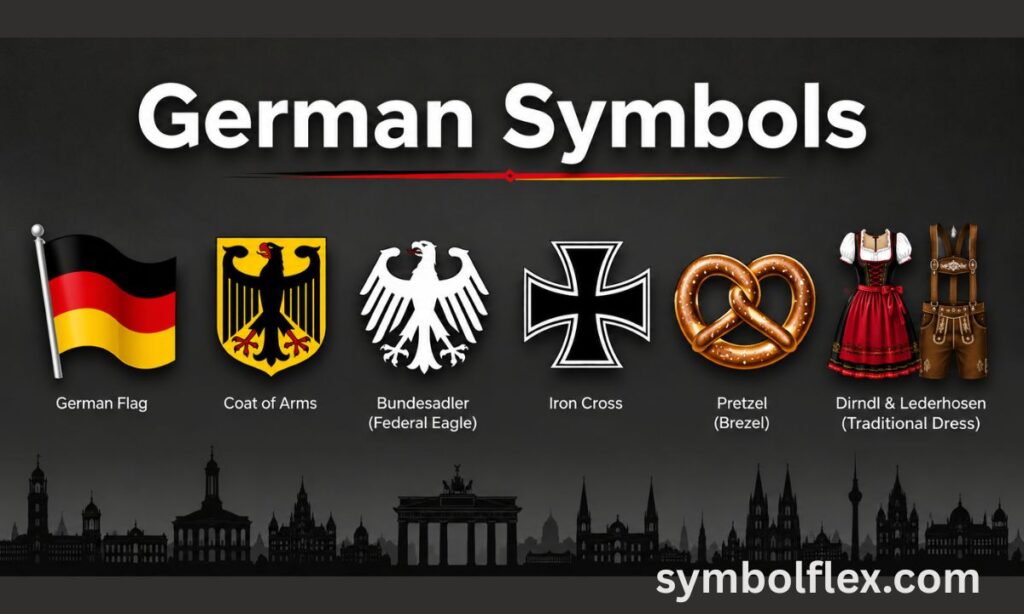
German symbols Germany ki poori history ko carry karte hain, Bronze Age carvings se lekar Germanic runes aur aaj ke black eagle passport emblem tak. Is topic mein search interest recently kaafi barh gaya hai, especially ancestry research, tattoo culture, aur simple curiosity ki wajah se ke ye symbols asal mein matlab kya rakhte hain. Ye guide 80+ symbols cover karti hai taake aapko scattered forum posts na parhne parein.
Sabse interesting baat ye hai ke ek single symbol jaise eagle emblem teen alag governments ke daur mein redesign, ban aur revive hua hai, aur har version us waqt ki Germany ke baare mein kuch bata raha hai. Chahe aap family heritage dhoond rahe hon, tattoo ka soch rahe hon, ya bas curiosity ho, ye article har ancient, historical, cultural aur modern German symbol ka clear matlab deta hai.
What are German Symbols?
German symbols are images, colors, objects, or marks that represent German history, identity, or values, ranging from ancient tribal carvings to today’s national emblem.
These symbols didn’t appear overnight. They developed in layers, much like the country itself. Early Germanic tribes used protective marks and runes carved into wood, stone, and bone. Centuries later, medieval kingdoms added coats of arms and heraldic eagles. The 19th and 20th centuries brought national flags, military decorations, and political emblems, some celebrated and some deeply painful.
What makes German cultural symbols worth studying is how they reflect real historical turning points. A symbol like the black eagle didn’t just appear as decoration. It survived empires, revolutions, a divided Germany, and reunification, changing shape each time to reflect a new political reality. That’s rare. Most national symbols stay static, but German symbolism actually documents change.
For American readers, understanding German symbols and their meanings also connects to something personal. Millions of Americans have German ancestry, and many are drawn to these symbols as a way of exploring heritage, whether through jewelry, tattoos, home décor, or simple curiosity about family history.
Ancient German Symbols And Their Hidden Stories
Long before Germany existed as a country, the people living in that region used symbols to mark territory, honor gods, and protect their homes and families.
Ancient German Symbols
Ancient German symbols date back to the pre-Christian era, when tribes across Central and Northern Europe carved marks into stone, wood, weapons, and jewelry.
Archaeologists have found these marks on burial urns, spearheads, and standing stones scattered across what is now Germany. Many of them weren’t decorative at all. They were believed to hold real power, offering protection in battle, luck in the harvest, or a connection to ancestors who had passed.
One thing that surprises a lot of people is how much these ancient symbols overlap with broader Northern European traditions. Germanic peoples were not isolated. They traded, fought, and intermarried with Norse, Celtic, and later Roman populations, and their symbols absorbed influence from all of them.
Germanic Tribe Symbols
Germanic tribe symbols were used by groups like the Saxons, Franks, Suebi, and Cherusci to mark identity, clan loyalty, and status within their communities.
Each tribe had its own visual language, though scholars have identified shared patterns across them. Warriors often carried personal marks on shields and weapons, both as identification in battle and as a kind of spiritual armor. Historical Roman writers, including Tacitus, documented some of these practices when describing Germanic tribes along the empire’s northern frontier.
Family and clan symbols mattered enormously in tribal society, since identity was tied to lineage rather than to a nation. A symbol carved into a doorpost or a piece of jewelry told a visitor exactly which family they were dealing with, and that mattered for trade, marriage, and alliance building.
Germanic Symbols
Germanic symbols is a broader term covering the shared visual culture of Germanic-speaking peoples across Northern Europe, including present day Germany, Scandinavia, and parts of the British Isles.
This is where things get interesting for anyone researching family history. Because Germanic tribes and Norse peoples shared linguistic and cultural roots, many symbols associated with Norse mythology (like certain runes) also appear in early German contexts. They’re not identical traditions, but they’re close cousins.
Modern historians are careful to separate genuine Germanic symbolism from later reinterpretations. In the 19th and 20th centuries, some of these ancient symbols were revived and, in a few unfortunate cases, distorted for political purposes. Understanding the original meaning matters, especially if you’re choosing a symbol for personal use today.
German Symbols And Meanings In Modern Culture
Modern Germany has streamlined its symbolic language into a smaller set of official emblems, but the culture around symbols is more visible today than at almost any point in the last century.
German Symbols And Meanings
Here’s a quick reference table covering some of the most searched German symbols and meanings.
| Symbol | Category | Core Meaning |
| Bundesadler (Federal Eagle) | National | Strength, unity, sovereignty |
| Black-Red-Gold Flag | National | Unity, freedom, democracy |
| Iron Cross | Military/Historical | Honor, sacrifice, duty |
| Oak Leaf | Cultural | Strength, endurance, loyalty |
| Edelweiss | Cultural | Purity, remembrance, alpine heritage |
| Ampelmännchen | East German/Modern | Nostalgia, regional identity |
These meanings didn’t come from a single source. They developed through centuries of use, and in many cases the same symbol carried different weight depending on the era. The oak leaf, for example, meant something different to a medieval forester than it did to a soldier receiving a military decoration.
German Symbolism
German symbolism as a broader concept refers to how meaning gets attached to visual marks within German culture, shaped by religion, politics, nature, and history all at once.
Unlike a lot of national symbolism, which tends to center around a single unifying myth, German symbolism is genuinely layered. You can trace almost every symbol back through multiple eras, and each era added or changed the meaning slightly. That’s part of what makes this topic so rich for research.
Symbols Of Germany
The official symbols of Germany today are limited to a handful of recognized national emblems, kept deliberately simple after the trauma of the 20th century.
The Federal Republic of Germany, established in 1949, made a conscious decision to move away from aggressive imperial and militaristic imagery. The result is a national symbol set that leans toward democratic, understated design rather than grandeur.
What Is The Symbol Of Germany?
The main symbol of Germany is the Bundesadler, the black federal eagle, shown with red talons and beak on a golden shield, representing strength, sovereignty, and democratic continuity.
You’ll find this eagle on official government buildings, the presidential standard, passports, and coins. It’s a deliberately softened redesign based on the Weimar Republic era eagle, chosen specifically because it broke from the harsher imperial and Nazi era versions that came before it.
German Symbols Text
German symbols text usually refers to special characters used in written German, including umlauts (ä, ö, ü) and the eszett (ß), along with decorative runic characters some designers borrow for aesthetic projects.
These aren’t just stylistic choices. Umlauts change pronunciation and meaning entirely, so getting them right matters if you’re using German text in a tattoo, design, or username.
German Symbols Letters
German symbols letters most often refers to old runic alphabets, particularly the Elder Futhark, which predates the Latin alphabet used in modern German writing.
Runes were originally a functional writing system, not purely decorative. Each letter also carried symbolic meaning tied to nature, fate, or protection, which is exactly why they remain popular in jewelry and tattoo design today.
German Symbols To Copy
If you’re looking for German symbols to copy and paste, here’s a simple reference list of commonly searched characters and marks:
- ä ö ü ß (German special letters)
- ᚦ ᚱ ᛟ ᛊ (commonly referenced runic characters)
- ⚜ (heraldic style symbol used decoratively)
- ✠ (Iron Cross style symbol, historically significant, use with awareness of context)
A quick caution here: some of these characters carry heavy historical weight. Copying a symbol for a username or bio is very different from understanding its full historical context, so it’s worth a little research before you use one publicly.
German Symbols Tattoos
German symbols tattoos typically draw from three sources: ancient runes, heraldic imagery like the eagle, and nature symbols like the oak leaf or edelweiss.
Tattoo artists report that clients most often request these symbols to honor German heritage, express personal strength, or mark a connection to family history. That said, there’s an important legal and ethical note here.
Certain symbols from the WWII era, including the swastika and specific SS insignia, are illegal to display publicly in Germany under Section 86a of the German Criminal Code, and are widely considered offensive elsewhere, including in the United States. If you’re considering a German symbols tattoo, sticking to genuinely ancient, cultural, or national symbols avoids this issue entirely while still honoring the heritage you’re after.
Iconic, Ancient And Historical German Symbols
Germany’s symbolic identity spans thousands of years, and some symbols have stayed remarkably consistent while others evolved dramatically with each new era.
Iconic German Symbols
The most recognizable iconic German symbols worldwide are the Bundesadler, the black-red-gold flag, and the Brandenburg Gate, which functions almost like a symbol in its own right despite being a physical structure.
These three show up constantly in American media, from news coverage of German elections to World Cup broadcasts, which is a big part of why they’re so instantly recognizable even to people with no direct connection to Germany.
Traditional German Symbols
Traditional German symbols include folk imagery tied to regional customs, such as the pretzel, the beer stein, and the oak tree, all of which carry cultural rather than political meaning.
The oak tree in particular has deep roots (literally and figuratively) in German tradition, historically associated with strength, endurance, and even sacred groves in pre-Christian belief.
Famous German Symbols
Famous German symbols tend to be the ones with global crossover appeal, things Americans recognize even without a background in German history, like the eagle emblem or the flag colors themselves.
Ancient German Symbols Tattoos
For tattoo purposes specifically, ancient German symbols tattoos usually pull from runic alphabets and tribal marks rather than national or political emblems, since these carry meaning without historical baggage.
Popular choices include individual runes tied to strength, protection, or journey, along with knotwork style designs inspired by early Germanic and broader Northern European art traditions.
Old German Symbols
Old German symbols from the medieval period include guild marks, city seals, and family crests, many of which are still visible on old buildings and churches across Germany today.
Medieval craftsmen used these marks to sign their work, almost like an early trademark system, and many German cities still display centuries-old coats of arms on official buildings.
Meaningful German Symbols
The most meaningful German symbols are usually the ones tied to values rather than politics, symbols representing unity, freedom, resilience, and craftsmanship.
German Symbols In War, Politics and Family
This is one of the more sensitive sections of German symbolism, and it deserves careful, factual treatment rather than glorification of any kind.
WW1 German Symbols
WW1 German symbols included the Iron Cross military decoration and the black-white-red flag of the German Empire, both tied to the imperial government under Kaiser Wilhelm II.
The Iron Cross itself dates back much further than World War I. <cite index=”10-1″>It was first established as a military decoration in the Kingdom of Prussia, with its black cross pattée design drawn from the insignia of the medieval Teutonic Order, worn by its knights as far back as the 13th century.</cite> By the time World War I began, it had already been awarded during earlier conflicts and was deeply embedded in German military tradition.
WW2 German Symbols
WW2 German symbols are the most historically sensitive category on this list, and they need to be understood strictly in an educational context, never as ordinary cultural imagery.
During this period, the Nazi regime co-opted and redesigned older German symbols for propaganda purposes. <cite index=”11-1″>The eagle emblem, for instance, was redesigned into a rigid, more aggressive geometric form and officially decreed Germany’s national symbol in 1935.</cite> <cite index=”10-1″>The Iron Cross itself was also altered during this era, with a swastika added to the design.</cite>
It’s important to be direct here: symbols from this specific era, particularly the swastika and SS insignia, are not neutral historical artifacts. They represent one of the most destructive ideologies in modern history, and displaying them is illegal in Germany and widely condemned elsewhere. Understanding this history matters, but it’s a completely separate category from the cultural and national symbols covered elsewhere in this guide.
WWII German Symbols
To avoid repeating the same ground twice, this section focuses on what happened after the war ended. <cite index=”11-1″>After 1945, the Federal Republic of Germany deliberately returned to a softer eagle design based on the earlier Weimar Republic version, intentionally stripped of the wreath and swastika imagery associated with the Nazi era.</cite> That decision reflects something important about how modern Germany handles its symbolic history: through conscious, deliberate rejection of the imagery associated with that period, not casual reuse.
East German Symbols
East German symbols refer to the distinct visual identity of the German Democratic Republic (GDR), which existed separately from West Germany between 1949 and 1990.
<cite index=”12-1″>Rather than using the traditional eagle, East Germany adopted a hammer and compass enclosed within a wreath of grain as its national emblem, with the hammer representing the working class, the compass representing intellectuals, and the grain representing farmers.</cite> This was a deliberate socialist rebranding, distinct from West Germany’s continuation of older symbolic traditions.
One East German symbol that’s genuinely beloved today, rather than politically loaded, is the Ampelmännchen, the little traffic light figure with a hat, which became a nostalgic pop culture icon after reunification and now appears on everything from t-shirts to street signs in Berlin.
German Symbols For Family
German symbols for family include the family crest or coat of arms tradition, along with folk symbols like the house blessing marks once carved above doorframes to protect a household.
Family crests, or Wappen, were originally tied to noble lineages, but the tradition expanded over time, and many German families, including immigrant families in the United States, have researched or commissioned crests connected to their surname and regional origin.
Popular German Symbols
The most popular German symbols searched online today blend history and modern relevance, with the eagle, the flag, and the Iron Cross topping most lists, followed closely by runic symbols for personal and tattoo use.
Deep Symbolic Meaning of German Symbols
Beyond the historical facts, German symbols carry layers of meaning that touch on spirituality, psychology, and shared cultural identity.
Spiritual Meaning
The spiritual meaning behind many ancient German and Germanic symbols centers on protection, connection to ancestors, and harmony with nature.
Pre-Christian Germanic spirituality was deeply tied to the natural world, with sacred groves, specific trees, and animals like the eagle or wolf carrying spiritual weight. Many of these associations survived, in folk form, well past the formal conversion to Christianity.
Psychological Meaning
On a psychological meaning level, symbols like the eagle or the oak tree tend to represent aspirational qualities, strength, resilience, freedom, and endurance, which is part of why they resonate with people choosing tattoos or personal emblems today.
There’s a well documented human tendency to seek out symbols that reflect the identity we want to project or the values we want to hold onto, and German symbols offer a particularly rich set of options for that kind of personal meaning making.
Cultural Meaning
The cultural meaning of German symbols is really about shared memory. A symbol like the black-red-gold flag doesn’t just represent a country; it represents a specific historical struggle for democracy and unity that Germans fought for across multiple generations.
Types / Variations of German Symbols
1. Federal Eagle (Bundesadler)
<cite index=”12-1″>The Bundesadler, depicted as a black eagle with red talons and beak on a golden field, symbolizes strength, unity, freedom, and resilience, with roots tracing back to the Roman Aquila standard adopted by Germanic tribes.</cite> <cite index=”13-1″>The eagle began appearing on German imperial banners as early as the 9th century, under Charlemagne and his successors.</cite>
2. Black-Red-Gold Flag
<cite index=”6-1″>The colour combination is generally traced to the uniforms of the Lützow Free Corps, a volunteer unit formed during the Napoleonic Wars, whose black uniforms featured red trim and golden brass details.</cite> <cite index=”3-1″>These colors became a symbol of national unity and civic freedom during the Hambach Festival of 1832 and were almost everywhere during the Revolution of 1848 and 1849.</cite>
3. Iron Cross (Eisernes Kreuz)
<cite index=”15-1″>King Frederick William III of Prussia established the Iron Cross as a military decoration on 17 March 1813, during the Napoleonic Wars, and it was later awarded again during the Franco Prussian War, World War I, and World War II.</cite> Today it remains the emblem of the modern Bundeswehr, redesigned after reunification in blue and silver for non military contexts.
4. Germanic Runes
Germanic runes form the Elder Futhark alphabet, a writing system used across Germanic speaking Europe before the widespread adoption of the Latin alphabet, with each rune carrying both a sound and a symbolic meaning tied to concepts like journey, protection, or fate.
5. Holy Roman Empire Eagle
<cite index=”13-1″>The Reichsadler, or Imperial Eagle, was derived from the Roman eagle standard and used by the Holy Roman Emperors, later carried forward through the German Empire, the Weimar Republic, and eventually reused, under a new name, by the modern Federal Republic of Germany.</cite>
German Symbols Across Cultures
Ancient Germanic Tribes
Germanic tribes developed their symbolic language independently in many respects, but they were never fully isolated from neighboring cultures, which shaped how their symbols evolved over centuries.
Roman Influence
<cite index=”12-1″>Roman contact introduced the eagle standard, the Aquila, to Germanic peoples, who eventually adopted and adapted it into their own emerging symbolic tradition.</cite> This is one of the clearest examples of cross cultural symbol borrowing in early European history.
Medieval Europe
Medieval Europe formalized German symbolism through heraldry, giving rise to the coat of arms tradition still visible in city seals, family crests, and church architecture across the country today.
Modern Europe
Modern Europe, especially after German reunification in 1990, reframed national symbols around democratic values rather than territorial power, a shift you can see clearly in the deliberately understated design of today’s Bundesadler.
Global Influence
German symbols have traveled well beyond Europe, showing up in American tattoo culture, heavy metal fashion, motorcycle subculture, and heritage focused jewelry design, often stripped of political context and embraced purely for their aesthetic and ancestral weight.
German Symbols in Art, Movies & Pop Culture
German symbols show up constantly in film and television, particularly in historical dramas set during the World Wars or the Cold War, where flags, uniforms, and emblems are used to establish setting instantly. Beyond film, German symbolism has heavily influenced graphic design, tattoo art, and even video game aesthetics, where runic alphabets and medieval crests are popular stylistic choices.
Fashion brands and streetwear designers have also borrowed from this visual language, particularly the Iron Cross shape, which crossed over into biker and rock culture decades ago and now exists almost entirely outside its original military context for many wearers.
Spiritual & Dream Meaning of German Symbols
When German symbols show up in dreams, particularly eagles or runic shapes, they’re commonly interpreted through the same lens as their waking symbolism: strength, protection, transformation, and a search for identity or ancestry.
Dream interpretation isn’t a science, but it’s worth noting that people who research their German heritage often report these symbols surfacing in dreams during periods of major life transition, which fits the broader pattern of eagles and protective marks representing personal power and change across many cultures, not just German ones.
Positive vs Negative Meaning
Positive Meanings
Most German symbols, especially the ancient, cultural, and modern national ones, carry overwhelmingly positive associations: unity, strength, freedom, craftsmanship, resilience, and heritage pride.
Negative Interpretations
A small but historically significant set of symbols from the Nazi era carry serious negative weight and remain illegal to display publicly in Germany. It’s worth repeating clearly: these symbols are not interchangeable with the broader German symbolic tradition, and treating them as ordinary cultural imagery misrepresents both German history and the millions of victims affected by that period.
Why Humans Are Attracted to German Symbols
People are drawn to German symbols for a mix of reasons that go beyond simple aesthetics. For many Americans with German ancestry, these symbols offer a tangible connection to family history that census records and old photographs can’t quite provide on their own.
There’s also a broader trend at play here: interest in ancestry and heritage has grown significantly in recent years, partly fueled by home DNA testing, and symbolic imagery is often the most emotionally resonant way people choose to express that discovered identity.
Beyond heritage, the sheer visual power of symbols like the eagle or ancient runes taps into something more universal, a human tendency to seek out marks that represent strength, protection, and continuity across generations.
Frequently Asked Questions
What is the most famous German symbol?
The Bundesadler, Germany’s black federal eagle, is the most recognized symbol, appearing on government buildings and official documents. (17 words)
What does the German eagle symbolize?
The German eagle symbolizes strength, sovereignty, and national unity, tracing back to Roman standards adopted by Germanic tribes. (17 words)
Are German WWII symbols illegal today?
Yes, certain Nazi era symbols like the swastika are illegal to display publicly in Germany under strict criminal law. (17 words)
What is the German symbol for family?
The family crest, or Wappen, traditionally represents German family lineage, still researched today by descendants of German immigrants. (17 words)
What do German runes mean?
German runes from the Elder Futhark alphabet carry both phonetic sounds and symbolic meanings tied to protection, journey, and fate.
Conclusion
German symbols carry an unusually honest historical record, one that includes triumph, struggle, and painful chapters the country has worked hard to reckon with openly. From ancient tribal marks and Germanic runes to the Bundesadler and the black-red-gold flag, each symbol tells you something real about where Germany has been and how it sees itself today.
Whether you’re researching family heritage, considering a tattoo, or just curious after seeing that eagle on a passport, understanding the full story behind these symbols makes them a lot more meaningful than a quick image search ever could. Which German symbol resonated with you the most? It’s worth sitting with that question for a minute, because the answer usually says something about what you value too.
