
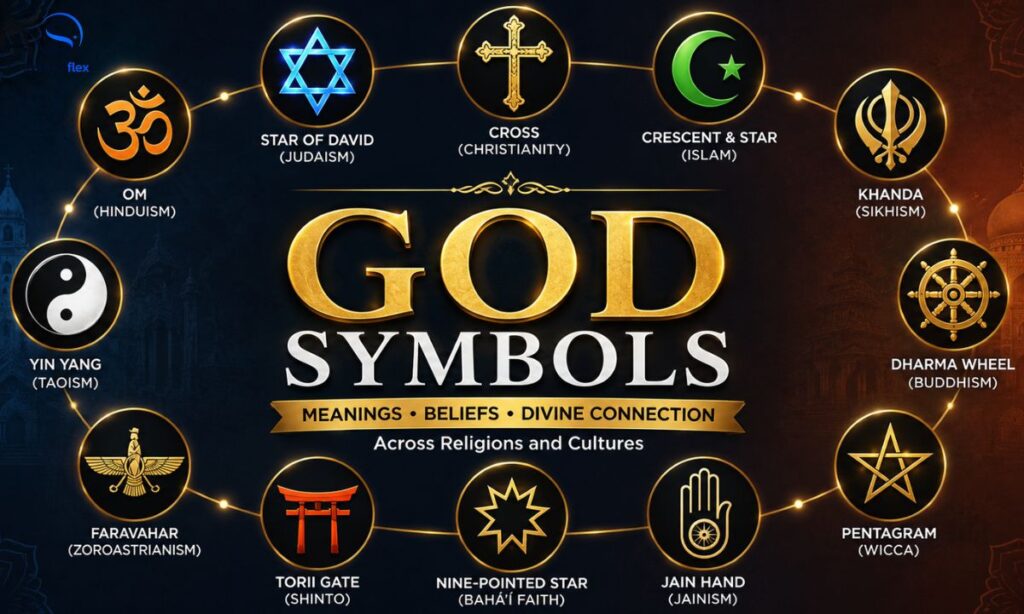
God symbols are visual marks, objects, or icons that represent a deity, a divine power, or a spiritual idea that goes beyond the physical world. People have used them for thousands of years to pray, protect themselves, mark sacred spaces, and feel connected to something bigger than everyday life.
If you have ever wondered why an ankh shows up on jewelry, why a lightning bolt means Zeus, or why the cross carries so much weight in Christian faith, you are in the right place. This guide walks through 56+ powerful God symbols from cultures all over the world, what they actually mean, and why they still matter today.
You will find Greek, Roman, Egyptian, Norse, Hindu, Aztec, and Christian symbols here, along with practical sections on copying and pasting symbols, tattoo ideas, and the deeper psychology behind why humans reach for symbols in the first place. Let’s get into it.
What Are God Symbols?

God symbols are images, objects, or signs used to represent a deity or a divine force, and every major religion and mythology has created its own version of them. They act as a kind of shorthand. Instead of describing a god’s full story every time, ancient people used a single image, like a lightning bolt or a sun disk, to instantly communicate who or what they meant.
This practice is far older than written language in many parts of the world. Cave paintings, carved totems, and early pottery show that humans were sketching symbolic representations of powerful forces long before they had an alphabet to write with. In ancient Egypt, for example, the ankh appeared on temple walls and tombs centuries before hieroglyphic writing became standardized into the complex system historians study today.
God Symbols You Can Copy And Use Easily
Many god symbols exist as actual Unicode characters, which means you can copy and paste them directly into texts, social media bios, or documents without needing an image. This section covers the most reliable ones and how to use them correctly.
Not every symbol you see online is a true Unicode character. Some are only available as images or custom fonts, which means they might show up as a blank box or a question mark on certain phones or browsers. Knowing the difference saves you from posting something that looks broken on someone else’s screen.
Below are some of the most searched and most reliable text based god symbols, along with quick notes on where they come from and how they typically get used.
God Symbols Text
Here are commonly used text based god symbols that render well across most modern devices:
- ☥ Ankh — ancient Egyptian symbol of life
- ☦ Orthodox Cross — used in Eastern Christianity
- ✡ Star of David — central symbol of Judaism
- ☪ Star and Crescent — associated with Islamic culture and several national flags
- ॐ Om — sacred sound and symbol in Hinduism, Buddhism, and Jainism
- ✝ Latin Cross — the most recognized Christian symbol worldwide
- ⚡ Lightning Bolt — commonly used to represent Zeus or Thor in casual, modern contexts
These characters are part of standard Unicode blocks, which is why they display correctly on nearly every smartphone, laptop, and tablet without needing a special font installed.
God Symbols Copy And Paste
If you just want a clean, ready to use list, here it is. Simply highlight and copy any of these:
☥ ☦ ✡ ☪ ॐ ✝ ⚡ ☯ ☽ ☀
A quick tip: if a symbol shows up as a box or blank square on your screen, it usually means your device’s default font does not support that particular character. Switching keyboards or using a Unicode enabled app usually solves this. These symbols work well in social media bios, journal entries, tattoo reference sketches, and even wedding invitations if you want a subtle nod to faith or heritage.
Powerful God Symbols And Meanings

The most powerful god symbols share one thing in common: they compress a huge, complicated idea into a single, instantly recognizable image. A lightning bolt does not just look cool, it represents sudden, uncontrollable power. A cross does not just mark a grave, it represents sacrifice and redemption to hundreds of millions of people.
Power, in the context of these symbols, usually falls into a few categories. Some represent physical force, like Thor’s hammer or Zeus’s thunderbolt. Others represent life and continuity, like the ankh or the tree of life. Still others represent wisdom, protection, or divine judgment, like the Eye of Horus or the scales associated with Ma’at in Egyptian belief.
God Symbols And Meanings
Here is a quick reference table of some of the most searched god symbols and what they represent:
| Symbol | Origin | Core Meaning |
| Ankh | Ancient Egypt | Eternal life |
| Eye of Horus | Ancient Egypt | Protection, healing |
| Trident | Greek (Poseidon) | Power over the sea |
| Lightning Bolt | Greek (Zeus) | Divine authority |
| Om | Hinduism | Sound of creation |
| Cross | Christianity | Sacrifice, faith |
| Mjölnir (Thor’s Hammer) | Norse | Strength, protection |
| Star of David | Judaism | Identity, covenant with God |
This table barely scratches the surface, but it shows how differently each culture chose to represent divine power. Some leaned on weapons, some on nature, and some on abstract sound or geometry.
Powerful Spiritual Symbols And Meanings
Not every powerful symbol is tied to a specific named god. Many spiritual symbols represent broader, more universal concepts of divinity, energy, or balance. The lotus flower, for instance, is deeply tied to spiritual awakening across Hindu and Buddhist traditions because it grows up through muddy water and blooms clean and untouched at the surface, a metaphor for enlightenment rising above struggle.
The third eye is another widely recognized spiritual symbol, representing inner vision, intuition, and awareness beyond ordinary sight. It shows up in Hindu iconography, particularly associated with Shiva, but has also been adopted more broadly in modern spiritual and wellness communities across the United States.
Mandalas, intricate circular designs used in Hindu and Buddhist meditation practices, represent the universe itself. Each ring and pattern within a mandala is thought to guide the mind toward a centered, meditative state, which is part of why mandala art has become so popular in adult coloring books and home decor in recent years.
Powerful Spiritual Symbols

Rounding out this category, a few more symbols consistently rank as powerful across belief systems:
- The evil eye, used across Mediterranean and Middle Eastern cultures to ward off jealousy and bad luck
- The hamsa hand, a protective palm shaped symbol found in both Jewish and Islamic traditions
- The all seeing eye, representing divine awareness and oversight
Each of these carries protective or awareness based meaning, showing a clear pattern: humans across very different regions independently developed symbols meant to guard against harm and represent watchfulness from a higher power.
Greek God Symbols And Meanings
Greek mythology remains one of the richest sources of god symbols, largely because each Olympian god was given a distinct, recognizable emblem tied to their domain. Zeus got the thunderbolt, Poseidon got the trident, and Athena got the owl, and these associations have stuck for over two thousand years.
Part of why Greek symbols remain so searched today comes down to pop culture. Between Percy Jackson novels, Marvel style adaptations, and video games like God of War, American audiences encounter these symbols constantly, often before they ever read the original myths.
It is worth noting that Greek mythology was not written down as a single unified text the way some religious traditions were. Instead, it developed through oral storytelling, regional variation, and different poets like Homer and Hesiod, which is part of why some symbols shift slightly depending on the source you check.
God Symbols Greek
The core lineup of recognizable Greek god symbols includes the thunderbolt for Zeus, the trident for Poseidon, the owl for Athena, the lyre for Apollo, and the caduceus for Hermes. Each of these appeared consistently on ancient pottery, coins, and temple carvings, which is how we know they were widely recognized symbols even in antiquity rather than modern inventions.
Greek God Symbols
Digging a bit deeper, Athena’s owl was not chosen randomly. Owls can see in near darkness, which the Greeks connected to Athena’s role as a goddess of wisdom and strategic insight, the ability to see clearly when others cannot. Similarly, Apollo’s lyre ties directly into his role as god of music, poetry, and the arts.
Hermes, the messenger god, carried the caduceus, a short staff with two intertwined snakes and wings at the top. Interestingly, the caduceus is often confused with the Rod of Asclepius, a single snake wrapped staff associated with medicine and healing, which is actually a different symbol entirely despite frequently being mixed up in modern medical logos.
Greek Gods Symbols And Meanings
Here is a slightly expanded reference:
| God | Symbol | Meaning |
| Zeus | Thunderbolt, eagle, oak tree | Authority, sky, kingship |
| Poseidon | Trident | Control over seas and earthquakes |
| Athena | Owl, olive tree | Wisdom, strategy |
| Apollo | Lyre, sun, laurel wreath | Music, prophecy, light |
| Hermes | Caduceus, winged sandals | Communication, travel, trade |
| Ares | Spear, vulture | War, aggression |
| Hades | Bident, Cerberus | The underworld |
Greek God Symbol
A common question people search is which single symbol counts as the most powerful Greek god symbol. There is no official ranking, but Zeus’s thunderbolt is generally considered the most dominant, since Zeus ruled as king of the Olympian gods and his weapon represented absolute, uncontestable authority over both gods and mortals.
Greek God Symbols Percy Jackson

Rick Riordan’s Percy Jackson series introduced an entire generation of American readers to Greek mythology through a modern lens. The books use classic symbols like Zeus’s lightning bolt, Poseidon’s trident, and Athena’s owl as actual plot devices, most famously the stolen master bolt that kicks off the first book’s entire storyline.
The series stays fairly accurate to traditional symbol associations, though it simplifies and modernizes certain details for a younger audience. Readers who enjoyed the books often go on to research the original mythology, which is part of why searches for Greek god symbols spike whenever a new book or show adaptation releases.
Symbols Of Greek God
Beyond the main Olympians, several secondary figures carry their own recognizable emblems. Dionysus, god of wine, is tied to the grapevine and thyrsus staff. Demeter, goddess of harvest, is represented by wheat and the cornucopia. These lesser searched symbols still appear frequently in classical art and are worth knowing if you want a fuller picture of Greek religious iconography.
Greek God Symbols Tattoos
Greek god tattoos remain consistently popular across the United States, and for good reason. The imagery is bold, instantly recognizable, and carries centuries of meaning packed into a single design. People often choose a specific god’s symbol based on personal identification, choosing Athena’s owl for wisdom, Ares’s spear for strength, or Apollo’s lyre for a creative or artistic identity.
Placement matters too. Smaller symbols like the trident or lightning bolt work well on wrists or ankles, while more detailed designs like a full owl or a portrait of a god tend to work better on larger areas like the forearm or back. As with any tattoo tied to religious or mythological imagery, it is worth doing a bit of research into the symbol’s actual meaning rather than choosing purely based on appearance.
Other God Symbols
Beyond Greek mythology, nearly every major civilization developed its own distinct set of god symbols, and comparing them side by side reveals fascinating overlaps in how humans think about divine power. This section covers Roman, Egyptian, Norse, Hindu, Aztec, and a few modern or fictional symbol systems.
Roman God Symbols
Roman mythology borrowed heavily from Greek mythology but renamed the gods and sometimes shifted their symbols slightly. Jupiter, the Roman equivalent of Zeus, kept the eagle and lightning bolt. Mars, equivalent to Ares, carried a spear, but unlike his Greek counterpart, Mars held a much more respected position in Roman culture since Rome saw itself as a warrior civilization founded by his sons, Romulus and Remus.
Egyptian God Symbols
Ancient Egyptian religion produced some of the most visually striking and enduring symbols in human history. The ankh, representing eternal life, remains one of the most recognized symbols in the world today, still used in jewelry and fashion thousands of years after it first appeared on temple walls. The Eye of Horus represented protection, healing, and royal power, and was often painted on ships and coffins to guard against harm.
Norse God Symbols
Norse mythology gave us Mjölnir, Thor’s hammer, one of the most popular symbols in modern tattoo culture and jewelry, largely thanks to Marvel’s movies but also due to a genuine revival of interest in Norse paganism, sometimes called Asatru, particularly in Scandinavian countries and parts of the United States. The Valknut, a symbol made of three interlocking triangles, is associated with Odin and the afterlife, though its exact original meaning remains debated among historians.
Hindu God Symbols
Hinduism offers one of the richest and most complex symbol systems in the world. Om, often written as ॐ, represents the primordial sound of the universe and is considered sacred across Hinduism, Buddhism, and Jainism alike. The trishul, a three pronged trident, belongs to Shiva and represents the balance of creation, preservation, and destruction.
Aztec God Symbols
Aztec cosmology centered heavily on Quetzalcoatl, the feathered serpent god, representing wind, wisdom, and the merging of earth and sky since the symbol combines a bird’s feathers with a snake’s body. The Aztec sun stone, often mistakenly called a calendar, actually held deep religious significance tied to cosmic cycles and sacrifice.
Chaos God Symbols
Unlike the other entries in this section, the Chaos Star, an eight pointed star symbol, does not come from ancient mythology at all. It was created in the 20th century, popularized through fantasy fiction and tabletop games, and later adopted by some modern chaos magic practitioners. It is worth knowing this distinction so you do not mistake it for an ancient religious symbol.
Zeus God Symbols
Zeus’s full symbol set goes beyond just the thunderbolt. He was also associated with the eagle, representing sight and authority from above, the oak tree, considered sacred at his oracle site in Dodona, and the bull, which he famously transformed into in several myths.
Apollo Greek God Symbols
Apollo’s symbols connect directly to his many roles as god of the sun, music, prophecy, and healing. The lyre represents music and poetry, the laurel wreath represents victory and honor, and the bow and arrow tie back to his role as a skilled archer, sometimes associated with plague and sometimes with protection depending on the myth.
Ares Greek God Symbols
Ares carried a spear and helmet as his primary emblems, along with animal associations to the vulture and dog, both scavenger or aggressive animals fitting for a war god who was, notably, not always portrayed favorably in Greek storytelling compared to more strategic war figures like Athena.
Apollo God Symbols And Ares God Symbols
Comparing the two reveals a clear contrast in how the Greeks viewed different aspects of conflict and order. Apollo represented controlled, purposeful power through music, prophecy, and light, while Ares represented raw, chaotic aggression through war and bloodshed. This contrast shows how Greek mythology used symbol pairs to explore complex human ideas about order versus chaos.
Greek God Symbols
A second wave of Greek deities also carry rich symbolic meaning, particularly figures tied to travel, the underworld, and nature, which are often searched separately from the main Olympian lineup.
Hermes God Symbols
Hermes’s primary symbol, the caduceus, features two snakes wrapped around a winged staff. He also carried winged sandals and a winged helmet, both representing his role as the fastest of the gods and messenger between Olympus and the mortal world.
Hermes Greek God Symbols
Beyond travel, Hermes also governed commerce, trade, and even thievery, which is why his symbols appear on ancient coins and boundary markers called herms, stone pillars placed at crossroads and borders throughout ancient Greece to invoke his protection over travelers.
Hades Greek God Symbols
Hades ruled the underworld, and his symbols reflect that domain directly. The bident, a two pronged staff, served as his signature weapon, distinct from Poseidon’s three pronged trident. Cerberus, the three headed guard dog, represented the boundary between the world of the living and the dead.
Hades God Symbols
It is worth correcting a common misconception here. Despite modern pop culture, particularly some video games and animated adaptations, portraying Hades as evil or villainous, ancient Greek religion did not actually view him this way. He was simply the god responsible for managing the afterlife, a necessary and respected role rather than a malevolent one.
Pan God Symbols
Pan, god of the wild and shepherds, is represented by the syrinx, or pan flute, along with goat legs and horns reflecting his half human, half goat appearance. He was closely tied to nature, spontaneity, and rural life, and his image later influenced how satyrs and similar nature spirits were depicted in later folklore.
Deity Symbol
The term deity symbol is slightly broader than god symbol, since it applies equally to goddesses and gender neutral divine figures rather than just male gods. This distinction matters in mythology research, since many powerful figures, like Athena or Isis, are goddesses with their own distinct symbol sets.
Symbol Of The Gods
Some symbols were recognized as representing divine power broadly, rather than one specific figure. The thunderbolt, the eye, and the sun all appear across multiple unrelated mythologies as general representations of divine authority, suggesting these particular images tap into something close to universal human intuition about what power and awareness look like.
Jesus Symbols
The most recognized symbol for Jesus is the cross, representing his crucifixion and, for Christians, his sacrifice for humanity’s redemption. Beyond the cross, several other symbols carry deep meaning within Christian tradition.
Symbol For Jesus
The fish symbol, known as the Ichthys, was used by early Christians, sometimes secretly, as a way to identify one another during periods of religious persecution in the Roman Empire. The Greek letters forming the word for fish also functioned as an acronym for “Jesus Christ, Son of God, Savior.”
Jesus Symbol
The lamb represents Jesus as a sacrificial figure, drawing on Old Testament sacrificial traditions and directly referenced in the New Testament phrase “Lamb of God.” This symbol appears frequently in stained glass windows and religious art throughout church history.
Jesus Symbols And Symbols For Jesus
Additional symbols include the shepherd’s staff, representing Jesus’s role guiding his followers, the dove, representing the Holy Spirit descending during his baptism, and the chi rho, formed from the first two Greek letters of “Christ,” widely used in early Christian art and later adopted into Roman imperial imagery after Emperor Constantine’s conversion.
Christian Symbols for God
Beyond symbols specifically tied to Jesus, Christianity uses several broader symbols to represent God the Father and the concept of the Holy Trinity as a whole.
God Symbols Christian
The Trinity knot, also called the triquetra, represents the three persons of God in Christian theology: Father, Son, and Holy Spirit, united as one continuous, unbroken shape. The Eye of Providence, an eye enclosed within a triangle, represents God’s watchful presence over creation and famously appears on the reverse side of the United States one dollar bill.
Symbol For God
When people search for a single symbol representing God, the answer usually comes back to the cross, simply because it is the most globally recognized Christian symbol, appearing on churches, flags, jewelry, and cemeteries across the world regardless of denomination.
Universal Symbol For God And Universal God Symbol
Whether a truly universal symbol for God exists across all religions is a genuinely interesting question. No single image is recognized by every faith, but certain concepts come close. Light, whether shown as the sun, a halo, or radiant rays, appears again and again across completely unrelated traditions to represent divine presence, suggesting that even without a shared symbol, cultures tend to reach for similar visual language when representing the divine.
God Symbols and Tattoos

Religious and mythological tattoos remain one of the most popular tattoo categories in the United States, with symbols chosen for personal meaning, heritage, or spiritual belief.
Symbols Of God
Popular choices include the cross for Christian faith, the Star of David for Jewish identity, the ankh for eternal life, and Om for spiritual balance. Each carries weight beyond simple decoration, often marking a significant personal or spiritual milestone for the person wearing it.
God Symbolism
The meaning behind a tattoo often shifts depending on placement and context. A small cross on the wrist might represent quiet, personal faith, while a large back piece depicting a full religious scene might represent a much deeper, more public declaration of belief.
Divine Symbols
Symbols like the halo and radiant light represent divinity broadly rather than one specific deity, and are frequently combined with other imagery in tattoo art, such as portraits or angel wings, to represent protection or connection to a higher power.
Divine Symbol
If someone is looking for a single symbol considered most broadly “divine,” the halo tends to top the list, since it visually communicates holiness across nearly every culture that has adopted the concept, even outside strictly Christian contexts.
Deep Symbolic Meaning of God Symbols
God symbols operate on more than one level at once: spiritual, psychological, and cultural, which is part of why they remain so powerful across thousands of years.
On a Spiritual Level
Spiritually, symbols act as focus points for prayer, meditation, and connection. Holding a small ankh pendant or tracing an Om symbol during meditation can help center attention and create a physical, tangible link to an abstract spiritual practice.
On a Psychological Level
Psychologist Carl Jung proposed that certain symbols function as archetypes, shared patterns embedded deep in human consciousness across cultures, which may explain why unrelated civilizations independently developed similar symbols for concepts like protection, power, and the eye of awareness. This idea offers one explanation for why symbols like the sun or the eye show up so consistently worldwide, even among cultures with no historical contact.
On a Cultural Level
Symbols also carry identity and belonging. For immigrant and diaspora communities in the United States, wearing a Star of David, a hamsa, or an Om pendant can serve as a quiet but meaningful connection to heritage, faith, and family history, especially for people living far from their ancestral homeland.
Types and Variations of God Symbols
Several god symbols have become so widely recognized that they function almost like visual shorthand across the entire world, instantly understood regardless of the viewer’s own religious background.
1. The Ankh
Originating in ancient Egypt, the ankh represents eternal life and appears constantly in temple carvings, jewelry, and modern fashion. Its distinctive loop and cross shape make it one of the most recognizable ancient symbols still in everyday use today.
2. The Eye of Horus
This symbol represents protection, healing, and royal power in ancient Egyptian belief. It differs from the similar looking Eye of Providence, which comes from Christian and Masonic tradition rather than Egyptian mythology, despite the visual similarity often causing confusion.
3. Om
Sacred across Hinduism, Buddhism, and Jainism, Om represents the sound of creation itself. It has become closely tied to yoga and meditation culture in the United States, often appearing on studio walls, mats, and jewelry far beyond its original religious context.
4. The Cross
The most recognized Christian symbol worldwide, representing sacrifice and redemption. Variations include the Celtic cross, blending Christian and older Celtic symbolism, and the Orthodox cross, used primarily in Eastern Christianity.
5. The Star of David
A central symbol of Jewish identity and faith, formed from two overlapping triangles. It represents the covenant between God and the Jewish people and appears on the flag of Israel today.
6. The Crescent and Star
Commonly associated with Islamic culture, though it is worth noting this symbol is more of a cultural and national emblem, appearing on several national flags, rather than a symbol mandated by Islamic religious texts themselves.
7. Thor’s Hammer
Known as Mjölnir, this Norse symbol represents strength and protection. It has seen a major modern revival, both through Marvel’s films and through a genuine resurgence of interest in Norse pagan spiritual practices.
God Symbols Across Cultures
Comparing god symbols across different civilizations reveals both fascinating differences and surprising similarities in how humans have tried to represent the divine.
Ancient Egypt
Egyptian religious life was deeply symbolic, with the ankh, Eye of Horus, and sun disk appearing constantly in daily religious practice, tomb art, and royal iconography, reflecting a culture where the line between the sacred and the everyday was thin.
Ancient Greece
Greek religion centered on the Olympian gods, each with a specific emblem tied to their domain, from Zeus’s thunderbolt to Athena’s owl, spreading through pottery, coinage, and temple architecture across the ancient Mediterranean world.
India
Hindu, Buddhist, and Jain symbols like Om, the lotus, and the trishul reflect a religious culture built around cycles of creation, preservation, and spiritual liberation, with symbols often carrying multiple layered meanings depending on context.
Abrahamic Traditions
Judaism, Christianity, and Islam each developed distinct core symbols, the Star of David, the cross, and the crescent moon respectively, despite sharing significant theological and historical roots as monotheistic faiths tracing back to a shared regional origin.
Norse and Celtic Cultures
Norse mythology gave the world Mjölnir and the Valknut, while Celtic tradition contributed symbols like the triquetra, later absorbed into Christian iconography as a representation of the Holy Trinity after Christianity spread through Celtic regions.
God Symbols in Art, Movies and Pop Culture
Modern entertainment has kept ancient god symbols alive and recognizable for entirely new generations. Percy Jackson introduced Greek symbols to millions of young American readers, while Marvel’s Thor films brought Mjölnir and Norse mythology into mainstream pop culture worldwide.
Video games have played an equally large role. The God of War series explores both Greek and Norse mythology in incredible visual detail, while Assassin’s Creed Odyssey lets players walk through recreated ancient Greek temples surrounded by accurate symbol depictions.
These portrayals are not always perfectly accurate to original mythology, but they spark genuine curiosity that often leads players and viewers to research the real historical and religious background afterward.
Spiritual and Dream Meaning of God Symbols
Dreaming about a god symbol, whether it is a cross, an ankh, or an Om, is a commonly searched but rarely deeply explained topic. Generally, dream interpretation frameworks suggest that seeing a religious or divine symbol in a dream reflects the dreamer’s subconscious search for guidance, reassurance, or clarity during a period of uncertainty.
A cross appearing in a dream is often interpreted as a sign of seeking forgiveness or moral clarity, while an ankh might reflect thoughts about mortality, renewal, or life transitions. These interpretations are not scientifically proven facts, but rather widely shared cultural frameworks that many people find personally meaningful when reflecting on their own dreams.
It is worth approaching dream symbolism with a balanced mindset. It can offer useful personal reflection without needing to be treated as a literal prophecy or guaranteed spiritual message.
Positive vs Negative Meaning
The same god symbol can carry very different meanings depending entirely on context. The inverted cross, for example, was historically used as a symbol of humility within Christianity, referencing the crucifixion of Saint Peter, who was said to have been crucified upside down because he felt unworthy of dying in the same manner as Jesus.
In modern popular culture, however, the inverted cross has been reappropriated, particularly within certain music and horror aesthetics, to represent rebellion or anti religious sentiment, a meaning almost entirely disconnected from its original historical context.
This pattern repeats across many symbols. The swastika, for instance, was a sacred symbol representing good fortune across Hindu, Buddhist, and Jain traditions for thousands of years before being tragically co opted in the 20th century, permanently altering its meaning in Western contexts despite its unrelated and much older positive origins in Eastern religions.
Why Humans Are Attracted to God Symbols
Humans consistently reach for symbols because abstract concepts like power, protection, and divinity are genuinely difficult to communicate through words alone. A single well designed symbol can convey an entire belief system faster than any sentence could.
Psychologically, symbols also offer comfort and identity. Wearing a religious or spiritual symbol can serve as a constant, physical reminder of personal values, faith, or heritage, something to return to during difficult moments. This need appears to be deeply rooted rather than a passing trend, given how consistently symbol based religious practice has appeared across every documented human civilization throughout history.
Jewelry and tattoo industries in the United States have both seen sustained interest in religious and spiritual symbolism over recent years, reflecting a broader cultural trend of people seeking personal meaning and connection through wearable, visible symbols rather than through text or verbal expression alone.
Frequently Asked Questions
What are God symbols?
God symbols are sacred signs representing divine power, faith, protection, creation, wisdom, and spiritual connection across cultures.
What is the most powerful symbol of God?
The most powerful God symbol depends on faith, but crosses, Om, and sacred names hold deep spiritual significance.
Why are God symbols important?
God symbols help people express faith, understand spiritual teachings, connect with divine energy, and remember sacred beliefs.
What does the eye symbol of God mean?
The Eye of Providence commonly represents divine watchfulness, protection, guidance, and God’s awareness of human actions and life.
Can God symbols have different meanings?
Yes, God symbols can have different meanings depending on religion, culture, historical traditions, personal beliefs, and spiritual practices.
Conclusion
From the ankh in ancient Egypt to Thor’s hammer in modern Marvel films, god symbols have carried meaning across thousands of years and dozens of cultures. Whether you are drawn to Greek mythology, Christian iconography, Hindu spirituality, or Norse tradition, these symbols all share a common thread: humanity’s ongoing search for connection with something greater than itself.
Whichever symbol resonates with you personally, whether tied to your own faith, your heritage, or simply an image that speaks to you, taking the time to understand its real history and meaning makes it far more powerful than treating it as decoration alone.
