

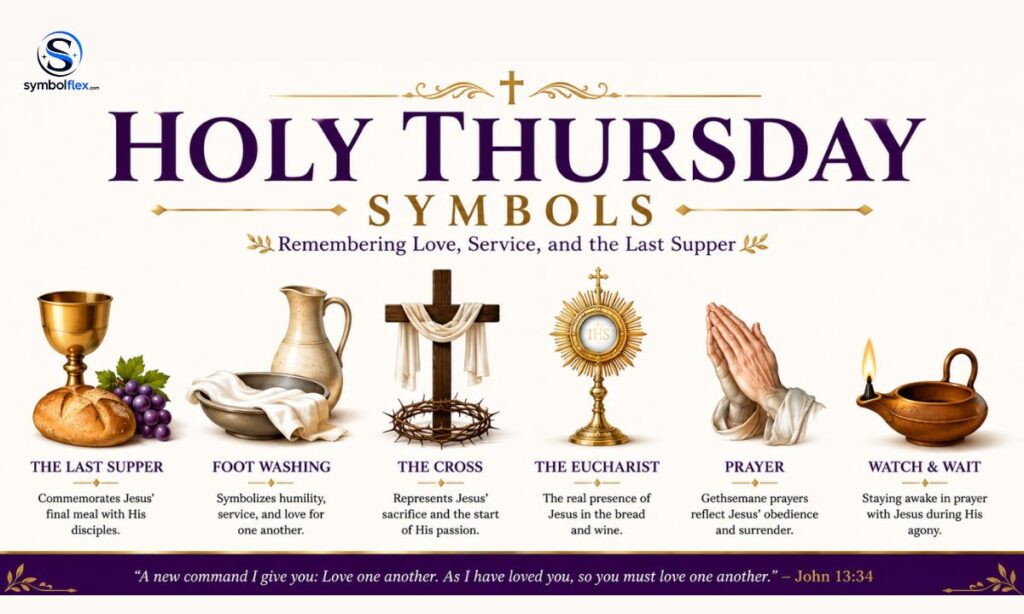
Holy Thursday symbols are trending again in 2026 as more people search for the deeper meaning behind this sacred day. From the bread and wine to the basin and towel, each symbol traces back to the Last Supper and Christ’s humility. Searches for “Maundy Thursday symbols” and “Holy Thursday meaning” are climbing, especially among younger Catholics reconnecting with their faith.
The Eucharist remains the theological centerpiece, while the washing of feet and the stripped altar create visuals people remember for years. With Maundy Thursday falling on April 2, 2026, this guide breaks down 101+ symbols and what they truly mean, across Catholic, Anglican, and global Christian tradition.
What Are Holy Thursday Symbols?

Holy Thursday symbols are the physical objects and ritual actions the Church uses to represent the events of the Last Supper and the beginning of the Easter Triduum. They include the bread and wine of the Eucharist, the basin and towel from the foot washing, the chalice, and the stripping of the altar at the end of Mass.
These symbols work on two levels at once. On the surface, they’re simple, everyday items: bread, water, cloth, wine. But in the context of Holy Thursday, each one points to a deeper spiritual truth about sacrifice, service, and covenant. That’s part of why the day resonates with so many people, even those outside the Catholic tradition.
You’ll notice that Holy Thursday symbols aren’t random. Every single one traces back to a specific moment in the Gospel accounts. The bread and wine come from the moment Jesus says “this is my body” and “this is my blood.” The basin and towel come from John’s Gospel, where Jesus washes his disciples’ feet. Nothing here is decorative for decoration’s sake, and that intentionality is what gives the day its emotional weight.
Holy Thursday Meaning And Symbolism
Holy Thursday marks the night before Jesus Christ’s crucifixion, when he instituted the Eucharist and demonstrated servant leadership by washing his disciples’ feet. The symbolism centers on sacrifice, humility, and covenant, three themes that repeat throughout the day’s rituals.
Holy Thursday Meaning
At its core, Holy Thursday is about a meal that changed everything. Jesus gathered his twelve closest followers in an upper room in Jerusalem, and during that meal, he transformed an ordinary Passover supper into something entirely new. He took bread, blessed it, and said it was his body. He took wine and called it his blood, poured out for the forgiveness of sins.
This moment is what Catholics and many other Christians call the institution of the Eucharist, the sacrament that remains central to Sunday Mass today. Holy Thursday isn’t a one-time historical footnote. It’s the origin story of a ritual practiced weekly, sometimes daily, in churches around the world.
There’s also a second, equally important event that happened that night: the washing of feet. Before the meal, Jesus took off his outer garment, wrapped a towel around his waist, and washed the feet of his disciples, including Peter, who initially refused. This act flipped the social order of the time on its head. Teachers didn’t wash the feet of students. Masters didn’t wash the feet of servants. Jesus did it anyway, and he told his followers to do the same for one another.
Thursday Symbolism
Thursday itself holds a specific place in the Holy Week timeline. It sits between Wednesday, sometimes called “Spy Wednesday” because of Judas’s betrayal arrangement, and Good Friday, the day of the crucifixion. That positioning matters. Holy Thursday is the calm before the storm, a night of intimacy and instruction right before events turn violent and tragic.
Some scholars and theologians point out that the timing lines up with the Jewish Passover, or Pesach, which commemorates the Israelites’ escape from slavery in Egypt. Jesus and his disciples were almost certainly observing a Passover meal, or something very close to it, which adds another layer of meaning. The old covenant tied to Passover lamb and unleavened bread becomes, in Christian theology, the new covenant tied to Christ’s body and blood.
Thursday also carries symbolic weight simply because it’s the last full day before the crucifixion. Everything that happens on this day, the meal, the washing, the prayer in the Garden of Gethsemane, the arrest, builds toward Good Friday. It’s a day of transition, and that sense of movement toward something bigger is baked into how churches structure their liturgy.
Happy Holy Thursday
A lot of people search for the right way to greet someone on this day, and honestly, the phrasing trips people up more than you’d expect. “Happy Holy Thursday” is commonly used in casual conversation and on social media, but some Catholics prefer “Blessed Holy Thursday” since the day involves solemn events like betrayal and the beginning of Christ’s passion.
If you’re sending a message to a Catholic friend or coworker, a simple, respectful option works best. Something like “Wishing you a meaningful Holy Thursday” or “Blessed Maundy Thursday to you and your family” tends to land well across denominations. Avoid overly festive language, since this isn’t a celebratory holiday like Easter Sunday.
Different church communities handle this differently, too. In many US parishes, especially those with strong Filipino, Latino, or Italian American congregations, greetings tend to lean more solemn and reflective. Protestant and Anglican communities that use the term “Maundy Thursday” often keep greetings simple and scripture focused, sometimes referencing John 13:34, the verse where Jesus gives his new commandment.
Holy Week Symbols And Meanings

Holy Week runs from Palm Sunday through Easter Sunday, and each day carries its own set of symbols that build a complete narrative of Christ’s final days. Understanding how Holy Thursday fits into this bigger picture helps explain why its symbols carry the weight they do.
Holy Week Symbols And Meanings
Palm Sunday opens the week with palm branches, symbolizing Jesus’s triumphant entry into Jerusalem. Holy Wednesday, sometimes called Spy Wednesday, is tied to coins, referencing Judas’s betrayal for thirty pieces of silver.
Holy Thursday follows with bread, wine, and the basin and towel. Good Friday brings the cross and crown of thorns. Holy Saturday is marked by silence and the Paschal candle, unlit until the Easter Vigil. Easter Sunday closes the week with the empty tomb and the lily, both symbols of resurrection.
| Day | Primary Symbol | Meaning |
| Palm Sunday | Palm branches | Triumphant entry, kingship |
| Spy Wednesday | Thirty silver coins | Betrayal |
| Holy Thursday | Bread, wine, basin, towel | Eucharist, humility, service |
| Good Friday | Cross, crown of thorns | Sacrifice, suffering |
| Holy Saturday | Extinguished candle, silence | Waiting, death |
| Easter Sunday | Empty tomb, lily | Resurrection, new life |
Seeing the whole week laid out like this makes it obvious why Holy Thursday matters so much. It’s the emotional pivot point. Everything before it builds anticipation, and everything after it moves toward suffering and then, eventually, joy.
Good Friday Symbol

The cross stands as the defining Good Friday symbol, representing both the method of Christ’s execution and, paradoxically, the ultimate symbol of Christian hope and redemption. The crown of thorns, placed on Jesus’s head by Roman soldiers as a mockery of his claimed kingship, is another core Good Friday image.
Good Friday symbolism connects directly back to Holy Thursday. The bread broken at the Last Supper foreshadows the body broken on the cross. The wine poured out anticipates the blood shed during the crucifixion.
Without understanding Holy Thursday, Good Friday loses a lot of its context, which is exactly why the Church treats these two days as part of one continuous liturgical event called the Triduum, along with Holy Saturday.
Holy Thursday Symbols Catholic
In the Catholic Church, Holy Thursday symbols are formalized through the Mass of the Lord’s Supper, a specific liturgy celebrated on this day that includes ritual foot washing, the transfer of the Eucharist to an altar of repose, and the stripping of the main altar afterward.
Holy Thursday Symbols Catholic
The Mass of the Lord’s Supper is unlike any other Mass in the Catholic calendar. It typically begins in the evening, reflecting the timing of the original Last Supper. The priest often wears white vestments, a color associated with joy and purity, which stands in contrast to the somber events the liturgy commemorates.
One of the most visually striking Catholic Holy Thursday symbols is the Mandatum, the ritual foot washing performed during Mass. In many US parishes, the priest washes the feet of twelve parishioners, mirroring Christ washing the feet of the twelve apostles. This tradition dates back centuries and was formally reintroduced into the modern Roman Missal in the 1950s.
After Communion, there’s no formal dismissal. Instead, the Eucharist is processed to a specially decorated altar of repose, sometimes in a side chapel, where the faithful are invited to keep watch in prayer, echoing Jesus’s request to his disciples in Gethsemane to “stay awake and pray.” The main altar is then stripped bare, and any bells or organ music go silent until the Easter Vigil.
Catholic Holy Thursday Symbols
Beyond the Mass itself, several other Catholic Holy Thursday symbols carry deep meaning. The chrism oil, blessed earlier in the week during the Chrism Mass, is used throughout the year for baptisms, confirmations, and ordinations. This oil represents the Holy Spirit’s presence and is closely tied to Holy Thursday because many dioceses celebrate the Chrism Mass on this same day, gathering priests from across the diocese with their bishop.
The tabernacle, normally the resting place for consecrated hosts, is left empty and open after Holy Thursday Mass, another visual cue that something significant has shifted. Sanctuary lamps, which usually burn continuously to indicate Christ’s presence in the tabernacle, are extinguished.
Regional traditions add even more texture. In several US dioceses with large Filipino and Latino communities, parishioners practice the Visita Iglesia, visiting multiple churches on Holy Thursday night to pray before the altar of repose at each location. This custom, brought over by immigrant communities, has become a meaningful part of Holy Thursday observance in cities across the country.
Maundy Thursday Symbols Explained
Maundy Thursday and Holy Thursday refer to the exact same day and the exact same events. The term “Maundy” is used more often in Anglican, Lutheran, and some Protestant traditions, while “Holy Thursday” is the more common term in Catholic circles, particularly in the United States.
Maundy Thursday Symbols
The core symbols under the Maundy Thursday name are identical to those used in Catholic tradition: bread, wine, the basin and towel, and the concept of commandment, since “Maundy” literally references Christ’s new commandment to love one another.
Symbols Of Maundy Thursday
Anglican and Episcopal churches in the US often place special emphasis on the foot washing ceremony, sometimes inviting the entire congregation to participate rather than a symbolic twelve. This communal approach to the ritual underscores the idea that servant leadership isn’t reserved for clergy alone.
Maundy Thursday Symbol
If you had to pick just one image most associated with Maundy Thursday specifically, it would likely be the towel and basin, since the term itself is rooted in the commandment given right after that act of service.
Maundy Thursday Holy Thursday Symbols
The confusion between these two names is extremely common, and honestly, it makes sense. Different denominations settled on different terminology over centuries, but they’re commemorating the same night, the same meal, and the same set of actions. Catholic, Orthodox, Anglican, Lutheran, and many other Christian traditions all mark this day, even if the name and some ritual details vary slightly.
Symbols Of Holy Thursday
Here’s a comprehensive list covering the full range of symbols tied to this day, organized by category so you can find exactly what you’re looking for.
Symbols Of Holy Thursday
The full list of recognized Holy Thursday symbols includes: bread, wine, the chalice, the basin, the towel, the Twelve Apostles, the stripped altar, the chrism oil, the Paschal lamb, the upper room, the extinguished sanctuary lamp, and the color white, among others.
Symbols For Holy Thursday
Many families use simplified versions of these symbols at home, especially those observing Holy Thursday outside of formal Mass. A shared meal with bread and wine, a foot washing between family members, or lighting a single candle can all serve as meaningful, accessible symbols for personal or household observance.
Holy Thursday Symbol
When people search for “the” Holy Thursday symbol, singular, they’re usually asking about the Eucharist, specifically the bread and wine, since this represents the central theological event of the day: the institution of Communion.
Symbol For Holy Thursday
Another commonly searched variation, this phrasing typically points toward the same answer: the chalice and host, which together represent the ongoing sacrament Catholics receive at every Mass.
Symbol Of Holy Thursday
Some search intent here leans toward the stripped altar specifically, since it’s such a visually jarring and memorable image for anyone who has attended the Mass of the Lord’s Supper in person.
Last Supper And Eucharist Symbols
The Last Supper is where Holy Thursday’s most important symbols originate, and the Eucharist, the sacrament of bread and wine, remains the day’s central focus.
Last Supper Holy Thursday Symbols
Leonardo da Vinci’s famous painting The Last Supper, housed in Milan, Italy, has shaped how many Americans visualize this event, even though the painting is a Renaissance interpretation rather than a historically accurate depiction.
The scene captures the moment Jesus announces that one of his twelve disciples will betray him, and each apostle’s reaction adds emotional depth to the symbolism of the meal.
Supper Holy Thursday Symbols

The meal itself likely followed Jewish Passover customs, which include unleavened bread, wine, and specific ritual foods like bitter herbs. This connection between Passover and the Last Supper is a point often highlighted by biblical scholars, since it frames Christ’s actions as a fulfillment of Jewish tradition rather than a break from it.
Holy Eucharist Holy Thursday Symbols
The doctrine of transubstantiation, the Catholic belief that bread and wine become the actual body and blood of Christ during Mass, traces directly back to the words Jesus spoke at this meal. This is one of the most theologically significant claims in Catholic teaching, and Holy Thursday is the day the Church specifically commemorates its origin.
Washing Of Feet Symbols
Foot washing symbolizes humility, servant leadership, and Christ’s command that his followers serve one another the way he served them.
Feet Holy Thursday Symbols
In first century Judea, feet were considered unclean, exposed to dust and dirt from unpaved roads and open sandals. Washing someone’s feet was typically a task assigned to the lowest servant in a household, which is exactly why Jesus performing this act shocked his disciples so deeply.
Washing Holy Thursday Symbols
The act of washing itself symbolizes cleansing and renewal, themes that echo baptism. Some theologians draw a direct line between the foot washing and baptismal imagery, since both involve water and represent a kind of spiritual purification.
Washing Feet Holy Thursday Symbols
During the ceremony, the presiding minister kneels, an unusual posture for clergy, and pours water over each participant’s feet before drying them with a towel. This physical act of kneeling reinforces the message far more powerfully than words alone could.
Jesus Washing Feet Holy Thursday Symbols
According to John’s Gospel, when Jesus approached Peter to wash his feet, Peter initially refused, saying Jesus should never wash his feet. Jesus responded that unless he washed him, Peter would have no part with him, prompting Peter to ask for his hands and head washed too. This exchange highlights the tension between human pride and the radical humility Jesus modeled that night.
Creative And Visual Symbols
Holy Thursday’s visual language extends well beyond the church sanctuary into art, graphic design, and church communications.
Clipart Holy Thursday Symbols
Churches and religious educators frequently use clipart versions of the chalice, bread, towel, and basin for bulletins, worship guides, and children’s ministry materials. Popular icons include a simple loaf and cup, hands washing feet, and the number twelve stylized in various ways to represent the apostles.
Action Holy Thursday Symbols
Beyond static images, Holy Thursday is defined by action symbols, meaning gestures and movements rather than objects. Kneeling, breaking bread, pouring wine, and extinguishing candles are all considered action symbols, and they often carry just as much meaning as the physical items themselves.
Holy Thursday Images And Downloads
Visual resources for Holy Thursday are in high demand every year, particularly among churches preparing bulletins and social media content.
Holy Thursday Images Free Download
If you’re looking for free, legally usable images, stick to sources that explicitly offer public domain or Creative Commons licensed religious art. Many US parishes maintain their own image libraries or subscribe to Catholic media services specifically to avoid copyright issues with commercial stock photography.
Maundy Thursday Images 2026

Maundy Thursday falls on April 2, 2026, based on the Western Christian calendar. Churches planning ahead for that date often start gathering and updating their visual materials well in advance, especially for bulletins, social graphics, and printed worship aids.
Deep Symbolic Meaning
Taken together, Holy Thursday’s symbols tell a unified story about covenant, sacrifice, and service. The bread and wine establish a new relationship between God and humanity. The basin and towel show what that relationship should look like in practice. The stripped altar reminds worshippers that glory, in Christian theology, often comes through suffering first.
This layered meaning is part of why Holy Thursday resonates so strongly even among people who aren’t deeply religious. The themes, sacrifice for others, humility in leadership, and the tension between celebration and grief, are universal human experiences, not exclusively theological concepts.
Types / Variations of Holy Thursday Symbols
The Bread and Wine
Representing Christ’s body and blood, this is the foundational symbol of the Eucharist and the most theologically central element of the entire day.
The Basin and Towel
Symbols of humility and service, these objects represent the command to serve others without regard for status or hierarchy.
The Chalice
The cup used during the Last Supper, symbolizing the New Covenant sealed through Christ’s sacrifice.
The Twelve Disciples
Representing the foundation of the Church, the twelve apostles symbolize both the original community of believers and, by extension, apostolic succession in Catholic teaching.
The Stripped Altar
Symbolizing abandonment and the beginning of Christ’s passion, the bare altar visually marks the transition from the Last Supper’s intimacy to the isolation of the crucifixion narrative.
Holy Thursday Symbols Across Cultures
Observance of Holy Thursday varies significantly across Christian traditions and countries. In the Philippines, the Visita Iglesia tradition draws massive crowds who travel between multiple churches. In Spain, elaborate processions with religious statues, called pasos, move through city streets. In several Latin American countries, Holy Thursday includes both solemn Mass attendance and, in some regions, complete closure of businesses.
Here in the United States, these international customs have blended into local parish life, especially in cities with large immigrant Catholic populations. It’s common to see a single US parish combine traditional American Catholic practice with elements brought over from Filipino, Mexican, Italian, or Polish communities, creating a distinctly American expression of a very old tradition.
Holy Thursday Symbols in Art, Movies and Pop Culture
Beyond da Vinci’s famous painting, Holy Thursday imagery appears throughout Western art history, from medieval illuminated manuscripts to Baroque depictions by artists like Tintoretto and Rubens. These works consistently return to the same core images: the meal, the washing of feet, and the chalice.
In film, biblical epics and passion narratives, including various adaptations spanning decades of American and international cinema, tend to dramatize the Last Supper as a turning point scene, often using it to build tension before the crucifixion sequence.
Even outside explicitly religious media, references to “the last supper” as a cultural shorthand for a final gathering before major change show up regularly in television and film, a testament to how deeply this imagery has embedded itself in broader Western culture.
Spiritual and Dream Meaning of Holy Thursday Symbols
People sometimes report dreaming about bread, feet washing, or betrayal themes around Holy Week, and there’s genuine interest in what these images might represent psychologically or spiritually. Bread in dreams is often interpreted as a symbol of sustenance, community, or provision.
Feet washing imagery can reflect a desire for humility or a need to serve others more selflessly. Betrayal themes, understandably common given the Judas narrative tied to this week, may reflect anxiety about trust in waking relationships.
It’s worth noting that dream interpretation isn’t an exact science, and these readings draw more from general psychological and folk traditions than from any official Church teaching. Still, the fact that so many people search for this connection shows how deeply Holy Thursday symbolism has worked its way into the collective imagination, well beyond formal religious practice.
Positive vs Negative Meaning
Holy Thursday symbols carry both uplifting and sobering dimensions, and that tension is part of what makes the day so powerful. On the positive side, the bread and wine represent unity, nourishment, and covenant. The basin and towel represent humility, service, and love in action.
On the more difficult side, the day also carries symbols of betrayal, Judas’s departure from the table, and abandonment, Peter’s later denial and the disciples’ eventual scattering in the Garden of Gethsemane. Holy Thursday doesn’t shy away from human weakness. It presents both extraordinary love and painful failure in the same narrative, which is part of why so many people find it relatable.
Why Humans Are Attracted to This Symbol
There’s a psychological reason rituals like these have survived for thousands of years. Shared meals, physical touch through service, and clear visual storytelling all tap into deep human needs for connection, meaning, and belonging. Anthropologists and sociologists of religion have long noted that ritual symbols function as a kind of collective memory device, passing down complex ideas in a form that’s easy to remember and repeat generation after generation.
Holy Thursday symbols work precisely because they’re grounded in ordinary, physical experience. Everyone understands what it means to share a meal or wash someone’s feet. That accessibility, combined with the depth of meaning layered on top, is a big part of why these traditions remain relevant to millions of Americans today, whether they attend Mass every week or only step into a church once a year.
Frequently Asked Questions
What is the main symbol of Holy Thursday?
The bread and wine of the Eucharist are widely considered the central symbol of Holy Thursday, since they represent the institution of Communion at the Last Supper.
Why is foot washing important on Holy Thursday?
Foot washing represents humility and servant leadership, modeling Jesus’s command that his followers serve one another rather than seek positions of status or honor.
What does the stripped altar mean?
The stripped altar symbolizes the abandonment and suffering Jesus experienced leading up to the crucifixion, marking the transition from the Last Supper into the somber events of Good Friday.
Are Holy Thursday symbols only religious?
While rooted in Christian theology, many Holy Thursday symbols, like shared meals and acts of humble service, carry broader human meaning that resonates even outside formal religious practice.
What do these symbols mean in dreams?
Dream interpretations tied to Holy Thursday imagery, such as bread or foot washing, are generally rooted in folk psychology rather than official Church teaching, often reflecting themes of community, humility, or trust.
Conclusion
Holy Thursday symbols carry an unusual amount of weight for such simple, everyday objects. Bread, wine, water, and cloth become vessels for some of the most profound ideas in Christian theology: sacrifice, humility, covenant, and service. Whether you encounter these symbols in a packed Catholic parish, an Anglican Maundy Thursday service, or simply in a painting hanging in a museum, they all point back to the same night and the same message.
If you’re preparing for Holy Thursday this year, consider taking a moment to sit with these symbols rather than rushing past them. Notice the bread and wine. Pay attention if you witness a foot washing. Watch the altar go bare. These small, deliberate acts have carried meaning for centuries, and understanding them a little more deeply can make the day feel far richer than it did before.
