
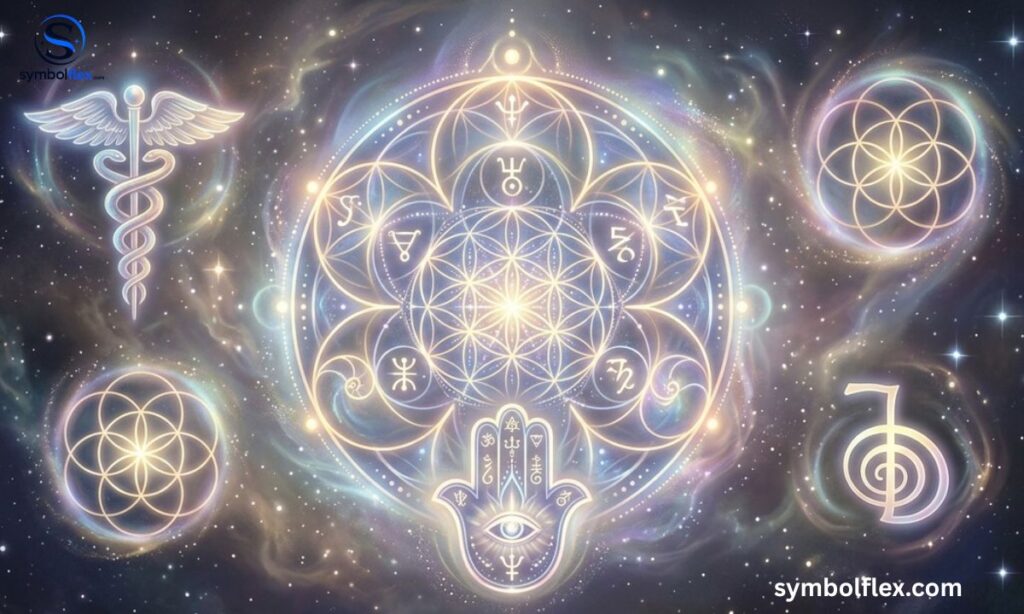
Healing symbols like the lotus flower, ankh, and spiral have represented recovery, protection, and inner peace for centuries. Interest in spiritual healing symbols and healing symbol tattoos keeps growing as people search for meaningful ways to process grief and personal growth. From ancient Egyptian symbols to modern Reiki healing symbols, this guide breaks down over 100 healing symbols and what they truly mean.
You’ll explore sacred geometry, Celtic, and Native American healing traditions, and see why shapes like circles and spirals appear across unconnected cultures. Quick fact: the ankh dates back more than 5,000 years to ancient Egypt, representing the breath of life.
What Are Healing Symbols?

Healing symbols are images or marks that carry meaning beyond their visual form, representing recovery, protection, renewal, or spiritual strength. They are different from ordinary signs because a sign points to one specific thing, while a symbol carries layered, often personal meaning.
Think about the difference between a stop sign and a lotus flower. A stop sign means exactly one thing to everyone who sees it. A lotus flower might mean spiritual awakening to one person, recovery from illness to another, and simple beauty to someone else. That flexibility is exactly what makes healing symbolism so powerful. It bends to fit the person using it.
Spiritual and Healing Symbols Tattoos
A healing symbol tattoo is a permanent way to mark a personal turning point, whether that’s recovering from illness, surviving grief, or choosing sobriety. Tattoos work differently than jewelry or art on a wall because they live on the body, which makes them feel more like a personal statement than a decoration.
People choose healing symbol tattoos for very specific reasons. Some want a daily reminder of how far they’ve come. Others want something private, placed somewhere only they see it, as a quiet form of self-encouragement.
A 2021 survey by the Pew Research Center found that roughly three in ten American adults have at least one tattoo, and a meaningful share of those cite personal growth or a life event as their reason for getting inked.
Healing Symbols Tattoos
The most requested healing tattoo designs tend to be simple and versatile: the lotus flower, the semicolon (representing a sentence, and a life, that continues), the phoenix, the ankh, and the mandala. Each one carries its own emotional weight, but they share a common thread of transformation.
Placement matters almost as much as the symbol itself. A small ankh on the wrist stays visible as a daily reminder, while a large mandala across the back or shoulder often represents a bigger, more private healing journey.
Tattoo artists frequently report that clients request these designs after a major life event, which is part of why healing symbolism has become such a consistent category in modern tattoo culture rather than a passing trend.
Tattoos About Healing
Tattoos chosen specifically to mark a recovery milestone, like finishing cancer treatment, leaving an abusive relationship, or reaching a year of sobriety, tend to follow a different emotional pattern than symbols chosen just for their aesthetic appeal. These tattoos often get planned around a specific date or anniversary.
Common choices in this category include broken chain designs (freedom from addiction), anchor symbols (staying grounded through hard times), and single feathers (lightness after carrying a heavy burden). Many people pair these images with a short word or date to anchor the meaning even further.
Strength Healing Symbols Tattoos

Symbols tied to resilience, like the lion, the mountain, the arrow, and the unbreakable knot, appeal to people who want their healing story to also communicate power rather than only softness. An arrow, for example, only moves forward after being pulled backward, which makes it a popular metaphor for setbacks that eventually lead to progress.
The mountain symbol works similarly. It represents both the difficulty of the climb and the achievement of reaching the top, which is why it’s a favorite among people recovering from long term illness or major surgery.
These designs tend to use bold lines and minimal detail, which keeps them readable at a glance and gives them a strong, confident look on the skin.
Spiritual Strength Healing Symbols Tattoos
Symbols that blend faith and resilience, such as a cross combined with a lotus, or an om symbol paired with a lion, speak to people who want their healing to reflect both personal strength and spiritual belief. These combination designs are more custom by nature, since they mix two symbol systems into one piece.
It’s worth noting that combining symbols from different cultures calls for some care. A symbol sacred to one culture, like a specific Native American medicine wheel design, shouldn’t be casually mixed with unrelated imagery without understanding its origin. Respectful research before getting a tattoo protects both the meaning and the culture behind it.
Healing Symbols And Meanings With Ancient And Spiritual Origins
Healing symbols carry different meanings depending on which culture and era they came from, even when the images look similar on the surface. A spiral in Celtic art means something different than a spiral in Native American sand painting, even though both represent cycles of life.
Understanding the origin of a symbol changes how you use it. A symbol pulled from its original context and slapped onto a mug or a tattoo without any understanding of its history often loses the depth that made it meaningful in the first place. This section works as a reference point before diving into the deeper cultural sections later in this guide.
Healing Symbols And Meanings
| Symbol | Common Meaning |
| Lotus Flower | Rising above hardship, purity, spiritual awakening |
| Ankh | Life force, protection, eternal breath |
| Tree of Life | Growth, connection, resilience |
| Spiral | Life cycles, personal growth, energy flow |
| Feather | Lightness, freedom, release |
| Caduceus | Medicine, balance, protection from illness |
This quick reference table gives you a starting point, but each symbol has far more depth than a single line can capture, which is exactly what the rest of this guide unpacks.
Symbols For Healing
Symbols people choose specifically during an active healing journey, like recovering from illness or processing a breakup, tend to focus on movement and change rather than static protection. The butterfly is a strong example. Its entire life cycle is a metaphor for transformation, from a grounded caterpillar to something that can fly.
Water is another common choice, representing cleansing and the washing away of pain. Across nearly every culture studied by anthropologists, water shows up as a purification symbol, which suggests this connection runs deeper than any single tradition.
Symbols Meaning Healing

When people search for a single symbol that means healing, they’re often hoping for a universal answer, but the honest truth is that no one symbol holds that title across every culture. The closest candidates are the lotus flower, the ankh, and the caduceus, each carrying strong healing associations in different parts of the world.
What matters more than finding “the one” symbol is finding one that resonates with your own story. A symbol chosen because it genuinely means something to you will always carry more weight than one chosen simply because it’s popular.
Symbols That Represent Healing
Nature provides some of the most universal healing imagery: the rising sun (new beginnings), the rainbow (hope after a storm), and the feather (release of burden). These symbols require no religious background to understand, which is part of why they translate so well across cultures.
Animal symbols also carry strong healing associations. The deer represents gentleness and grace through hardship in several Native American traditions, while the phoenix, originally from Greek mythology, represents rebirth from destruction.
Symbolism For Healing
Color and shape both affect how a symbol is read. Gold tends to represent divine energy and lasting value, while silver is more closely tied to reflection and emotional healing. Circular shapes suggest wholeness and continuity, while sharp, angular shapes tend to represent protection or breaking free from something.
Material matters too. A symbol carved in stone feels permanent and grounded, while the same symbol drawn in watercolor feels soft and in progress, which is why artists choose their medium carefully when creating healing focused artwork.
Healing Symbol
If someone asks whether there’s a single, universal healing symbol, the most accurate answer is no.
Healing symbolism is inherently plural because human cultures developed their visual languages independently, often without contact with one another, yet arrived at strikingly similar ideas like circles, spirals, and light representing recovery.
That overlap is itself meaningful. It suggests that certain visual patterns speak to something shared in human psychology, not just cultural coincidence.
Healing Symbolism
Symbolism as a concept works because the human brain is wired to find and remember patterns. A repeated image, seen often enough, starts to carry emotional weight beyond its literal shape. This is the same mechanism behind brand logos, religious icons, and, yes, healing symbols.
Healing symbolism specifically taps into hope, memory, and identity. It gives people a way to externalize an internal process, which researchers in psychology describe as a form of externalization, a technique also used in talk therapy to help people process difficult emotions.
Spiritual And Cultural Healing Symbols From Around The World
Spiritual healing symbols connect a person’s recovery process to something larger than themselves, whether that’s a higher power, universal energy, or ancestral tradition. This section covers the major systems and cultures behind the world’s most recognized healing symbols.
Every tradition covered here developed independently, shaped by its own geography, religion, and history. Reading them side by side reveals how differently, and how similarly, cultures have approached the same universal human need to heal.
Spiritual Symbol For Healing
A spiritual healing symbol differs from a purely decorative one because it’s tied to belief, ritual, or practice rather than just appearance.
The om symbol, for example, isn’t just a nice shape. It represents the primordial sound of the universe in Hindu and Buddhist tradition, chanted during meditation to align mind and body.
Spiritual Healing Symbols
Beyond om, common spiritual healing symbols include the hamsa (protection from negative energy, used across Middle Eastern and North African cultures), the cross (redemption and restoration in Christianity), the Star of David (divine protection in Judaism), and the dharma wheel (the path toward enlightenment in Buddhism).
These symbols matter to millions of people worldwide, and their staying power over centuries speaks to how deeply symbolic thinking is woven into human spirituality.
Energy Healing Symbols
Energy healing is based on the idea that the body has a life force, sometimes called qi, prana, or chi depending on the tradition, that can become blocked or imbalanced. Symbols used in energy healing are meant to help redirect or unblock that flow.
Chakra symbols are the most well known example in the West. Each of the seven chakras, from the root to the crown, has its own symbol and color, representing a different aspect of physical or emotional well being.
Pranic Healing Symbols

Pranic healing, developed by Master Choa Kok Sui in the 1980s, uses the body’s energy field, or aura, as the basis for treatment. Practitioners use hand movements and visualization rather than fixed symbols in the way Reiki does, though color visualization (green for cleansing, violet for transformation) plays a similar symbolic role.
Reiki Healing Symbols
Reiki, a Japanese healing practice developed by Mikao Usui in the early 1900s, uses a specific set of sacred symbols that practitioners learn during formal training.
The four traditional symbols are Cho Ku Rei (power), Sei He Ki (harmony and emotional healing), Hon Sha Ze Sho Nen (distance healing), and Dai Ko Myo (master symbol, representing enlightenment).
Reiki Healing Symbols And Meanings
Each Reiki symbol is used for a specific purpose during a session. Cho Ku Rei is often drawn first to increase the power of the energy being channeled.
Sei He Ki addresses emotional and mental healing specifically, which is why practitioners often use it when a client is working through anxiety or grief rather than physical pain alone.
Healing Symbols Reiki
Modern Reiki practitioners sometimes adapt these traditional symbols into jewelry or art for clients to keep as a reminder between sessions, though the symbols themselves are traditionally taught only through Reiki attunement, a formal training process passed from teacher to student.
Sekhem Healing Symbols
Sekhem, also written as SKHM, is an energy healing system that claims ancient Egyptian roots, though its modern form was developed in the 20th century.
Its symbols differ from Reiki’s, focusing more on the concept of universal life force as described in Egyptian spiritual tradition.
Sacred Geometry Healing Symbols
Sacred geometry refers to patterns believed to represent the fundamental structure of the universe.
The Flower of Life, Metatron’s Cube, and the Seed of Life are the most recognized examples, often used in meditation art because their symmetry is thought to promote a sense of calm and order.
Ancient Healing Symbols
Ancient cultures across the globe, often with no contact with one another, developed remarkably similar healing symbols built around circles, spirals, and light. This pattern shows up in cave paintings, pottery, and early religious carvings from Europe to Asia to the Americas.
Ancient Egyptian Healing Symbols
The ankh, the Eye of Horus, and the scarab beetle are the three most iconic Egyptian healing symbols.
The Eye of Horus was specifically associated with protection and restoration, and ancient Egyptian physicians reportedly used fractions based on parts of the eye symbol in medical calculations, an early link between symbolism and practical medicine.
Egyptian Healing Symbols
Beyond the well known trio, the Djed pillar (stability and strength) and the lotus (rebirth, since the flower closes at night and reopens each morning) round out Egypt’s healing symbol system, both frequently found in tomb art meant to guide the dead toward renewal in the afterlife.
Celtic Healing Symbols
The triquetra (three interlocking loops representing mind, body, and spirit) and the Celtic tree of life (representing the connection between the physical and spiritual world) are the most recognized Celtic healing symbols, both drawing heavily on the Celtic belief that nature and spirit were never separate.
Native American Healing Symbols
The medicine wheel, representing balance between the physical, emotional, mental, and spiritual self, is one of the most widely recognized Native American healing symbols.
It’s important to note that specific designs vary significantly between tribes, so treating “Native American symbols” as one single system oversimplifies a wide range of distinct traditions.
Shamanic Healing Symbols
Shamanic traditions, found across Siberia, the Americas, and parts of Asia, often use spirit animal imagery and dreamcatchers as healing tools, believed to filter out negative energy while a person sleeps and allow positive energy through.
Symbols Of Healers
Historically, healers themselves were often marked by specific symbols of their role, like the caduceus and the Rod of Asclepius. These two symbols are frequently confused with one another, even in modern medical branding.
Healing Symbols Witchcraft
Modern witchcraft and folk healing practices often use the pentacle (protection and balance of the five elements), moon phases (emotional cycles and intuition), and herbs like sage and rosemary, burned or carried as tools for cleansing negative energy.
Healed Symbol
While most searches focus on symbols of an ongoing healing process, some people specifically look for symbols marking the completion of healing.
The phoenix rising from ashes, a sunrise breaking over a horizon, and a butterfly fully emerged from its cocoon all represent that finished, arrived feeling rather than the struggle of getting there.
Healing Symbols In Nature And Visual Inspiration
Nature has always been one of the richest sources of healing symbolism, since the natural cycles of growth, decay, and renewal mirror the human healing process almost exactly.
Symbols Of Healing In Nature
Trees represent steady growth and deep roots through storms. Rivers represent constant movement forward, even through obstacles.
The changing seasons represent that difficult periods are temporary, always followed by renewal. These aren’t abstract metaphors. They’re patterns people have observed and leaned on for comfort since long before written history.
Healing Symbols Pictures
When people search for healing symbol images, they’re usually drawn to specific visual styles: minimalist line art for a modern, understated look, watercolor designs for something softer and more emotional, and mandala patterns for detailed, meditative pieces. The style someone chooses often says as much about their personality as the symbol itself.
Symbols Of Healing
Bringing the nature and visual threads together, the most enduring symbols of healing share three qualities: simplicity, movement, and a connection to something larger than the individual.
That combination is what allows a symbol to stay meaningful over generations rather than fading into a passing trend.
Deep Symbolic Meaning
Healing symbols work on more than one level simultaneously, operating spiritually, psychologically, and culturally all at once, even when the person using them only consciously registers one of those layers.
Spiritual Level
On a spiritual level, symbols connect the individual to something beyond the self, whether that’s a specific deity, universal energy, or the idea of fate. This connection often provides comfort precisely because it removes the sense that healing is something a person has to manage entirely alone.
Psychological Level
On a psychological level, symbols support what therapists call externalization, giving shape to an internal experience so it becomes easier to process.
This is part of why grief counselors sometimes recommend creating or choosing a symbol during bereavement, as a way to hold onto memory without being overwhelmed by it every time it’s recalled.
Cultural Level
On a cultural level, the same symbol can carry very different weight depending on where a person grew up. A lotus flower might be a deeply religious image to someone raised in a Buddhist household and simply a pretty flower to someone else, which is why context always matters when interpreting symbolic meaning.
Types and Variations of Healing Symbols
These six symbols come up more often than any others in healing symbolism research, spanning multiple continents and thousands of years of continuous use.
1. The Ankh
Originating in ancient Egypt over 5,000 years ago, the ankh represents the breath of life and was frequently carved into tombs and temple walls as a symbol of eternal vitality. It remains one of the most recognized healing symbols in the world today, often worn as jewelry.
2. The Lotus Flower
Sacred in both Buddhism and Hinduism, the lotus represents rising above hardship because of its unique growth pattern: it takes root in muddy water yet blooms perfectly clean above the surface. That contrast between where it starts and where it ends up is exactly why it resonates so strongly with people in recovery.
3. The Caduceus
Often mistaken for the medical symbol of Asclepius (a single snake wound around a staff), the caduceus actually features two snakes and wings, and originally represented Hermes, the Greek messenger god, rather than medicine specifically. This mix up is so common that even some hospitals have used the wrong symbol in their branding.
4. The Reiki Symbols
As covered earlier, the four traditional Reiki symbols each serve a distinct purpose during a healing session, from amplifying energy to supporting emotional balance, and remain central to Reiki practice worldwide today.
5. The Tree of Life
Appearing in Celtic, Norse, and Kabbalah traditions alike, the Tree of Life represents the connection between roots (the past and ancestry) and branches (growth and future potential), making it one of the most cross culturally consistent healing symbols in existence.
6. The Spiral
Found in Native American sand art and Celtic stone carvings alike, the spiral represents the cyclical nature of growth and healing, the idea that we don’t heal in a straight line but circle back through similar lessons as we move forward.
Healing Symbols Across Cultures
Comparing healing traditions side by side highlights both the differences and the surprising overlap between cultures that had no historical contact with one another.
Ancient Egypt
Egyptian healing symbolism centered on the afterlife and eternal renewal, with the ankh and Eye of Horus as its clearest examples.
India
Indian healing symbolism draws heavily from Hindu and Buddhist tradition, with the lotus and om as its most recognized symbols, both tied closely to meditation and spiritual practice.
China
Chinese healing symbolism centers on balance, most visibly through the yin and yang symbol, representing the idea that health depends on equilibrium between opposing forces.
Celtic Culture
Celtic healing symbolism draws from nature and interconnectedness, with the triquetra and tree of life reflecting a worldview where spirit and nature were never separate.
Native American Traditions
Native American healing symbolism, while varying by tribe, commonly centers on balance and the medicine wheel, reflecting a holistic view of physical, emotional, mental, and spiritual health.
Healing Symbols in Art, Movies and Pop Culture
Healing symbols have moved well beyond religious and ceremonial use into mainstream art, film, and fashion. Tattoo culture, jewelry brands, and album covers regularly borrow from ancient symbol systems, sometimes with real understanding of their origin and sometimes not.
Films dealing with grief, recovery, or transformation frequently lean on visual symbolism, using imagery like butterflies, light breaking through darkness, or water to represent a character’s internal healing arc without needing to say it out loud.
This kind of visual storytelling works precisely because these symbols already carry shared meaning in the viewer’s mind.
Spiritual and Dream Meaning of Healing Symbols
Dreaming about a healing symbol often reflects the mind processing an ongoing emotional recovery, even if the dreamer isn’t consciously thinking about it during waking hours. Dream interpretation isn’t an exact science, but certain patterns show up consistently across cultures and personal accounts.
Dreaming about light breaking through darkness often reflects hope returning after a difficult period. Water in dreams frequently represents emotional cleansing, especially if the water is calm rather than turbulent. Snakes shedding their skin, a common dream image, often points to personal transformation or letting go of an old identity.
Positive vs Negative Meaning
Most healing symbols aren’t universally positive. Context, orientation, and intention all affect how a symbol should be read.
Positive Meaning
In their traditional, upright, and culturally respected form, healing symbols represent growth, protection, and renewal. A lotus in full bloom represents achievement. An upright pentacle represents balance and protection.
Negative Meaning
The same symbols can carry a negative or diluted meaning when reversed, misused, or stripped of their original context. An inverted pentacle, for example, carries very different connotations than an upright one in most Western traditions.
Commercialization can also water down meaning, when a sacred symbol gets mass produced without any connection to its origin, it risks becoming just decoration rather than something genuinely meaningful.
Why Humans Are Attracted to Healing Symbols
People are drawn to healing symbols because the human brain is naturally wired to find comfort in visual patterns, and symbols offer a sense of control during periods that otherwise feel chaotic and uncertain.
Psychologically, choosing or creating a symbol gives someone a small, concrete action to take during an experience that often feels overwhelming and shapeless. Getting a tattoo, wearing a pendant, or hanging a specific piece of art becomes a way to say “this happened to me, and I’m still here” without needing to explain the whole story out loud.
Frequently Asked Questions
What is the most powerful symbol for healing?
The lotus, the ankh, and the caduceus are widely seen as the most powerful healing symbols worldwide.
What symbol represents strength and healing?
The lion, mountain, and arrow are popular symbols representing strength combined with healing and personal recovery journeys.
What is the Native American symbol for healing?
The medicine wheel is the most recognized Native American healing symbol, though exact meanings vary by tribe.
Is the lotus flower a healing symbol?
Yes, the lotus flower represents rising above hardship and is sacred in ancient Buddhist and Hindu traditions.
What are the four Reiki healing symbols?
The four traditional Reiki symbols each serve a unique purpose for power, harmony, distance healing, and mastery.
Conclusion
Healing symbols matter because they turn something invisible, like grief, recovery, or hope, into something you can actually see and hold onto. Whether you’re drawn to the ancient Egyptian ankh, the Reiki symbols used in energy work, or a simple spiral inspired by nature, the right symbol is the one that genuinely reflects your own story, not just the one that’s trending.
If you’re considering a healing symbol tattoo, piece of jewelry, or meditation practice built around one of these images, take the time to understand where it comes from. That understanding is what turns a nice picture into something that actually supports you through the process of getting better.
