

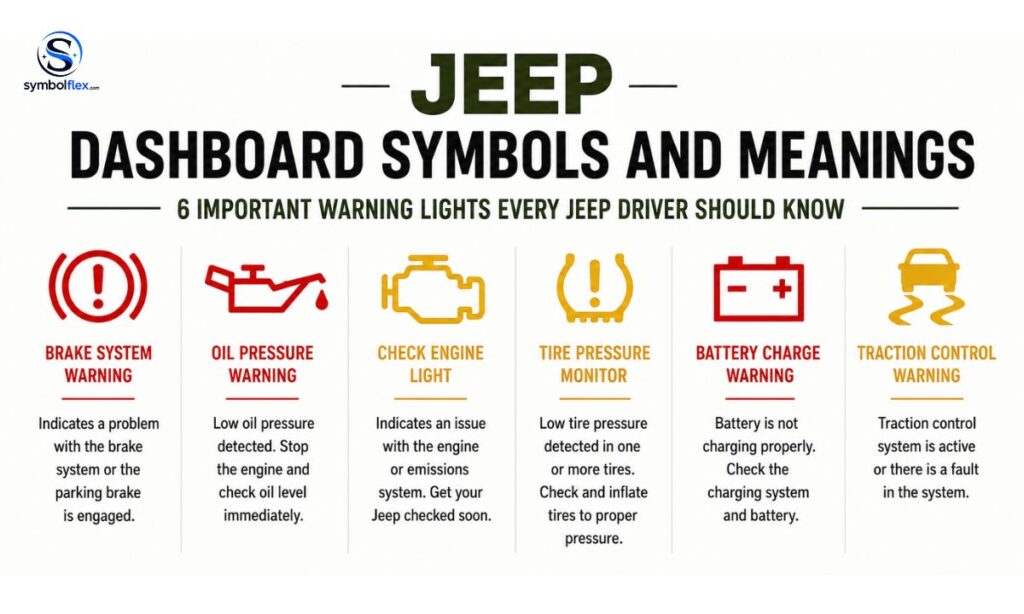
Jeep dashboard symbols and meanings can be the difference between a quick fix and a blown engine. Every Jeep owner has been there: you’re cruising down the highway, a strange light flickers on, and suddenly your confidence drops. Those small glowing icons aren’t random. They’re your Jeep’s way of talking to you, and knowing what they’re saying puts you in control.
From the check engine light to the tire pressure warning, every symbol on your Jeep’s instrument cluster carries a specific message tied to a real system. Red means stop immediately. Amber means act soon. Green means all clear.
Once you understand that simple color code, plus the meaning behind each icon, you’ll never feel lost staring at your dashboard again. This guide covers every major Jeep dashboard warning light, across every popular model, so you always know exactly what to do next.
What Are Jeep Dashboard Symbols and Meanings?

Jeep dashboard symbols are graphical icons displayed on your instrument cluster that communicate the operating status of your vehicle’s systems. They exist so drivers can respond quickly without needing to read lengthy text messages while behind the wheel.
Your Jeep’s instrument panel is essentially the nervous system of your car translated into visual language. Every symbol represents a real sensor reading pulled from your vehicle’s onboard diagnostics system, also known as OBD-II. When a sensor detects something outside its normal range, it triggers the corresponding dashboard symbol.
Understanding these symbols is not just about convenience. It’s about protecting your investment and your safety. A Jeep engine can sustain irreparable damage within minutes if you keep driving with an oil pressure warning light on. That small glowing icon is the only thing standing between you and a catastrophic repair bill.
Jeep Dashboard Symbols And Meanings Guide
The best way to understand Jeep dashboard lights is to organize them by urgency and function. Not every light means something is broken. Some simply confirm that a feature you turned on is working correctly.
Here’s a quick reference by color category:
| Light Color | What It Means | Your Action |
| Red | Urgent system failure or safety risk | Stop driving, assess immediately |
| Amber/Yellow | Caution, service needed soon | Schedule service within days |
| Green | Active feature confirmation | No action needed |
| Blue | Informational status (e.g., high beams) | No action needed |
| White | Feature active (newer Jeep models) | Monitor if unexpected |
Most Jeep owners focus too much on whether the light is on or off and not enough on the color and whether it’s flashing or solid. A solid amber check engine light is serious. A flashing check engine light means pull over now, because active misfires can destroy a catalytic converter in minutes.
Jeep Dashboard Symbols And Meanings PDF

Jeep provides an official symbols and meanings PDF through its owner’s manual, available at Jeep’s official website under the “Owners” section. You can also find model-specific PDFs on the Stellantis owner resources portal, which manages Jeep’s parent company resources.
Each PDF is organized by symbol, color, and recommended action. The challenge is that owner’s manual PDFs can run 500 to 700 pages, so finding the specific symbol page takes patience. A smarter move is to download the Jeep Family app, which provides a quick digital symbol lookup by model year.
Keep a printed copy of the most critical warning lights in your glove compartment. Focus on the red lights section. If you’re ever stranded without cell service, you’ll want that reference handy.
What Does A Mean On Jeep Dashboard?
The “A” symbol on a Jeep dashboard refers to the Auto Stop/Start system indicator. This feature automatically shuts off the engine when you come to a complete stop, like at a red light, and restarts it when you lift your foot off the brake. The system is designed to reduce fuel consumption and lower emissions during city driving.
When the Auto Stop/Start system is actively running, the “A” with a small arrow circling it appears on your instrument cluster. A green “A” means the engine has automatically stopped. An amber or crossed-out “A” means the system has been temporarily disabled, often because the battery charge is too low to support an automatic restart, or because the climate control needs the engine running to maintain cabin temperature.
Some Jeep owners find this feature annoying and use an aftermarket Auto Stop Eliminator module to permanently disable it. If you see the “A in a circle” on your Jeep dashboard and your vehicle feels like it keeps shutting off at stops, that’s exactly what it’s designed to do. It’s not a malfunction.
Jeep Models Dashboard Symbols Explained
Different Jeep models share a core set of dashboard symbols but also carry unique indicators tied to their specific engineering and feature sets. Knowing which symbols are model-specific saves you time and unnecessary worry.
Jeep Cherokee Dashboard Symbols And Meanings
The Jeep Cherokee introduced several technology-forward warning symbols starting with its 2014 redesign. Cherokee owners frequently encounter the Selec-Terrain mode indicator, which shows the active off-road driving mode: Auto, Snow, Sand/Mud, or Sport.
One symbol that confuses Cherokee owners is the hill descent control light, which looks like a car on a downhill slope. When this is amber and flashing, it means the system is activating. When it’s solid green, the system is actively controlling your descent speed. The Cherokee’s Active Drive Lock indicator, a 4WD symbol with a lock icon, is another model-specific light you won’t find on all Jeep products.
The 2019 Cherokee refresh also introduced lane departure warning and forward collision warning indicator symbols. These appear as small lane line graphics and a car-with-collision graphic respectively. If these flash and then stay lit, the sensors may be blocked by dirt or a cracked windshield.
Jeep Wrangler Dashboard Symbols And Meanings
The Jeep Wrangler has more unique dashboard symbols than almost any other model because of its dedicated off-road engineering. Wrangler-specific indicators include the front axle disconnect light, the sway bar disconnect indicator, and the Dana 44 axle lock symbol on Rubicon trims.
The 4WD indicator on the Wrangler will show 4H, 4L, or 2H to confirm your active drive mode. If the 4WD indicator is flashing rather than solid, it means the system is still trying to fully engage. This is normal during the transition but should stop flashing within a few seconds. If it keeps flashing, there may be a transfer case or actuator issue.
JL Wranglers (2018 and newer) added new electronic safety symbols not found on older JK models, including electronic stability control and trailer sway control lights. If you recently bought a used JK and you’re noticing symbol differences in forums, that generational gap explains it.
Jeep Compass Dashboard Symbols And Meanings

The Jeep Compass is one of the most popular compact SUVs in the U.S., and its dashboard symbols reflect a mix of mainstream safety tech and basic 4WD indicators. The 2017 Compass redesign brought updated symbols for active lane management, blind spot monitoring, and rear cross-path detection.
Compass owners with front-wheel-drive trims won’t see 4WD-specific lights at all. AWD-equipped versions will show an AWD active indicator when the system is distributing torque to the rear wheels. Many Compass drivers panic when this light comes on during rain or snow. It’s not a problem. It’s confirmation that the AWD system is doing its job.
Jeep Grand Cherokee Dashboard Symbols And Meanings
The Jeep Grand Cherokee sits at the premium end of the Jeep lineup, and its dashboard reflects that with some of the most advanced indicators in the brand. The Quadra-Lift air suspension warning is a Grand Cherokee exclusive: it looks like a car with arrows on each corner and indicates the air suspension system needs attention.
The Quadra-Drive II indicator and the electronic limited-slip differential (ELSD) status light are also exclusive to Grand Cherokee. These lights tell you exactly how torque is being distributed across all four wheels in real time. If the air suspension light comes on and your Grand Cherokee feels like it’s sitting lower on one corner, don’t drive it to the dealer. Have it towed, because driving on a failed air strut causes secondary damage fast.
Jeep Gladiator Dashboard Symbols And Meanings
The Jeep Gladiator is the brand’s pickup truck, and it carries a set of truck-specific dashboard symbols related to trailer towing and payload monitoring. The trailer brake controller active symbol and the trailer sway control indicator are unique to Gladiator and Wrangler models equipped for towing.
Gladiator Rubicon trims add off-road-specific indicators that mirror the Wrangler’s sway bar and axle lock symbols. If you’re using your Gladiator for work hauling and the payload capacity warning symbol activates, the system is telling you that the truck’s sensors detect you may be approaching the maximum payload rating.
Jeep Avenger Dashboard Symbols Explained
The Jeep Avenger is a European-market electric SUV that represents a new chapter for Jeep’s dashboard symbol vocabulary. Its instrument cluster includes EV-specific indicators like battery state of charge, regenerative braking strength display, and charging status symbols you simply won’t find on any combustion-powered Jeep.
The Avenger’s battery temperature warning is one to watch in extreme cold, as lithium-ion battery packs lose efficiency in temperatures below freezing. An amber snowflake symbol over the battery icon signals reduced range due to cold temperatures. This is normal EV behavior, not a malfunction.
Jeep Warning Lights And Symbol Meanings

Understanding the full range of Jeep warning lights and symbols helps you respond with confidence instead of anxiety when something appears on your dashboard.
Check Engine Light
The Jeep check engine light is the most commonly misunderstood dashboard symbol in automotive history. It can be triggered by something as minor as a loose gas cap or as serious as a failing catalytic converter. The icon looks like a small engine block outline.
A solid check engine light means the system has detected a fault that’s stored a trouble code but is not currently causing active damage. Schedule a diagnostic scan within a few days. A flashing check engine light means there is an active engine misfire happening right now, which can destroy your catalytic converter within miles. Pull over safely and stop driving.
Any auto parts store like AutoZone or O’Reilly will scan your OBD-II codes for free. The trouble code, called a DTC, will point your mechanic to the exact system at fault. Do not let a shop charge you just to “read the code.”
Oil Pressure Warning Light
The Jeep oil pressure warning light looks like a small oil can with a drop falling from its spout. When this appears in red, it means your engine’s oil pressure has dropped below the minimum threshold needed for safe lubrication.
Low oil pressure is not the same as low oil level. You can have plenty of oil in the engine but still have low pressure if the oil pump is failing or if the oil passages are clogged. Both situations cause catastrophic engine damage within minutes if you keep driving. The correct response is to pull over safely, turn off the engine, and check your oil level as a first step.
If the oil level is normal and the light is still on, do not restart the engine. Call for a tow. Replacing an oil pump is expensive but far cheaper than replacing a seized engine.
Battery Charge Warning Light
The Jeep battery warning light looks like a simple rectangular battery icon with positive and negative terminals. When it activates, it means the charging system is not maintaining proper voltage, usually because the alternator is failing.
Your Jeep’s battery light is actually a charging system warning more than a battery warning. A perfectly new battery will still trigger this light if the alternator stops producing current. When this light comes on while driving, your vehicle is running entirely off stored battery power. Depending on your battery’s charge level, you may have as little as 20 to 30 minutes of driving before the engine dies.
Turn off every non-essential electrical load: air conditioning, heated seats, radio, and phone chargers. Head directly to the nearest safe stop and have the alternator tested.
Tire Pressure Monitoring System Light
The Jeep TPMS light looks like a cross-section of a tire with an exclamation point inside it. It activates when one or more tires drops below the recommended pressure by more than 25 percent.
Here’s something most guides miss: TPMS lights frequently turn on in cold weather even with perfectly inflated tires. Tire pressure drops approximately 1 PSI for every 10-degree Fahrenheit drop in ambient temperature. If you wake up to a 30-degree morning after a 60-degree evening, your tires may have lost 3 PSI overnight, enough to trigger the warning.
After inflating your tires to the correct PSI, the TPMS light may reset automatically after driving a few miles. If it doesn’t reset, consult your owner’s manual for the manual reset procedure, which varies by Jeep model.
ABS Warning Light
The ABS warning light displays the letters “ABS” inside a circle. It means the Anti-lock Braking System has detected a fault, which is most commonly a failed wheel speed sensor.
You can technically drive with an ABS warning light on because your standard brakes still function. However, your ABS will not engage if you need to make a panic stop on wet or icy pavement, which significantly increases your stopping distance and risk of skidding. Fix it promptly, especially heading into winter months.
Airbag Warning Light
The Jeep airbag warning light shows a seated person with a large circle in front of them, representing a deployed airbag. This is one light you should never ignore or delay fixing.
If your airbag warning light is on, your airbags may not deploy in a collision. The most common causes are a failed clock spring (a coiled connector inside the steering column), a faulty airbag sensor, or an uncleared code from a previous minor collision. A qualified technician needs to diagnose this with a specialized scan tool, not a standard OBD-II reader.
Frequently Asked Questions
What does the check engine light mean on a Jeep?
The check engine light means your Jeep’s onboard diagnostics have detected a fault in one of the engine or emissions systems. It can range from a loose gas cap to a failing oxygen sensor. Get a free OBD-II scan at any auto parts store to find the specific code before scheduling repairs.
Can I drive with the Jeep oil pressure warning light on?
No. Pull over safely as soon as possible and turn off the engine. Driving with low oil pressure can destroy internal engine components in minutes. Check your oil level first. If it’s normal and the light is still on, call for a tow.
Why is my Jeep tire pressure light on but tires look fine?
Temperature drops cause tire pressure to fall, which can trigger the TPMS light even when tires have no leak. Inflate all tires to the recommended PSI and drive a few miles to reset the sensor. If the light persists, you may have a slow leak or a faulty TPMS sensor.
What color warning lights are most serious?
Red warning lights require immediate action. Amber or yellow lights mean you should schedule service soon. Green and blue lights simply confirm an active feature is working normally.
Do all Jeep models have the same dashboard symbols?
Standard safety warning symbols (check engine, oil pressure, battery, TPMS, ABS) are consistent across Jeep models because they follow ISO standards. However, model-specific features like Quadra-Lift air suspension on the Grand Cherokee or sway bar disconnect on the Wrangler Rubicon produce unique symbols found only on those vehicles.
Conclusion
Jeep dashboard symbols and meanings are your vehicle’s way of communicating with you in real time. Every icon on your instrument cluster represents a sensor reading, a system status, or a safety alert designed to keep you informed and protected. The three things every Jeep owner should remember are simple: red means stop, amber means schedule service, and green means everything is working as intended.
Don’t wait until a warning light has been glowing for weeks before taking action. Keep your owner’s manual in the glove compartment, invest in an inexpensive OBD-II scanner, and download the Jeep Family app so you always have a fast reference available. The more familiar you are with your Jeep’s dashboard symbols, the more confidently you’ll handle whatever the road throws at you. That’s the Jeep way.
