

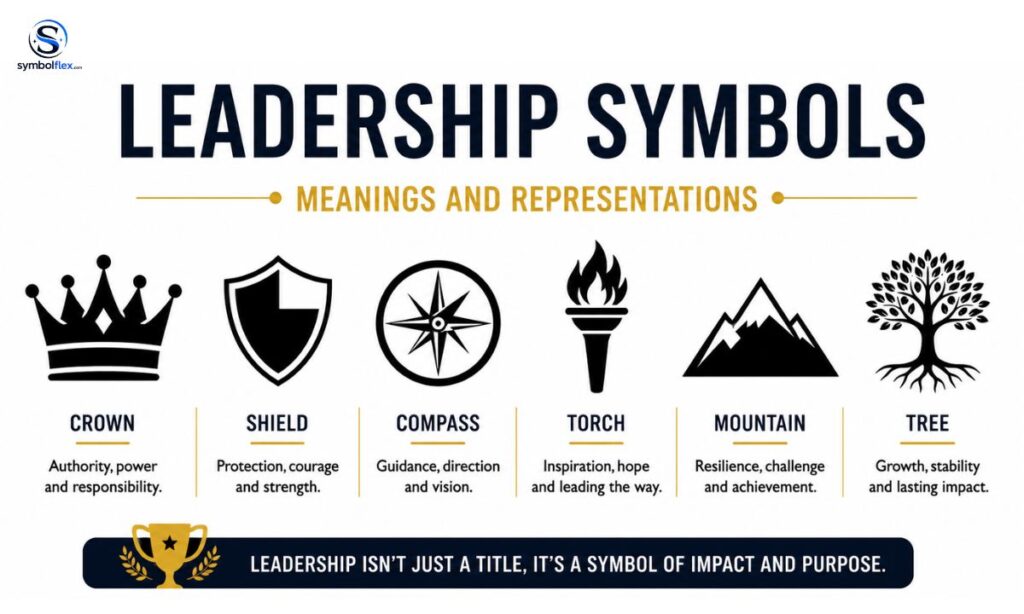
Leadership symbols are visual, cultural, and historical markers, such as crowns, eagles, lions, and scepters, that represent authority, strength, wisdom, and influence. People have used them for thousands of years to instantly show who holds power and why they deserve trust. Think about why a lion feels regal or why a crown still carries weight even in countries without a king.
Crowns have represented authority for over 4,000 years, making them one of the oldest continuously used leadership symbols in history. That single fact proves this isn’t a passing trend, it’s wired into how humans understand power.In this guide, you’ll explore 100+ leadership symbols and their meanings, from ancient Egyptian and Greek imagery to modern logos, tattoos, and even dream symbolism.
You’ll learn the difference between symbols of strength and symbols of guidance, discover why animals like the eagle and lion appear across unrelated cultures, and find out exactly which symbol best represents your own leadership style.
What Are Leadership Symbols?

Leadership symbols are recognizable images, objects, or figures that communicate authority, direction, or influence without a single word being spoken. They work because the human brain processes visual information faster than text, so a crown or a raised fist tells a story in half a second.
Throughout history, every culture has needed a shorthand for power. A king could not carry a resume to prove he was in charge, so he wore a crown. A general could not explain his rank verbally in the middle of a battle, so stripes and stars did the talking. This is the core function of symbols of leadership: they compress complicated ideas, authority, trust, responsibility, and vision, into something you can see and instantly understand.
There are several categories worth knowing before we go deeper. Some symbols represent power and control, like a scepter or throne. Others represent strength and courage, like a lion or mountain. Some lean more toward wisdom and guidance, such as an owl or a compass. And a growing number of modern leadership symbols focus on service and humility rather than dominance, which reflects how leadership thinking has shifted over the last century.
Leadership Symbols And Meanings Across Cultures And History
Leadership symbols and their meanings shift depending on the culture, time period, and belief system that created them, but most fall into a few universal themes: strength, wisdom, authority, and protection. Understanding this pattern makes it much easier to interpret any symbol you come across.
Historians and anthropologists have long noted that separate civilizations, with no contact with one another, still landed on similar imagery for leadership. Egypt had its crook and flail. China had the dragon. Rome had the eagle and the laurel wreath.
This is not a coincidence. Carl Jung, the influential Swiss psychiatrist, proposed that humans share a collective unconscious, a pool of universal symbols that show up across unrelated cultures.Leadership symbolism is one of the clearest examples of this idea in action.Understanding symbols of leadership across time also reveals how leadership itself has evolved.
Ancient symbols tended to emphasize divine authority, the idea that a ruler’s power came from the gods. Modern symbols, by contrast, often emphasize earned trust, competence, and service. A modern company logo featuring a shield does not claim divine right, it claims protection and reliability.
Symbols Of Leadership With Meaning
Some of the most recognized symbols of leadership with meaning include the crown (authority and sovereignty), the lion (courage and strength), the eagle (vision and freedom), the torch (guidance and knowledge), and the shield (protection and responsibility).
Each of these carries a layered meaning depending on where you encounter it. A crown on a king represents inherited authority. A crown used in a business award represents achievement. The lion, similarly, can represent physical courage in one context and calm, confident authority in another, since real lions spend most of their time resting rather than fighting.
It’s worth noting that meaning often depends on posture and context within the symbol itself. A lion shown roaring suggests aggressive strength, while a lion shown resting or standing guard suggests protective, steady leadership. This kind of detail is exactly why designers and storytellers choose specific imagery so carefully.
Symbols Of Leadership In Education
In schools and universities, leadership symbols tend to focus on knowledge, growth, and mentorship rather than dominance or power. Common examples include the graduation cap, the open book, the torch of knowledge, and the owl.
These symbols exist because educational leadership is fundamentally different from political or military leadership. A teacher or principal is not trying to command obedience, they are trying to inspire growth. That’s why you’ll see torches (representing enlightenment), keys (representing unlocking potential), and trees (representing growth) far more often in school crests and mascots than crowns or swords.
Student council programs across the United States also frequently use the gavel as a leadership symbol, borrowed from courtroom authority, to represent fair and structured decision making among peers. This shows how symbols can migrate from one context, like law, into another, like education, while keeping their core meaning of order and responsibility intact.
Symbols Of Leadership
Here is a quick reference list of widely recognized symbols of leadership and their core meaning:
- Crown: authority, sovereignty, achievement
- Lion: courage, strength, calm dominance
- Eagle: vision, freedom, far-sightedness
- Scepter: rule, control, divine authority
- Torch: guidance, knowledge, hope
- Shield: protection, responsibility, defense
- Compass: direction, purpose, integrity
- Oak Tree: stability, endurance, resilience
- Wolf: loyalty, strategy, pack leadership
- Mountain: steadfastness, ambition, perspective
This list only scratches the surface, but it gives you a strong foundation for understanding the deeper sections ahead.
Visual And Creative Leadership Symbol Designs
Visual leadership symbols are used across branding, education, and personal projects because they communicate trust and authority faster than written words. This is why so many people search for images, clip art, and drawings tied to leadership themes.
Designers rely on a small set of proven shapes and figures because audiences already recognize them. A shield instantly signals protection. A star instantly signals excellence. This shared visual vocabulary saves time and builds instant credibility, which is exactly why banks, universities, and government agencies lean so heavily on these same recurring images.
Visual design also allows nuance that words cannot always capture. A black and white version of a crown feels more timeless and formal, while a colorful, cartoonish crown feels playful and approachable. The same base symbol can be adjusted in tone simply through color, line weight, and style, which is why so many organizations commission custom variations rather than using generic stock imagery.
Symbol Of Leadership Images
Images representing leadership are widely used in presentations, classroom materials, office decor, and social media graphics. The most searched examples include crowns, eagles, mountain peaks, chess pieces (especially the king), and lightbulbs representing visionary thinking.
Professionals building presentations or portfolios often lean toward simpler, more abstract imagery like arrows, upward graphs, or a single star, since these feel modern and less tied to monarchy or military history. This is a noticeable shift from older leadership imagery, which leaned heavily on royal and religious themes.
Pictures Of Leadership Symbols
Teachers, coaches, and youth program leaders frequently search for pictures that communicate leadership in a way children can understand, since abstract concepts like “vision” or “integrity” are hard for younger audiences to grasp visually. Simple, friendly imagery works best here: a torch, a compass, a helping hand, or a group of animals working together.
Leadership Symbols Black And White

Black and white versions of leadership symbols are popular for printing, coloring pages, tattoo stencils, and minimalist branding. Removing color forces a design to rely purely on shape and line, which often makes a symbol feel more serious, timeless, and premium.
Many tattoo artists specifically prefer black and white leadership symbols like lions, crowns, and compasses because line work ages better on skin than color fills, and the symbolism reads just as clearly without color.
Leadership Symbols Clip Art
Clip art versions of leadership symbols remain popular for classroom bulletin boards, event flyers, and internal company newsletters. The most searched clip art symbols include crowns, stars, flags, medals, and handshake icons, largely because they are instantly recognizable even at a small size.
Leadership Symbol Designs In Art And Personal Expression
Leadership symbols show up in personal art, tattoos, and branding because people want to visually express strength, authority, or purpose as part of their own identity. This is where symbolism moves from history books into everyday life.
Unlike institutional use, personal expression through leadership symbols tends to be deeply individual. Someone getting a lion tattoo may not care about ancient Mesopotamian kingship, they care about representing their own resilience after a hard chapter in life. This personal layer of meaning is just as valid as the historical one, and it’s a major reason these symbols have survived for so long.
Artists and tattoo clients often blend multiple leadership symbols into one piece, such as a lion wearing a crown, or an eagle gripping an arrow and an olive branch, similar to the imagery on the Great Seal of the United States. Combining symbols allows for more specific storytelling than any single image could achieve alone.
Leadership Symbol Drawing
Beginner and intermediate artists frequently choose leadership symbols for drawing practice because the shapes are bold, recognizable, and satisfying to render. Popular subjects include lions, eagles, crowns, and torches, since each has strong, well-defined lines that are forgiving for less experienced artists.
Leadership Symbol Tattoo

Tattoos remain one of the most personal ways people carry leadership symbolism with them daily. The lion is consistently one of the most requested designs, representing personal courage and quiet confidence rather than aggression. The compass is another favorite, often chosen by people who see themselves as guides or mentors for others.
Placement matters too. Forearm placements tend to favor bold, visible symbols like lions or crowns, meant to be seen and to serve as a personal reminder, while chest or back placements often favor more private, spiritual symbols like a shepherd’s staff or a rising sun.
Logo Leadership Symbols
Brand logos frequently borrow leadership symbols to build instant trust. Shields suggest security, especially in finance and insurance. Crowns and laurel wreaths suggest excellence and premium quality. Eagles suggest strength and national pride, especially common among American companies wanting to signal reliability and patriotism.
Historical And Cultural Leadership Symbols
Historical leadership symbols like crowns, scepters, and coats of arms were used to visually prove a ruler’s right to govern, especially in eras when literacy was low and spoken claims of authority needed physical, visible proof.
Before mass communication existed, a symbol had to do the work that a title or announcement does today. This is why medieval kings invested enormous resources into ceremonial objects: a crown studded with jewels was not vanity, it was a visual contract with the public that said “this person’s authority is real and sanctioned.”
Coats of arms served a similar purpose but added a layer of family legacy. A noble family’s symbol was passed down for generations, meaning the imagery itself carried historical weight before a new leader even spoke a word.
Ancient Symbols Of Leadership
Some of the earliest ancient symbols of leadership include the Egyptian crook and flail, representing a pharaoh’s role as both shepherd and disciplinarian of the people, and the Mesopotamian royal scepter, symbolizing divine appointment to rule.
Ancient Leadership Symbols
Beyond Egypt, ancient Greek city states used the laurel wreath to crown victors and leaders alike, linking leadership with honor and achievement rather than pure inherited power. Roman leadership symbols leaned heavily on the eagle, which represented military strength and was carried into battle as a standard that soldiers were sworn to protect at all costs.
Coat Of Arms Leadership Symbols
A coat of arms typically combined several symbols of leadership into one design, such as a lion for courage, a shield for protection, and a motto reflecting the family’s values. These emblems were legally protected in many European countries and remain a recognized part of heraldic tradition today.
Objects And Things That Represent Leadership
Objects that represent leadership are physical items, like keys, gavels, and pens, that symbolize authority, decision making power, or responsibility within a specific role.
Unlike mythical or animal symbols, object based leadership symbols tend to be practical and tied to a specific function. A key represents access and control. A gavel represents order and final decisions. These objects earn their symbolic status through repeated real world use rather than ancient mythology.
Objects That Represent Leadership
Common objects that represent leadership include the gavel (order and authority), the key (access and trust), the pen (decision making and commitment), and the flag (unity and collective identity).
Objects That Represent Leadership Styles
Different objects can represent different leadership styles. A compass suggests visionary leadership focused on direction. An anchor suggests stability focused leadership that prioritizes consistency over rapid change. A torch suggests transformational leadership focused on inspiring others.
Items That Represent Leadership

Everyday items that represent leadership often appear as gifts or awards, including engraved pens, compass necklaces, plaques, and trophies, each chosen to reflect a specific leadership quality being honored.
Things That Symbolize Leadership
Broader things that symbolize leadership include natural elements as well, such as mountains (steadfastness), rivers (adaptability), and the sun (guidance and clarity).
Things That Represent Leadership
| Object | What It Represents |
| Crown | Authority and sovereignty |
| Key | Access and trust |
| Compass | Direction and integrity |
| Shield | Protection and responsibility |
| Torch | Guidance and inspiration |
Leadership Symbols In Power, Strength, And Control
Symbols that represent leadership tied to power and control typically emphasize dominance, decisiveness, and command, using imagery like thrones, scepters, and raised fists.
This category of symbolism is the oldest and most direct. It does not soften authority with humility, it simply states that power exists and must be respected. Understanding this category helps explain why so many older monarchies and empires relied on such visually dramatic, imposing designs.
Leader Symbols
Classic leader symbols include the throne, the crown, and the raised staff, all designed to physically elevate a leader above others, both literally and symbolically.
Symbol Of A Leader
A symbol of a leader often depends on culture. In Western traditions, a crown or scepter dominates. In many African leadership traditions, a ceremonial staff or stool carries the same symbolic weight, representing wisdom passed down through generations of chiefs.
Symbol Of Leader
Similarly, a single symbol of leader status can vary by profession. A judge’s gavel, a general’s stars, and a CEO’s corner office all function as modern equivalents of the ancient throne.
Symbol For Leadership
If you are searching for one universally understood symbol for leadership, the crown remains the strongest candidate globally, recognized across nearly every culture as a marker of authority, even in countries with no monarchy.
Symbols For Leadership
Multiple symbols for leadership are often combined for stronger effect, such as pairing a crown with a shield to suggest both authority and protection, a common combination in corporate and athletic branding.
Symbols That Represent Leadership
Beyond crowns and shields, symbols that represent leadership also include the eagle, the lion, the mountain summit, and the compass, each emphasizing a different leadership trait: vision, courage, ambition, and direction.
Leadership Symbolism
Leadership symbolism is the broader study of why these images hold meaning at all. It draws from psychology, anthropology, and history, and it explains why certain shapes and creatures consistently appear across unrelated societies.
Symbolism For Leadership
Symbolism for leadership is often used deliberately in speeches, mottos, and branding to reinforce a message without directly stating it. A company using an eagle in its logo is quietly communicating ambition and vision without ever saying those words in its marketing copy.
Specialized Leadership Symbol Categories
Specialized leadership symbols exist for specific contexts, such as military rank, servant leadership, and control, allowing each field to communicate authority in a way that fits its own culture and values.
Symbols That Represent Control
Symbols tied to control include the scepter, the whip in historical contexts, and the modern gavel, all representing the ability to enforce decisions and maintain order.
Strength Leadership Symbols
Strength leadership symbols commonly include the lion, the oak tree, the mountain, and iron itself, each representing endurance, resilience, and the ability to withstand pressure.
Military Leadership Symbols
Military rank relies heavily on standardized symbols like stars, stripes, and eagles. In the United States military, a single star typically represents a Brigadier General, while additional stars indicate higher rank, a system designed so authority can be recognized instantly, even across language barriers.
Servant Leadership Symbols
Servant leadership symbols intentionally avoid dominance imagery. Instead, they use humbler symbols like a basin and towel, referencing acts of service, or an open hand, representing giving rather than commanding. This category has grown significantly as leadership philosophy has shifted toward collaboration over control.
Leadership Symbols Animals
Animals remain some of the most powerful leadership symbols because their real world behavior maps naturally onto human leadership traits.
| Animal | Leadership Meaning |
| Lion | Courage and calm authority |
| Eagle | Vision and far sightedness |
| Wolf | Loyalty and strategic thinking |
| Elephant | Wisdom and memory |
| Bear | Protection and strength |
Leadership Symbol Media And Visual Resources
Leadership symbol images and resources are widely used across business, education, and design because visual shorthand communicates authority faster than paragraphs of text.
Symbol Of Leadership Images
In professional settings, leadership symbol images often appear in slide decks and portfolios, typically favoring cleaner, more abstract designs like arrows, ascending bar charts, or a single guiding star rather than literal crowns or thrones.
Leadership Symbols And Meanings
A quick reference on leadership symbols and meanings helps readers scan for exactly what they need:
| Symbol | Meaning |
| Crown | Sovereignty, achievement |
| Lion | Courage, calm strength |
| Eagle | Vision, freedom |
| Compass | Direction, integrity |
| Torch | Guidance, hope |
Leadership Symbols Clip Art
For printable and downloadable use, clip art versions of these same symbols remain popular in classrooms and community events, valued for their clarity even at small sizes or low resolution.
Deep Symbolic Meaning of Leadership Symbols
The deeper meaning of leadership symbols goes beyond visuals, touching on spiritual belief, psychological identity, and cultural values that shape how authority is understood.
Spiritual Meaning
In many religious traditions, leadership is tied to service rather than dominance. The image of a shepherd, common in Christian, Jewish, and other pastoral traditions, represents a leader who protects and guides rather than rules by force. Similarly, light and torches often represent spiritual enlightenment passed from leader to follower.
Psychological Meaning
Psychologically, leadership symbols often represent internal qualities people want to embody: confidence, trust, identity, and self assurance. This is part of why tattoos and personal jewelry featuring these symbols carry such strong emotional weight for the people who choose them.
Cultural Meaning
Cultural context can completely change a symbol’s meaning. The dragon represents power and good fortune in Chinese leadership tradition, while in many Western stories it represents danger to be conquered. The eagle represents freedom and vision in the United States, while in ancient Rome it represented military conquest and imperial reach.
Types and Variations of Leadership Symbols
Specific leadership symbols like the crown, lion, eagle, throne, scepter, and flag each carry distinct meanings shaped by centuries of consistent cultural use.
Crown
The crown remains the single most recognized symbol of authority worldwide, tracing back over 4,000 years to early Mesopotamian and Egyptian rulers.
Lion
Known as the “king of the jungle,” the lion’s symbolism comes from its calm, confident demeanor rather than constant aggression, reflecting steady rather than reactive leadership.
Eagle
The eagle’s keen eyesight and high vantage point have made it a global symbol of vision and foresight, famously chosen as the national emblem of the United States in 1782.
Throne
A throne physically elevates a leader, reinforcing authority through simple spatial positioning, a psychological tactic still used today in courtrooms and boardrooms.
Staff or Scepter
The scepter historically represented a ruler’s connection to divine authority, suggesting their power was granted rather than seized.
Flag
Flags unify large groups under a single shared symbol, representing collective identity and leadership at a national or organizational level.
Leadership Symbols Across Cultures
Leadership symbolism differs by region because each culture developed its own historical relationship with power, religion, and governance.
Ancient Egypt
Pharaohs used the crook and flail together, symbolizing both nurturing guidance and firm discipline, alongside the ankh representing eternal life and divine favor.
Ancient Greece
Greek leadership symbolism favored the laurel wreath, awarded to both military victors and respected leaders, linking authority with honor rather than pure inherited power.
China
Chinese leadership symbolism centers on the dragon and the color yellow, both historically reserved for emperors, representing supreme authority and cosmic balance.
Medieval Europe
European leadership symbols leaned on coats of arms, castles, and crowns, often combining multiple symbols to represent both family legacy and territorial power.
Modern Society
Modern leadership symbolism has shifted toward abstract, achievement based imagery, including checkmarks, verified badges, and ascending graphs, reflecting a culture that values competence over inherited status.
Leadership Symbols in Art, Movies and Pop Culture
Popular film and television frequently lean on classic leadership symbols to communicate a character’s role instantly. A crown or throne signals a ruler before a single line of dialogue is spoken.
A cape often signals a protector figure, while a raised sword or staff signals a call to action. These visual shortcuts work because audiences already understand the symbolism from centuries of shared cultural exposure, proving just how deeply this imagery is embedded in human storytelling.
Spiritual and Dream Meaning of Leadership Symbols
Dreaming about crowns, thrones, or commanding figures is often interpreted by dream analysts as a reflection of the dreamer’s own desire for control, recognition, or confidence in waking life.
A crown appearing in a dream may suggest a person is stepping into a new level of responsibility, while a broken or falling crown may reflect anxiety about losing status or control. These interpretations are not scientifically proven, but they remain a popular lens for understanding personal growth and self perception.
Positive vs Negative Meaning of Leadership Symbols
Leadership symbols can represent both admirable and troubling qualities depending on how power is used, making context essential to interpreting their meaning.
Positive Meaning:
Symbols like the torch, compass, and open hand represent guidance, integrity, and generosity, reflecting leadership that uplifts others.
Negative Meaning:
The same crown or throne that represents earned authority can also represent corruption or oppression when tied to leaders who abused their power, a reminder that symbols are neutral until connected to real behavior.
Why Humans Are Drawn to Leadership Symbols
Humans are naturally drawn to visual hierarchy because early survival often depended on quickly identifying who held authority within a group. This instinct has not disappeared, it has simply moved from tribal chiefs to CEOs, coaches, and elected officials.
Symbols of leadership satisfy a deep psychological need for order, direction, and trust, which is exactly why they remain so powerful even in a modern, highly literate world.
Frequently Asked Questions
What is the most powerful symbol of leadership?
The crown remains the most powerful and universally recognized symbol of leadership, representing authority, sovereignty, and earned trust globally.
What animal best represents leadership?
The lion best represents leadership, symbolizing calm courage, confidence, and steady authority rather than constant aggression or dominance.
What does a crown symbolize in leadership?
A crown symbolizes sovereignty, achievement, and rightful authority, showing that a leader’s power is recognized, respected, and legitimate.
What color represents leadership the most?
Gold and purple represent leadership most strongly, historically symbolizing royalty, wisdom, wealth, and authority across many ancient cultures.
What is a good symbol for a leadership tattoo?
A lion, compass, or crown makes a strong leadership tattoo, representing courage, direction, and authority in a lasting way.
Conclusion
Leadership symbols are far more than decoration. They are a visual language humans have relied on for thousands of years to communicate trust, authority, strength, and guidance without saying a single word. Whether it’s a crown carved into ancient stone, a lion inked onto someone’s arm, or a simple compass used in a company logo, these symbols continue to shape how we recognize and respect leadership today.
As you think about your own leadership style, consider which symbol feels most true to who you are. Are you a torch, lighting the way for others? A shield, protecting your team? Or a compass, always pointing toward what matters most? Whichever symbol resonates, you’re now part of a tradition stretching back thousands of years.
