
Life symbols are images, objects, or shapes that represent existence, growth, renewal, and the human journey from birth to death and beyond. People have leaned on them for thousands of years to express something words struggle to hold. Every culture on earth, from ancient Egypt to modern Japan, has built its own version of a life symbol, whether inked into skin, carved into temple stone, or passed down as a wedding ring.
Some, like the circle and the spiral, appear almost everywhere on the planet, invented independently by people who never once made contact. That’s not a coincidence. It points to a deep, shared human need to make life feel visible and permanent. This guide walks through more than 100 life symbols and their meanings, pulled from real history rather than recycled definitions.
Life Symbols and Meanings

A life symbol carries meaning because a group of people agreed, over generations, that a shape or object stands for something bigger than itself. That’s really the short version of how all symbolism works.
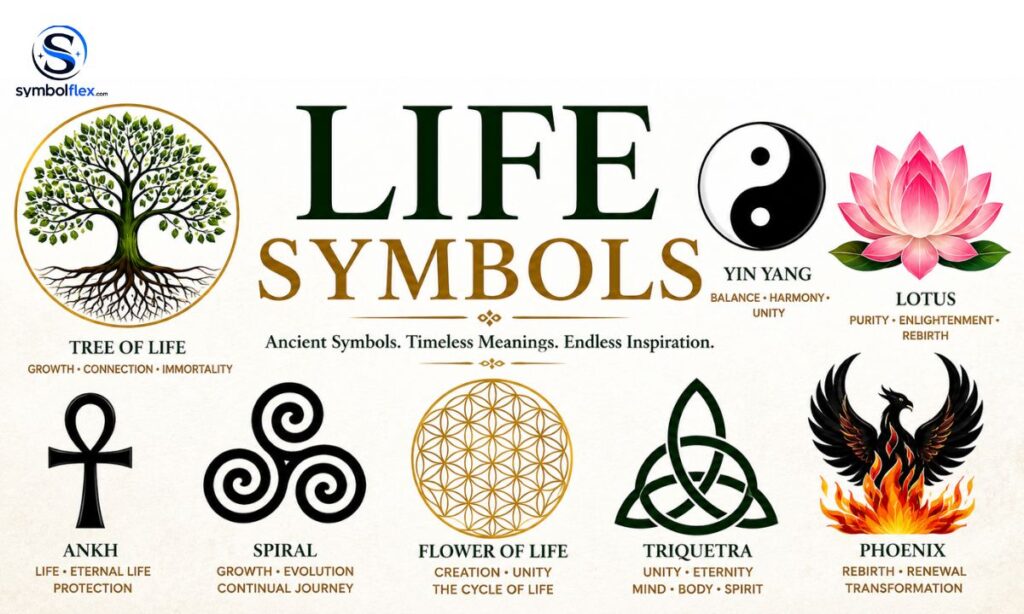
Some of the most searched life symbols include the Tree of Life (growth and connection), the Ankh (Egyptian symbol of life itself), the Lotus flower (purity and rebirth), the Infinity symbol (eternity), and the Phoenix (rising from destruction).
Each one solves a different emotional problem for the person using it. Someone recovering from a hard year might choose the Phoenix. A new parent might lean toward the Tree of Life. Someone marking a spiritual practice might pick the Lotus.
| Symbol | Origin | Core Meaning |
| Ankh | Ancient Egypt | Life, vitality, the key to existence |
| Tree of Life | Multiple cultures | Growth, family, connection |
| Infinity | Mathematics, later spiritual use | Eternity, endless love |
| Phoenix | Greek mythology | Rebirth, resilience |
| Lotus | Egypt, India, East Asia | Purity, spiritual awakening |
| Ouroboros | Ancient Egypt and Greece | The cycle of life and death |
Understanding this table is useful, but the real value comes from knowing why each symbol earned its meaning, which is what the rest of this guide covers in detail.
Tree of Life Symbols
The Tree of Life represents growth, family connection, and the idea that everything living is rooted in something larger than itself. It’s one of the most universally recognized life symbols on the planet.
You’ll find versions of it in Norse mythology, where the tree Yggdrasil connects nine different worlds. Celtic tradition calls it Crann Bethadh, a symbol of balance between the underworld, the earthly world, and the heavens. In the Bible, the Tree of Life sits at the center of the Garden of Eden, representing immortality and divine connection. Even in Kabbalistic Jewish mysticism, the Tree of Life diagram maps out ten different aspects of divine creation.
What makes this symbol so durable is its structure. Roots dig into the earth (ancestry and grounding), the trunk stands firm (stability and identity), and branches reach outward (growth, family, future generations). That visual logic translates instantly, no matter what language you speak or what religion you practice.
Tree of Life Symbols and Meanings
Each part of the Tree of Life carries its own layer of meaning, which is why the symbol works so well as a complete story rather than a single image.
The roots symbolize where you come from, your ancestry, your foundation, and the parts of your history that support you even when they’re invisible. The trunk represents your core self, your strength, and your ability to stay upright through difficult seasons. The branches stand for expansion: your relationships, your children, your achievements, and everything that grows outward from a strong center.
Modern jewelry designers lean heavily on this layered meaning. A Tree of Life pendant with intertwined roots and branches is often gifted at family milestones, weddings, or as a memorial piece, because it visually says “we are all connected” without needing a single word of explanation.
Eternal Life Symbols
Eternal life symbols represent the idea that existence continues beyond physical death, whether through spiritual afterlife, memory, or the ongoing cycle of nature.
The most recognized eternal life symbols include the Ankh, the Ouroboros (a snake eating its own tail), the infinity symbol, and the evergreen tree, which stays green through every season and became a symbol of enduring life long before it became a Christmas tradition. In many Native American traditions, the circle itself represents eternity, since a circle has no beginning and no end.
Religious traditions add their own layer here too. Christianity often uses the cross alongside symbols like the phoenix to represent resurrection. Buddhism uses the endless knot, a symbol with no clear starting or ending point, to represent the interdependence of all things across time.
Interestingly, the Ouroboros appears in both ancient Egyptian and Norse mythology independently, suggesting the idea of an endless cycle is one of the most naturally occurring concepts in human symbolism.
Symbols of Life
Symbols of life extend beyond mythology into the natural world, where sunlight, water, and seeds have represented survival and continuation since prehistoric times.
Water is one of the oldest. Nearly every ancient civilization, from Mesopotamia to the Nile Valley, built its cities near rivers and treated water as sacred because it was directly tied to survival. The sun follows closely behind, worshipped by cultures from ancient Egypt (Ra) to the Aztecs (Huitzilopochtli) as the literal source of life on earth.
Seeds and eggs round out this category. A seed represents dormant potential, life waiting for the right conditions to begin. An egg represents the same idea in animal form, which is exactly why so many spring festivals across different cultures, including Easter and Nowruz, use eggs as their central symbol.
What Symbolizes Life

Growth, continuity, and renewal are the three core ideas that symbolize life across nearly every culture studied by anthropologists.
If you search this exact phrase, you’re probably looking for a quick, clear answer, so here it is directly: life is most commonly symbolized through the Tree of Life (growth), the circle or infinity symbol (continuity), and the sunrise or Phoenix (renewal). These three concepts cover almost every life symbol that exists, since nearly all of them are variations on one of these themes.
Beyond the big three, smaller everyday items carry the same weight in personal contexts. A heartbeat line tattoo symbolizes life literally, since it traces the exact rhythm that keeps a person alive. A single candle flame has represented life and hope since ancient Roman times, when it was lit during religious ceremonies to mark the presence of a living spirit.
Symbols for Life
People choose specific symbols for life when marking a permanent commitment, like a tattoo, a wedding ring, or a piece of memorial jewelry.
The most requested tattoo choices in this category, based on trends reported by tattoo studios across the United States in recent years, are the semicolon (representing a continued story after hardship), the infinity loop, and the small Tree of Life design placed on the wrist or forearm. Each one is chosen because it says something permanent about the wearer’s outlook on their own existence.
Wedding traditions borrow from this same well. The infinity symbol shows up constantly in engagement rings because it visually represents a love with no end point. Some couples now choose Tree of Life wedding bands specifically because the design can be read two ways: as a symbol of their union and as a symbol of the family they intend to grow together.
Life Symbols Across Different Cultures and Religions
Nearly every major culture and religion has developed its own visual language for representing life, and studying them side by side reveals more similarities than differences.
Christianity leans on the cross, the dove, and the fish (Ichthys) to represent spiritual life and resurrection. Buddhism and Hinduism both elevate the Lotus flower as their central life symbol, since it grows up through muddy water to bloom clean and untouched, a metaphor for spiritual awakening. Islam frequently uses geometric and floral patterns, since figurative art is traditionally avoided, with endless repeating designs representing the infinite nature of life and creation.
Indigenous traditions across the Americas use the medicine wheel and the circle of life to represent the same continuity that other cultures express through trees or snakes. A genuinely interesting pattern emerges here: cultures separated by oceans and centuries kept landing on nearly identical shapes, circles, spirals, and trees, to explain the same idea.
That consistency is part of why psychologists like Carl Jung argued that certain symbols are archetypal, meaning they’re wired into shared human consciousness rather than simply copied from one culture to another.
Symbol for Change in Life
The butterfly, the spiral, and the phoenix are the three most common symbols people use to represent major change or transformation in life.
The butterfly earns its place here through pure biology. It doesn’t just grow, it completely restructures itself inside a chrysalis before emerging as something entirely different. That’s a rare, visible example of total transformation happening in nature, which is why therapists and grief counselors sometimes use butterfly imagery when discussing personal change with clients.
The spiral works differently. Rather than a straight line of progress, it suggests that growth happens in loops, you revisit old lessons from a new, higher vantage point each time. Celtic art uses spirals constantly for this exact reason. The phoenix takes the most dramatic route of the three, representing change that comes only after total destruction, which is why it resonates so strongly with people recovering from serious hardship or loss.
Symbols That Have Deep Meaning
A symbol earns deep meaning when it connects an abstract idea, like hope or eternity, to something people can actually see and remember.
The Flower of Life, a geometric pattern of overlapping circles found in Egyptian, Chinese, and Assyrian art, is a strong example. Its layered, mathematically precise design has led some scholars and spiritual practitioners to view it as a map of creation itself, even though its exact original purpose remains debated among historians.
The yin and yang symbol, while not exclusively a life symbol, carries deep meaning because it represents balance rather than opposition, light needs dark, growth needs rest, and life needs death to have any meaning at all. Symbols like these succeed because they hold complexity in a simple shape, which is exactly what makes them worth studying rather than just decorating with.
Things That Represent Life
Everyday things that represent life include candles, water, seeds, keys, and hourglasses, since each ties directly to survival, time, or potential.
A candle represents life through fire itself, an element every ancient culture treated as sacred because it provided warmth, safety, and light against darkness. An hourglass represents life through time, a visual reminder that every existence has a beginning and an end, which is why it appears so often in Renaissance paintings alongside skulls in the “memento mori” art tradition.
Keys carry a more symbolic weight, borrowed directly from the Ankh, which was literally nicknamed “the key of life” by ancient Egyptians. A key suggests access, the idea that life itself is something to be unlocked or discovered rather than simply lived passively.
What Represents Life
Growth, breath, and continuity represent life at the most fundamental level, which is why symbols tied to those three ideas dominate nearly every culture’s imagery.
Breath specifically deserves more attention than it usually gets. In Hebrew, the word “ruach” means both breath and spirit, and in many spiritual traditions, breath is treated as the literal presence of life entering and leaving the body. That’s part of why meditation practices across Buddhist, Hindu, and Christian contemplative traditions all center on breathing as a way to connect with something larger than the self.
Blood carries similar symbolic weight in Western traditions, historically tied to vitality, family lineage, and sacrifice. Combined, breath and blood cover the two most literal, physical representations of life that exist, long before any culture invented an abstract symbol to stand in for them.
Things That Symbolize Life
Rivers, seasons, and sunrises are natural events that symbolize life because they demonstrate constant renewal without any human intervention required.
A river never contains the same water twice, yet it looks the same day after day, which ancient Greek philosopher Heraclitus famously used as a metaphor for existence itself, arguing that you can never step into the same river twice because both you and the river are always changing.
Seasons follow the same pattern on a larger scale: winter’s apparent death is always followed by spring’s return, a cycle so reliable that entire agricultural religions were built around celebrating it.
Sunrise closes out this trio. It’s the single most repeated symbol of hope and renewal across nearly every culture studied, likely because it’s the one life symbol every human being on earth witnesses personally, without needing religion, mythology, or art to explain it first.
Symbol of Life Meaning

If there’s one definitive symbol of life, most historians and symbologists point to the Ankh, since it’s the only major ancient symbol whose literal translation is “life” itself.
Unlike symbols that developed their meaning gradually through cultural association, the Ankh’s meaning was built into its name from the start. Egyptian hieroglyphics used the Ankh character to spell the actual word for life, which makes it structurally different from something like the Tree of Life, whose meaning grew more through storytelling and metaphor over centuries.
This distinction matters if you’re choosing a symbol for personal use. A Tree of Life carries a story you can interpret loosely. An Ankh carries a definition that hasn’t changed in over four thousand years.
Symbols That Represent Life
The Tree of Life, the Ankh, the Lotus, the Phoenix, and the circle remain the five most consistently cited symbols that represent life across historical and modern sources alike.
Each covers a different angle of the same theme. The Tree of Life represents connection and growth. The Ankh represents life in its most literal, almost scientific sense. The Lotus represents spiritual purity rising out of difficulty. The Phoenix represents survival through destruction. The circle represents the plain, mathematical fact that life has no true edges, it loops back into itself through birth, death, and rebirth in nearly every belief system that addresses the afterlife.
Choosing among them usually comes down to which part of “life” a person wants to highlight: the growth (Tree), the essence (Ankh), the purity (Lotus), the resilience (Phoenix), or the continuity (circle).
What Symbol Represents Life
The single symbol most frequently cited as representing life, according to historical texts and modern search behavior alike, is the Ankh.
It’s worth repeating why this holds up. The Ankh appears in temple carvings, on the hands of gods and pharaohs in Egyptian art, and in burial chambers where it was believed to grant the deceased continued life in the afterlife. No other ancient symbol carries such a direct, unambiguous link between its shape and its meaning.
That said, context changes the answer. In a Christian context, the cross often plays this role instead. In a Buddhist context, the Lotus takes over. The Ankh wins the “most universally cited” category specifically because it originated with life as its sole, literal purpose.
Powerful Symbols with Deep Meanings
Powerful symbols earn that label when they combine visual simplicity with layered, multi generational meaning, which is exactly what separates the Ankh, the Tree of Life, and the Phoenix from more decorative designs.
Simplicity matters more than people expect. The most enduring symbols in human history, the circle, the cross, the spiral, are all shapes a child could draw. That simplicity is what allowed them to travel across cultures and survive for thousands of years without losing meaning in translation.
Depth is the other half of the equation. A powerful symbol usually works on at least two levels at once, a literal one (a tree grows) and a metaphorical one (families grow the same way). When a symbol only works on one level, it tends to fade into decoration rather than staying meaningful.
Symbol That Represents Life
Among single symbols, the Ankh continues to hold the strongest historical claim to representing life directly, though the Tree of Life holds the strongest claim in modern, everyday use.
This split matters. Ancient Egyptian religious texts, tomb inscriptions, and temple art consistently use the Ankh to represent life and, by extension, the afterlife. Modern usage, particularly in jewelry, tattoos, and home décor across the United States, leans more heavily toward the Tree of Life because its meaning (family, growth, connection) fits better with how people talk about their lives today.
Both are correct answers depending on whether you’re asking a historian or a tattoo artist.
Spiritual Life Symbols That Represent Growth, Change, and New Beginnings
Spiritual traditions rely on the Lotus, the spiral, and the sunrise to represent the internal journey of growth, change, and starting over.
The Lotus does the heaviest lifting here. In Buddhist and Hindu traditions, it grows from mud at the bottom of a pond, pushes through murky water, and blooms perfectly clean above the surface. That journey mirrors the spiritual path itself: struggle and confusion at the start, followed by clarity and peace.
The spiral represents growth that isn’t linear, and the sunrise represents the simple, daily proof that endings are never final. Together, these three symbols cover almost every spiritual framework used to describe personal transformation, from Buddhist enlightenment to Christian rebirth through baptism.
Symbols Representing Life
Beyond the major symbols already covered, seed pods, rivers, and the number eight (associated with infinity and balance in several Eastern traditions) also represent life in less obvious ways.
Seed pods specifically show up in folk art across Scandinavian and Eastern European traditions, representing dormant potential and patience, the idea that not everything meaningful grows immediately. Rivers, already discussed for their symbolism of change, also represent life through nourishment, since so many ancient civilizations depended entirely on a single river for survival.
The number eight deserves its own mention. In Chinese culture, it’s considered lucky partly because its shape resembles the infinity symbol when rotated, linking prosperity directly to the idea of an unending, flourishing life.
Objects That Represent Life
Candles, keys, mirrors, and hourglasses are physical objects that represent life because each one ties directly to time, self reflection, or vitality.
A mirror might seem like an unusual entry here, but it earns its place through its symbolic connection to the soul in folklore traditions across Europe and parts of Asia, where reflections were historically believed to capture a piece of a person’s living essence. Keys, as mentioned earlier, borrow meaning directly from the Ankh’s “key of life” association.
Hourglasses close the list by representing life’s most uncomfortable truth: it’s finite. Renaissance artists used hourglasses constantly in still life paintings specifically to remind viewers that time, and therefore life, keeps moving whether you’re paying attention or not.
Symbols Meaning Life
Across every culture studied for this guide, four recurring shapes consistently mean life: the circle, the spiral, the tree, and the flame.
Each solves a different symbolic problem. The circle means life through continuity. The spiral means life through growth that loops back on itself. The tree means life through connection and family. The flame means life through energy and warmth, the literal spark that separates a living body from a lifeless one.
Nearly every other life symbol on this list is a variation or combination of these four core shapes, which is part of why they show up again and again across unrelated cultures.
Symbolism for Life
Symbolism for life works by translating an abstract experience, like growth or mortality, into a concrete image that the brain can process instantly.
This is actually backed by cognitive research on visual processing, which shows that humans process images significantly faster than text or abstract language. That’s a huge part of why symbols became humanity’s first shared language, appearing in cave paintings tens of thousands of years before written language existed.
Religious and spiritual institutions understood this instinctively long before modern psychology confirmed it. A single image, like a cross or a Lotus, can communicate an entire belief system faster than a paragraph of text ever could, which is exactly why symbolism became central to nearly every major religion.
What Symbolises Life
Using the British spelling of the word doesn’t change the answer: growth, breath, and continuity remain the three core concepts that symbolise life globally.
What does shift slightly is regional preference in symbol choice. British and European traditions have historically leaned more heavily on floral and heraldic imagery (roses, oak trees, lions) to represent life and vitality, compared to the more geometric focus (circles, spirals, knots) found in Celtic and Norse traditions from the same general region.
Both traditions ultimately point back to the same three core ideas, just expressed through different visual vocabularies shaped by local geography and available materials.
Symbolism of Life
The symbolism of life, taken as a whole, tends to fall into three philosophical categories: cyclical (life repeats), linear (life progresses toward a goal), and eternal (life never truly ends).
Eastern philosophies, including Buddhism and Hinduism, generally favor cyclical symbolism, reflected in ideas like reincarnation and the wheel of samsara. Western monotheistic traditions, including Christianity and Islam, generally favor linear symbolism, where life moves from birth toward a final judgment or afterlife destination.
Indigenous and animist traditions frequently favor eternal symbolism, where life and death aren’t separate categories at all, but continuous states within the same natural system.
Recognizing which category a symbol falls into makes it much easier to understand why two cultures might use completely different imagery to express what is, underneath, a very similar idea about existence.
Thing That Represent Life
If you only remember one thing that represents life after reading this guide, make it breath, since nearly every culture and language ties the concept of spirit or soul directly to the act of breathing.
Beyond breath, water remains the single most universally recognized representation of life, given its non negotiable role in biological survival across every species on earth, not just humans. No civilization in recorded history has thrived without reliable access to it.
Greek Life Symbols
Ancient Greek culture produced several lasting life symbols, most of which centered on wisdom, peace, and cyclical renewal rather than the more literal, afterlife focused symbols found in Egypt.
Greek mythology treated life as something governed by fate, represented by the three Moirai (Fates), who spun, measured, and cut the thread of every human life. That thread imagery alone influenced centuries of later art and literature about the fragility and preciousness of a single lifetime.
Beyond mythology, Greek culture also produced some of the earliest recorded medical symbols tied to life and healing, including the Rod of Asclepius, a staff wrapped by a single serpent, which remains in use today as a medical symbol across hospitals and health organizations in the United States and worldwide.
The Ankh-Style Cross (Sometimes Confused)
This symbol is frequently mislabeled as Greek, but it’s actually Egyptian in origin, a mix up worth clearing up given how often it appears in searches. People often confuse the Ankh’s cross-like shape with early Christian or Greek crosses simply because of the visual similarity.
The real Ankh predates Greek civilization by well over a thousand years and carries an entirely different symbolic history rooted in Egyptian religion rather than Greek philosophy or early Christianity.
The Greek Key (Meander)
The Greek Key, also called the meander, is a continuous geometric line that represents infinity, unity, and the unbroken flow of life. It appears constantly in Greek pottery, architecture, and clothing borders.
Its unbroken pattern, one continuous line with no start or end, makes it a quieter, more architectural cousin of the infinity symbol, favored for its clean, repeatable design.
The Owl
The owl represents wisdom and the ongoing life of the mind, closely associated with the goddess Athena in Greek mythology. Its connection to life comes through intellect rather than biology.
Ancient Athenians even minted coins featuring the owl, linking wisdom directly to prosperity and the flourishing of civic life in the city state.
The Olive Branch
The olive branch represents peace, prosperity, and life continuing after conflict, a symbolism that has survived largely unchanged from ancient Greece into modern diplomatic use.
Olive trees themselves live for centuries, sometimes over a thousand years, which gave the ancient Greeks a very literal reason to associate the tree with long, resilient life.
Flower of Life Symbols
The Flower of Life is a geometric pattern made of evenly spaced, overlapping circles, historically associated with creation, unity, and the underlying structure of existence.
Examples of this pattern have been found carved into stone at the Temple of Osiris in Abydos, Egypt, one of the oldest known instances of the design. Similar patterns later appeared in Chinese, Japanese, and Assyrian art, suggesting the design either spread through trade and travel or, like the circle and spiral, was independently discovered by multiple cultures drawn to the same mathematical elegance.
Modern spiritual and wellness communities have adopted the Flower of Life heavily, often interpreting it as a visual map of how all living things are geometrically connected, though this specific interpretation is a modern one layered onto an ancient design rather than a documented ancient belief.
Pro Life Symbols
Separate from spiritual or mythological life symbols, the term “pro life” refers to imagery associated with a specific political and social movement in the United States focused on opposition to abortion.
Common symbols associated with this movement include the pink and blue ribbon, the small feet pin (representing the size of a ten week old fetus), and the rose, often used at related events and memorials. It’s worth being clear that this is a contested political topic in the United States, and these symbols carry meaning specifically within that policy debate, separate from the broader spiritual and cultural life symbols covered elsewhere in this guide.
Readers researching this specific term are usually looking for the movement’s imagery rather than mythological symbolism, which is why it’s addressed here directly and neutrally rather than folded into the spiritual sections above.
Greek Life Symbols and Meanings
Taken together, Greek life symbols consistently emphasize wisdom, peace, fate, and cyclical renewal, distinguishing them from the more literal afterlife symbolism found in Egyptian culture.
The table below summarizes the four Greek symbols covered in this guide.
| Symbol | Represents |
| Greek Key (Meander) | Infinity, unity, unbroken life |
| Owl | Wisdom, intellectual life |
| Olive Branch | Peace, long life, prosperity |
| Rod of Asclepius | Healing, medical life force |
Spiritual Life Symbols and Meanings
Spiritual life symbols exist to represent the internal, non physical side of existence, the soul, consciousness, and personal transformation, rather than biological survival.
Across nearly every major spiritual tradition, four symbols repeat constantly: the Lotus, the Tree of Life, the infinity symbol, and the spiral. Each represents a different stage or aspect of spiritual growth, from initial awakening to complete transformation.
What ties them together is motion. Unlike static symbols of protection or strength, spiritual life symbols nearly always depict some kind of movement or process, blooming, branching, looping, spiraling, because spiritual growth itself is understood as a process rather than a fixed state.
Lotus Flower
The Lotus represents purity, spiritual awakening, and rising above difficulty, since it grows through muddy water to bloom clean above the surface.
In Hindu tradition, several deities are depicted sitting on Lotus flowers, symbolizing divine purity untouched by the material world below. In Buddhism, the flower’s stages, from bud to full bloom, are used to represent different stages of spiritual enlightenment.
Tree of Life
Already covered in depth above, the Tree of Life earns its place here again specifically for its spiritual dimension: it represents the connection between the physical world, the spiritual world, and everything that exists between them.
Kabbalistic tradition maps ten spiritual attributes onto its branches, while Norse tradition uses Yggdrasil to physically connect nine separate spiritual and physical realms.
Infinity Symbol
The infinity symbol represents eternal existence, endless love, and a spiritual reality that isn’t bound by time.
Though its origin is mathematical rather than mystical, spiritual communities adopted it heavily throughout the twentieth century as shorthand for anything eternal, from divine love to the eternal nature of the soul itself.
Spiral
The spiral represents spiritual growth that moves in cycles rather than a straight line, revisiting the same lessons from a higher vantage point each time around.
Celtic spiritual art uses triple spirals constantly, often interpreted as representing life, death, and rebirth as one continuous, connected motion rather than three separate events.
New Life Symbols
New life symbols represent beginnings, and nearly all of them are drawn directly from observable events in nature: transformation, sunrise, birth, and rebirth.
These symbols tend to feel more optimistic and forward looking compared to eternal life symbols, which focus more on continuity than fresh starts. That distinction matters practically. Someone celebrating a new job, a recovery milestone, or a new chapter in life is far more likely to reach for a butterfly or sunrise than an Ankh or infinity symbol.
Each of the four symbols below represents a slightly different flavor of “new beginning,” from gradual transformation to sudden, dramatic rebirth.
Butterfly
The butterfly represents transformation and new life through its own biological process of complete metamorphosis.
Because the change happens entirely out of sight, inside a chrysalis, the butterfly has become a favorite symbol for grief counselors and therapists discussing personal change that isn’t always visible to others while it’s happening.
Sunrise
The sunrise represents hope, renewal, and the guaranteed return of light after darkness.
It holds a unique position among life symbols because it’s the only one on this list that every person on earth can witness directly and personally, without needing any cultural or religious context to understand its meaning.
Egg
The egg represents fertility, potential, and new life waiting to begin.
Its symbolism predates Easter by thousands of years, tracing back to spring fertility festivals across ancient Persian, Slavic, and Germanic cultures, all of which used eggs to represent the return of life after winter.
Phoenix
The Phoenix represents rebirth through destruction, a symbol of life that returns stronger after being completely consumed.
Originating in Greek mythology and later appearing in Egyptian and Chinese traditions in slightly different forms, the Phoenix remains one of the most requested tattoo designs in the United States among people marking recovery from illness, loss, or major life setbacks.
Base 12 Eternal Life Symbols
The number twelve carries strong symbolic weight across cultures, appearing in the zodiac, the months of the year, and several religious traditions, which is why some spiritual frameworks group eternal life symbols into sets of twelve.
A commonly cited grouping includes the Ankh, the Ouroboros, the infinity symbol, the Tree of Life, the Phoenix, the Lotus, the circle, the spiral, the evergreen tree, the sun, the endless knot, and the Flower of Life. Together, these twelve cover nearly every major theme discussed throughout this guide: continuity, rebirth, growth, and eternity.
Grouping symbols this way isn’t an ancient tradition itself, but rather a modern organizational method that reflects how consistently the number twelve shows up across unrelated symbolic systems, from the twelve zodiac signs to the twelve months that structure the modern calendar.
Egyptian Life Symbols

Ancient Egyptian culture produced some of the most literal and enduring life symbols in human history, largely because Egyptian religion was deeply focused on the afterlife and what it took to achieve eternal existence.
Unlike Greek symbols, which often represent abstract virtues like wisdom or peace, Egyptian symbols tend to represent life and protection in very direct, almost functional terms, tools or objects believed to actively grant or protect life rather than simply represent the concept.
This practical, almost technical approach to symbolism is part of why Egyptian life symbols remain some of the most recognizable and widely used in modern jewelry and tattoo culture today.
The Ankh
The Ankh is the definitive Egyptian symbol of life, frequently shown being held to the nose of a pharaoh by a god, representing the literal breath of life being granted.
It remains the single most cited symbol in answer to the question “what symbol represents life” across historical and modern sources alike.
The Scarab Beetle
The Scarab Beetle represents rebirth and transformation, tied directly to the sun god Ra and the beetle’s habit of rolling dung balls, which ancient Egyptians associated with the sun’s daily journey across the sky.
Scarab amulets were commonly placed on mummies specifically to protect and guide the soul’s rebirth into the afterlife.
The Djed Pillar
The Djed Pillar represents stability and endurance, associated with the spine of the god Osiris and the idea of life continuing steadily despite hardship.
It was frequently included in burial rites specifically to grant the deceased strength and stability in their continued existence beyond death.
The Eye of Horus
The Eye of Horus represents protection, health, and royal power, tied to the myth of Horus losing and later recovering his eye in battle.
Ancient Egyptian physicians reportedly used a version of the symbol as an early form of medical notation, linking the eye’s protective meaning directly to the idea of healing and preserved life.
Life Symbols With Meaning
This section serves as a quick reference checklist, gathering the most searched life symbols and their core meanings in one place for easy scanning.
- Ankh: life itself, breath, vitality
- Tree of Life: growth, family, connection
- Infinity: eternity, endless love
- Phoenix: rebirth, resilience
- Lotus: purity, spiritual awakening
- Ouroboros: the cycle of life and death
- Scarab Beetle: transformation, rebirth
- Spiral: growth through cycles
Each entry here is covered in far more depth earlier in this guide, but this list works well as a fast reference for anyone comparing symbols before choosing one for a tattoo, gift, or design project.
Life Symbols Casket Corners
Casket corners are the decorative metal or fabric ornaments placed at the corners of a casket, and specific designs, including praying hands, doves, and roses, carry their own life and afterlife symbolism within funeral traditions.
Doves specifically represent the soul’s peaceful departure and connection to the divine, a symbol used across Christian funeral traditions in the United States for generations. Praying hands represent faith and hope in continued spiritual life after death, while rose corners often represent love and the beauty of a life that was lived fully.
This is a smaller, more specific search category, but it matters to the people researching it, often during a difficult and emotional time, which is why accuracy and a respectful tone matter more here than almost anywhere else in this guide.
Life Life Symbols and Meanings
This heading reflects a common keyword variation, and the meanings remain consistent with the rest of this guide: growth, continuity, protection, and renewal.
Rather than repeat content already covered in depth, it’s worth noting how consistently these four themes appear regardless of which specific phrasing someone searches. Whether the query is “life symbols,” “symbols of life,” or this exact variation, the underlying intent is almost always the same: a person trying to understand what a specific image or object represents.
Everyday Life Symbols
Everyday life symbols are the modern, secular images people encounter constantly without necessarily thinking of them as symbolic at all, including the heartbeat line, the recycling symbol, and the family tree chart.
The heartbeat line, now a common tattoo choice, represents life in its most literal, medical sense, the exact rhythm doctors monitor to confirm a person is alive. The recycling symbol, while modern, taps into the same ancient idea of cyclical renewal found in symbols like the Ouroboros, just applied to environmental sustainability instead of mythology.
Family tree charts, meanwhile, are a direct, practical descendant of the mythological Tree of Life, mapping real growth and connection across generations using the same branching visual logic ancient cultures used to describe the universe.
Real Life Symbols
Real life symbols are the tangible, personal items people use to represent their own existence, including photographs, scars, and inherited heirlooms.
Unlike mythological symbols, these carry meaning that’s entirely personal rather than culturally inherited. A scar might represent survival. A grandmother’s ring might represent continuity across generations. A childhood photograph might represent a version of life that no longer exists but still shaped everything that came after.
This personal category matters because it’s where ancient symbolism and individual human experience actually meet. A person wearing a Tree of Life necklace passed down from a parent is combining an ancient symbol with a very real, personal story.
Real Life Symbols of Rebellion
Certain symbols carry meaning tied specifically to resistance and social change, including the raised fist, the peace sign, and the rainbow flag, each representing a different form of collective life and identity being asserted publicly.
The peace sign, designed in 1958 for the British nuclear disarmament movement, combines the semaphore signals for the letters N and D inside a circle, later adopted globally as shorthand for anti war sentiment.
The raised fist has represented worker solidarity and civil rights movements across multiple decades and countries. These are inherently tied to specific political and social movements, and this guide presents them factually and neutrally rather than endorsing any particular position.
Deep Symbolic Meaning of Life Symbols
Life symbols operate on at least three levels simultaneously: spiritual, psychological, and cultural, which is exactly what gives the strongest ones their staying power.
Understanding all three layers explains why the same symbol can mean slightly different things to different people, even within the same culture.
Spiritual Meaning
On a spiritual level, life symbols represent connection to something beyond the physical body, whether that’s a soul, a divine force, or an afterlife.
This is the layer most often addressed by religious institutions directly, through scripture, ritual, and sacred art.
Psychological Meaning
On a psychological level, life symbols help people process complex emotional experiences, like grief, hope, or transformation, by giving them a concrete image to focus on.
This is part of why grief counselors and therapists frequently incorporate symbolic imagery, like the butterfly or the Phoenix, into conversations about loss and recovery.
Cultural Meaning
On a cultural level, the same symbol can carry different, sometimes even opposite, meanings depending on the society interpreting it.
A clear example is the swastika, an ancient sun and life symbol used for thousands of years across Hindu, Buddhist, and Jain traditions to represent good fortune, long before it was violently co opted in twentieth century Europe. This is a good reminder that symbols aren’t fixed, their meaning depends heavily on the historical and cultural context surrounding them.
Types and Variations of Life Symbols
Life symbols generally fall into seven recognizable categories, each representing a different core idea about existence.
1. The Tree of Life
Represents growth, family, and connection across generations.
2. The Ankh
Represents life in its most literal, original sense.
3. The Infinity Symbol
Represents eternity and endless continuation.
4. The Spiral
Represents growth through repeated cycles rather than a straight line.
5. The Lotus Flower
Represents purity and spiritual awakening.
6. The Phoenix
Represents rebirth through destruction.
7. The Circle
Represents wholeness and the unbroken nature of existence.
Life Symbols Across Cultures
Comparing life symbols across cultures reveals both striking overlap and meaningful, culture specific differences.
Ancient Egypt
Egyptian symbolism, including the Ankh and the Scarab, tends to focus on literal, functional protection of life in the afterlife.
Celtic Culture
Celtic symbolism, including the triquetra and the spiral, tends to focus on balance and interconnected cycles rather than linear progress.
Eastern Cultures
Eastern traditions, including Buddhism, Hinduism, and Taoism, favor the Lotus and yin and yang, emphasizing balance and spiritual cycles over literal, physical protection.
Greek Mythology
Greek symbolism, including the Olive Branch and the Rod of Asclepius, tends to focus on wisdom, peace, and healing rather than the afterlife.
Native American Culture
Native American traditions, including the medicine wheel, emphasize the interconnected circle of life, honoring the relationship between humans, animals, and the natural world as a single continuous system.
Life Symbols in Art, Movies and Pop Culture
Life symbols remain a constant visual shorthand in modern storytelling, appearing across film, painting, tattoo art, and fashion precisely because audiences already understand their meaning instinctively.
Movies
Filmmakers frequently use Phoenix imagery to visually signal a character’s rebirth after apparent defeat, and spiral motifs to suggest a character trapped in a repeating psychological pattern.
Paintings
Renaissance painters used hourglasses and candles constantly in still life work, part of the “memento mori” tradition reminding viewers of life’s brevity.
Tattoos
Among tattoo studios across the United States, the Tree of Life, the semicolon, and the infinity symbol remain some of the most consistently requested life symbol designs.
Fashion and Jewelry
Ankh necklaces, infinity rings, and Tree of Life pendants remain steady sellers, particularly for milestone gifts like graduations, weddings, and the birth of a child.
Spiritual and Dream Meaning of Life Symbols
In dream interpretation traditions, seeing a tree, an egg, a butterfly, or a phoenix is generally read as a sign of upcoming growth, change, or a fresh start, according to folklore and popular dream dictionaries rather than clinical psychology.
Dreaming of a tree in full bloom is traditionally interpreted as a sign of personal or family growth. Dreaming of an egg is often read as a symbol of untapped potential or an upcoming new beginning.
It’s worth being clear that these interpretations come from folk tradition and popular culture, not from established psychological science, so they’re best understood as reflective tools rather than predictions.
Positive and Negative Meaning of Life Symbols
Most life symbols carry a dominant positive meaning, but context, orientation, and cultural framing can shift that meaning toward something more cautionary.
Positive Meaning
Growth, hope, protection, and renewal dominate the positive interpretations of nearly every symbol covered in this guide.
Negative Meaning
An inverted or reversed symbol can sometimes carry a warning meaning instead, and certain symbols, like the swastika discussed earlier, can carry an entirely negative meaning in specific modern cultural contexts despite a positive ancient origin.
Why Humans Are Attracted to Life Symbols
Humans are drawn to life symbols because the brain processes images faster than language, and symbols compress complex, hard to express feelings about existence into something small enough to wear, draw, or remember.
There’s also a psychological safety element at play. A symbol like the Phoenix lets someone express “I survived something difficult” without having to explain the full story out loud. That’s a real, practical function, not just decoration.
Finally, symbols satisfy a basic human need for continuity. Choosing a four thousand year old symbol like the Ankh connects a person, even subconsciously, to every other human who has used that same image across an enormous stretch of history, which is a strangely comforting thought for most people who think about it directly.
Frequently Asked Questions
What is the most powerful symbol of life?
The Ankh is considered the most powerful life symbol, since its name literally translates to life itself.
What symbol represents eternal life?
The Ouroboros, infinity symbol, and evergreen tree all represent eternal life through endless, unbroken cycles of existence.
What flower symbolizes life and rebirth?
The Lotus flower symbolizes life and spiritual rebirth, blooming clean and pure above murky, muddy water below.
What symbol represents new beginnings in life?
The butterfly, sunrise, and phoenix all represent new beginnings, each showing transformation, renewal, or rebirth after hardship.
Are life symbols the same across all cultures and religions?
No, meanings vary by culture, though shapes like circles, trees, and spirals repeat across unrelated traditions worldwide.
Conclusion
Life symbols exist because words alone have never been quite enough to capture what it feels like to be alive, to grow, to lose something, and to begin again. From the Ankh’s literal declaration of life itself, to the Tree of Life’s sprawling branches, to the Phoenix rising from its own ashes, these images have carried the same weight across thousands of years and dozens of unrelated cultures.
Whatever symbol you’re drawn to, whether it’s the quiet permanence of the infinity loop or the loud, dramatic comeback of the Phoenix, you’re taking part in something genuinely ancient. People have always needed a way to hold onto meaning that’s bigger than a single lifetime, and that’s exactly what these symbols were built to do.
