

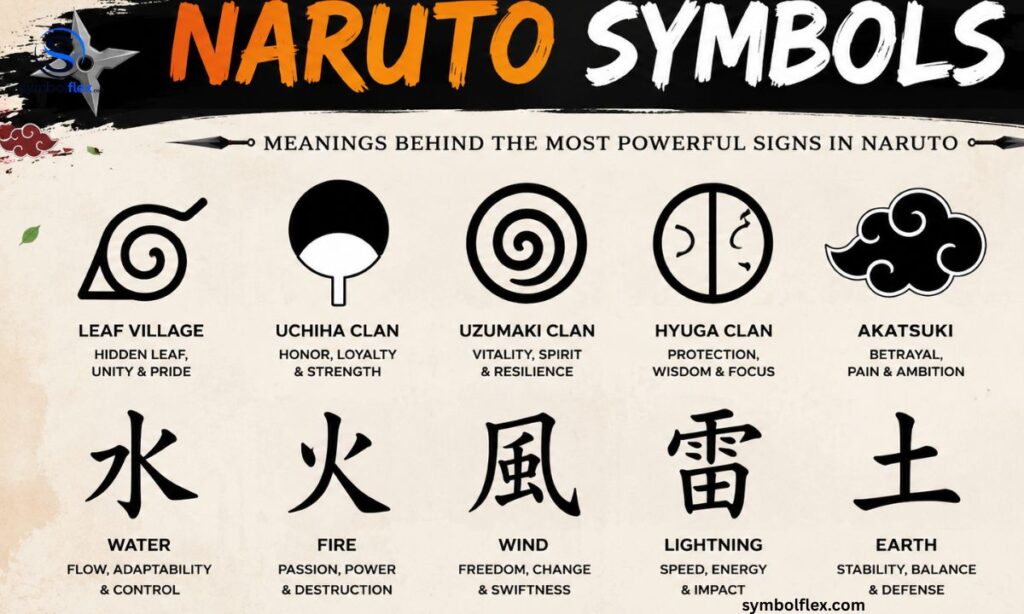
The world of Naruto is built on more than just jutsu and epic battles — every clan mark, hidden sign, and secret symbol carries a story of its own. From the iconic Uchiha clan fan symbol to the spiral emblem of the Hidden Leaf Village, each mark reflects a character’s identity, legacy, and hidden power.
In this guide, we break down 165+ Naruto symbols spanning clans, villages, and characters, including the unique designs behind the Sharingan, Byakugan, and Rinnegan, the meaning behind hidden village headbands, and secret signs only true fans can recognize. If you want to truly understand the deeper lore and symbolism behind Naruto, this article is your ultimate guide.
What Are Naruto Symbols?
Naruto symbols are visual crests, clan marks, village insignias, and power signs used throughout the Naruto and Naruto Shippuden series to represent identity, heritage, and spiritual power. They’re not decoration. They’re a coded language.
These symbols appear everywhere: on shinobi headbands, clan uniforms, jutsu scroll seals, curse marks burned into skin, and the backs of flak jackets worn by Hidden Leaf ninja. Each one tells you something specific about who a character is, where they come from, and what kind of power they carry.
Kishimoto didn’t design these randomly. He built the Naruto world on a foundation of real Japanese visual tradition. Japanese family crests, called kamon, have been used for over a thousand years to identify clans, noble houses, and samurai families. The clan symbols in Naruto follow the same logic. Simple, bold, geometric, and immediately recognizable, because that’s how real clan identity works in Japanese culture.
The Deep Symbolic Meaning Behind Naruto Symbols
Every major Naruto symbol operates on at least three levels of meaning: spiritual, psychological, and cultural. That’s why they feel so weighty even to viewers who don’t consciously analyze them.
Spiritual Meaning
The spiritual symbolism in Naruto runs deep, drawing from Shinto, Buddhism, and Hindu traditions that have shaped Japanese art for centuries.
The Uzumaki spiral connects to ancient concepts of eternal life energy. In Shinto tradition, spirals appear in sacred art to represent the continuous flow of nature and divine power. This isn’t a coincidence. The Uzumaki clan was literally defined by their extraordinary life force and longevity within the story, making the spiral a perfect visual choice.
Buddhist concepts of impermanence and suffering are woven into the Akatsuki’s visual identity. The organization’s nihilistic philosophy, the idea that the world is irreparably broken and must be reset, echoes Buddhist teachings about dukkha (suffering) taken to a dark extreme. The red clouds that symbolize blood and sorrow reflect this spiritual pessimism visually.
Psychological Meaning
Naruto symbols function as powerful psychological identity markers, and that’s a big reason why fans form such personal connections to them.
Psychologist Carl Jung described symbols as the language of the unconscious mind. He argued that certain shapes carry universal meaning across cultures because they tap into shared human experience.
The spiral is one of Jung’s archetypal symbols, representing the journey inward toward self-discovery. Naruto’s entire story arc is exactly that journey, which is why the Uzumaki spiral on his back feels so right even to viewers who can’t articulate why.
The Uchiha crest carries a fascinating psychological dual weight within the story. For young Sasuke, it represents pride and belonging. After the massacre, it becomes a symbol of grief and trauma. By the end of the series, it’s a burden carried with purpose. That single symbol shifts meaning three times across the narrative, which is something only truly well-designed symbols can do.
Cultural Meaning
The cultural architecture of Naruto’s symbol system is built on real Japanese tradition, then layered with global influences that make it land differently for audiences worldwide.
In feudal Japan, kamon were serious business. They appeared on samurai banners, household goods, and formal clothing, instantly communicating clan loyalty and social standing. The Uchiha and Uzumaki crests operate on exactly this logic. You see the symbol, you know who you’re dealing with and what they represent.
American fans often experience these symbols through a completely different cultural lens. The Akatsuki cloud, for example, is read in the USA primarily as a symbol of cool rebellion and outsider identity, often without knowledge of its tragic backstory about war-torn villages and rivers of blood.
That reinterpretation isn’t wrong. It’s just a different cultural layer being added to the same symbol, which is actually how living symbols work across time and geography.
Most Important Naruto Symbols and Their Meanings
Out of 165+ symbols in the Narutoverse, these five are the most culturally significant, widely recognized, and deeply meaningful both inside the story and in real-world fan culture.
Uzumaki Clan Symbol
Visual Description
The Uzumaki clan symbol is a bold red or black spiral that resembles a whirlpool viewed from directly above. It has no sharp edges. The line curves continuously inward from a wide outer ring to a tight center point, giving it a fluid, never-ending quality.
Depending on the context, it appears as a single spiral or a doubled variation. Think of the shape of a galaxy arm, a snail shell cross-section, or water draining from a bathtub. That’s the Uzumaki spiral.
Meaning
The word uzumaki literally means whirlpool or vortex in Japanese. That’s not a subtle choice. The Uzumaki clan was known across the shinobi world for their ferocious life force, their mastery of sealing jutsu, and their near-supernatural physical endurance. A whirlpool is a perfect visual metaphor: it pulls everything into its center, it never stops moving, and it’s incredibly difficult to escape once you’re caught in it.
In Japanese culture, spirals have been used in sacred art and architecture for centuries to represent longevity, strength, and the eternal cycle of life. Ancient Jomon pottery found in Japan dating back over 10,000 years features spiral motifs. The symbol Kishimoto chose for the Uzumaki clan wasn’t random. It was an intentional reach back into the deepest layers of Japanese visual culture.
Where It Appears
- Naruto’s orange jacket (back)
- Konoha flak jackets worn by all Leaf ninja
- Kushina Uzumaki’s hairpins and clothing
- Sealing scrolls used throughout the series
- Fan merchandise, tattoo studios, and streetwear across the USA
Uchiha Clan Symbol
Visual Description
The Uchiha clan crest is a stylized fan shape, a circular base topped with a wide, spreading triangular form. In Japanese, this shape is called an uchiwa, a traditional round paper fan used for centuries in Japan to fan fires and cool the air.
The crest appears in red, white, or black depending on the context, and it’s almost always worn on the back of the character’s uniform, a placement choice that mirrors real samurai heraldry tradition.
Meaning
The name “Uchiha” is a phonetic variation of uchiwa. That’s Kishimoto telling you directly what this clan is: the people who fan the flames. The Uchiha were the greatest fire-style jutsu users in the shinobi world, capable of summoning divine fire through techniques like Amaterasu (named after the Japanese sun goddess). The symbol isn’t just decoration. It’s a literal description of what these people do and who they are.
But the Uchiha crest also carries a heavier meaning within the story. Because it appears on the backs of their uniforms, the symbol is often seen as characters walk away, or as they fall. It becomes a mark of legacy and loss as much as pride and power. When Itachi walks away from the village after the massacre, the Uchiha crest on his back is the last thing the audience sees. That’s deliberate visual storytelling at its most precise.
Where It Appears
- Back of Uchiha clan uniforms
- Itachi’s ANBU uniform
- Sasuke’s clothing across all series arcs
- Uchiha compound architecture in Konoha
- Among the most common Naruto-inspired tattoo designs in the USA
Akatsuki Cloud Symbol
Visual Description
The Akatsuki cloud is a jagged, stylized cloud shape printed in red on the long black cloaks worn by every member of the organization. Unlike soft, natural cloud shapes, these clouds have harsh, irregular edges that feel aggressive and intentional.
The red-on-black contrast is one of the most visually striking color combinations in all of anime, and it’s part of why the Akatsuki aesthetic has become iconic in global pop culture.
Meaning
The red clouds don’t represent danger in a general sense. They have a specific, heartbreaking origin. The clouds represent the blood that fell like rain over Amegakure, the Hidden Rain Village, during the devastating wars that shaped the Akatsuki’s founding members.
Yahiko, Nagato, and Konan created the original Akatsuki as a peace organization born out of witnessing relentless war as orphaned children. The red clouds were a reminder of what they were fighting to prevent.
That origin story completely reframes the symbol. What reads as menacing villain aesthetic to a first-time viewer is actually a monument to grief and the memory of suffering. By the time the organization became a force of global destruction, the clouds had shifted from a memorial to a warning. Same symbol, completely different meaning depending on who’s wearing it and why.
Where It Appears
- All Akatsuki member cloaks (Pain, Itachi, Konan, Kisame, Deidara, and others)
- Promotional artwork and video game designs
- One of the most popular Naruto tattoo designs across the USA
- Cosplay culture at events like Anime Expo and Comic-Con
Hidden Leaf Village Symbol
Visual Description
The Hidden Leaf Village symbol is a clean, minimal leaf shape with a gentle swirl at its base, engraved on a rectangular metal plate attached to a cloth headband. The design is symmetrical, with a slightly pointed top and smooth, natural curves along the sides. It’s usually silver or steel-colored, mounted on blue, black, or red cloth. Simple, clean, and immediately iconic.
Meaning
The leaf represents growth, renewal, and the continuous cycle of nature. In the context of the story, it symbolizes the Will of Fire, which is the belief passed down through generations of Konoha ninja that the village must be protected, that the next generation must surpass the current one, and that the bonds between people are worth dying for.
The headband itself carries enormous weight as a cultural object. In real Japanese tradition, hachimaki (headbands) are worn as symbols of focus, determination, and effort. Athletes, students, and workers tie them on before demanding tasks. By making the shinobi’s headband the primary symbol of professional identity, Kishimoto connected his ninja world to a deeply familiar Japanese cultural practice.
Where It Appears
- Every main character’s headband (Naruto, Sakura, Kakashi, and most supporting characters)
- Village gates and official Konoha documents
- Best-selling merchandise item in the USA, with headband replicas widely available on Amazon and Etsy
- The most commonly recognized Naruto symbol among non-fans in the USA
Curse Mark Symbol
Visual Description
Sasuke’s Heaven Curse Mark appears as three tomoe-like shapes arranged in a circular pattern on the left side of his neck. The shapes resemble the tomoe found in the Sharingan, but twisted and distorted.
When the mark activates, it spreads across the skin in dark, flame-like patterns. In Stage 2 activation, those patterns cover large portions of the body, giving the bearer an almost demonic appearance.
Meaning
The Curse Mark is the clearest symbol of corrupted power in the entire series. It represents the promise of strength that comes with a devastating cost, which is a theme that appears in mythology worldwide from Faust’s deal with Mephistopheles to Achilles’ tragic invulnerability. Orochimaru didn’t create something new. He tapped into one of humanity’s oldest narrative fears: the power that consumes you.
What makes the design especially clever is that the tomoe shapes deliberately mirror the Sharingan. Orochimaru essentially took sacred Uchiha power and inverted it, creating a corrupted version of their most iconic ability. This visual parallel suggests he reverse-engineered something divine into something profane, which is exactly what his character represents within the story.
Where It Appears
- Sasuke’s neck and body (progressing through Stage 1 and Stage 2)
- The Sound Four ninja who also bear curse marks
- Anko Mitarashi, who carries a partial version of the same mark
- Frequently featured in fan art alongside Sharingan imagery
Naruto Symbols Across Cultures
Naruto symbols resonate globally because they tap into visual and spiritual traditions that different cultures already recognize at a deep level.
Japanese Culture
The clearest cultural roots of Naruto’s symbol system are in traditional Japanese kamon design. Kamon are family crests that have been used in Japan since at least the Heian period (794 to 1185 CE).
They appear on samurai banners, formal kimonos, and gravestones. The rules of kamon design are nearly identical to Naruto’s clan symbols: bold, simple, scalable, and immediately legible from a distance.
The shinobi headband also connects to real Japanese tradition. Hachimaki are worn by Japanese students during exam season, by athletes during competitions, and by workers during demanding physical labor. They carry a culturally understood message of focused determination. That meaning transfers directly into the Naruto world, where earning your headband means you’ve proven you’re ready to serve and protect.
Chinese Culture
The five chakra natures in Naruto (fire, water, earth, wind, and lightning) directly mirror the Chinese Five Elements theory known as Wu Xing, which has been used in Chinese medicine, philosophy, and martial arts for thousands of years.
The visual symbols associated with each nature carry this influence. Yin-Yang symbolism also appears clearly in the show’s treatment of positive and negative chakra, dark and light release, and the balance between the Sage of Six Paths’ two sons.
Hindu Spiritual Influence
Beyond the word “chakra,” Hindu influence appears throughout the show’s most sacred concepts. The Sage of Six Paths and his cosmology echo Hindu creation narratives about divine beings who shape existence.
The Rinnegan’s visual design references the third eye of Shiva. Even the concept of senjutsu (Sage Mode) mirrors yogic traditions where practitioners achieve higher consciousness by aligning themselves with natural energy.
Western Interpretation
American fans generally encounter Naruto symbols without cultural context and rebuild meaning from the visual information alone. The Akatsuki cloud became a streetwear icon partly because red-on-black communicates danger and rebellion universally.
The Uchiha crest reads like a medieval house sigil to Western audiences familiar with Game of Thrones-style heraldry. This isn’t a misreading. It’s a natural cultural translation that actually demonstrates how well-designed these symbols are: they communicate clearly even without their backstory.
Modern Global Culture
Today, Naruto symbols function as a shared visual language for the global anime community. On social media platforms like Instagram, TikTok, and Twitter/X, these symbols serve as instant identity signals.
Posting an Uzumaki spiral tells people something about who you are and what you value without a single word. That’s exactly what symbols are designed to do, and it’s a remarkable achievement for a fictional universe to have built that kind of real-world symbolic currency.
Naruto Symbols in Art, Movies and Pop Culture
Naruto symbols have moved far beyond the anime into mainstream American fashion, tattoo culture, and creative art.
Tattoos
Naruto-inspired tattoos are consistently ranked among the top anime tattoo requests in American tattoo studios. The most popular choices are the Uzumaki spiral, Akatsuki cloud, Hidden Leaf headband symbol, Sharingan eye, and Curse Mark. Placement trends favor forearms, upper arms, behind the ear, and the back of the neck, locations that mirror where the symbols appear on characters in the show.
What makes these tattoo choices meaningful is that fans aren’t just reproducing cool images. They’re selecting symbols that represent personal values: resilience (Uzumaki), belonging (Leaf Village), inner strength (Sharingan), or the complexity of ambition (Curse Mark). A Naruto tattoo is rarely just a fandom badge. It’s usually a statement about what the wearer has been through.
Fashion
The Akatsuki cloak is one of the most replicated anime garments in American cosplay and streetwear history. Beyond cosplay, Uchiha crest hoodies, Leaf Village headbands, and Uzumaki-print shirts are mainstream items available at Hot Topic, Amazon, and independent Etsy stores with thousands of sales.
Anime streetwear as a category has grown significantly in the USA, with Naruto being one of the top three most represented franchises alongside Dragon Ball Z and One Piece.
Movies and Media
The Boruto: Naruto Next Generations series introduced evolved versions of existing symbols and entirely new clan marks, expanding the symbolic vocabulary Kishimoto originally built.
Streaming platforms like Crunchyroll and Netflix have brought Naruto to entirely new audiences since the early 2020s, meaning a whole new generation of American fans is encountering these symbols for the first time and searching for their meaning.
Art and Fan Creations
The Naruto fan art community is enormous and genuinely creative. Artists on platforms like DeviantArt, Pinterest, and Instagram have reinterpreted clan symbols in watercolor, geometric minimalism, traditional Japanese calligraphy styles, and Western tattoo aesthetics.
A particularly fascinating trend is fans designing entirely new clan symbols using Kishimoto’s visual language as a framework, treating his symbol system as a real design tradition they can participate in and extend.
Spiritual and Dream Meaning of Naruto Symbols
Many people report dreaming about Naruto symbols years after watching the series, which makes sense because powerful visual symbols have a way of embedding themselves in the unconscious mind.
Seeing the Uzumaki Spiral in Dreams
Spirals are among the most universally analyzed dream symbols in depth psychology. Carl Jung identified the spiral as an archetype of the self, representing the journey inward toward deeper self-knowledge and wholeness.
Dreaming of the Uzumaki spiral often reflects a period of personal growth, transformation, or finding inner strength after a difficult period. It’s a symbol of momentum and forward motion even when the path feels circular.
Seeing the Akatsuki Cloud
Red symbols in dreams are generally connected to strong emotion: passion, urgency, warning, or unresolved anger. Seeing the Akatsuki cloud might reflect feelings of operating outside social norms, carrying pain that has turned outward, or wrestling with a morally complex decision. It might also appear during periods when you’re questioning systems of authority or feeling like the path forward requires breaking established rules.
Seeing the Hidden Leaf Symbol
Dreaming of a belonging or community symbol like the Leaf Village crest often surfaces during times of transition, when identity and community feel uncertain. It can reflect a desire for connection, pride in personal achievement, or anxiety about whether you’ve truly earned your place in a community you value. The leaf’s natural imagery also connects to dreams about renewal and fresh starts.
Seeing the Curse Mark
Curse-type symbols in dreams often represent awareness of a destructive pattern, temptation toward something harmful, or the weight of an inherited burden you didn’t choose.
Seeing the Curse Mark might reflect guilt, an awareness of giving in to something self-destructive, or the unsettling recognition of hidden power you’re not sure you can control. In Jungian terms, it represents the shadow self: the parts of ourselves we try to suppress but that keep demanding attention.
Positive and Negative Meanings of Naruto Symbols
Every major Naruto symbol carries both positive and negative meanings, which is what makes them feel so true to life.
The Uzumaki spiral represents resilience, unbreakable life force, and belonging to a powerful lineage. But it also represents the loneliness of being the last of your clan, carrying a legacy too heavy for one person.
The Hidden Leaf symbol stands for loyalty, growth, and community. Its shadow side is the burden of conformity and the devastating pain of rejection from the community you gave everything to protect.
The Uchiha crest represents elite power, fire mastery, and noble heritage. Its darkness is the curse of passionate love that becomes grief, and the pride that becomes isolation.
The Akatsuki cloud started as a memorial for the innocent and became a warning from the dangerous. It represents how suffering can transform purpose into destruction.
The Curse Mark represents the promise of power and the loss of self. But it also represents the very human experience of reaching for something forbidden because ordinary strength doesn’t feel like enough.
What makes Naruto’s symbol system so emotionally powerful is that none of these symbols are purely good or purely evil. They all carry both, which reflects the actual complexity of the characters who bear them.
Why Humans Feel Drawn to Naruto Symbols
People are drawn to Naruto symbols because great symbols tap into universal human needs for identity, belonging, and meaning, and Kishimoto designed these to do exactly that.
Humans are wired for symbol recognition from infancy. Neuroscientists have documented that the brain processes visual symbols faster than written language and stores them with stronger emotional associations. When you see the Uzumaki spiral on a piece of merchandise, your brain retrieves not just a visual memory but an emotional one: the feeling of watching Naruto refuse to give up, again and again. The symbol carries the emotional weight of the entire story.
For many American fans who grew up watching Naruto on Cartoon Network and Toonami in the mid-2000s, these symbols are also deeply tied to nostalgia. They represent not just a TV show but a specific period of childhood, specific emotions, specific friendships. Wearing or displaying a Naruto symbol connects you back to that time and identity in a way that’s genuinely comforting.
There’s also the appeal of hidden meaning. People are naturally drawn to symbols that seem to hold secrets, which is exactly what this article has been unpacking. Knowing that the Akatsuki cloud represents blood and sorrow, not just cool aesthetics, gives you access to a layer of meaning most casual fans miss. That knowledge feels like belonging to an inner circle, which is itself a fundamentally human desire.
Naruto Symbols and Their Hidden Connection to Real Life
The reason Naruto symbols feel personally meaningful to so many people is that Kishimoto designed them to reflect universal human experiences, not just fictional ones.
The Uzumaki spiral is a perfect metaphor for resilience. Life often feels like a spiral: you return to the same challenges, the same fears, the same questions. But each time around, you’re at a slightly different point on the spiral, deeper in, further along, closer to the center of who you actually are. Naruto’s entire story is that spiral made visible.
The Curse Mark maps onto addiction, trauma, and the seductive pull of anything that promises relief but extracts a cost. Countless fans have written online about recognizing their own struggles in Sasuke’s relationship with his curse mark. That’s not overprojection. That’s a symbol doing exactly what it was designed to do.
Frequently Asked Questions
What does the Uchiha clan symbol mean?
The Uchiha fan symbol represents balance between fire and air, symbolizing the clan’s strength and unity.
Why do hidden villages have different symbols?
Each village symbol reflects unique history, values, and identity, distinguishing shinobi nations like Leaf, Sand, and Mist.
What is the meaning behind the Sharingan symbol?
Sharingan represents heightened perception and copying abilities, symbolizing the Uchiha clan’s legendary visual prowess and power.
Do clan symbols indicate character strength?
Not directly, but symbols often represent inherited abilities, bloodline traits, and the legacy each clan carries forward.
What does the Akatsuki cloud symbol represent?
The red cloud symbolizes danger and ambition, representing the organization’s mysterious, powerful, and villainous shinobi members.
Conclusion
Naruto symbols are far more than anime design choices. They’re a carefully constructed visual language rooted in real Japanese kamon tradition, Hindu spiritual philosophy, Buddhist symbolism, and universal human psychology. From the Uzumaki spiral’s ancient connection to life force and resilience to the Akatsuki cloud’s heartbreaking origin in bloodshed and war, every major symbol in this series carries layers of meaning that reward curiosity.
Whether you’re drawn to these symbols as a lifelong fan, a tattoo enthusiast, an art lover, or someone who just started watching Naruto last week, understanding what they actually mean makes them richer. You’re not just seeing a cool logo. You’re reading a story told entirely in shape, color, and cultural memory.
