

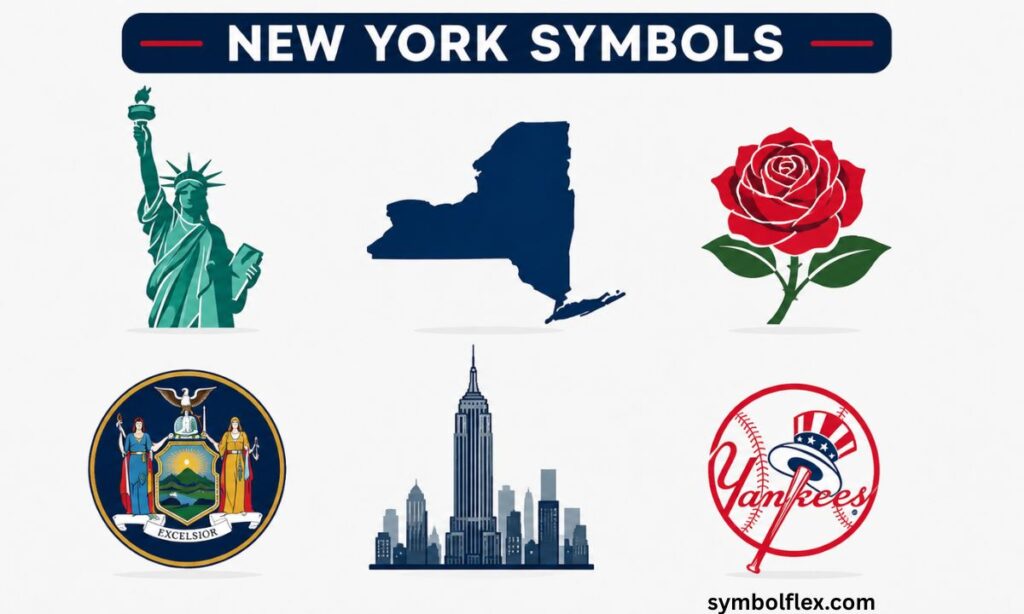
New York symbols represent the heart of both a state and a city known worldwide for freedom, ambition, and diversity.
Icons like the Statue of Liberty and Empire State Building capture the spirit of opportunity, while official emblems such as the Eastern Bluebird and Sugar Maple reflect New York’s natural heritage.
Modern symbols like the yellow taxi and NYC skyline show the city’s nonstop energy and culture. This guide explores 50+ New York symbols and their meanings in a simple, easy-to-understand way. Together, these symbols reveal what makes New York truly iconic.
What Are New York Symbols?
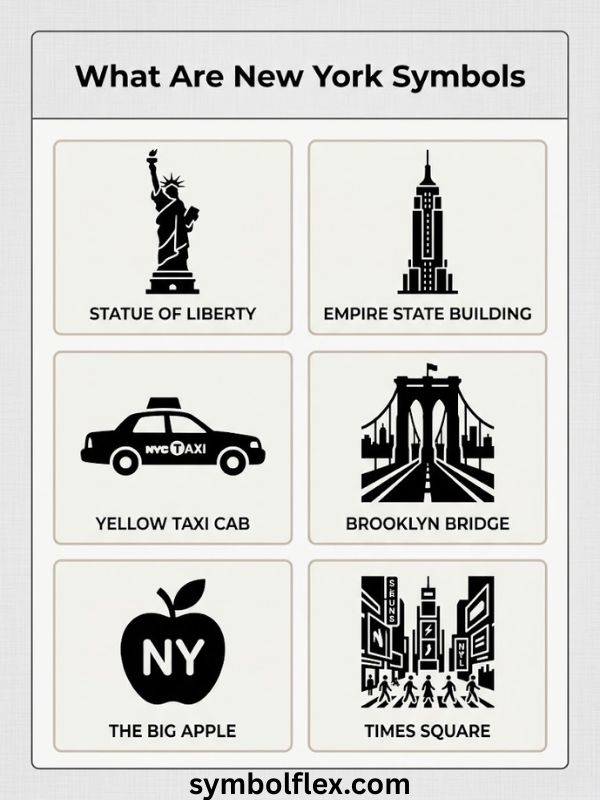
New York symbols are the objects, animals, plants, landmarks, and images that represent the identity, history, and values of New York State and New York City. Some are official, chosen through state law, like the state bird or state flower.
Others are unofficial but just as recognizable, like the Statue of Liberty or a yellow taxi cab.
Broadly, New York symbols fall into three groups:
- Official state symbols — legally designated by the New York State Legislature
- NYC landmarks and city symbols — buildings, bridges, and places tied to New York City’s identity
- Cultural and modern symbols — images, phrases, and icons that represent New York in art, media, and everyday design
Official New York State Symbols
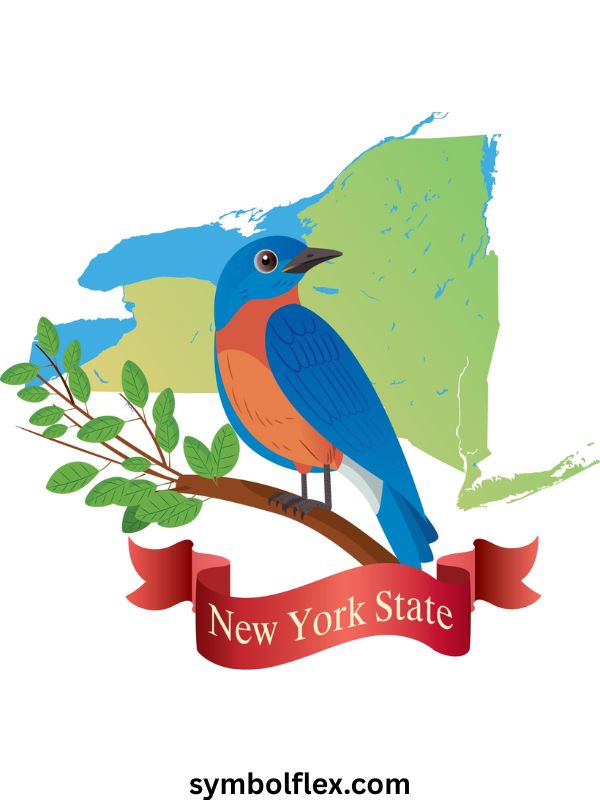
These are the symbols formally adopted by New York State. Each one was chosen for a reason, often tied to the state’s landscape, history, or values.
| Symbol Category | Official Symbol |
| State Bird | Eastern Bluebird |
| State Flower | Rose |
| State Animal | Beaver |
| State Tree | Sugar Maple |
| State Fish (freshwater) | Brook Trout |
| State Fish (saltwater) | Striped Bass |
| State Insect | Nine-Spotted Ladybug |
| State Gem | Garnet |
| State Fruit | Apple |
| State Beverage | Milk |
| State Muffin | Apple Muffin |
| State Fossil | Sea Scorpion (Eurypterus) |
| State Shell | Bay Scallop |
| State Reptile | Snapping Turtle |
| State Motto | Excelsior |
New York State Bird — Eastern Bluebird
The Eastern Bluebird was named New York’s state bird in 1970. It symbolizes hope and renewal, largely because the species nearly vanished from the region before conservation efforts brought it back — a fitting symbol for a state built on comebacks.
New York State Flower — The Rose
Adopted in 1955, the rose represents love, beauty, and resilience. New York didn’t pick one specific rose variety, which many people find fitting for a state defined by diversity rather than a single tradition.
New York State Animal — The Beaver
The beaver isn’t just a cute mascot — it’s tied directly to New York’s economic history. The fur trade, especially beaver pelts, was central to the colony’s early wealth and is even pictured on the New York City flag.
New York State Tree — Sugar Maple
Chosen in 1956, the sugar maple represents strength and endurance through harsh winters, and its brilliant fall color has become part of New York’s seasonal identity, especially upstate.
New York State Motto — Excelsior
Latin for “ever upward,” Excelsior captures the ambition baked into New York’s culture — the same drive behind its skyscrapers, its immigrant history, and its reputation as a place people go to build something bigger.
Iconic New York City Symbols
When most people say “New York symbols,” they actually mean NYC landmarks. These are the images that appear on postcards, movie posters, and passport stamps.
- Statue of Liberty — freedom, immigration, and opportunity
- Empire State Building — ambition, human achievement, and skyline pride
- Brooklyn Bridge — connection, engineering progress, and unity between boroughs
- Times Square — energy, entertainment, and nonstop modern life
- Yellow Taxi Cab — urban movement and NYC’s fast pace
- One World Trade Center — resilience and rebuilding after tragedy
- Chrysler Building — Art Deco elegance and 1920s ambition
- Grand Central Terminal — transition, travel, and the city’s constant motion
- Central Park — nature within chaos, a shared breathing space for millions
- Wall Street Charging Bull — financial power and economic confidence
- Flatiron Building — architectural innovation and early 20th-century growth
- Broadway — creativity, performance, and storytelling
- The Subway (MTA) — the pulse and grit of everyday city life
- Coney Island — nostalgia, working-class leisure, and old-school Americana
- The NYC Skyline — collective ambition — thousands of dreams stacked into one skyline
- “I Love NY” Logo — civic pride, created originally as a tourism campaign
- The Big Apple (nickname) — opportunity and reward for those who “make it”
Brooklyn and Borough Symbols
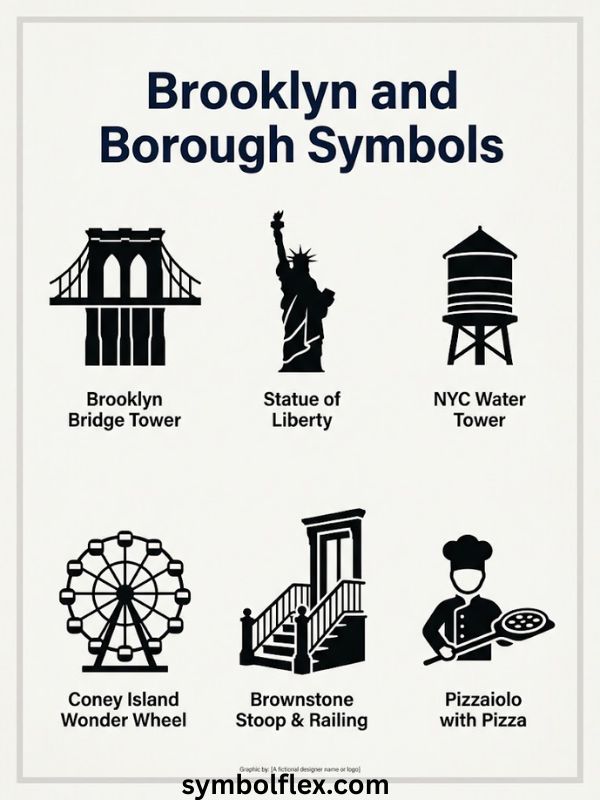
New York City isn’t just Manhattan. Each borough carries its own symbols, and Brooklyn in particular has built its own identity separate from “the city.”
- Brooklyn Bridge — often used as shorthand for the borough itself
- Brooklyn sign / borough seal — local pride and independence from Manhattan
- Coney Island’s Cyclone and boardwalk — Brooklyn’s working-class roots
- The Dodgers’ ghost — nostalgia for a team that once symbolized Brooklyn loyalty
- Prospect Park — Brooklyn’s answer to Central Park, representing green space and community
Other boroughs carry their own quieter symbols too: Yankee Stadium for the Bronx, the Unisphere in Queens (a symbol of global unity from the 1964 World’s Fair), and the Staten Island Ferry, which represents an often-overlooked but essential part of the city.
Historical and Colonial New York Symbols
New York’s symbolism didn’t start with skyscrapers. Long before the skyline existed, the region carried different meanings.
- The Dutch Windmill — a nod to New Amsterdam, New York’s original Dutch settlement
- The Tulip — another Dutch colonial symbol still used in some regional branding
- Ellis Island — the literal gateway for millions of immigrants, symbolizing new beginnings
- The Beaver on the NYC flag — colonial trade and the fur economy
- Religious diversity of colonial New York — early New York was unusually tolerant for its time, home to Dutch Reformed, Quaker, Jewish, and Anglican communities side by side, laying early groundwork for the city’s later reputation as a melting pot
Creative and Modern New York Symbols
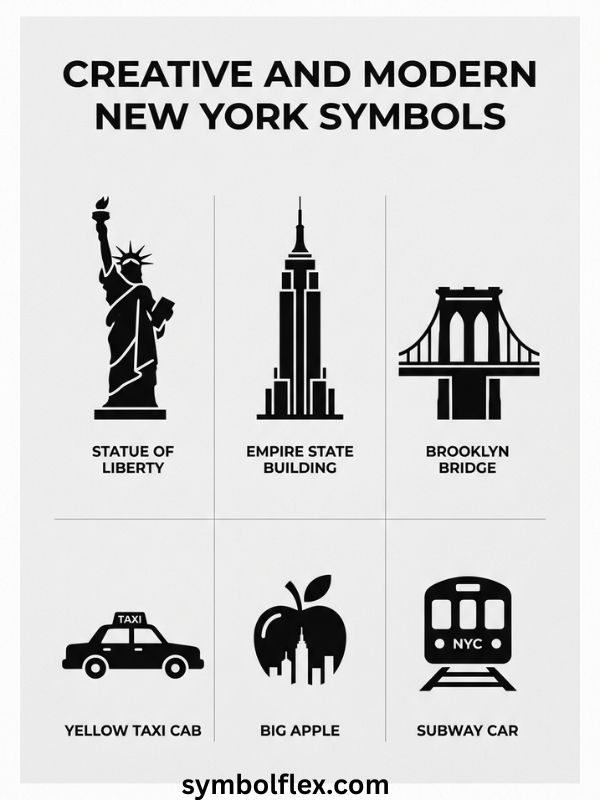
Beyond landmarks, New York shows up constantly in design, art, and casual culture — often simplified into easy, recognizable shapes.
Popular in art, drawing, and design:
- The Statue of Liberty’s torch (used alone as a symbol of freedom)
- A simple skyline silhouette
- Yellow taxi icon
- The apple (as shorthand for “Big Apple”)
- Subway line letters/numbers in circles
- The Brooklyn Bridge cables as a minimalist line drawing
Popular in tattoos:
- Statue of Liberty (freedom, personal independence)
- Skyline silhouette (roots, hometown pride)
- “212” or “718” area codes (borough identity)
- Empire State Building (ambition, personal achievement)
- Compass rose combined with skyline (journey and direction)
Popular for kids and beginners to draw:
- Apple shape (Big Apple)
- Simple triangle-topped skyscraper (Empire State Building)
- Basic bridge outline (Brooklyn Bridge)
- Torch and crown shape (Statue of Liberty)
These simplified versions matter because they make New York symbols usable everywhere — on t-shirts, logos, school projects, and social media graphics — without losing what they represent.
What New York Symbols Really Mean
Most New York symbols carry meaning on more than one level.
Cultural level: They represent a shared American story — immigration, reinvention, and the idea that anyone can “make it” in New York. This is why the Statue of Liberty and Ellis Island remain the most emotionally loaded symbols on this list.
Psychological level: New York symbols often represent ambition and pressure at the same time. The Empire State Building can mean achievement, but the same skyline can also represent stress, competition, and the grind of city life — both readings are common and both are valid.
Symbolic/dream level: In dream interpretation and pop psychology, New York imagery (skyscrapers, crowded streets, taxis) is frequently associated with drive, urgency, and the feeling of being pulled in many directions — reflecting how the city actually feels to live in.
New York Symbols in Art, Film, and Pop Culture
Few places have been photographed, filmed, and painted as often as New York. The skyline alone has become cinematic shorthand, when a movie wants to signal ambition, reinvention, or a fresh start, it often opens with a shot of Manhattan.
Photographers from the early 20th century onward used the Empire State Building and Brooklyn Bridge to represent modern human achievement, while later pop artists turned taxis, subway signs, and the “I Love NY” logo into instantly recognizable graphic icons.
Even musicians and writers use New York as a stand-in for opportunity, loneliness, and reinvention all at once, proof that these symbols work because they hold contradictions well.
Positive vs. Negative Meaning of New York Symbols
| Positive Meaning | Negative Meaning |
| Freedom and opportunity (Statue of Liberty) | Overwhelm and pressure (crowded skyline) |
| Ambition and success (Empire State Building) | Materialism and competition (Wall Street Bull) |
| Connection and unity (Brooklyn Bridge) | Isolation in a crowd (subway, dense city life) |
| New beginnings (Ellis Island) | Displacement and loss of roots (rapid urban change) |
Understanding both sides is part of what makes New York symbolism so rich — these aren’t simple “good luck charm” symbols. They reflect a real, complicated place.
Why People Are Drawn to New York Symbols
New York symbols resonate globally because they represent universal human experiences, not just one city. Freedom, ambition, reinvention, and diversity aren’t uniquely American ideas — they’re things people everywhere relate to.
That’s part of why the Statue of Liberty appears in tattoos in Tokyo, why the skyline shows up on phone cases in London, and why “I Love NY” has been copied by tourism campaigns worldwide. These symbols travel well because they represent a feeling, not just a place.
Frequently Asked Questions
What is New York’s most famous symbol?
The Statue of Liberty is generally considered New York’s — and one of America’s — most recognized symbols, representing freedom and immigration.
What is the official New York state animal?
The beaver, adopted in 1975, largely because of its role in the region’s early fur trade economy.
What flower represents New York State?
The rose, adopted in 1955, without a specific variety being named.
What does the yellow taxi symbolize in New York culture?
It represents the city’s constant motion, accessibility, and urban energy — a visual shorthand for “New York” almost as strong as the skyline itself.
Why is New York called the Big Apple?
The nickname dates back to the 1920s, originally used in horse-racing slang, and later became associated with opportunity and reward — the idea that success in New York is the “big prize.”
Final Thoughts
New York’s symbols work on two levels at once, official and unofficial, historical and modern. The beaver and sugar maple tell the story of the land and its early economy, while the Statue of Liberty and the skyline tell the story of who New York became: a place built by ambition, shaped by immigration, and recognized instantly anywhere in the world.
