
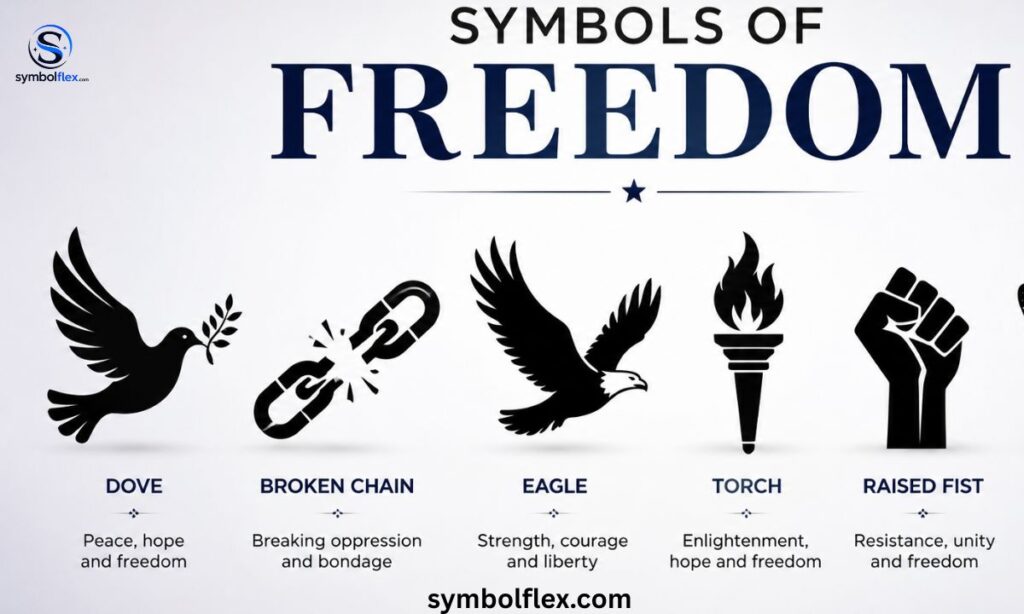
Symbols of freedom are images and objects that represent liberty, hope, and independence, and they’ve shaped human culture since ancient times.
From the soaring eagle to broken chains, these symbols speak a language that words often can’t capture.
Every culture, from Ancient Greece to modern America, has found its own way to picture what freedom feels like.
Some symbols mark national pride, like the flag or the Statue of Liberty, while others reflect personal growth, like a butterfly or an open road. In this guide, you’ll discover 92+ powerful symbols of freedom, along with the history and meaning behind each one.
What Are Symbols of Freedom?
Symbols of freedom are visual or cultural representations of liberty, independence, and release from restriction. They can be animals, objects, colors, or gestures that communicate an abstract idea in a way words often can’t.
Humans are visual creatures. Long before written language spread widely, people used images to communicate ideas like power, faith, and freedom.
A carved bird on an ancient tomb did the same job a slogan does today: it told a story instantly, without needing translation.
Universal And Ancient Freedom Symbols

The most universal symbols of freedom are the bird in flight, the open sky, and broken chains, because these images appear independently across dozens of unrelated ancient cultures.
Universal Symbol Of Freedom
When people search for a single universal symbol of freedom, the answer almost always comes back to birds, particularly ones shown mid-flight.
Wings suggest the ability to rise above a situation and go somewhere new. This idea shows up in Egyptian tomb paintings, Greek mythology, and Native American ceremonial art, all without direct influence between these groups.
Ancient Symbols Of Freedom
Ancient civilizations built belief systems around liberty long before the word existed as we use it now. The Romans used the pileus, a soft felt cap, as a symbol given to freed slaves, marking their new legal status, one of the earliest documented objects tied directly to legal freedom.
The laurel wreath carried connotations of freedom from struggle, worn by Greek athletes after real achievement. Torches and flames appear across nearly every ancient culture, representing enlightenment and the light that leads people out of oppression.
Symbols Of Freedom In Mythology
Mythology gives us rich freedom symbols in mythology because ancient storytellers used gods and creatures to explain abstract human desires.
The Greek goddess Nike, shown with large wings, represented victory closely tied to liberation from oppressive rule. Pegasus, the winged horse, represents freedom through the union of earthbound strength and flight.
In Egyptian mythology, the phoenix, a bird reborn from its own ashes, ties freedom to transformation rather than simple escape. Norse ravens like Huginn and Muninn symbolized free thought and unrestricted travel between worlds.
Symbols Of Freedom Tattoos
Tattoo culture has adopted freedom symbolism heavily. A tattoo is permanent, personal, and visible, making it a natural home for symbols tied to identity.
Symbols of freedom tattoos are consistently among the most requested designs at tattoo studios across the United States.
People choose freedom tattoos for personal reasons: recovery from addiction, a divorce, or overcoming a mental health struggle. The tattoo becomes a permanent reminder of reclaiming control over one’s own life.
Tattoos That Symbolize Freedom

Popular tattoos that symbolize freedom include birds in flight (especially swallows, historically linked to sailors returning home), feathers transforming into birds, and compass designs representing self-guided purpose.
Broken chain tattoos remain popular, often placed around the wrist or ankle, areas that historically would have been restrained.
The placement itself becomes part of the symbolism. Butterfly tattoos suggest full transformation, since the creature physically becomes something entirely different than it started as.
Freedom Symbol Tattoo
If you’re considering a single freedom symbol tattoo, placement matters as much as the image.
Wrist and forearm placements are visible daily, serving as a personal reminder, while chest and back placements hold more private meaning.
Before getting one, research the cultural origin of the symbol. Eagle feathers in Native American traditions carry sacred meaning that isn’t meant to be used casually.
Spiritual And Creative Freedom Symbols
Spirituality and art have historically been the strongest channels for expressing freedom symbolism, since both deal with ideas that are hard to explain through logic alone.
Symbols Of Freedom In Art
Symbols of freedom in art span centuries. Eugène Delacroix’s “Liberty Leading the People,” painted in 1830, shows a woman personifying liberty leading citizens over fallen soldiers, remaining one of the most referenced freedom images in Western art history.
Norman Rockwell’s “Four Freedoms” series translated President Franklin D. Roosevelt’s speech into relatable illustrations for everyday Americans.
Spiritual Symbols Of Freedom
The spiritual meaning of freedom often centers on release from internal restriction rather than external circumstances.
The lotus flower, in Buddhist and Hindu traditions, represents enlightenment and freedom from suffering, since it grows through mud yet blooms clean.
Open hands, shown in prayer or meditation, represent surrender and release across many traditions, while doves represent the Holy Spirit and peace in Christianity, tied to Noah’s story.
Symbol Of Freedom Drawing
For a symbol of freedom drawing, simple line work often communicates the idea more powerfully than complex detail.
Popular subjects include a bird mid-flight, open doors leading into light, and broken chains lying loose, all chosen because they show movement rather than a static object.
Journaling communities have popularized these sketches as part of self-growth content.
Symbols Of Freedom Not American

While the United States has strong national freedom symbolism, symbols of freedom not American deserve attention too.
South Africa’s story of broken chains and Nelson Mandela’s release from prison remain powerful modern freedom symbols.
France’s Bastille Day imagery represents freedom from monarchy, holding emotional weight similar to America’s Fourth of July.
India’s spinning wheel, or charkha, became a symbol of independence during the movement to end British colonial rule, championed by Mahatma Gandhi.
Symbols Freedom
Beyond the major categories, additional symbols freedom enthusiasts often search for include the infinity symbol, representing limitless freedom, and mountains, representing freedom achieved through overcoming difficulty.
These often show up in recovery programs and therapy work rather than national contexts.
Deep Symbolic Meaning
Freedom symbols operate on three distinct levels: spiritual, psychological, and cultural, which explains why the same image can mean different things to different people.
Spiritual Level
On a spiritual level, freedom symbols represent release from suffering, ego, or attachment, a state of mind rather than a change in circumstances.
Psychological Level
Psychologically, freedom symbols connect to autonomy, a core human need tied to motivation and wellbeing.
When people feel they lack control, freedom symbolism becomes a way of mentally reclaiming that sense of agency.
Cultural Level
Culturally, freedom symbols are shaped by shared history. The American eagle means something different to an American audience than to someone unfamiliar with U.S. history, because it’s loaded with national memory.
Types / Variations of Symbols of Freedom
The most recognized types of freedom symbols include birds, broken chains, open roads, butterflies, flags, keys, and open sky, each representing a slightly different angle on the same core idea.
1. The Bird (Especially Eagle or Dove)
The eagle represents strength paired with freedom, exactly why it was chosen as America’s national bird. The dove leans softer, representing peace alongside freedom.
2. Broken Chains
Broken chains are among the most direct freedom symbols. This symbol carries heavy historical weight tied to the abolition of slavery and appears in Juneteenth imagery and civil rights commemorations.
3. The Open Road
American culture has a strong relationship with the open road as a freedom symbol, tied to road trip culture and Route 66 nostalgia.
4. The Butterfly
The butterfly represents transformation more than escape, since it physically changes form entirely before it can fly.
5. The Flag
Flags represent collective freedom and shared identity. The American flag carries layered meaning tied to independence, sacrifice, and unity.
6. The Key
Keys symbolize access and unlocking new opportunity, tied to overcoming a legal, financial, or personal barrier.
7. The Sky
Open sky represents limitless possibility, appearing in phrases, artwork, and architecture designed to evoke freedom and expansion.
Symbols of Freedom Across Cultures
Freedom symbolism varies meaningfully across cultures, shaped by each society’s specific history with independence, oppression, and liberation.
Ancient Greece
Ancient Greece tied freedom closely to democracy and civic participation, with symbols like the owl of Athena representing wisdom used in service of self-governance.
Ancient Egypt
Egyptian culture used the feather of Ma’at, the goddess of truth and balance, as a symbol tied to spiritual freedom through moral alignment.
Native American Cultures
Eagle feathers hold deep, sacred meaning in many Native American cultures, traditionally earned through acts of honor and courage rather than worn casually.
Medieval Europe
Medieval Europe’s freedom symbolism centered on legal documents like the Magna Carta, signed in 1215, which limited royal power and planted early seeds of individual rights.
Modern Western Culture
Modern Western culture leans on monuments like the Statue of Liberty and the Liberty Bell, both central to American identity and visited by millions each year for what they represent.
Symbols of Freedom in Art, Movies & Pop Culture
Pop culture continues to reshape freedom symbolism for new generations through film, music, and literature. Movies like Braveheart and The Shawshank Redemption use freedom imagery to create some of the most emotionally memorable scenes in modern cinema.
Music has carried freedom symbolism too. Protest songs throughout American history have used freedom-related imagery to unify audiences around shared struggles.
Photography has produced iconic freedom images, including the unidentified “Tank Man” from Tiananmen Square in 1989, recognized worldwide as a symbol of individual courage against state power.
Spiritual & Dream Meaning of Symbols of Freedom
Dreaming about flying, birds, or open doors is commonly associated with a subconscious desire for freedom or escape from a restrictive situation in waking life.
Flying dreams are frequently linked to feelings of empowerment, often increasing during major life transitions like changing jobs or relocating.
Dreaming of open doors tends to relate to new opportunity, while dreams involving broken chains often connect to a recent decision that felt liberating in waking life.
Positive vs Negative Meaning
Freedom symbols aren’t automatically positive. Context and intent shape whether a symbol represents hope or chaos.
Positive Meaning
In positive contexts, freedom symbols represent hope, courage, resilience, and healthy independence, marking personal growth and empowerment.
Negative Meaning
In negative contexts, the same symbols can represent recklessness or freedom pursued without responsibility. A broken chain in one context represents liberation, while in another it could suggest abandonment of structure entirely.
Why Humans Are Attracted to Symbols of Freedom
Humans are drawn to freedom symbols because autonomy is a core psychological need, not just a political ideal. Feeling in control of one’s own choices is directly tied to overall wellbeing.
Major social movements have relied on shared symbols to unify people around a common goal. The American Revolution and the civil rights movement both leaned on repeated imagery to build collective identity and momentum.
Frequently Asked Questions
What is the most powerful symbol of freedom?
The bird in flight, particularly the eagle and dove, is widely considered the most powerful and universally recognized symbol of freedom.
What animal represents freedom the most?
Birds represent freedom more than any other animal, thanks to their ability to fly beyond physical boundaries.
What flower symbolizes freedom?
The lotus flower symbolizes freedom and enlightenment in Buddhist and Hindu traditions.
Is the butterfly a symbol of freedom or transformation?
The butterfly represents both, since its physical transformation is closely tied to the idea of personal freedom gained through change.
What’s a good symbol of freedom for a tattoo?
Popular choices include birds in flight, broken chains, feathers, and compass designs, each with a slightly different personal meaning.
Conclusion
Symbols of freedom connect ancient history, spiritual tradition, and modern personal expression into one continuous human story.
Whether it’s an eagle overhead, a broken chain in a tattoo, or a simple drawing of an open door, these images carry weight because they speak to something every person understands: the desire to live without unnecessary restriction.
