

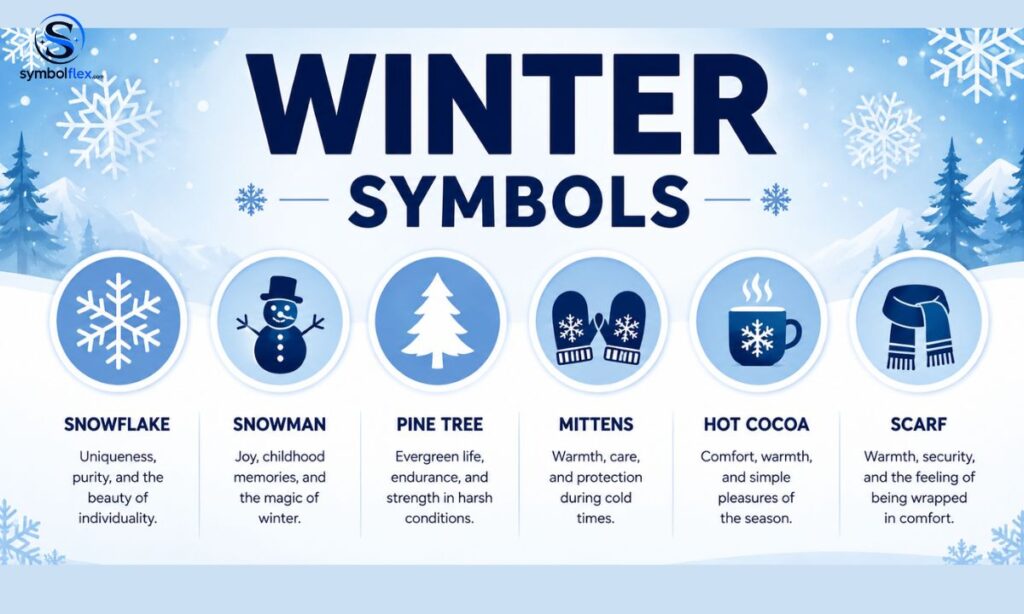
Winter symbols are images and natural elements like snowflakes, ice, and bare trees that represent the winter season and its deeper meaning of rest, renewal, and reflection.
Whether you’re searching for a cute snowflake to copy into your bio or want to understand winter’s spiritual significance, this guide covers both. Search interest in winter symbolism and copy paste winter emojis spikes every year between late November and February, driven by journaling and aesthetic trends.
Fun fact: The word “winter” comes from an old Germanic root meaning “time of water.” Another fact: no two snowflakes have ever been documented as identical, a discovery credited to Wilson Bentley, who photographed thousands of snow crystals in the early 1900s.
What Are Winter Symbols?

Winter symbols are visual or conceptual representations that capture the mood, appearance, or spirit of the winter season. This includes natural elements like snow and ice, as well as cultural icons like wreaths, stars, and candles.
Think of a winter symbol as a shortcut for a feeling or an idea. When you see a snowflake on a greeting card, your brain does not need an explanation. You instantly connect it to cold weather, the holiday season, or maybe a childhood memory of catching snowflakes on your tongue. That is the power of symbolism. It communicates instantly, without words.
These symbols show up everywhere once you start looking for them. They appear in home decor during the colder months, in tattoo designs that carry personal meaning, in social media bios where people use a simple ❄️ to signal the season, and in spiritual practices where winter represents a pause before new growth. Some symbols are literal, like an icicle or a snowman. Others are more abstract, like the idea of “coldness” representing emotional distance in literature.
It also helps to separate winter symbols from winter decorations. A string of fairy lights is decoration. A snowflake, on the other hand, carries centuries of symbolic weight tied to purity, individuality, and impermanence. Understanding this difference is the first step toward appreciating why winter symbolism has stuck around for so long, and why it still resonates with people today.
Winter Symbols And Spiritual Meanings
Winter symbols carry spiritual weight because the season itself mirrors a universal human experience: a period of rest, introspection, and preparation before renewal. Nearly every major spiritual tradition treats winter as a sacred pause rather than an ending.
This section breaks down the most searched winter symbols, from snowflake text characters to the deeper question of what snow and cold actually represent on a spiritual level. If you have ever wondered why winter feels heavier or more reflective than other seasons, the answer often lies in these older, symbolic frameworks that humans built long before modern psychology gave us language for the same experience.
Snowflake Symbol Text
A snowflake symbol text refers to the small Unicode characters people copy and paste into messages, social media bios, or documents to represent winter without using an actual emoji. Common examples include ❄, ❅, and ❆.
These text based symbols are popular because they render consistently across almost every device and font, unlike emojis which can look different depending on the platform. Designers and writers often prefer them for a cleaner, more minimalist look, especially in printed materials or professional documents where a colorful emoji might feel out of place.
Typing them is simple once you know where to look. Most people just copy them directly from a list like this one rather than digging through special character menus, which is exactly why “copy and paste” searches for winter symbols are so common.
Winter Symbols Cute

“Cute” winter symbols are softer, rounder, and more playful versions of standard winter icons, popular in journaling, Pinterest boards, and TikTok aesthetics. Think mittens, hot cocoa mugs, and chubby little snowmen instead of sharp icicles.
This trend reflects a broader shift in how younger audiences engage with seasonal symbolism. Rather than the traditional, formal imagery of old greeting cards, the current aesthetic leans into comfort and warmth even while depicting a cold season. It is a subtle but interesting contradiction: cute winter symbols make cold weather feel cozy instead of harsh.
You will notice this style heavily in bullet journal spreads and Canva templates, where a simple line drawing of a snowflake next to a steaming mug communicates “winter” far more effectively than a realistic snowstorm ever could.
Cute Winter Emojis
Popular cute winter emojis include ❄️ ☃️ 🧣 🧤 ☕ 🦌 ⛄ and 🕯️. These are frequently combined in strings for Instagram captions or bios during the colder months.
Each of these emojis taps into a specific sensory memory. The scarf and mittens suggest touch and warmth. The mug of cocoa suggests taste and comfort. The deer suggests the quiet stillness of a snowy forest. Together, they build a small emotional world in just a few characters, which is exactly why they perform so well on social platforms.
A simple combo like “❄️🤍☕” has become almost a universal shorthand for “cozy winter mood” across bios and captions, regardless of the platform or the user’s age group.
What Does The Cold Symbolize?
Cold symbolizes clarity, emotional distance, and endurance. It can represent a sharpening of the mind, but it can also symbolize isolation or a guarded heart, depending on the context.
In literature and everyday language, we describe unfriendly people as “cold” and difficult situations as “giving someone the cold shoulder.” This is not accidental. Cold, by its physical nature, forces distance and caution, so it became a natural metaphor for emotional coldness and loneliness in human relationships. At the same time, cold air is often described as clarifying, the kind of chill that wakes you up and sharpens focus.
There is a duality here worth sitting with. Cold can strip away distraction the way winter strips leaves from a tree, revealing something more honest underneath. Many people describe stepping outside into freezing air as a moment of sudden mental clarity, almost a reset button for an overactive mind.
What Does Snow Symbolise?
Snow symbolizes purity, silence, and a fresh start. Its clean, uniform blanket over the ground has long represented a blank slate, a covering of the old to make way for something new.
Snow’s symbolism is tied directly to its physical behavior. It falls silently, softens loud sounds, and covers imperfections in the landscape, whether that is a cracked sidewalk or a dead garden bed. This quality gives it a natural association with peace and stillness that few other natural phenomena can match.
There is also a temporary quality to snow that adds another layer of meaning. It melts. It does not last. This has made snow a popular symbol for impermanence in poetry and art, a gentle reminder that even the most beautiful coverings eventually give way to what lies beneath.
Symbolism Of Snow

The symbolism of snow extends beyond purity into themes of unity and individuality at the same time, since each snowflake is structurally unique yet part of a larger, uniform blanket.
This paradox has fascinated scientists and poets alike. On a microscopic level, snowflakes form through a delicate, six sided crystal structure influenced by tiny variations in temperature and humidity as they fall. No two paths through the atmosphere are exactly alike, which is why the flakes rarely match perfectly. Yet from a distance, all those individual crystals blend into one smooth, undifferentiated field of white.
Many spiritual teachers have used this exact image to talk about the balance between individuality and community, the idea that a person can be entirely unique while still being part of something larger than themselves.
Snow Symbolism Meaning
In short, snow symbolism meaning centers on four core ideas: purity, renewal, stillness, and impermanence. These four themes repeat across nearly every culture that experiences a snowy winter.
Purity refers to the visual cleanliness of fresh snowfall. Renewal points to the way snow prepares soil and land for spring growth by insulating it through the cold months. Stillness reflects the quiet that falls over a landscape during a snowstorm. Impermanence, as mentioned earlier, reminds us that snow always melts, no matter how deep it falls.
Together, these meanings form a fairly complete emotional map of what winter itself represents, which is part of why snow is treated as the single most recognizable winter symbol across nearly every list, survey, and cultural reference on the subject.
Spiritual Meaning Of Snow
The spiritual meaning of snow is closely tied to cleansing and preparation. In many traditions, snow is viewed as a covering that quiets the noise of the world so a person can hear their own thoughts more clearly.
This idea shows up in meditative and contemplative practices, where practitioners describe winter retreats or quiet snowy mornings as ideal conditions for spiritual awakening and inner reflection. The physical stillness of a snow covered landscape mirrors the internal stillness many spiritual traditions try to cultivate through practices like meditation or prayer.
It is worth noting that this is not tied to any single religion. Buddhist, Christian, and various indigenous traditions all independently arrived at similar interpretations of snow as a symbol of spiritual cleansing, which suggests something universal about how humans respond to a snow covered world.
Winter Spiritual Representation

Winter spiritually represents a sacred pause, a season built for rest, reflection, and preparation rather than action. It is the spiritual equivalent of taking a deep breath before the next chapter begins.
Spiritual Meaning Of Winter
The spiritual meaning of winter centers on rest before renewal. Just as the earth rests beneath the snow, waiting for spring, humans are encouraged in many traditions to slow down and turn inward during these months.
This is not laziness or avoidance. It is a deliberate, structured kind of rest that many wisdom traditions treat as necessary for growth. Trees do not grow in winter, but their roots are quietly strengthening underground, preparing for the burst of growth that spring will bring. This natural pattern has become a widely used metaphor for personal transformation, where periods of apparent stillness are actually periods of deep, invisible progress.
Connotations Of Winter
The connotations of winter split into two camps: comfort and hardship. Positive connotations include coziness, family gatherings, and quiet reflection. Negative connotations include scarcity, isolation, and difficulty.
Historically, winter genuinely was a season of hardship for most of human civilization, tied to food scarcity and harsh survival conditions long before modern heating and grocery stores existed. That history still echoes in how we talk about “weathering” hard times or facing a “winter” in one’s personal life, meaning a difficult, resource scarce period.
At the same time, modern life has softened winter into something cozier for many people, associated with holidays, fireplaces, and time with loved ones. Both connotations are valid, and most people carry a mix of both when they picture the season.
What Does Winter Represent Spiritually?
Spiritually, winter represents endings that make room for beginnings. It is the season most closely tied to letting go, whether that means old habits, past relationships, or outdated versions of yourself.
Many spiritual practitioners use the winter months for intentional release work, similar to how New Year’s resolutions cluster around this time of year. The symbolism is direct: just as trees drop their leaves to conserve energy, people are encouraged to drop what no longer serves them before entering a new cycle.
This framing gives winter a sense of purpose rather than dread. Instead of simply enduring the cold months, this perspective treats winter as active spiritual work, even if that work looks like rest from the outside.
Copy Paste Winter Symbols
For quick reference, here are some copy paste winter symbols you can use right now in captions, journals, or messages: ❄️ ☃️ ⛄ 🧊 🌨️ 🦌 🕯️ ❆ ❅ ✻
These cover a range of moods, from playful (⛄) to more elegant and minimal (❆). The next section breaks these down further with more complete, organized lists.
Winter Symbols Copy And Paste Ideas

The best winter symbols copy and paste options fall into four categories: nature based, holiday based, cozy themed, and minimalist text symbols. Below you will find curated lists for each.
Copy And Paste Winter Symbols
Holiday adjacent picks, useful for December content without going fully into Christmas specific imagery: 🕯️ ✨ 🌟 🎄 🧦 🥶
These strike a balance many brands and creators look for during the holiday season, festive enough to feel seasonal, but general enough to work for readers who do not celebrate Christmas specifically.
Cute Winter Symbols
For a soft, aesthetic feel, try: 🤍 ☕ 🧣 🧤 🐇 ⛄
This set pulls heavily from the “cute winter” trend discussed earlier, favoring warmth and comfort imagery even though the underlying theme is cold weather.
Cute Winter Symbols Copy And Paste
Ready made combo strings you can copy directly: “❄️🤍☕” or “⛄🧣🕯️” or “🦌🌲❄️”
These three combinations cover three distinct moods: minimalist and clean, cozy and warm, and outdoorsy and rustic. Pick whichever matches the tone of your caption or design project.
Simple Winter Symbols
If you want just one symbol, the simplest and most universally recognized options are: ❄️ ⛄ 🧊
A single snowflake remains the most instantly recognizable winter symbol worldwide, more so than any other option on this list, which is why it appears in nearly every seasonal logo, greeting card, and weather app icon.
Simple Simple Winter Symbols
For the absolute minimum, text based single character options include: ❆ ❅ ✻
These work particularly well in typography or design contexts where an actual colored emoji would clash with a monochrome or minimalist aesthetic.
Winter Symbols Emoji And Aesthetic Designs
Winter symbols show up not just as emojis but across design formats like PNG graphics, vector art, and clipart, each suited to a different creative use case.
Winter Symbols Emoji
Beyond the basics already mentioned, lesser used but effective winter emoji include 🌬️ (representing cold wind), 🏔️ (representing frozen mountains), and 🌌 (representing long winter nights).
These are worth knowing because most lists stop at snowflakes and snowmen, missing the fact that wind, mountains, and night sky imagery are just as central to how people experience winter, especially in colder or more rural regions of the United States.
Winter Emoji Combos
A few ready to use combos for captions: “🌨️🕯️🤍” for a quiet, reflective mood, “🦌🌲❄️” for an outdoorsy feel, and “☕🧣⛄” for classic coziness.
Combos work best when they tell a small story rather than just listing random winter related icons. Notice how each combo above builds a scene rather than a random grouping.
Winter Symbols Aesthetic
The current winter symbols aesthetic trends split into three main styles: Scandinavian minimalism, cottagecore coziness, and moody dark academia.
Scandinavian minimalism favors clean lines, muted colors, and simple line art snowflakes. Cottagecore coziness leans into warm knits, candles, and rustic cabin imagery. Dark academia winter aesthetics favor deep, moody tones like navy and burgundy paired with imagery of frost on windows or bare branches against gray skies. Knowing which style you are going for helps you choose symbols that actually match rather than clash.
Winter Symbols PNG

Winter symbols PNG files are transparent background graphics commonly used in design tools like Canva, Photoshop, or scrapbooking software, allowing the symbol to layer cleanly over any background.
These are especially useful for anyone building printables, planner pages, or social media graphics where a plain emoji would look flat or low quality compared to a properly designed icon.
Winter Symbols Vector
Vector winter symbols are scalable graphic files, typically in SVG or AI format, that stay crisp at any size. This makes them ideal for logos, merchandise printing, or large scale banners where a standard image file would blur or pixelate.
Designers favor vectors specifically because a single snowflake vector file can be resized from a tiny website icon to a large storefront window decal without any loss of quality.
Winter Symbols Clipart
Popular winter clipart themes include snowflakes, pinecones, mittens, evergreen branches, and cardinals perched on snowy branches, a particularly popular image in the American Midwest and Northeast where cardinals are common winter visitors.
Clipart tends to favor a slightly more illustrated, less photorealistic style compared to PNG or vector graphics, which makes it a favorite for greeting cards, classroom materials, and craft projects.
Winter Symbols Drawing
For beginners interested in drawing winter symbols, start with simple shapes: a six pointed snowflake built from three overlapping lines, a rounded icicle with a slight taper, or a bare tree drawn with just a trunk and a few forked branches.
These basic forms are commonly taught in bullet journaling communities because they require no advanced drawing skill yet instantly read as “winter” to anyone looking at the page.
Snowflake Symbols And Snow Meaning
The snowflake stands as the single most recognized winter symbol across cultures, representing individuality, purity, and the fleeting nature of beauty.
Snowflake Symbol
The snowflake symbol almost always carries a six sided or six pointed structure, mirroring the actual hexagonal crystal formation found in real ice crystals due to the molecular structure of water.
This is not artistic invention. Water molecules naturally bond in a hexagonal lattice as they freeze, which is why snowflakes almost universally display six fold symmetry regardless of their specific pattern. That scientific reality became the foundation for the symbol as we know it today.
Snowflake Text Symbol
Common snowflake text symbols you can copy directly include ❄ ❅ ❆ and ✻, each offering a slightly different visual weight, from bold and simple to delicate and ornate.
Snowflake Symbols
Multiple snowflake symbols are often used together in patterns for borders, backgrounds, or repeated decorative elements, particularly in print design and fabric patterns.
Snowflakes Symbols
When used in plural form, snowflakes symbols typically represent abundance, gentleness, and a gradual accumulation, since a single flake means little but a field of them transforms an entire landscape.
Snowflakes Symbol
This phrasing usually points back to the same core meaning discussed above: a reminder that small, individually insignificant things can create massive collective change when they accumulate over time.
Snow Symbolism
Snow symbolism in mythology often ties directly to gods and spirits of winter. In Norse mythology, for example, cold and frost are personified through beings called the Jotnar, or frost giants, who represent the raw, untamed power of winter itself.
What Does Snow Symbolize?
Snow symbolizes a fresh start. Because it covers the ground uniformly, it visually erases what came before, giving people a psychological sense of a clean slate each time it falls.
What Does Snow Represent?
Beyond a fresh start, snow represents time and memory, especially in literature, where a “first snow” often marks the passage of a year or triggers nostalgic reflection on childhood winters.
Winter Symbolism And Spiritual Meaning
At its core, winter symbolism reflects a universal life cycle: endings, rest, and the quiet preparation that comes before new growth.
Symbol For Winter, Symbols For Winter, and Symbols Of Winter
The most universally recognized symbols of winter include the snowflake, the icicle, the evergreen tree, the full moon, and the bare deciduous tree. Each one represents a slightly different facet of the season, from purity to endurance to quiet strength.
Winter Symbol and Symbol Of Winter
If forced to choose just one symbol of winter, most cultures land on the snowflake, largely because of its instant visual recognizability and its deep tie to the season’s most defining physical feature: snowfall itself.
Symbolism Of Winter, Symbolism For Winter, Winter Symbolism, and Winter Symbolism Meaning
Taken together, the symbolism of winter centers on three themes: dormancy, endurance, and quiet strength. Dormancy reflects the way nature pauses its visible growth. Endurance reflects survival through harsh conditions. Quiet strength reflects the idea that real resilience often looks like stillness rather than struggle.
What Does Winter Symbolize, What Does Winter Represent, What Does Winter Symbolise, What Represents Winter, and Winter Represents
Winter symbolizes the necessary pause between cycles of growth. It represents patience, the kind that does not fight against difficult conditions but simply waits them out with quiet trust that change is coming.
Symbolic Meaning Of Winter and Winter Spiritual Meaning
The symbolic meaning of winter is deeply tied to wisdom. Older traditions often associate winter with elders and the wisdom that comes from having survived many hard seasons, both literal and metaphorical.
Cold Symbolism
Finally, cold symbolism circles back to resilience. Just as your body has to work harder to stay warm in freezing temperatures, cold has become a metaphor for the inner strength required to push through difficult circumstances without losing yourself.
Cultural And Unique Winter Symbols

Different cultures around the world have developed their own distinct sets of winter symbols, shaped by their specific climates, religions, and histories.
Ancient Winter Symbols
Ancient winter symbols were often tied directly to the winter solstice, the shortest day of the year, which many early civilizations marked with fire and light based rituals to symbolically encourage the sun’s return.
Pagan Winter Symbols
Pagan winter symbols center on the Yule log, evergreen wreaths, and holly branches, all tied to the pre-Christian solstice celebration of Yule, which later influenced many modern Christmas traditions.
Celtic Winter Symbols
In Celtic tradition, winter is symbolized through the legend of the Holly King and Oak King, two mythological figures who battle for seasonal dominance, with the Holly King ruling the darker half of the year.
Japanese Winter Symbols
Japanese culture uses yuki, meaning snow, alongside the tsubaki, or camellia flower, which blooms in winter and symbolizes quiet resilience since it flowers even in the cold when most other plants cannot.
Christmas Winter Symbols
Christmas winter symbols include stars, bells, candy canes, and evergreen trees, most of which blend older pagan solstice symbols with later Christian meaning layered on top over centuries of tradition.
Winter Symbols Not Christmas
For readers who want seasonal symbolism without any holiday connection, winter symbols not tied to Christmas include icicles, frost patterns on windows, the aurora borealis, and hibernating animals like bears and hedgehogs, all purely tied to the natural season rather than any specific celebration.
Winter Symbols Ideas, Winter Symbols And Meanings, and Things That Represent Winter
Beyond the obvious choices, lesser known things that represent winter include the color white, the full moon, silence itself as a concept, and the smell of woodsmoke, all of which evoke winter without needing a literal image at all.
Deep Symbolic Meaning of Winter Symbols
Winter symbols carry meaning across three distinct layers: spiritual, psychological, and cultural, and understanding all three gives you the fullest possible picture of why this season resonates so deeply with people.
Spiritual Meaning
On a spiritual level, winter symbols point toward inner transformation. The visible stillness above ground hides enormous change happening below the surface, much like a person’s quietest periods often precede their biggest personal breakthroughs.
Psychological Meaning
Psychologically, winter symbols are tied to introspection and mood. Shorter days and colder weather naturally push people indoors and inward, which is part of why journaling, reading, and reflection tend to increase during winter months compared to busier, more outward facing seasons like summer.
Cultural Meaning
Culturally, winter symbols function as shared shorthand. A single snowflake image on a storefront instantly communicates “seasonal sale” without a single word, showing just how deeply embedded these symbols have become in everyday communication across American culture and beyond.
Types and Variations of Winter Symbols
Winter is not one single image but a collection of related elements, each carrying its own specific symbolic weight.
Snow
As covered earlier, snow represents purity, stillness, and renewal, remaining the most universally recognized element of winter symbolism worldwide.
Ice
Ice symbolizes preservation and fragility at the same time. It can protect what is frozen beneath it, like a pond protecting fish through winter, while also being brittle and easily broken, making it a popular metaphor for emotional walls people build to protect themselves.
Bare Trees
Bare trees represent vulnerability paired with quiet potential. A leafless tree looks dead to an untrained eye, yet it is very much alive, simply conserving energy until conditions improve, a powerful metaphor for personal growth during difficult periods.
Winter Night
The winter night, being the longest of the year around the solstice, symbolizes mystery, rest, and the value of darkness itself, a concept many modern wellness practices have started reclaiming rather than treating darkness as purely negative.
Cold Wind
Cold wind represents change and clearing. Wind by nature moves things, sweeping away old leaves and dust, making it a fitting symbol for clearing out old patterns or stagnant situations in a person’s life.
Winter Symbols Across Cultures
Examining winter symbolism globally reveals both striking differences and surprising similarities in how separate cultures independently arrived at similar conclusions about the season.
Norse Culture
In Norse culture, winter is tied to Yule, a midwinter festival honoring Odin, and to the frost giants of Norse mythology, who embody winter’s harsh, untamed power over the natural world.
Ancient Chinese Philosophy
In ancient Chinese philosophy, winter corresponds to the water element and the Yin energy within the Five Elements framework, representing stillness, introspection, and stored potential energy waiting to be released come spring.
Celtic Traditions
Celtic traditions mark the winter solstice as a turning point between darkness and light, celebrated through fire rituals meant to symbolically call the sun back from its lowest point in the sky.
Japanese Culture
Japanese culture connects winter to Setsubun, a late winter festival marking the transition toward spring, along with a broader appreciation for impermanence known as wabi-sabi, which finds beauty in transient, imperfect things like melting snow.
Christian Symbolism
Christian symbolism ties winter to Advent, a season of waiting and preparation before Christmas, using imagery of light overcoming darkness to represent hope arriving during the year’s darkest stretch.
Winter Symbols in Art, Movies and Pop Culture
Winter imagery has served as a powerful storytelling device throughout art and film history, often representing emotional turning points rather than just literal weather.
Classic paintings frequently use snow covered landscapes to convey isolation or quiet contemplation, a technique used by countless landscape painters across European and American art history. In film, winter scenes often mark a character’s lowest emotional point or, alternatively, a moment of clarity and rebirth, think of any film where a character has a realization while walking alone through falling snow.
Modern pop culture has also embraced winter symbols in a more lighthearted, aesthetic sense. Seasonal branding across retail, social media filters, and holiday marketing campaigns leans heavily on snowflakes, frost, and soft blue and white color palettes to instantly signal “winter” to an audience without needing any additional text or explanation.
Spiritual and Dream Meaning of Winter Symbols
In dream interpretation traditions, winter symbols often represent a need for rest or an unconscious signal that a chapter of life is ending.
Dreaming of snow is commonly interpreted as a sign of emotional clarity or a fresh perspective forming beneath the surface, similar to how snow visually clears away clutter on the ground. Dreaming of ice, by contrast, is sometimes linked to feeling emotionally frozen or stuck, unable to move forward in a particular situation. Dreaming of a bare winter landscape can point toward feelings of loneliness, but also toward a sense of quiet potential waiting to unfold.
These interpretations should be treated as common folk and spiritual perspectives passed down through journaling and dream work communities rather than clinical psychological fact. Still, many people find value in reflecting on winter imagery that appears in their dreams, using it as a journaling prompt rather than a literal prediction.
Positive vs Negative Meaning of Winter Symbols
Winter symbolism carries both light and heavy meanings depending on personal experience and cultural background, and both interpretations are equally valid.
| Positive Meaning | Negative Meaning |
| Renewal and rest | Isolation and loneliness |
| Purity and clarity | Stagnation |
| Coziness and family time | Scarcity |
| Inner peace | Emotional coldness |
| Quiet strength | Loss |
Someone who grew up with warm holiday memories will likely lean toward the positive associations of coziness and family closeness. Someone who has experienced hardship, grief, or seasonal low moods during winter months may connect more strongly with the negative associations of isolation and loss.
Neither reading is wrong. Winter symbolism is flexible enough to hold both truths at once, which is part of why it has remained such a rich subject across art, literature, and spiritual practice for so long.
Why Humans Are Attracted to Winter Symbols
People are drawn to winter symbols because they tap into deep, shared human experiences: nostalgia, sensory comfort, and the natural rhythm of rest and renewal.
There is a strong nostalgic pull tied to winter imagery, especially in the United States, where childhood memories of snow days, holiday gatherings, and cozy indoor time are deeply woven into cultural identity.
Even people who dislike cold weather often feel a warmth when they see a snowflake graphic or a candle lit window, because the symbol has become detached from the literal discomfort of cold and reattached to comfort and connection instead.
There is also a sensory comfort angle. Winter symbols like a steaming mug or a soft scarf trigger real physical memory of warmth, which is part of why cozy winter aesthetics have become so popular across social media platforms in recent years.
Finally, there is the ritual aspect. Humans are drawn to seasonal markers because they give structure to time, and winter symbols serve as a visual checkpoint that another year is turning toward its close, inviting reflection before the cycle begins again.
Frequently Asked Questions
Is a snowflake a symbol of Christmas or winter in general?
A snowflake represents winter in general, not just Christmas, symbolizing purity, individuality, and the season’s quiet beauty.
What does winter symbolize spiritually?
Winter spiritually symbolizes rest, introspection, and preparation, representing a quiet pause before renewal and personal growth begins.
What color represents winter?
White and pale blue represent winter best, symbolizing snow, ice, stillness, and the season’s calm, quiet atmosphere.
What animal symbolizes winter?
Deer, snowy owls, and polar bears commonly symbolize winter, representing resilience, adaptation, and survival through harsh conditions.
Can I use winter symbols in a username or bio?
Yes, symbols like snowflakes and simple winter icons work great in usernames, bios, and social media captions.
Conclusion
Winter symbols carry far more weight than a simple decoration or a cute emoji string. From the snowflake’s quiet message of purity and individuality to the deeper spiritual idea of winter as a sacred pause before renewal, this season has earned its place as one of the most symbolically rich times of the year.
Whether you came here looking for a quick copy and paste snowflake for your next caption or a genuine understanding of what winter represents on a spiritual level, hopefully you leave with both. The next time snow falls outside your window, it might carry a little more meaning than it did before.
