

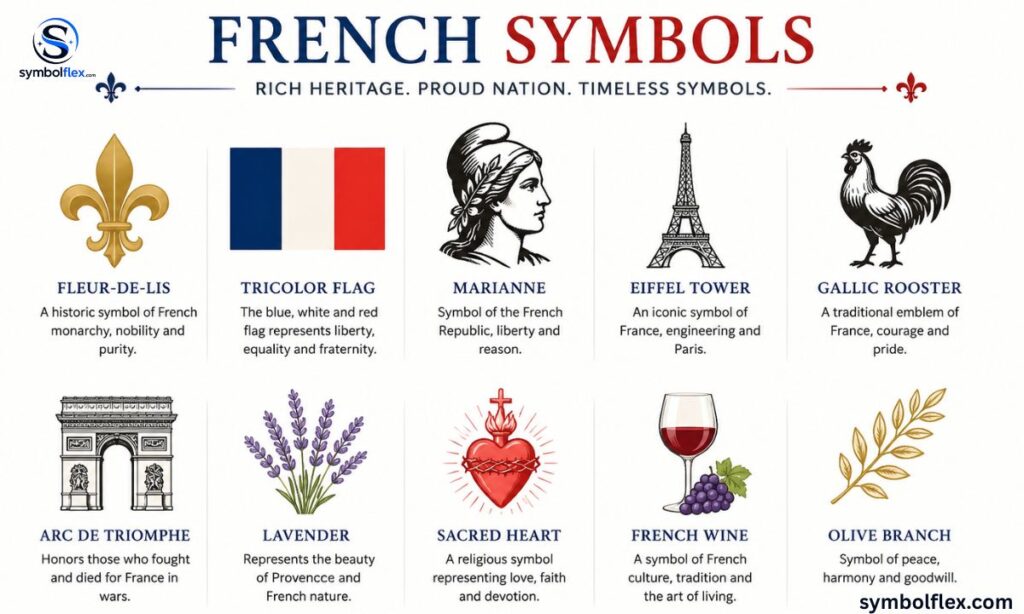
From the royal Fleur-de-Lis to the bold Tricolor flag, these emblems shaped an entire civilization. You’ve seen them on NFL helmets, tattoo parlors, and luxury brands. Now it’s time to understand what they really mean.
No other country packs this much history into its emblems. The Fleur-de-Lis survived kings, revolutions, and wars. It still shows up on everything from Boy Scout badges to Super Bowl celebrations today.
That’s the Fleur-de-Lis. It’s been a symbol of power, faith, and identity for over 1,000 years. French symbols are everywhere around you. This guide breaks down 77+ of them, from ancient Gaul to modern pop culture.
What Are French Symbols?

French symbols are the emblems, images, and icons that represent France’s identity, history, and values.
Think of them like America’s Bald Eagle or Stars and Stripes. They tell you something important at a single glance.
The difference is that French symbols carry over 1,000 years of history behind them. They survived kingdoms, revolutions, wars, and empires.
France’s symbolic story is unique because it broke sharply at key moments. The French Revolution of 1789 didn’t just change the government. It threw out an entire visual language and built a new one almost overnight.
French Symbols And Meanings Guide
Every French symbol was created for a reason. Each one reflects the values and struggles of its time.
Here’s a quick reference of the most important ones:
| Symbol | Category | Core Meaning |
| Fleur-de-Lis | Royal / Heraldic | Royalty, purity, divine grace |
| Gallic Rooster | National Animal | Courage, vigilance, French identity |
| Marianne | Republican Figure | Liberty, reason, democracy |
| Tricolor Flag | National Flag | Liberty, peace, the people |
| Cross of Lorraine | Religious / Resistance | Faith, resilience, free France |
| Phrygian Cap | Revolutionary | Freedom from tyranny |
| Oriflamme | Medieval Royal | Sacred royal battle authority |
| Fasces | Republican | Unity and collective strength |
| Arc de Triomphe | Architectural | Military glory, national sacrifice |
| La Semeuse | Numismatic | Sowing the republic’s ideals |
French Symbols And Meanings
The Phrygian cap is one symbol most people overlook.
It’s the red pointed hat you see on Marianne’s head. Its roots go back to ancient Rome. Freed enslaved people wore it as proof of their liberation.
French revolutionaries adopted it. To them, it meant breaking free from monarchy. You’ll still see it on French coins and official seals today.
La Semeuse (The Sower) is another hidden gem. She’s a woman casting seeds into the wind. This image has appeared on French stamps and coins since 1897.
She represents the French Republic spreading its ideals across the land. It’s a simple image with a powerful meaning.
National Symbols In France
France officially recognizes five core national symbols.
These appear on government buildings, official documents, and public spaces across the country:
- The Tricolor Flag (blue, white, red)
- La Marseillaise (the national anthem, written in 1792)
- “Liberté, Égalité, Fraternité” (the national motto)
- Marianne (the face of the French Republic)
- The Gallic Rooster (the national animal)
Here’s something surprising. The Fleur-de-Lis is NOT an official symbol of modern France. It was the symbol of the monarchy. When the Republic took over, it deliberately moved away from royal emblems.
Yet the Fleur-de-Lis remains the symbol most Americans associate with France. That says a lot about the power of beautiful design.
Iconic French Symbols

Some French symbols have become truly global.
The Eiffel Tower is the most photographed structure on earth. The Fleur-de-Lis shows up on NFL helmets, Boy Scout badges, and jewelry stores. Marianne appears on every French postage stamp.
What makes these symbols last? It’s not just their age. It’s their flexibility.
The Fleur-de-Lis looks right on a medieval knight’s shield. It looks right on a New Orleans ironwork gate. It looks right as a minimalist tattoo. That kind of timeless adaptability is rare.
Ancient French Symbols And Meanings
Long before France existed, Celtic Gallic tribes had their own rich symbols.
The ancient Gauls used the wild boar as a symbol of war. The horse represented freedom and nobility. The serpent appeared in religious ceremonies, connected to fertility and seasons.
The triskelion (a three-armed spiral) was common across Celtic Europe. It represented the three realms: land, sea, and sky. You can still find it carved into pre-Roman artifacts dug up across modern France.
These ancient symbols planted the seeds for everything that came later.
Medieval French Symbols
The medieval period gave French symbolism its formal structure.
Heraldry became the visual language of power. Every noble family, religious order, and royal house had its own coat of arms.
The Fleur-de-Lis rose to prominence under King Louis VII in the 12th century. He used it on his battle standard: golden lilies on a blue background. It was one of history’s most powerful royal images.
Things That Represent France
Beyond official symbols, many everyday items represent France to the world:
- The baguette (UNESCO added its craftsmanship to its Heritage list in 2022)
- The beret (more stereotype than reality, but still iconic)
- Champagne (France legally owns the name)
- Haute couture and Paris fashion houses
- The café as a philosophical and social institution
- The Tour de France as a symbol of national endurance
- Asterix the Gaul, the beloved comic character based on ancient Gallic identity
French Language And Keyboard Symbols
French uses special characters and accent marks that change both spelling and meaning.
If you’re writing in French on a US keyboard, you need to know how to produce these symbols.
French Symbols On Keyboard
On Windows: Use Alt codes. Hold Alt and type a number on your numeric keypad.
- Alt + 130 = é
- Alt + 133 = à
- Alt + 135 = ç
You can also switch your keyboard to French layout (AZERTY) in Settings.
On Mac: Use the Option key.
- Option + E, then a vowel = accent aigu (é)
- Option + backtick, then a vowel = accent grave (è, à)
- Option + I, then a vowel = circumflex (ê, î)
- Option + U, then a vowel = tréma (ë, ï)
- Option + C = ç
French Symbols Letters

French uses five accent marks. Each one changes the sound or meaning of a letter:
Accent Aigu ( ´ ): Only on the letter e. Makes the “ay” sound. Example: é
Accent Grave ( ` ): On e, a, and u. On e, it makes an “eh” sound. On a and u, it distinguishes between similar words. Example: ou means “or,” où means “where.”
Accent Circonflexe ( ^ ): On all vowels. Often marks a letter where an “s” once existed. Example: forêt (forest), hôpital (hospital).
Tréma ( ¨ ): Shows two vowels are pronounced separately. Example: ë, ï, ü
Cédille ( ¸ ): Only under c. Gives it a soft “s” sound before a, o, or u. Example: ç
French Symbols Copy And Paste
Here are all French special characters ready to use:
Lowercase: à â ä æ ç é è ê ë î ï ô œ ù û ü ÿ
Uppercase: À Â Ä Æ Ç É È Ê Ë Î Ï Ô Œ Ù Û Ü Ÿ
French Punctuation: « » (guillemets, France’s version of quotation marks)
Don’t forget the guillemets. French doesn’t use English-style quotes. It uses « these angled brackets » with a space inside. If you’re writing formal French, this matters a lot.
Artistic And Popular French Symbols
French symbols have moved from history books into tattoo studios, art galleries, and social media.
Their beauty and layered meaning make them some of the most requested symbols in creative culture worldwide.
French Symbols Tattoos
The Fleur-de-Lis is one of the top-requested tattoo symbols in the United States. In the South, especially Louisiana, it carries deep cultural roots. People get it for ancestry, faith, sports loyalty, or pure love of the design.
The Cross of Lorraine has a strong tattoo following because of its WWII Resistance story. It works beautifully in fine-line minimalist styles and bold traditional tattoo work alike.
Joan of Arc translates into stunning tattoo art. Her armor, banner, and fire create a visually rich image packed with symbolism. It’s a popular choice for people who connect with themes of courage and spiritual mission.
Fleur De Lis French Symbols

The Fleur-de-Lis is the single most recognized French symbol in the world.
Its name means “flower of the lily” in French. Historians still debate whether it actually depicts a lily, an iris, or a stylized bee.
Its royal use in France dates back to the 5th century, though the Capetian dynasty in the 12th century made it famous. King Louis VII covered his battle standard with golden Fleur-de-Lis on blue. It became one of history’s most powerful royal images.
It spread through Europe via royal marriages and the Crusades. The Catholic Church embraced it as a symbol of the Holy Trinity. Its three petals represented the Father, Son, and Holy Spirit.
In North America, French colonizers brought it in the 17th and 18th centuries. It took deep root in Louisiana, Quebec, and the Great Lakes region.
Today you’ll find it on:
- The New Orleans Saints NFL logo
- The Boy Scouts of America badge
- The flag of Louisiana
- The flag of Quebec
- Countless jewelry, tattoo, and home décor designs
5 Symbols Of France
Here are the five most important symbols of France:
- Fleur-de-Lis — Royalty, purity, and over 1,000 years of French heritage
- Gallic Rooster — Courage, vigilance, and the spirit of France
- Marianne — Liberty, reason, and the French Republic
- Tricolor Flag — The revolutionary ideals of liberty, equality, and fraternity
- Cross of Lorraine — Faith, resilience, and wartime resistance
Deep Symbolic Meaning
French symbols work on multiple levels at once. That’s why they’ve lasted for centuries.
Spiritual Level
The Fleur-de-Lis carries deep Christian meaning. Its three petals represent the Holy Trinity. It’s also connected to the Virgin Mary, whose flower is the lily in Catholic tradition.
French Gothic cathedrals are covered in Fleur-de-Lis carvings for exactly this reason.
The Cross of Lorraine is a variant of the Christian cross. Its double horizontal bar connects to the True Cross. Joan of Arc carried it believing she was fulfilling a divine mission. That spiritual weight never left the symbol.
Psychological Level
French symbols feel prestigious to American audiences. That’s not an accident. It’s a result of centuries of French cultural output in art, philosophy, food, and fashion.
The Fleur-de-Lis also works on a visual psychological level. Its symmetrical three-part structure is satisfying to the eye. It feels complete and balanced. Medieval designers understood visual psychology intuitively.
Cultural Level
France has used its symbols as tools of cultural influence for centuries.
French language, literature, fashion, and cuisine all carry French symbols with them as they travel the world. When Louis Vuitton stamps its monogram on a bag, it trades on the accumulated prestige of French symbolic tradition.
For diaspora communities in Louisiana, Quebec, and former French colonies across Africa and Asia, French symbols serve as anchors of identity. They connect people to heritage even across vast distances and generations.
French Symbols Across Cultures
Revolutionary France
The French Revolution of 1789 was one of history’s most dramatic symbolic overhauls.
The white Bourbon flag was replaced by the Tricolor. The Fleur-de-Lis was stripped from public buildings. The king’s face on coins was replaced by Marianne. New symbols appeared almost overnight: the Phrygian cap, the fasces, and the level (symbolizing equality).
The Revolution understood something powerful. Controlling symbols meant controlling how people understood history and identity.
Modern France
Traditional and contemporary symbols coexist in modern France.
Marianne, the Gallic Rooster, and the Tricolor remain powerful civic symbols. But France has developed new symbolic associations too.
The Eiffel Tower means romantic ambition to the whole world. The Palme d’Or at Cannes means cinematic excellence. French luxury brands mean craftsmanship and cultural sophistication.
French Symbols in Art, Movies and Pop Culture
French symbols are everywhere in global pop culture.
Disney’s “Ratatouille” and “The Hunchback of Notre Dame” use French architecture and cultural symbols as visual storytelling tools. “Midnight in Paris” turns the Eiffel Tower and café culture into symbols of nostalgic romance.
In gaming, Assassin’s Creed: Unity is set in Revolutionary Paris. Players absorb French symbolic vocabulary just by playing through the story.
In sports, the New Orleans Saints’ Fleur-de-Lis logo is arguably the most visible French symbol in American culture. When the Saints won the Super Bowl in 2010, the Fleur-de-Lis became a symbol of New Orleans’ recovery from Hurricane Katrina. An ancient symbol gained a brand new emotional meaning.
Spiritual and Dream Meaning of French Symbols
French symbols carry meaning even in dreams and spiritual practice.
Dreaming of a Fleur-de-Lis is often linked to spiritual growth, purity, or divine guidance. The Gallic Rooster in dreams connects to new beginnings and awakening. It’s the herald of dawn, after all.
Marianne in a dream often signals a call to stand up for your values. The Cross of Lorraine points to resilience and the meaningful endurance of hardship.
In New Age communities, the Fleur-de-Lis has become popular in meditation and intention-setting. Its three-part structure connects to mind, body, and spirit. Crystal healers pair it with stones associated with purity and spiritual clarity.
Positive vs Negative Meaning
Positive Meaning
French symbols carry extraordinary positive weight.
The Tricolor flag inspired democratic movements across the world. The Fleur-de-Lis represents purity and divine grace. Marianne embodies the belief that reason and freedom can defeat tyranny. The Cross of Lorraine shows that people can resist oppression with dignity.
For millions of people, French symbols represent cultural aspiration. The pursuit of beauty. The value of ideas. The dignity of craft. That’s a remarkable legacy.
Negative Meaning
Honest history matters here.
The Fleur-de-Lis carries a painful past in French colonialism. In French colonial Louisiana and the Caribbean, enslaved people who attempted to escape were sometimes branded with a Fleur-de-Lis as punishment. That history is real and documented.
Communities in Louisiana and Haiti have complex relationships with this symbol as a result. Beautiful symbols can carry dark histories. Ignoring that doesn’t make it go away.
Royal French symbols also represented centuries of absolute monarchy. Many French people suffered deeply under that system. The Revolution’s violence against these symbols reflected genuine pain and anger.
Symbols are never neutral. They carry the history of who used them and why.
Why Humans Are Attracted to French Symbols
People are drawn to French symbols because they combine visual beauty with powerful storytelling.
A great symbol communicates in a single glance what a paragraph can barely express. French symbols have had centuries to perfect that art.
There’s also the aspiration factor. France has positioned itself as a global cultural capital in fashion, cuisine, philosophy, and art. Getting a Fleur-de-Lis tattoo or decorating with French motifs means aligning yourself with a tradition that values beauty and history.
Frequently Asked Questions
What is the most famous French symbol?
The Fleur-de-Lis is the most famous French symbol, representing royalty and divine grace.
What does the Fleur-de-Lis symbolize in France?
It symbolizes royalty, purity, and Catholic faith in French history and culture.
What is the national animal symbol of France?
The Gallic Rooster is France’s national animal, representing courage and French identity.
Why is the rooster a symbol of France?
Because the Latin word gallus meant both rooster and French person at the same time.
What do the three colors of the French flag mean?
Blue means liberty, white means peace, and red represents the French people.
Conclusion
From ancient Gallic tribes to French Resistance fighters. From Revolutionary crowds raising the Tricolor to Saints fans painting Fleur-de-Lis on their faces. These symbols have always carried something worth carrying: identity, courage, beauty, and belief.
Understanding French symbols means understanding a huge part of Western history. It means understanding American cultural heritage too. And it means understanding the universal human need to make meaning through images.
