
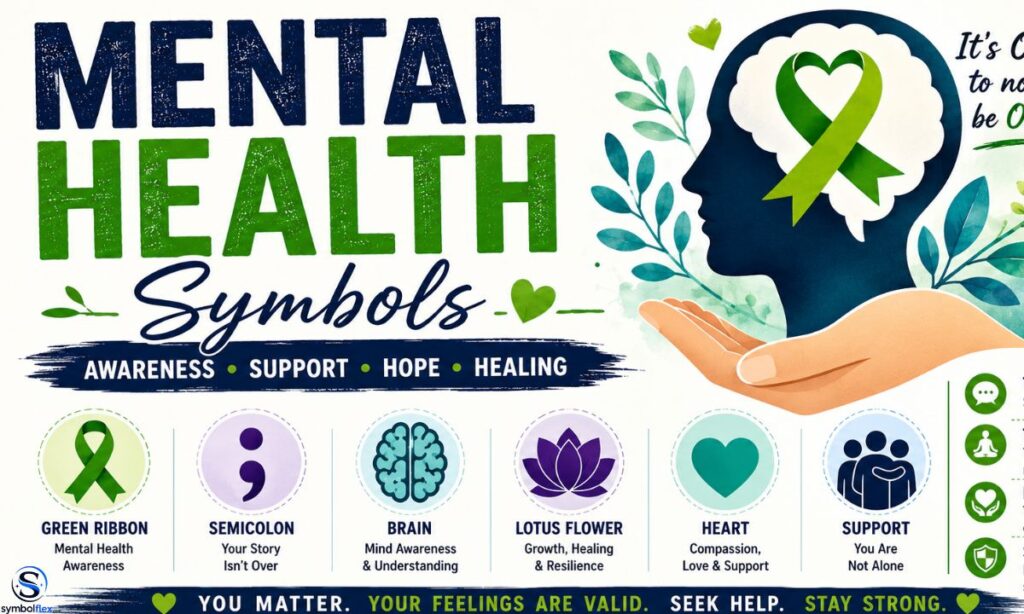
Mental health symbols are visual images, like the semicolon, the green ribbon, or the lotus flower, that let people express emotional struggle, healing, and hope without saying a word. In 2026, these symbols are trending everywhere, from tattoo studios and TikTok bios to therapy offices and national awareness campaigns, making them one of the fastest growing forms of self expression in the U.S. today.
A tattoo can say what a person isn’t ready to say out loud, and that’s why interest in terms like “semicolon tattoo meaning” and “mental health symbol emoji” keeps climbing. This guide breaks down 75+ symbols, their true meanings, and why so many people are choosing images over words to tell their story.
What Are Mental Health Symbols?

Mental health symbols are images, colors, shapes, or icons that represent emotional experiences like depression, anxiety, trauma, recovery, or resilience. They give people a way to express something personal without needing to explain it in words.
Think about how hard it can be to describe depression to someone who has never felt it. Words often fall short. Symbols fill that gap. A single image, like a butterfly or an anchor, can carry an entire emotional story that would otherwise take paragraphs to explain. This is part of why symbolic language has been part of human communication for thousands of years, long before modern psychology gave names to conditions like anxiety or PTSD.
In the context of mental wellness, these symbols usually fall into a few categories. Some represent awareness campaigns, like the green ribbon for general mental health awareness or the purple ribbon tied to PTSD and anxiety.
Others represent personal journeys, like the semicolon that marks a moment someone chose to keep going instead of ending their story. And some are drawn from nature or mythology, like the phoenix or lotus flower, which speak to transformation and rebirth after hardship.
Mental Health Symbols And Meanings
The meaning behind a mental health symbol usually depends on its history, its color, and the personal story attached to it. No two symbols carry the exact same emotional weight, even if they look similar on the surface.
Understanding these meanings matters because context changes everything. A green ribbon means something very different from a semicolon, even though both fall under the umbrella of mental health awareness symbols. Below, we break down the most searched variations of this topic, from tattoos to emoji, so you can find exactly what you are looking for.
Mental Health Symbols Tattoos
Mental health tattoo symbols are among the most personal choices someone can make with their body art. Unlike a random design, these tattoos usually mark a turning point, a diagnosis, a recovery milestone, or a tribute to someone lost.
The semicolon is by far the most requested design in this category, often placed on the wrist, forearm, or behind the ear. Other popular choices include the lotus flower for spiritual growth, the butterfly for transformation, and the anchor for stability during hard times. Tattoo artists across the country report that clients often bring in a personal story along with the design request, which makes these sessions emotionally different from a typical tattoo appointment.
Placement matters too. Wrist tattoos are visible daily, acting as a constant reminder of progress. Tattoos placed over the heart or ribs tend to be more private, chosen for personal reflection rather than public statement. Healing time for small, simple mental health symbols is usually short, around two to three weeks, but the emotional meaning behind them tends to last a lifetime.
Symbols Of Mental Health Recovery

Recovery symbols represent the ongoing process of healing rather than a single fixed moment. They tend to focus on movement, growth, and continuation instead of an endpoint.
The semicolon fits here too, since its entire meaning is built around the idea that “your story isn’t over.” The anchor represents staying grounded during recovery from addiction or depression, which is why it’s common among people in sobriety programs. The phoenix, rising from ashes, speaks to a more dramatic form of recovery, often chosen by people who have survived trauma, abuse, or a mental health crisis.
Recovery symbols are frequently shared in support groups and online communities like Reddit’s mental health forums, where people post their new tattoos as a way of celebrating progress. This kind of public sharing has helped normalize conversations that used to stay hidden, turning a private struggle into a visible, shared experience of symbols of resilience and hope.
Mental Health Symbols Copy Paste
Sometimes people want a mental health symbol for a text message, social media bio, or digital journal rather than a tattoo. Copy paste symbols solve that problem instantly.
Common choices include the infinity symbol (♾), the yin yang (☯), the butterfly emoji (🦋), and a simple green heart (💚) to represent mental health awareness. These characters work across almost every platform, from Instagram captions to text messages, without needing any special app or design skill.
| Symbol | Meaning |
| ♾ | Infinity, endless recovery, continuity |
| ☯ | Balance between light and dark emotions |
| 🦋 | Transformation and personal growth |
| 💚 | General mental health awareness |
| 🌿 | Growth and calm |
Mental Health Tattoos
Beyond single symbol designs, mental health tattoos as a broader category include full illustrations, quotes, and combined imagery. These tattoos often blend a symbol with a phrase, a date, or a portrait-style design.
Minimalist line work has become the dominant style for this category in the United States, favored for its subtlety and lower visibility. Watercolor style tattoos, on the other hand, use soft color blending to represent emotional fluidity, which some people feel matches the up and down nature of mental health struggles better than a solid black outline.
Many tattoo studios have started offering “healing sessions” specifically for mental health related designs, where the artist takes extra time to talk through the story behind the piece before starting the work. This shift shows how far the tattoo industry has come in treating these designs with the emotional care they deserve.
Mental Health Symbol Emoji
Emoji have become an informal but widely understood language for mental health online, especially among younger generations who grew up texting before they learned to talk about feelings out loud.
The brain emoji (🧠) combined with a heart often signals a conversation about mental wellness. The green heart specifically has become shorthand for mental health awareness across social platforms, following the same color coding as the official green ribbon. Butterfly and infinity emoji are also common additions to bios belonging to people who are open about their mental health journey.
These small digital symbols matter more than they might seem. For someone scrolling through a feed, seeing a familiar emoji combo can feel like spotting a friendly face in a crowd, a small signal that says “you are not alone in this.”
Mental Health Symbol Drawing

Drawing mental health symbols has become a popular form of low pressure self expression, especially in bullet journals and therapy workbooks. You don’t need to be an artist to sketch a simple semicolon, a wave, or a lotus outline.
Therapists sometimes encourage clients to draw their own version of a symbol as part of expressive art therapy, since the act of creating something with your hands can be calming in a way that talking isn’t always able to achieve. Simple shapes like spirals, waves, and open hands are common starting points for beginners.
Many people keep a small sketch in a journal as a private version of a tattoo they aren’t ready to get permanently. It is a low stakes way to sit with a symbol’s meaning before making a bigger commitment.
Popular Symbols For Mental Health Awareness
The most recognized mental health awareness symbols in the United States are ribbon colors, each tied to a specific condition or cause. Green stands for general mental health awareness, while other colors represent more specific struggles.
Awareness symbols exist to do one job well: start conversations. They show up on t shirts during Mental Health Awareness Month every May, on pins worn by advocates, and on social media graphics shared by organizations like the National Alliance on Mental Illness. Below is a closer look at the most searched symbols in this space.
Semicolon Symbol Meaning Mental Health
A semicolon in grammar marks a pause where a sentence could have ended but didn’t, and that is the exact metaphor behind the semicolon mental health symbol. The Semicolon Project, started in 2013, turned this small punctuation mark into one of the most recognized symbols of suicide prevention and mental health survival in the world.
The idea is simple but powerful. The author chose to continue the sentence instead of ending it, just like the person wearing the symbol chose to continue their life instead of ending it. This message resonates deeply with people who have experienced suicidal thoughts, depression, or self harm, offering a quiet way to say “I’m still here” without needing to explain the full story.
Since its creation, the semicolon has appeared as tattoos, jewelry, and artwork worldwide, making it arguably the single most recognizable symbol tied to mental health survival and continued life.
Symbol For Mental Illness
The green ribbon is widely recognized as the official symbol for mental illness awareness in the United States, chosen for its association with growth, renewal, and hope.
Unlike condition specific ribbons, the green ribbon covers mental illness broadly, making it the go to symbol for general awareness campaigns rather than any single diagnosis. It appears during Mental Illness Awareness Week, observed every October, and is used by major advocacy organizations across the country.
This broad approach has both strengths and limits. It creates a unified symbol that everyone can rally behind, but it can also blur the lines between very different conditions, from anxiety to schizophrenia, that each deserve their own nuanced understanding.
Symbols For Mental Health Awareness

Different colors of ribbons represent different specific conditions, allowing advocacy campaigns to target a particular cause rather than mental health in general.
| Ribbon Color | Represents |
| Green | General mental health awareness |
| Purple | PTSD and anxiety disorders |
| Teal | Anxiety and stress disorders |
| Gray | Mental illness in general (alternate color) |
| Orange | Self injury awareness |
These colors are often combined with a symbol, like a ribbon shaped into a heart or paired with the semicolon, to create layered designs used in fundraising walks, pins, and social media graphics throughout the year.
Mental Health Symbolism
Symbolism, as a concept, is the practice of using an image to represent an idea or feeling that would otherwise be difficult to express directly. Mental health symbolism applies this practice specifically to emotional and psychological experiences.
Psychologists have long studied why symbolic thinking feels so natural to humans. Carl Jung, the founder of analytical psychology, argued that symbols connect to something he called the collective unconscious, shared patterns of meaning that show up across cultures even when those cultures never had contact with each other. That theory helps explain why a symbol like the butterfly represents transformation almost everywhere in the world, not just in one culture.
This shared symbolic language is part of what makes mental health symbols so effective at building community. When someone sees a semicolon tattoo on a stranger, they instantly understand a piece of that person’s story, even without a single word being exchanged.
Mental Symbols
Mental symbols, in a broader sense, refer to images tied to the mind and cognitive experience rather than emotional states specifically. This includes icons like the brain, a maze, or a lightbulb.
These symbols often appear in contexts related to mental clarity, confusion, or intellectual struggle rather than emotional pain alone. A maze, for example, is sometimes used to represent the confusing, circular nature of anxious or obsessive thinking patterns.
While less common in tattoo culture than emotional symbols like the semicolon or lotus, mental symbols show up frequently in educational materials, therapy worksheets, and clinical diagrams used by counselors and psychologists.
Symbols Of Mental Health
At its core, this phrase captures the full range of imagery connected to psychological wellbeing, spanning awareness ribbons, tattoo designs, and cultural icons discussed throughout this guide.
Rather than one single symbol, mental health as a topic is represented by an entire visual language built over decades of advocacy work. This layered approach reflects how complex mental health actually is, with no single image able to capture every condition, experience, or recovery story.
Symbols For Mental Illness
Similar to the ribbon system covered earlier, specific mental illness symbols sometimes go beyond color alone and include shapes tied to particular diagnoses, like a puzzle piece historically used (though now controversial) in some neurodivergence awareness campaigns.
It’s worth noting that symbol meanings can shift over time as advocacy groups and the communities they represent push back on outdated imagery. Staying current on which symbols are considered respectful and accurate is part of responsible advocacy work.
Symbols Of Suffering
Symbols of suffering focus on the harder, heavier side of mental health, representing pain, struggle, and emotional weight rather than hope or recovery.
Common images include a broken chain, a storm cloud, cracked glass, or a wilting flower. These symbols are not meant to glamorize pain but to validate it, giving people a way to acknowledge that their struggle is real and worth representing visually.
Many people who choose these darker symbols pair them with a second, more hopeful image, like a storm cloud next to a small sun, to show the full arc of their emotional experience rather than just the difficult part.
Symbols Mental Health
This search variation typically reflects people looking for a general reference list, essentially wanting a quick, skimmable overview rather than deep explanation. If that’s what brought you here, the tables throughout this guide are built exactly for that kind of fast lookup.
Symbols For Mental Health
Similarly, this phrasing usually signals someone searching for design inspiration, whether for a tattoo, a piece of jewelry, or digital content. The types and variations section further down this guide covers the seven most popular choices in detail.
Mental Health Tattoo And Illustration Meanings
Tattoos and illustrations do more than decorate skin or paper; they document a person’s emotional history in permanent or semi permanent form. This section covers specialized categories, from clinical genograms to childhood focused illustrations.
Genogram Mental Health Symbols
A genogram is a clinical tool, similar to a family tree, used by therapists and counselors to map patterns of mental illness, trauma, and relationship dynamics across generations.
Genograms use standardized shapes rather than artistic symbols. A square represents a male family member, a circle represents a female family member, and different line styles indicate relationships, from marriage to conflict to estrangement. Shading or special markings within these shapes can indicate a diagnosed mental health condition, substance use history, or significant trauma.
This tool is widely used in family therapy settings because it reveals patterns that might otherwise stay invisible, like a recurring history of depression across three generations. Seeing that pattern laid out visually can be a powerful moment of clarity for someone in treatment.
Men’s Mental Health Symbols

Men’s mental health awareness has its own set of symbols, developed partly in response to research showing men are statistically less likely to seek therapy or openly discuss emotional struggles compared to women.
The blue ribbon is commonly associated with men’s mental health campaigns, often tied to Movember, the annual mustache growing initiative that raises awareness for men’s health issues broadly, including suicide prevention. Simple, understated designs tend to dominate this category, reflecting a cultural preference among many men for subtlety over overt emotional display.
Organizations focused specifically on male suicide prevention have leaned into these symbols heavily, since men account for a significant majority of suicide deaths in the United States according to CDC data, making targeted awareness efforts especially important.
Tattoos Mental Health Symbols And Meanings
When people search this specific phrase, they are usually looking for a combined resource covering both the visual design and the emotional backstory. Every tattoo symbol mentioned throughout this guide, from the semicolon to the phoenix, fits into this category.
Mental Health Symbols And Their Meanings
This is essentially the master reference list this entire guide is built around. If you remember only a few symbols from this article, the semicolon, green ribbon, lotus flower, and butterfly cover the most universally recognized meanings in modern mental health culture.
Mental Health Symbols And Meanings Tattoos
This near duplicate phrase reflects the tattoo specific angle already covered in depth earlier in this guide, with placement, style, and story all playing a role in the final design choice.
Depression Mental Health Symbols
Depression specific symbols often draw on nature imagery to represent heaviness and gradual healing. A rain cloud, a wilted flower, or a broken chain are common choices.
These symbols resonate because depression itself often feels like a weight, something pressing down rather than a sharp, sudden pain. A wilted flower slowly turning upright, sometimes shown in a two part illustration, captures the slow, nonlinear nature of depression recovery better than words often can.
Some people choose to pair a depression symbol with a small detail representing hope, like a single green leaf on an otherwise wilted stem, to show that healing and struggle can coexist in the same image.
Positive Mental Health Symbols
Positive symbols focus on hope, growth, and emotional wellness rather than struggle. A sunflower, a rising sun, or open hands are frequent choices in this category.
The sunflower in particular has grown in popularity as a symbol of hope, partly because of its natural behavior of turning to follow the sun, which people interpret as a metaphor for choosing to seek light even during dark periods. Open hands, often shown cupped together, represent both self acceptance and the willingness to receive support from others.
Mental Health Symbols Illustration

Illustrated mental health symbols appear frequently in awareness campaign posters, book covers, and therapy office artwork. These illustrations often combine multiple symbols into a single cohesive image, like a lotus flower blooming from a storm cloud.
Childhood Mental Health Symbols Illustration
Symbols aimed at children look noticeably different from adult focused imagery, favoring soft colors, rounded shapes, and familiar figures like rainbows, teddy bears, or smiling suns.
Child therapists use these gentler symbols intentionally, since young children process emotions differently than adults and respond better to friendly, non threatening imagery. A rainbow, for example, is often used in school counseling programs to represent the idea that difficult feelings eventually pass, much like a storm giving way to clearer skies.
Childhood Mental Health Symbols Images
These images typically appear in therapy workbooks, school counseling materials, and children’s books focused on emotional literacy. Their purpose is educational as much as symbolic, helping kids build vocabulary around feelings they might not yet know how to name.
Anxiety Mental Health Symbols
Anxiety specific symbols often represent the tangled, overwhelming nature of anxious thoughts. A knotted rope, a tangled line, or ocean waves are common visual metaphors.
The teal ribbon is the most widely recognized color associated with anxiety awareness. Wave imagery has also grown in popularity, since it captures the way anxiety often comes in cycles, building, peaking, and eventually receding, rather than staying at a constant level.
Mental Health Symbols Clipart
Clipart versions of these symbols are widely used in classroom materials, presentations, and printable worksheets. Free and paid clipart libraries typically offer ribbon icons, brain illustrations, and simplified versions of the semicolon and lotus flower for non commercial educational use.
Deep Symbolic Meaning
Mental health symbols carry meaning on more than one level at once. Beyond their surface appearance, these images often connect to spiritual beliefs, psychological theory, and cultural history simultaneously.
Spiritual Level
On a spiritual level, many mental health symbols represent transformation, protection, or a connection to something larger than the individual struggle itself. The lotus flower, for instance, is deeply tied to spiritual growth in Buddhist and Hindu traditions, representing the idea that beauty can emerge from difficult, muddy conditions.
The phoenix carries similar spiritual weight, representing rebirth after complete destruction. People who have survived severe trauma or a major mental health crisis often connect with this symbol specifically because it doesn’t shy away from the intensity of what they went through; it honors it as part of the transformation story.
Psychological Level
Psychologically, symbols function as a form of externalization, a technique where an internal feeling is given an outside form that can be examined, discussed, and processed more easily than an abstract emotion alone. This is a concept actively used in narrative therapy, a recognized approach developed by therapists Michael White and David Epston.
When someone gets a semicolon tattoo, they are, in a psychological sense, creating a permanent external marker of an internal decision. This externalization can reinforce commitment to recovery, since the symbol serves as a visible, repeated reminder every time the person sees it.
Cultural Level
Culturally, the meaning of a symbol can shift dramatically depending on where and when it’s used. A symbol that represents hope in one culture might carry a completely different, even negative, association in another.
This is why cultural context matters so much when choosing or interpreting a mental health symbol. The anchor, for example, has long represented stability in Western maritime culture, but its meaning shifts slightly in different regions depending on local maritime history and folklore.
Types and Variations of Mental Health Symbols
Seven symbols stand out as the most consistently recognized across tattoos, awareness campaigns, and personal storytelling in the United States today.
1. Semicolon
The semicolon represents continuing your story instead of ending it, rooted in the Semicolon Project’s suicide prevention message. It remains the most tattooed mental health symbol in the country.
2. Green Ribbon
The green ribbon is the official color for general mental health awareness, worn during Mental Illness Awareness Week and throughout Mental Health Awareness Month each May.
3. Lotus Flower
The lotus represents growth through difficulty, since the flower blooms clean and beautiful despite growing out of muddy water, a metaphor widely used in Buddhist philosophy.
4. Butterfly
The butterfly symbolizes transformation, drawing on the insect’s dramatic shift from caterpillar to winged creature as a metaphor for personal change and emotional growth.
5. Anchor
The anchor represents stability and staying grounded, frequently chosen by people in addiction recovery or those working to maintain emotional balance during difficult periods.
6. Phoenix
The phoenix represents rebirth from destruction, drawn from Greek mythology, and is often chosen by trauma survivors who want to honor both the struggle and the recovery that followed.
7. Infinity Symbol
The infinity symbol represents an ongoing, never ending journey, often used to show that recovery isn’t a single finish line but a continuous process worth committing to.
Mental Health Symbols Across Cultures
Symbolic representations of emotional and psychological struggle appear in nearly every culture throughout history, though the specific images and meanings vary widely from one tradition to the next.
Ancient Egypt
In Ancient Egypt, the ankh symbolized life and vitality, and some historians connect it loosely to concepts of healing and wholeness, given its central role in religious and medical iconography of the time.
Eastern Traditions
Eastern traditions, particularly Buddhism and Taoism, contributed heavily to modern mental health symbolism. The lotus flower and the yin yang both originate from these traditions, emphasizing balance, growth, and the coexistence of opposing forces like light and dark, or struggle and peace.
Greek Mythology
Greek mythology gave the world the phoenix and the concept of “psyche,” the Greek word for both soul and butterfly, which is part of why the butterfly became so closely tied to emotional and spiritual transformation in Western symbolism.
Indigenous Cultures
Many Indigenous cultures across North America use nature based symbols, including feathers and specific animal imagery, to represent healing, protection, and connection to community. These symbols carry deep, culturally specific meaning, and it’s worth approaching them with respect and awareness rather than casual borrowing.
Modern Western Culture
Modern Western culture has largely built its mental health symbolism around advocacy campaigns, ribbon colors, and social media driven imagery like the semicolon, reflecting a more recent, organized approach to awareness compared to the ancient roots of symbols like the lotus or ankh.
Mental Health Symbols in Art, Movies and Pop Culture
Mental health symbolism extends well beyond tattoos and ribbons, showing up consistently across creative industries as a way to represent psychological experiences visually.
Movies
Films exploring depression, anxiety, and trauma often lean on visual metaphors, like storms, cages, or mazes, to represent a character’s internal state without relying entirely on dialogue. This approach helps audiences feel the emotional weight of a character’s experience rather than just hearing about it.
Paintings
Fine art has long used color and abstract shapes to represent emotional states, with darker, heavier tones often symbolizing depression or grief, while brighter, flowing colors represent hope or recovery. Art therapy programs frequently borrow from these same visual techniques.
Books
Literature uses symbolic objects, weather, and recurring imagery to mirror a character’s mental state throughout a story arc, a technique that predates modern psychology by centuries but maps closely onto contemporary understanding of emotional symbolism.
Tattoos
Pop culture has normalized mental health tattoos significantly over the past decade, with public figures openly sharing their own symbol tattoos and the stories behind them, helping reduce stigma around visible mental health markers.
Fashion
Jewelry brands and streetwear labels have increasingly incorporated symbols like the semicolon and awareness ribbons into their designs, turning fashion into another accessible entry point for mental health advocacy.
Spiritual and Dream Meaning of Mental Health Symbols
When these symbols appear in dreams, many people interpret them through a spiritual or subconscious lens rather than a literal one. Dreaming of a butterfly, for example, is often interpreted as a sign of upcoming personal transformation or emotional release.
Dream interpretation isn’t a clinical science, but it holds cultural weight for many people processing their emotions. A phoenix appearing in a dream might be interpreted as the subconscious mind processing a period of hardship and signaling readiness for renewal. An anchor might suggest a need for stability during a chaotic time in someone’s waking life.
Whether or not you personally believe in dream symbolism, these interpretations often serve a practical psychological purpose, giving people language to reflect on feelings they may not have consciously acknowledged yet.
Positive vs Negative Meaning
The same mental health symbol can hold both a positive and a difficult meaning at once, depending on the context and the person interpreting it. A broken chain, for example, can represent being trapped by struggle, or it can represent breaking free from it, depending entirely on framing.
This duality isn’t a flaw in symbolic language; it’s actually one of its greatest strengths. It allows a single image to hold complexity, honoring both the pain someone has experienced and the strength they’ve built while moving through it. A storm cloud paired with a small sun captures this duality directly, acknowledging hardship without erasing hope.
Why Humans Are Attracted to These Symbols
Humans are drawn to symbols because the brain processes images faster and more emotionally than it processes text, making symbolic communication feel more immediate and personal than words alone.
Research in cognitive psychology consistently shows that visual information is processed by the brain significantly faster than written language. This helps explain why a single tattoo or ribbon can communicate an entire emotional history in an instant, something a paragraph of text often struggles to do with the same impact.
Beyond speed, symbols also offer safety. Talking openly about depression, anxiety, or suicidal thoughts can feel vulnerable, even frightening, but wearing a symbol offers a middle ground, a way to say “this is part of my story” without requiring a full explanation unless the person chooses to share one.
That built in privacy, combined with the sense of community that comes from recognizing a shared symbol on a stranger, is a big part of why this visual language has grown so much over the past decade.
Frequently Asked Questions
What is the official symbol for mental health awareness?
The green ribbon is the official symbol for mental health awareness, representing hope, growth, and continued advocacy.
What does the semicolon tattoo mean for mental health?
It means choosing to continue your story instead of ending it, inspired by the Semicolon Project’s message.
What color ribbon represents mental illness?
Green represents mental illness overall, while purple and teal specifically represent PTSD, trauma, and severe anxiety disorders.
Is a butterfly a mental health symbol?
Yes, the butterfly represents transformation and personal growth, making it popular among people recovering from mental struggles.
What symbol represents anxiety?
The teal ribbon and flowing wave imagery are the most common symbols associated with anxiety awareness today.
Conclusion
Mental health symbols give people a way to express something words often can’t fully capture. From the quiet weight of the semicolon to the hopeful rise of the phoenix, each image in this guide carries its own story, shaped by history, psychology, and personal experience.
Whether you’re considering a tattoo, looking for the right emoji to add to your bio, or simply trying to understand a symbol you noticed on someone else, the meaning behind these images matters. They aren’t just decoration. They’re a form of honesty, a way of saying “this is part of my journey” without needing to explain every detail.
If one of these symbols resonated with you, take your time before making it permanent. Sit with the meaning, think about your own story, and choose the one that actually reflects where you’ve been and where you’re headed.
