
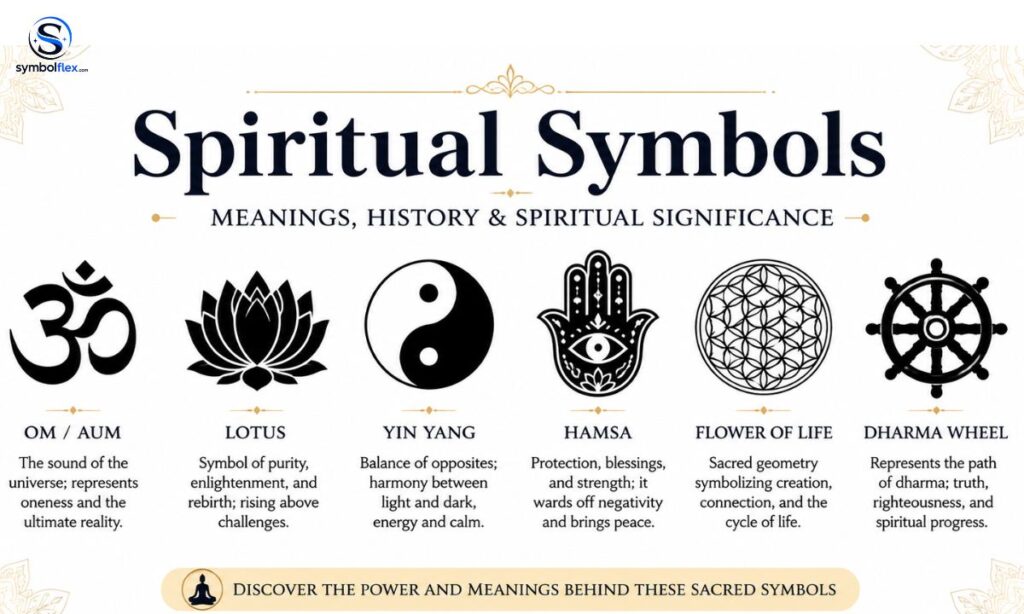
Spiritual symbols and their meanings come down to one simple idea: they are visual shortcuts that carry an entire belief, feeling, or truth inside a single shape. A lotus flower can hold the idea of rebirth.
A circle can hold the idea of eternity. That’s the whole point of a symbol: it says something big without needing a single word. If you’ve ever felt drawn to a certain shape on a necklace, a tattoo, or a temple wall, you’re responding to thousands of years of human meaning packed into a few lines.
This guide covers 130+ powerful spiritual symbols, from ancient signs and symbols that built entire religions to modern icons used for healing, protection, and success. You’ll learn what each symbol truly means, where it comes from, and how the same symbol can mean something completely different depending on culture and context.
What Are Spiritual Symbols and Meanings?

Spiritual symbols are images, shapes, or objects that represent a spiritual idea, belief, or experience rather than a literal object. They function as a kind of shared language, one that lets people across different generations and cultures communicate something as abstract as “the soul” or “the divine” using a picture instead of a paragraph.
The word “symbol” comes from the Greek term symbolon, which originally referred to two halves of an object used to identify trusted parties. That origin still fits. A spiritual symbol connects two things: the physical world and an unseen idea. When you see the Om symbol, you’re not just seeing a shape. You’re being connected to a concept some traditions describe as the sound of the universe itself.
What makes spiritual symbolism different from regular symbolism is intention. A stop sign tells you to stop. A sacred symbol tells you something about existence, morality, or the unknown. This is why the same shape, like a circle or a cross, can show up in nearly every civilization in recorded history. Humans have always needed a way to point at something they can’t fully explain in words.
Powerful And Ancient Spiritual Symbols
The most powerful spiritual symbols share one trait: they’ve survived. A symbol that’s still recognized after thousands of years has clearly tapped into something universal about the human experience.
Powerful Spiritual Symbols And Meanings
Some symbols carry weight because of how directly they represent life, death, protection, or transformation. The Ankh, an Egyptian cross with a loop at the top, represented eternal life and was carved into tombs and temples for over 3,000 years. The Eye of Horus was believed to offer protection, health, and royal power, and ancient Egyptians used it as both jewelry and a healing symbol.
The Hamsa Hand, shaped like an open palm, appears across Middle Eastern, Jewish, and Islamic traditions as a guard against the “evil eye.” The Tree of Life shows up in nearly every major religion, from Norse mythology to Kabbalah, as a symbol of interconnected growth and the balance between roots and branches, or the seen and unseen world.
These symbols weren’t randomly chosen. Each one solved a human problem: fear of death, need for protection, desire to understand growth. That’s a pattern worth remembering as you go through this list.
7 Spiritual Symbols
If you only remember seven, make it these: the Ankh, the Om symbol, the Yin and Yang, the cross, the lotus flower, the Hamsa Hand, and the infinity symbol. Together, they represent life, sound and vibration, balance, faith, purity, protection, and eternity.
Each one is instantly recognizable across cultures, which is rare. Most symbols stay regional. These seven have crossed borders, religions, and centuries without losing their core meaning, which says a lot about how deeply they connect to shared human concerns.
10 Spiritual Symbols And Their Meaning

Here’s a quick reference table for ten widely recognized symbols and what they represent at their core.
| Symbol | Origin | Core Meaning |
| Ankh | Ancient Egypt | Eternal life |
| Om | Hinduism, Buddhism | Universal sound, consciousness |
| Yin Yang | Taoism, China | Balance of opposites |
| Lotus Flower | Buddhism, Hinduism | Purity, rebirth |
| Hamsa Hand | Middle East, Judaism, Islam | Protection |
| Cross | Christianity | Faith, sacrifice |
| Infinity Symbol | Mathematics, modern spirituality | Endlessness, eternal love |
| Dreamcatcher | Native American (Ojibwe) | Filtering bad dreams |
| Triquetra | Celtic tradition | Unity, trinity |
| Mandala | Hindu and Buddhist practice | Wholeness, the universe |
Tables like this one make it easy to scan for a specific symbol without reading through paragraphs, which is exactly why people search for lists in the first place.
Ancient Spiritual Symbols And Meanings
Ancient spiritual symbols tend to focus on the biggest human questions: life, death, and what comes after. The scarab beetle in Egypt symbolized rebirth because ancient Egyptians observed the beetle rolling dung into a ball, which reminded them of the sun’s daily journey across the sky. The ouroboros, a snake eating its own tail, appeared in ancient Greek and Egyptian art to represent the cycle of life, death, and renewal.
The spiral is one of the oldest symbols in existence, found in Neolithic carvings across Ireland, most famously at Newgrange, a passage tomb built around 3200 BCE. Historians and archaeologists generally interpret the spiral as a representation of growth, the journey of life, or the movement of the sun and seasons.
These ancient signs and symbols weren’t decoration. They were often the closest thing early civilizations had to written philosophy, encoding entire belief systems into carvings, jewelry, and architecture long before most cultures had formal written language.
Powerful Symbols With Deep Meanings
Some symbols carry more emotional weight than others because they touch on struggle and transformation rather than static ideas. The phoenix, a bird said to rise from its own ashes, represents resilience and starting over. The Celtic knot, with no visible beginning or end, represents the idea that life, faith, or love has no true ending.
Deep symbolic meaning often comes from tension. A symbol that only represented peace wouldn’t resonate the same way as one that represents overcoming difficulty. That’s part of why symbols like the phoenix remain popular choices for tattoos among people going through major life changes.
Spiritual Symbols For Life, Healing And Success
People don’t just study spiritual symbols out of curiosity. Many actively use them to support a goal, whether that’s healing from a hard season, attracting success, or simply feeling more grounded day to day.
Spiritual Symbols For Success
Spiritual symbols for success often connect to abundance and forward movement. In Chinese tradition, the koi fish represents perseverance and good fortune, based on a legend about a koi that swam upstream and transformed into a dragon. The elephant, especially in Hindu culture through the god Ganesha, represents the removal of obstacles.
The four leaf clover, while more folk symbol than religious icon, remains one of the most recognized luck symbols in Western culture, largely because of its rarity in nature. People don’t need to believe a symbol has literal power for it to still serve as a helpful mental anchor before a big decision or challenge.
Pictures Of Spiritual Symbols
Visual recognition matters here. Someone searching for pictures of spiritual symbols usually already has a symbol in mind and wants to confirm what it looks like before getting it tattooed, framed, or worn as jewelry. Shapes matter down to small details. A Celtic cross, for example, differs from a standard cross by its circular ring, which represents the sun and eternity in Celtic belief.
Getting these small details right matters, especially for symbols tied to specific cultures or religions, since an inaccurate version can unintentionally misrepresent the meaning it’s supposed to carry.
Unique Symbols And Meanings
Some of the most interesting symbols rarely make it onto mainstream lists. The Sankofa, from the Akan people of Ghana, is shown as a bird looking backward while walking forward, representing the idea that you must understand your past to move ahead wisely. The Slavic Kolovrat, a sun wheel symbol, represented the cycle of seasons and protection in pre-Christian Slavic belief systems.
These unique symbols and meanings are worth knowing precisely because they don’t show up everywhere. They add real depth to a personal spiritual practice instead of relying only on the most commercialized icons.
Meaningful Spiritual Symbols And Meanings
What makes a symbol “meaningful” is almost always personal. Some people connect with the anchor because it represents stability during hard times, a meaning that grew from early Christian use of the anchor as a symbol of hope and steadfast faith. Others connect with the feather, which in many Native American traditions represents a message or connection from a loved one who has passed on.
Spiritual Symbols And Meanings List
For quick reference, here’s a broader list covering many of the most searched symbols and their generally accepted meanings.
- Lotus flower: purity, spiritual awakening, rising above difficulty
- Om: universal sound, higher consciousness
- Yin Yang: balance and harmony between opposing forces
- Hamsa Hand: protection from negative energy
- Ankh: eternal life
- Tree of Life: growth, connection, balance
- Infinity symbol: eternal love, endlessness
- Triquetra: unity of mind, body, and spirit
- Mandala: wholeness and the structure of the universe
- Dreamcatcher: filtering out bad dreams and negative energy
- Phoenix: rebirth and resilience
- Scarab: transformation and renewal
Healing Spiritual Symbols And Meanings
Healing spiritual symbols are among the most searched because people often turn to symbolism during genuinely difficult times. The Rod of Asclepius, a snake wrapped around a staff, has represented healing and medicine since ancient Greece and is still used today as a medical symbol worldwide. Reiki symbols, such as Cho Ku Rei, are used in Japanese energy healing practices to represent the flow and focusing of energy.
The mandala also plays a healing role in several traditions, used as a focal point for meditation to help calm the mind and represent the idea of wholeness. Carl Jung, the Swiss psychiatrist who helped found analytical psychology, famously used mandala drawing with patients as a tool for psychological integration, an early bridge between spiritual symbolism and modern therapeutic practice.
Understanding Different Spiritual Symbols And Their Meanings
No single culture owns spiritual symbolism, and understanding that is key to using these symbols respectfully.
Different Spiritual Symbols And Meanings
Comparing symbols side by side often reveals surprising overlap. The circle, for instance, represents eternity in Celtic tradition, wholeness in Buddhist mandalas, and the cycle of life in many Indigenous belief systems. Different spiritual symbols and meanings frequently point toward the same handful of human concerns: protection, continuity, balance, and transcendence.
Hindu Spiritual Symbols And Meanings
Hindu spiritual symbols are some of the richest in the world. The Om represents the primordial sound of creation and is chanted at the start of most Hindu rituals and meditation practices. The swastika, long before its distortion by the Nazi regime in the 20th century, was and still is a sacred symbol in Hinduism representing good fortune and well-being, a meaning it retains in Hindu, Buddhist, and Jain communities today.
The trishula, a three-pronged trident associated with the god Shiva, represents the three fundamental aspects of existence: creation, preservation, and destruction.
Native American Spiritual Symbols And Meanings
Native American spiritual symbols vary enormously between the hundreds of distinct tribal nations across North America, so it’s inaccurate to treat them as one unified system. The dreamcatcher originated specifically with the Ojibwe people and was traditionally hung above a sleeping place to filter out negative dreams.
The medicine wheel, used by many Plains tribes, represents the four directions, the cycle of life, and balance between physical, emotional, mental, and spiritual health.
Spiritual Awakening Spiritual Symbols And Meanings
Symbols tied to spiritual awakening usually represent expanded perception or a shift in consciousness. The third eye, associated with the ajna chakra in Hindu and yogic tradition, represents intuition and inner vision beyond ordinary sight. The lotus blooming from mud is one of the most quoted metaphors for awakening, representing the idea that clarity and enlightenment can grow directly out of struggle.
Spiritual Tattoo Spiritual Symbols And Meanings
Tattoos built around spiritual symbols tend to mark a turning point. Common choices include the lotus for personal growth, the Om for inner peace, and the phoenix for recovery after hardship. A meaningful tattoo symbol usually reflects a specific chapter of someone’s life rather than a generic aesthetic choice.
Deep Insights Into Spiritual Signs And Symbolism
Signs and symbols aren’t identical, even though people often use the terms interchangeably.
Spiritual Signs And Meanings
A spiritual sign is usually an event or experience, while a symbol is a fixed image. Repeating numbers like 111 or 333, an unexpected feather crossing your path, or a specific animal appearing at a meaningful moment are all commonly interpreted as spiritual signs. Interpretation of these signs is deeply personal and varies by belief system, so no single meaning is universally “correct.”
Spiritual Symbol Meanings
Spiritual symbol meanings are typically more stable than sign interpretations because they’re tied to established traditions rather than personal experience. That said, meaning still shifts depending on context, culture, and even color. A white lotus and a blue lotus, for example, carry different connotations in Buddhist art, with white representing purity and blue representing wisdom.
Symbols Meaning Truth

Symbols associated with truth often involve light or clarity. The owl, in Greek mythology associated with the goddess Athena, represents wisdom and the ability to see what others miss. The scales, most recognizable from depictions of justice, represent balance and fair judgment.
Spiritual Symbols, Spiritual Meanings, and Spirit Signs
At their core, spiritual symbols, spiritual meanings, and spirit signs all point to the same human need: making sense of what can’t be fully explained through logic alone. Whether that’s a fixed image passed down for millennia or a fleeting sign noticed on a hard day, the underlying function is the same. It gives people a way to feel connected to something larger than themselves.
Powerful Spiritual Symbolism And Their Importance
Spiritual symbolism functions as a kind of cultural memory, preserving ideas that might otherwise be lost, encoded into something as durable as a stone carving or as portable as a piece of jewelry. This is one reason spiritual signs and symbols have survived wars, colonization, and centuries of change: symbols are harder to erase than spoken language.
Powerful spiritual symbols also carry importance because they operate below conscious thought. Carl Jung argued that certain symbols function as archetypes, patterns embedded in what he called the collective unconscious, shared across cultures that had no direct contact with each other. That theory helps explain why symbols like the circle and the spiral independently appeared in civilizations separated by oceans and thousands of years.
The spiritual meaning of symbols also shifts with the individual using them. A spirit symbol representing a guide might mean an actual deity to one person and a metaphor for inner strength to another. Both can coexist without contradiction.
Symbols Of Spirituality And Metaphysical Understanding
Metaphysical symbolism goes a layer deeper than religious symbolism, often focusing on energy, geometry, and universal patterns rather than a specific deity or tradition.
Metaphysical symbols frequently draw from sacred geometry, the belief that certain shapes and proportions reflect the underlying structure of the universe. The Flower of Life, a pattern of overlapping circles found in ancient sites from Egypt to Turkey, is often interpreted as representing the interconnected nature of all creation.
Metatron’s Cube, derived from that pattern, is said in some traditions to contain every geometric shape in the universe, symbolizing balance and underlying order.Symbols of spirituality used in everyday practice, like prayer beads, candles, and incense, function the same way as major religious icons: they act as physical anchors for an internal, often invisible spiritual state.
Spiritual Symbols For Tattoos And Cultural Meaning
Tattoos have become one of the most common ways people carry spiritual symbolism with them permanently, which raises real questions about cultural respect.
Spiritual symbols and meanings for tattoos should always be researched before getting inked, especially for symbols tied to a culture or religion that isn’t your own. A symbol like the Om carries deep religious weight in Hinduism and Buddhism, and using it purely as decoration without understanding its meaning can be seen as disrespectful.
African spiritual symbols offer some of the richest, most underused options in Western tattoo culture. Adinkra symbols from the Akan people of Ghana, like Gye Nyame (“except for God”) and Sankofa (“go back and get it”), carry entire proverbs within a single design.
Choosing symbols for spirituality as a tattoo works best when the symbol connects to something real in your own story, not just its appearance. That personal connection is usually what separates a tattoo someone still loves after twenty years from one they regret.
Deep Symbolic Meaning
Every powerful symbol tends to operate on three separate levels at once, which is part of why the same image can mean different things to different people.
On the spiritual level, a symbol connects to something transcendent, whether that’s a deity, the universe, or a sense of the sacred. On the psychological level, it connects to something internal, tapping into Jungian archetypes or personal emotional associations built over a lifetime. On the cultural level, a symbol carries the specific history, rituals, and values of the community that created it.
A single symbol, like the lotus, can be spiritual (representing enlightenment in Buddhism), psychological (representing personal growth to someone recovering from hardship), and cultural (carrying specific meaning within Hindu, Buddhist, and Egyptian art traditions) all at the same time. Recognizing all three levels is what separates a surface-level understanding of symbolism from a genuinely informed one.
Types and Variations of Spiritual Symbols and Meanings
1. The Ankh
The Ankh is a cross topped with a loop, originating in ancient Egypt around 3000 BCE. It represented eternal life and was frequently held by gods and pharaohs in tomb art, symbolizing the key to the afterlife.
2. The Lotus Flower
The lotus grows out of muddy water yet blooms perfectly clean, which is why it represents purity and spiritual awakening in both Hinduism and Buddhism. Different colored lotuses carry different meanings, from white purity to red compassion.
3. The Yin and Yang
Rooted in Chinese Taoist philosophy, Yin and Yang represent how opposite forces, like light and dark or active and passive, are interconnected and dependent on each other rather than in true conflict.
4. The Cross
The cross predates Christianity but became its defining symbol after the crucifixion of Jesus, representing sacrifice, faith, and salvation. Variations like the Celtic cross add regional meaning tied to the sun and eternity.
5. The Om Symbol
Considered the sound of creation in Hinduism and Buddhism, Om is chanted to align the mind with universal consciousness and is often the first sound uttered at the start of meditation or prayer.
6. The Hamsa Hand
Shaped like an open right hand, the Hamsa appears in Jewish, Muslim, and broader Middle Eastern traditions as protection against the evil eye, often featuring an eye symbol at its center.
Spiritual Symbols and Meanings Across Cultures
Comparing symbolism across regions shows how universal certain spiritual concerns really are, even when the specific imagery differs.
Ancient Egypt
Egypt gave the world the Ankh, the Eye of Horus, and the scarab beetle, all tied to concepts of protection, kingship, and the afterlife, reflecting a civilization deeply focused on what happens after death.
India
India’s symbolism, shaped by Hinduism, Buddhism, and Jainism, centers on Om, the lotus, and chakra symbols, generally focused on consciousness, energy, and the path toward enlightenment.
China
Chinese symbolism, rooted in Taoism and Confucianism, gave rise to Yin and Yang, the dragon, representing power and good fortune, and symbols tied to the five elements: wood, fire, earth, metal, and water.
Ancient Greece
Greek symbolism produced the ouroboros, the laurel wreath representing victory and honor, and the caduceus, a staff with two snakes still used today as a symbol of medicine and commerce.
Native American Traditions
Native American symbolism varies by nation but broadly includes the medicine wheel, dreamcatcher, and various animal totems, each carrying specific meaning tied to a tribe’s relationship with land, community, and spirit.
Spiritual Symbols and Meanings in Art, Movies and Pop Culture
Spiritual symbolism shows up constantly in mainstream art and entertainment, often stripped of its original religious context. The Eye of Providence, a triangle with an eye inside it, appears on the U.S. dollar bill and has been reinterpreted endlessly in film and design, generally symbolizing divine watchfulness or hidden knowledge depending on the context.
Yin and yang imagery frequently appears in fashion and design to represent balance, even outside any connection to Taoist philosophy. Mandala patterns have become common in adult coloring books and home decor, valued for their calming visual structure even by people with no religious connection to Buddhism or Hinduism.
This crossover into pop culture isn’t necessarily a bad thing. It keeps ancient symbols visible and recognized by new generations, even if the deeper meaning sometimes gets diluted along the way.
Spiritual and Dream Meaning of Spiritual Symbols and Meanings
Symbols that appear in dreams are often interpreted very differently from symbols used in waking ritual or decoration. A snake in a dream is commonly interpreted across multiple traditions as representing transformation or hidden fear, rather than danger alone. Water in dreams frequently represents emotion, with calm water suggesting peace and turbulent water suggesting inner conflict.
Feathers appearing in dreams are often interpreted as messages of comfort or connection to someone who has passed away, echoing their meaning in Native American waking traditions. Light, whether a glowing figure or a bright open space, is one of the most consistently positive dream symbols across cultures, generally associated with clarity, guidance, or spiritual presence.
Dream interpretation is inherently subjective, and no single meaning applies universally. Still, recognizing these recurring patterns can help someone reflect on what a dream might be pointing toward in their own life.
Positive vs Negative Meaning
Almost every powerful symbol carries the potential for both positive and negative interpretation, depending on history and context. The swastika is the clearest example: a symbol representing good fortune in Hinduism, Buddhism, and Jainism for thousands of years, later co-opted by the Nazi regime in the 20th century and turned into a symbol of hate in Western contexts. Both meanings now exist simultaneously, which is exactly why context matters so much when discussing symbolism.
The skull, similarly, can represent death and danger in one context, and rebirth or the impermanence of life in Buddhist and Mexican Day of the Dead traditions in another. Even the snake, often feared in Western storytelling since the biblical account in Genesis, represents healing and medicine in the Greek Rod of Asclepius and transformation in many Eastern traditions.
Understanding both sides of a symbol’s meaning, rather than only the most familiar one, leads to a far more accurate and respectful understanding of spiritual symbolism as a whole.
Why Humans Are Attracted to Spiritual Symbols and Meanings
Humans are drawn to spiritual symbols because the brain is naturally wired to search for patterns and meaning, especially when facing uncertainty. This tendency, sometimes called apophenia in psychology, explains why people instinctively look for significance in shapes, numbers, and recurring images.
Symbols also offer something language sometimes can’t: an instant emotional connection. A single glance at a familiar symbol, like a cross or a lotus, can trigger a feeling built up over years of personal or cultural association, faster than any sentence could manage. That immediacy is part of what makes symbols so powerful in ritual, art, and personal identity.
Finally, symbols provide a sense of continuity and belonging. Wearing or displaying a spiritual symbol connects a person not just to an idea, but to everyone else across history who has held that same belief. In a world that often feels fragmented, that sense of shared meaning across generations is part of what keeps spiritual symbolism relevant today, and likely always will.
Frequently Asked Qustions
What is the most powerful spiritual symbol?
The Ankh is widely considered the most powerful spiritual symbol, representing eternal life across ancient Egyptian religious and royal tradition.
What symbol represents new beginnings spiritually?
The lotus flower represents new beginnings spiritually, since it blooms clean from muddy water, symbolizing growth after hardship.
Are spiritual symbols the same as religious symbols?
No, spiritual symbols are broader; religious symbols belong to specific faiths, while spiritual symbols can carry personal, cultural, or universal meaning.
What symbol means protection in most cultures?
The Hamsa Hand means protection in most cultures, guarding against negative energy and the evil eye across several traditions.
How do I know which spiritual symbol matches my energy?
Choose a symbol that reflects your personal journey or intention; genuine resonance matters more than popularity or trend.
Conclusion
Spiritual symbols and their meanings offer something rare: a direct line between an idea too big for words and a shape simple enough to wear, carve, or carry. From the Ankh of ancient Egypt to the lotus of Buddhist tradition to the everyday feather that reminds someone of a lost loved one, these symbols have survived because they answer something real in the human experience.
The most meaningful approach isn’t collecting as many symbols as possible. It’s understanding the story, culture, and depth behind the ones that genuinely resonate with you. Which symbol from this list feels most familiar to your own journey? That’s usually the one worth learning more about.
