

Hand symbols and meanings cover every signal your hands can send, from a casual wave to sacred gestures used in prayer and meditation for thousands of years. Long before written language existed, people were already speaking through their hands, whether it was a raised palm or a closed fist.
This guide brings together everyday hand gestures, ancient and spiritual hand symbols, and religious signs used across cultures worldwide. The same gesture can mean something completely different depending on the culture, religion, or setting it appears in, so context always matters.
You’ll also find modern hand signs from pop culture, sports, and social media, explained through real, verified history rather than repeated internet myths. By the end, you’ll understand exactly where these gestures came from and what they truly mean today.
What Are Hand Symbols?

A hand symbol is any deliberate positioning of the fingers, palm, or whole hand used to communicate a specific meaning without words. That definition covers a huge range of things, from a religious blessing gesture to a peace sign flashed for a photo.
Humans have used their hands to communicate since long before spoken or written language existed in the form we know it today. Some of the oldest human artwork ever discovered is not a picture of an animal or a person, it is a handprint. Fact check: the stenciled handprints at Cueva de las Manos in Patagonia, Argentina, some of the most studied hand imagery on earth, have been dated to between roughly 9,000 and 13,000 years old, and the site is now a UNESCO World Heritage location.
That single fact tells you something important: the hand itself, not just what it’s doing, has always carried weight as a symbol of presence, identity, and belonging.It helps to separate two terms that often get used interchangeably. A hand symbol is typically a fixed, culturally recognized sign with an established meaning, think of the peace sign or a religious blessing gesture.
A hand gesture, on the other hand, is often more spontaneous or conversational, like pointing, waving, or giving a thumbs up in casual conversation. Many hand signs blur this line over time. A gesture that starts as informal slang, like a “call me” sign, can eventually become a recognized cultural symbol simply through repetition and shared understanding.
Hand Symbols And Meanings Guide
Here’s the short answer: hand symbols and meanings shift depending on region, religion, era, and even the exact orientation of the hand, so there is no single universal dictionary that applies everywhere. This section works through the most common ways people search for and think about hand symbolism, one angle at a time.
Hand Symbols And Meanings
If you only remember a handful of hand symbols, these are the ones worth knowing. The peace sign (two raised fingers) signals calm and nonviolence. The hamsa hand (an open palm, often with an eye in the center) is a protective amulet common across the Middle East and North Africa.
The raised fist represents solidarity and resistance. Praying hands signal devotion or gratitude across several religions. And the simple handshake remains one of the most universal gestures of trust in business and social life.
Each of these has a documented history, which is worth remembering the next time you see a claim online that a symbol is secretly linked to something sinister. Most widely used hand symbols have a plain, traceable origin rooted in protection, solidarity, or communication, not conspiracy.
Hand Symbol Meanings
Meanings shift more than most people expect. A gesture that reads as friendly in the United States can carry an entirely different, sometimes offensive, connotation abroad. The classic American thumbs up, for example, is understood as approval or “good job” across most of the English speaking world, but it can be read as a rude or dismissive gesture in parts of the Middle East, West Africa, and South America.
This regional variation isn’t random. It usually traces back to older, localized meanings that got attached to a gesture long before global travel and social media flattened cultural boundaries. Understanding this is genuinely useful if you travel internationally or work with people from different backgrounds, a gesture you consider harmless small talk could land very differently for someone else.
Hand Symbol Meaning Spiritual
Spiritually, many traditions treat the hands as more than tools, they’re treated as channels for energy. In yoga and Ayurvedic thought, specific hand positions called mudras are believed to direct the body’s internal energy, or prana, in particular ways. In Christian and Jewish prayer traditions, the position of the hands during blessing or prayer is treated as meaningful in itself, not just symbolic decoration.
This idea, that where you put your hands actually changes something internally or spiritually, shows up again and again across unrelated traditions on different continents. That kind of convergence is one of the more interesting patterns in the study of hand symbolism, and we’ll dig into it further later in this guide.
Hand Symbol
At its simplest, a hand symbol is a fixed, recognizable hand position that stands in for an idea, whether that’s peace, protection, devotion, or belonging. What separates a true symbol from a random gesture is repetition and shared recognition. Enough people have to agree, consciously or not, on what a shape means for it to function as a symbol rather than just a movement.
Hand Symbolism
Hand symbolism as a field of study shows up heavily in art history. Renaissance painters, for example, were extremely deliberate about hand placement in religious paintings. A raised hand with two fingers extended in a blessing gesture appears constantly in depictions of Christ and the saints, and it wasn’t accidental, it followed established visual conventions that audiences at the time would have immediately recognized.
Hands Symbolism
Symbolism involving both hands together, rather than one hand alone, tends to represent completeness, partnership, or wholeness. Praying hands pressed together, hands clasped in a handshake, or two hands cupped together to receive something all lean on the idea that pairing amplifies meaning. A single open palm can mean stop or offer, but two hands together tend to signal connection, unity, or a completed action.
What Do Hands Symbolize?
Hands symbolize creation, connection, power, protection, and work. Across nearly every culture studied, hands show up as the physical link between intention and action, you think something, and your hands are what make it real in the world. That’s why hands appear so consistently in origin stories, religious art, and protective folklore, they represent the moment an idea becomes a tangible result.
What Do Hands Represent?
Beyond the symbolic, hands represent individual identity in a very literal sense. Fingerprints are unique to each person, and handprints have been used as a form of personal signature and identification for thousands of years, long before modern biometrics existed.
A handshake represents trust partly because it historically proved you weren’t holding a weapon. In that sense, hands represent both the deeply personal (your unique print) and the deeply social (your word, sealed with a grip).
What Does The Hand Symbol Mean?

There’s no single “the hand symbol,” which is exactly why context matters so much. If someone is asking about a specific symbol, like the hamsa, the peace sign, or a religious blessing gesture, the meaning depends entirely on which one they mean. This guide breaks down the most searched specific symbols in the sections that follow, so you can jump to the one you’re actually curious about.
What Does A Hand Represent?
On a more universal, psychological level, a hand represents capability and agency, the sense that a person is capable of acting on their intentions. Phrases like “lend a hand” or “helping hand” reflect this deeper association between the physical hand and the abstract idea of assistance, ability, and care.
Symbolism Of Hands
Pulling this cluster together, the symbolism of hands sits at the intersection of the physical and the abstract. Hands are literal tools we use every day, and at the same time, they’ve become one of humanity’s richest sources of symbolic meaning, spanning religion, protest, art, and everyday communication. That dual nature, practical and symbolic at once, is what makes hand symbolism such a durable and universal part of human culture.
Hand Gestures And Modern Meanings
Here’s the direct answer: modern hand gestures range from friendly everyday signals like a wave or a thumbs up to deliberate cultural signs tied to fandoms, sports, and internet trends, and the meaning of each one depends heavily on the setting it’s used in.
Unlike the older spiritual and religious symbols covered earlier, this section focuses on gestures you’re likely to actually use or see this week, at a sports game, in a text message, or scrolling through short form video. Modern hand gestures move fast. A gesture can go from regional slang to a global trend in a matter of months thanks to social media, and understanding where a gesture came from helps explain why it means what it means today.
It’s also worth noting that gestures don’t always age gracefully. Some hand signs that were completely neutral decades ago have picked up new, sometimes unwanted associations over time, which is part of why staying informed about current usage matters, especially if you use gestures professionally or while traveling.
Hand Gestures Meaning With Pictures
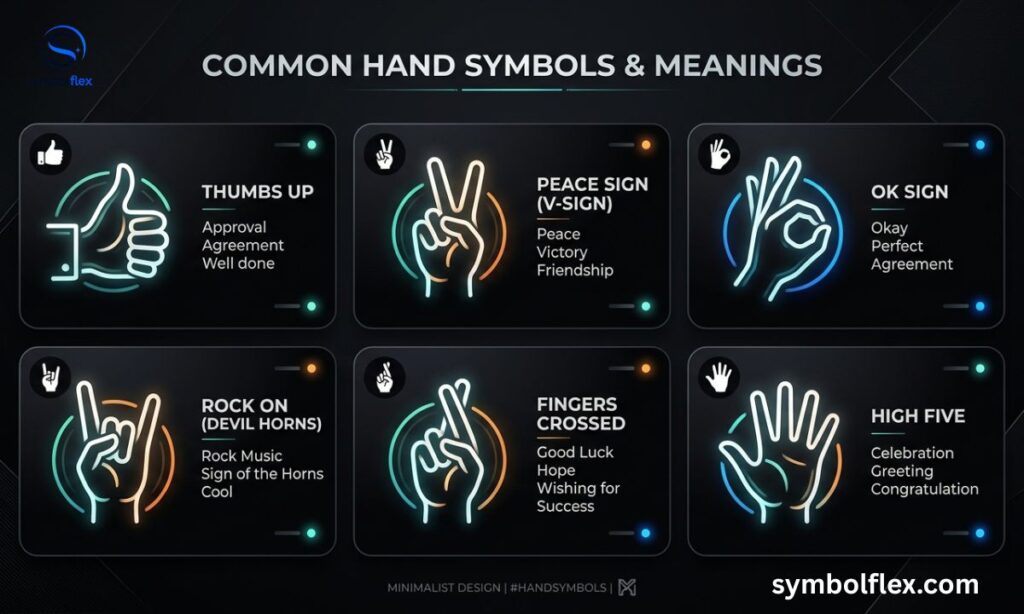
While a written guide can’t replace an actual photo reference, picture in your mind these commonly searched gestures: the thumbs up (fist with thumb extended upward), the peace sign (index and middle finger raised in a V), the OK sign (thumb and index finger forming a circle), the fist bump (two closed fists lightly touching), and the simple open palm wave.
Each of these has become so visually standardized that most people recognize them instantly, even across language barriers, which is exactly why they spread so easily online.
Hand Gestures And Their Meanings List
A quick reference list makes this easier to scan:
- Thumbs up: approval, agreement, “good job”
- Peace sign: calm, nonviolence, greeting
- OK sign: agreement or precision in the US, though it carries very different, sometimes offensive meanings in Brazil, Turkey, and parts of the Middle East
- Fist bump: casual greeting or celebration, popularized partly for hygiene reasons as an alternative to handshakes
- Wave: hello or goodbye
- Finger heart: affection, popularized by Korean pop culture
- Crossed fingers: hoping for good luck, or in some contexts, secretly signaling a statement isn’t meant sincerely
Hand Signs With Meaning

A hand sign, as distinct from a spontaneous gesture, tends to be more deliberate and coded. Think of the “call me” gesture (thumb and pinky extended, other fingers curled), the “rock on” sign (index and pinky raised, others curled), or the “hang loose” shaka sign popular in surf culture. These are learned signals passed down through subculture and repetition rather than instinctive body language.
Hand Signs
Broadly, hand signs function as a kind of shorthand vocabulary. Sports referees use standardized hand signs to communicate rulings across a noisy stadium. Divers use hand signs underwater where speech is impossible. Auctioneers, stock traders, and construction crews all rely on specialized hand sign systems built for environments where verbal communication is difficult or unreliable.
Hand Signs Meanings
In American culture specifically, a handful of regional hand signs have become nationally recognized. The University of Texas “Hook ’em Horns” sign (index and pinky raised, thumb tucked) and various college and professional sports team hand signals are instantly recognizable to fans, functioning almost like a visual password that marks group belonging.
Hand Signs And Meanings
Sports fandom is a particularly rich area for this kind of symbolism. Team specific hand signs let strangers instantly recognize each other as part of the same fan community, and referees rely on universally agreed hand signals (like crossed arms for an incomplete pass, or a raised fist for a delay of game penalty) that fans learn to read almost as fluently as the athletes themselves.
Hand Signs With Deep Meaning
Some hand signs carry more emotional weight than a casual greeting. The American Sign Language sign for “I love you,” which combines the handshapes for the letters I, L, and Y into one gesture, has become widely recognized and used even by people with no connection to the Deaf community, precisely because it communicates something meaningful in a single, simple shape.
Modern Hand Signs
Social media has created an entirely new category of hand signs. The Korean “finger heart,” made by crossing the thumb and index finger, spread globally through K-pop culture and is now used far beyond its country of origin.
Short form video platforms have also popularized dozens of micro-trends built around specific hand movements, though most of these fade quickly compared to older, more established gestures.
7 Powerful Hand Gestures
Here’s a quick list of gestures widely considered powerful because of the history or emotion behind them: the raised fist (solidarity and resistance), praying hands (devotion), the open palm blessing (protection and peace), the peace sign (nonviolent protest), the hamsa (spiritual protection), the thumbs up (universal encouragement), and the handshake (trust and agreement). What makes these “powerful” isn’t complexity, it’s the weight of history and repeated cultural use behind a very simple physical action.
Bad Hand Gestures Meaning With Pictures
Understanding potentially offensive gestures matters most for travelers and business professionals working across cultures. The OK sign, generally positive in the US, can be read as a vulgar insult in Brazil and parts of Europe. The thumbs up, generally friendly in the US, can be considered rude in parts of West Africa and the Middle East.
The “moutza” (an open palm pushed toward someone with fingers spread) is deeply offensive in Greece, even though it looks similar to a simple stop gesture elsewhere. None of this means these gestures are inherently bad, it simply means their meaning is not universal, and a little awareness goes a long way when you’re traveling or working internationally.
Spiritual, Ancient And Cultural Hand Symbols
Here’s the short version: spiritual hand symbols use specific finger and palm positions to represent protection, devotion, energy flow, or connection to the divine, and many of these traditions independently developed strikingly similar ideas about what an open or raised hand means.
This section moves from the modern and everyday into older, more sacred territory. These symbols tend to carry more emotional and historical depth, and they’re worth treating with a bit more care and respect than a casual internet trend, since for many people, these gestures remain living parts of active religious and cultural practice today, not historical curiosities.
Hand Symbol Meanings Spiritual
Across multiple unrelated traditions, hands are treated as conduits for spiritual or life energy. In yoga philosophy, mudras are believed to direct prana, or life force, through specific channels in the body. In Reiki and other energy healing practices, the hands are the primary tool for directing healing intention.
In Christian and Jewish prayer, the specific positioning of the hands during blessing is treated as more than symbolic gesture, it’s considered part of the actual act of blessing itself.
Hand Symbols Spiritual
Protective hand symbolism appears with remarkable consistency across cultures that had little to no historical contact with one another. The hamsa in the Middle East and North Africa, similar open hand talismans in parts of Latin America, and protective hand gestures in various indigenous traditions all lean on the same basic idea, an open, visible hand wards off harm and misfortune.
Spiritual Hand Symbols

The most recognized spiritual protection symbol worldwide is almost certainly the hamsa, sometimes called the Hand of Fatima in Islamic tradition or the Hand of Miriam in Jewish tradition. Fact check: the word hamsa comes from the Arabic word for “five,” referring to the five fingers of the hand, and archaeological evidence places hamsa style hand imagery on Israelite tombs dating back to roughly the 8th century BCE, meaning the symbol likely predates both Islam and later forms of Judaism as we know them today, and may trace back to older Phoenician and regional goddess worship.
Spiritual Hand Symbols And Meanings
| Symbol | Origin | Core meaning |
| Hamsa | Middle East and North Africa | Protection from the evil eye, divine blessing |
| Abhaya mudra | Buddhism | Fearlessness, protection, reassurance |
| Praying hands | Christianity, multiple faiths | Devotion, gratitude, humility |
| Anjali mudra | Hinduism, yoga | Respect, greeting, unity of self |
| Bhumisparsha mudra | Buddhism | Calling the earth to witness, enlightenment |
Hand Meaning Symbol
Beyond specific gestures, the hand itself has often functioned as a religious symbol independent of any particular finger position. In Christian iconography, a hand emerging from clouds is a recognized visual shorthand for the presence or will of God, used in medieval and Renaissance art specifically because showing a full divine figure was often considered inappropriate.
Hand Symbols Meanings
Naming conventions differ across faiths even when the physical symbol looks nearly identical. The same open hand shape can be called the Hand of Fatima, the Hand of Miriam, or the Hand of Mary, depending on which religious community is using it, a good reminder that a single visual symbol can hold multiple, equally valid layers of meaning depending on who is looking at it.
Hands Symbol Meaning
The number and position of the fingers frequently carries additional layered meaning within a single symbol. In the hamsa, the five fingers are tied to the five pillars of Islam in Muslim tradition, and to the five books of the Torah in Jewish tradition, showing how a single physical detail, five fingers, can be reinterpreted meaningfully across different belief systems without changing the underlying symbol at all.
Powerful Hand Symbols
Symbols associated with strength and protection tend to share certain visual traits, they’re usually bold, simple, and easy to reproduce, which is part of why they endure. The raised fist, the hamsa, and the abhaya mudra all share this same visual economy, a small number of clear lines communicating a big idea instantly.
Ancient Hand Symbols And Meanings
Some of the oldest documented hand symbolism comes from cave art. The handprints at Cueva de las Manos in Argentina, dated between roughly 9,000 and 13,000 years old, were likely created by blowing mineral pigment through hollow bone pipes over an outstretched hand pressed against the rock wall. Ancient Egyptian art also frequently depicted hands in religious and royal contexts, often as gestures of offering or protection tied to specific deities.
Hand Symbols And Their Meaning
Pulling this section together, ancient and spiritual hand symbols share a common thread across cultures that never historically interacted, the belief that an open hand offers protection, and that a raised or positioned hand can channel something beyond the purely physical. That’s a genuinely striking pattern once you notice it, and it sets up the more institutional, organized symbolism covered in the next section.
Religious, Occult And Pop Culture Hand Symbols
Here’s the direct answer: religious hand symbols are typically well documented gestures used in worship and ritual, while occult and secret society hand symbols are often surrounded by far more speculation online than actual verified evidence, and it’s worth telling those two categories apart.
This section covers some genuinely sensitive search terms, and it’s handled here as factually and neutrally as possible. A lot of what circulates about secretive hand symbols is internet folklore rather than documented history, and part of being a trustworthy source on this topic means being honest about that difference.
Christian Hand Symbols

The Christian tradition includes several recognized hand gestures. The sign of the cross, traced across the forehead and chest, is one of the most universally recognized Christian gestures.
The blessing hand, with specific fingers raised (often the thumb, index, and middle finger together, or all fingers extended), appears constantly in religious art depicting Christ and saints. Praying hands, palms pressed together, represent humility and devotion and are recognized well beyond Christianity itself as a shorthand for prayer in general.
Buddhist Hand Symbols
Buddhist mudras are among the most detailed and codified hand symbol systems in any religious tradition. The abhaya mudra, palm raised outward at shoulder height, represents fearlessness and protection. The dhyana mudra, hands resting in the lap with palms up, represents meditative concentration.
The bhumisparsha mudra, one hand touching the earth, represents the moment the Buddha called the earth to witness his enlightenment. Each mudra is used deliberately in specific meditative and artistic contexts, not interchangeably.
Satanic Hand Symbols
Handled factually: the gesture most commonly associated with this search term is the so called “devil horns” or “sign of the horns,” made by extending the index and pinky fingers while folding down the middle and ring fingers. Fact check: this exact hand shape traces back to an older Italian folk gesture called the mano cornuto, or corna, traditionally used to ward off the evil eye, not to invoke anything demonic.
Musician Ronnie James Dio is widely credited with popularizing the gesture in heavy metal after joining Black Sabbath in 1979, and by his own account and his widow’s, he learned it from his Italian grandmother’s protective folk gesture, not from any occult ritual.
Satanic Hand Symbols And Meanings
The gap between the gesture’s folk origin and its later heavy metal association is a good example of how meaning shifts over time. What started as a centuries old protective gesture in southern Italian culture became, decades later, a recognizable symbol of rock and metal fan identity, largely disconnected from its original protective purpose.
Bandmate Geezer Butler has also claimed he used the gesture on stage before Dio and taught it to him, so even the modern rock history is genuinely contested among the musicians involved.
Demonic Hand Symbols
Claims about specific “demonic” hand signs circulating online are almost always folklore or internet speculation rather than documented religious practice from any established tradition. It’s worth treating these claims with healthy skepticism, since a striking number of them trace back to a single unverified source repeated across many low quality websites rather than any primary religious text or historical record.
Occult Hand Symbols
Ceremonial magic traditions, historically documented in academic and religious studies literature, do include specific hand gestures used in ritual practice. These are generally recorded in published historical and academic sources rather than secretive internet claims, and genuine scholarship on the topic tends to be far more measured and specific than the sweeping claims that circulate on social media.
Illuminati Hand Symbols
The commonly claimed “triangle” hand sign, formed by touching the thumbs and index fingers together, is widely associated online with the historical Bavarian Illuminati, a short lived 18th century secret society. There is no documented historical evidence connecting this specific hand gesture to the actual historical Illuminati, which was disbanded in the 1780s. The modern association is largely a product of internet conspiracy culture from the 2000s onward rather than any verified historical practice.
Masonic Hand Symbols
Freemasonry does use documented hand gestures as part of its ritual and recognition system, and unlike some of the claims in the previous section, these are actually described in published Masonic texts available to the public. These gestures function primarily as internal recognition signals between members rather than symbols with broader public meaning.
Freemason Hand Symbols
Specific published gestures include recognition signs used during initiation ceremonies and lodge meetings. Because Freemasonry has existed openly for centuries with substantial published literature, its documented hand symbolism is considerably better sourced than most of the occult claims discussed earlier in this section.
Sorority Hand Symbols
This is a distinctly American cultural phenomenon worth including here. US college sororities each have their own specific hand signs, typically formed to represent their Greek letters, used at events, in photos, and at recruitment. These function similarly to sports fan hand signs, as an instantly recognizable marker of group belonging among current and former members.
Entertainment And Specialized Hand Signs
Here’s the quick answer: entertainment and specialized hand signs are gestures built for a specific fictional universe, art form, or profession, and many of them, even in fiction, are actually based on real historical hand traditions.
Naruto Hand Symbols
The hand seals used in the anime and manga series Naruto, where characters form specific finger patterns to perform techniques, are loosely based on real hand seal traditions found in Japanese Buddhist practice and in historical ninjutsu folklore, which itself drew on Buddhist mudra symbolism.
The show popularized a fictional, expanded version of these seals, but the underlying concept, that specific hand shapes channel focused energy or intention, has genuine roots in older Japanese religious and martial traditions.
Domain Expansion Hand Symbols
In the anime and manga series Jujutsu Kaisen, characters perform a specific hand gesture, typically pressing the palms together or forming a particular sign, before activating a powerful technique called Domain Expansion. While this is an entirely fictional invention specific to the series, it draws visually on the same tradition of ritualized hand gestures preceding a significant action, echoing real world practices like a martial artist’s bow or a religious practitioner’s mudra before beginning a ritual.
Solfege Hand Symbols
Away from fiction entirely, Curwen hand signs, developed by English music educator John Curwen in the 19th century, assign a specific hand shape to each note of the solfège scale (do, re, mi, fa, sol, la, ti). Music teachers still use this system worldwide today to help students visualize pitch relationships, making it one of the most practical, functional hand sign systems still in everyday active use.
Deep Symbolic Meaning of Hand Symbols
Here’s the short answer: hand symbols carry meaning on at least three distinct levels at once, spiritual, psychological, and cultural, and understanding all three explains why the same gesture can feel powerful to completely different people for completely different reasons.
Spiritual Level
On a spiritual level, many traditions treat the hand as a bridge between the physical body and something beyond it, whether that’s called divine energy, prana, or simply intention made visible. This is why so many religious rituals specifically involve the hands rather than just words, the physical gesture is treated as doing something, not just representing something.
Psychological Level
Psychologically, body language researchers have long studied hands as one of the clearest windows into a person’s internal state. Open palms tend to read as honest and non threatening. Clenched or hidden hands tend to read as defensive or withholding.
This isn’t just folk wisdom, it’s a well documented area of nonverbal communication research, and it helps explain why certain hand symbols (an open palm blessing, for example) feel instinctively calming even to people unfamiliar with the specific religious tradition behind them.
Cultural Level
Culturally, the same physical gesture can carry completely opposite meanings depending on where you are. A gesture considered a sacred blessing in one country might be considered rude, meaningless, or even legally sensitive in another.
This is exactly why the “bad hand gestures” section earlier in this guide matters so much for anyone traveling or working across cultures, cultural context isn’t a minor footnote, it’s often the single biggest factor in how a hand symbol is actually understood.
Types and Variations of Hand Symbols
Here’s the quick answer: the most historically significant hand symbol types include the hamsa, mudras, the raised fist, the peace sign, the handshake, and the open palm blessing, each representing a distinct category of protection, meditation, resistance, or connection.
1. Hamsa Hand
Originating in the Middle East and North Africa, the hamsa hand is a protective amulet believed to ward off the evil eye. Its five fingers connect to meaningful numbers across multiple faiths, the five pillars of Islam and the five books of the Torah among them.
Today it’s also one of the most popular jewelry motifs worldwide, worn by people well outside its original religious context, largely because its protective meaning translates easily across cultures.
2. Mudras
Mudras are the symbolic hand positions used throughout Hindu and Buddhist practice, particularly in yoga and meditation. Each mudra is associated with a specific intention, the abhaya mudra for fearlessness, the dhyana mudra for meditative focus, and dozens of others used in classical Indian dance and religious art. Practitioners believe these hand positions actively direct internal energy rather than simply representing an idea symbolically.
3. Raised Fist
The raised fist has one of the best documented modern histories of any hand symbol on this list. Fact check: its use as a popular political symbol traces back to the early 20th century international labor movement, with one of the earliest recorded American instances coming from Industrial Workers of the World organizer Big Bill Haywood during the 1913 Paterson silk strike in New Jersey.
It later became globally famous through the 1968 Black Power salute by American sprinters Tommie Smith and John Carlos on the Olympic podium in Mexico City, and remains widely used today in Black Lives Matter demonstrations and other solidarity movements.
4. Peace Sign
Fact check: the modern peace sign was designed in February 1958 by British graphic artist Gerald Holtom for the Campaign for Nuclear Disarmament, first appearing publicly at the Aldermaston anti nuclear march that same year.
The symbol combines the semaphore flag signals for the letters N and D, standing for Nuclear Disarmament, enclosed in a circle. Holtom deliberately never trademarked the design so it could be used freely by anyone, which is a major reason it spread so widely and so quickly into the 1960s counterculture and beyond.
5. Handshake
The handshake is one of the oldest documented gestures of trust, historically believed to have proven that neither party was holding a concealed weapon. Today it remains a near universal business and social greeting across most of the world, though its exact etiquette (grip strength, duration, eye contact) still varies noticeably by culture and region.
6. Open Palm Blessing
The open palm blessing gesture appears across multiple, unrelated religious traditions, Christian, Jewish, and Buddhist practice all include some version of a raised, open palm used to bless or reassure. The consistency of this specific gesture across traditions that had little historical contact with each other is one of the more compelling patterns in comparative religious symbolism.
Hand Symbols Across Cultures
Here’s the direct answer: hand symbolism developed somewhat independently across ancient civilizations, South Asia, the Middle East, Western culture, and East Asia, yet many of these regions arrived at strikingly similar core ideas, protection, blessing, and connection, without direct contact with one another.
Ancient Civilizations
Ancient Egyptian religious art frequently used hand imagery in depictions of offerings and divine protection. Mesopotamian art included hand shaped amulets tied to fertility and protective goddess worship, some of the same archaeological threads later scholars connect to the origins of the hamsa itself.
And prehistoric handprints, found not just in Argentina but on cave walls across multiple continents, suggest the impulse to leave a symbolic handprint behind is close to universal in early human culture.
South Asian Traditions
In Hinduism and Buddhism, mudras form an entire structured vocabulary of meaning built specifically around hand position. Henna hand art, widely practiced across South Asia for weddings and celebrations, adds another symbolic layer, temporary decorative patterns applied specifically to the hands to mark significant life events.
Middle Eastern Cultures
The hamsa remains the defining hand symbol of this region, cutting across Islamic, Jewish, and Christian communities alike as a shared symbol of protection against the evil eye, even while each faith attaches its own specific name and religious framing to the same visual design.
Western Culture
Western hand symbolism tends to skew more political and social than overtly religious in its most visible modern forms, the peace sign, the raised fist, and the handshake all carry more secular, civic weight than sacred weight in mainstream Western use, even though older Christian gestures still persist within religious practice specifically.
East Asian Symbolism
East Asian hand symbolism spans Buddhist mudras, the modern Korean finger heart gesture, and stylized hand seals popularized through Japanese martial arts folklore and later through anime and manga. This region shows particularly clearly how ancient religious hand symbolism and modern pop culture gestures can coexist and even influence one another.
Hand Symbols in Art, Movies and Pop Culture
Hand gestures have shaped visual storytelling for centuries, long before film existed. Renaissance painters used deliberate hand placement in religious artwork to communicate meaning instantly to audiences who may not have been able to read accompanying text, a raised blessing hand or a pointed finger told viewers exactly how to interpret a scene.
Film and television carried this tradition forward. Directors frequently use close up shots of hands, a clenched fist, a trembling palm, an outstretched hand, as visual shorthand for tension, resolve, or connection, without needing a single line of dialogue. This is a deliberate craft choice, not an accident, cinematographers understand that audiences read hand gestures almost as quickly and instinctively as facial expressions.
Music culture has produced some of the most widely recognized modern hand symbols, from the devil horns discussed earlier to hand signs specific to particular music genres and fan communities. Social media has only accelerated this, a specific hand gesture from a music video or celebrity appearance can become a recognizable trend within days, spreading across the world far faster than any historical hand symbol ever could.
Spiritual and Dream Meaning of Hand Symbols
In dream interpretation traditions, hands frequently symbolize control, capability, and connection to others. Seeing your own hands clearly in a dream is often interpreted as a sign of taking charge of a situation in waking life, while dreaming of a specific symbolic hand gesture, like a hamsa or a blessing hand, is sometimes interpreted as a sign of seeking protection or reassurance during a stressful period.
It’s worth being clear here that dream interpretation is a matter of cultural tradition and personal belief rather than scientific consensus. Different dream interpretation traditions, from Jungian psychology to folk dream dictionaries, don’t always agree on specific meanings, and no controlled research confirms that any single interpretation is objectively correct.
That said, plenty of people find real value in reflecting on recurring dream imagery, including hand symbols, as a way of processing what’s on their mind. If a specific hand symbol keeps appearing in your dreams, it may simply be worth noticing what that symbol means to you personally, rather than assuming a fixed universal answer applies.
Positive vs Negative Meaning of Hand Symbols
Most hand symbols carry a clearly positive or protective meaning within their original cultural context, the hamsa protects, praying hands express devotion, the peace sign calls for calm. Negative or offensive meanings usually develop later, often through regional variation or through a gesture’s association with a specific offensive act in one particular culture.
| Generally positive | Can be negative or offensive depending on context |
| Hamsa (protection) | OK sign (offensive in Brazil, Turkey) |
| Praying hands (devotion) | Thumbs up (rude in parts of the Middle East, West Africa) |
| Peace sign (nonviolence) | Palm push toward someone, or “moutza” (deeply offensive in Greece) |
| Raised fist (solidarity) | Certain finger positions considered vulgar in specific countries |
The lesson here isn’t that any of these gestures are inherently good or bad, it’s that meaning is built by culture and context, and a little research before using a hand gesture abroad genuinely goes a long way.
Why Humans Are Attracted to Hand Symbols
Hands are among the most expressive parts of the human body, used constantly for greeting, warning, blessing, and connecting long before spoken language became as sophisticated as it is today. That evolutionary head start likely explains part of why hand symbols feel so instinctively powerful, they tap into communication pathways older than words themselves.
There’s also a psychological angle worth noting. Researchers studying mirror neurons, brain cells that activate both when we perform an action and when we watch someone else perform it, have suggested this system plays a role in why we respond so strongly to hand gestures specifically. Watching someone raise a fist or press their palms together in prayer can trigger something close to a shared physical and emotional response in the observer, which is part of why these symbols carry such emotional weight even across cultural boundaries.
Finally, simplicity matters. The most enduring hand symbols, the peace sign, the raised fist, the hamsa, are all visually simple enough to draw, recognize, and reproduce instantly. That simplicity is exactly what allows a symbol to spread globally and survive for generations, whether it started in a 1958 protest march, a centuries old Middle Eastern amulet tradition, or a Buddhist meditation hall.
Frequently Asked Questions
What is the most common hand symbol and its meaning?
The peace sign and the thumbs up are the most recognized hand symbols, showing calm and approval.
What hand symbol means good luck?
Crossed fingers remain the most common Western symbol used for good luck, hoping for a positive outcome.
What is the spiritual meaning of hands touching?
Hands touching often represents deep connection, agreement, or shared intention across prayer, blessing, and daily human interaction.
What does it mean when you dream about hands?
Dreaming about hands often symbolizes control, capability, and connection, though interpretations vary widely across different cultural traditions.
Is the OK hand sign offensive in any country?
Yes, the OK sign is considered offensive in Brazil, Turkey, and parts of the Middle East region.
Conclusion
Hand symbols and meanings connect some of humanity’s oldest spiritual traditions with the gestures you use in ordinary conversation today. A single raised palm can carry the weight of a 9,000 year old cave painting, a 1958 peace march, or a simple hello, depending entirely on where and how it’s used.
What ties all of it together is one simple idea, hands have always been one of our most honest ways of communicating, saying things words alone can’t quite capture. From sacred mudras to the peace sign and the hamsa, every gesture carries a story worth knowing.
Next time you greet someone, bless a meal, or flash a peace sign for a photo, remember how much history is packed into that small, familiar motion. Whether it’s a spiritual hand symbol, a cultural hand sign, or just a friendly wave, your hands are speaking a language far older than any words you’ll say alongside them. Understanding hand symbols and meanings helps you read the world, and the people in it, just a little bit better.
