

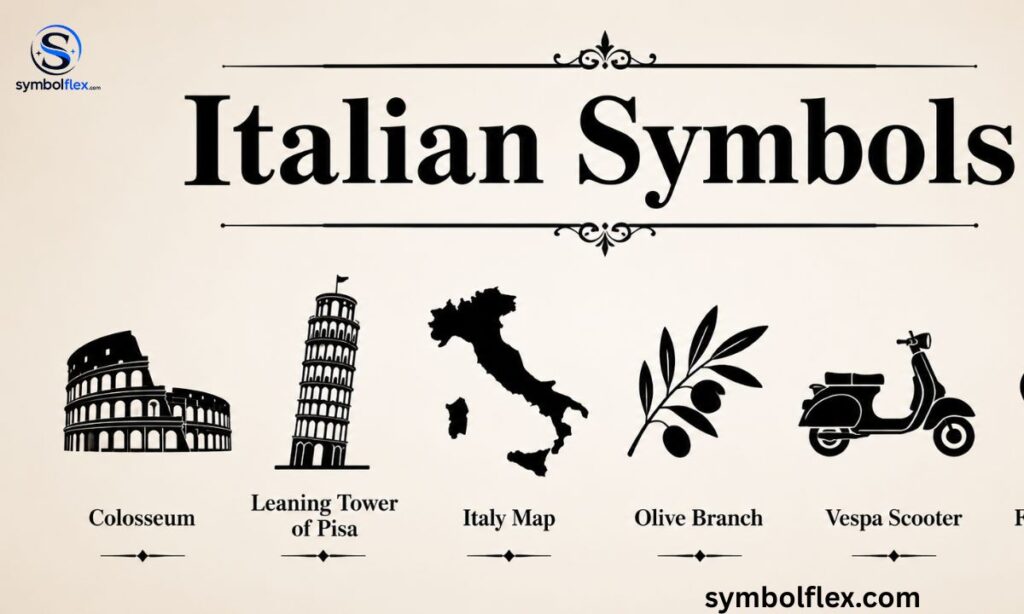
Italian symbols are visual icons like the cornicello, the Roman eagle, and the olive branch that represent Italy’s deep history, faith, and family values. Some date back over 2,000 years to ancient Rome, while others grew from Catholic tradition and folk beliefs passed down through generations of families.
This is exactly why so many people still wear a small red horn charm around their neck, or why the Colosseum feels like Italy itself in just one image. These symbols carry meaning that goes far beyond decoration, tying everyday life back to centuries of history.
Italy holds one of the richest symbolic traditions in the world, blending ancient Roman power, religious meaning, and folk protection beliefs into one identity. From national emblems like the flag and coat of arms to personal charms like Italian horn jewelry and heritage tattoos, this guide covers 107+ Italian symbols and explains the real meaning, history, and cultural significance behind each one.
What Are Italian Symbols?

Italian symbols are images, objects, or emblems that carry meaning tied to Italian identity, history, or belief. They range from official national emblems, like the flag and the coat of arms, to folk charms passed down through generations of families.
Most Italian cultural symbols fall into a handful of broad categories. There are national and political symbols, like the tricolor flag and the Stellone d’Italia (the Star of Italy). There are religious symbols rooted in Catholicism, since the Vatican sits inside Rome and Catholic identity runs deep across the country. And there are folk symbols of protection and luck, many of which trace back to pre-Christian Italian beliefs that never fully disappeared even after Christianity became dominant.
What makes Italian symbolism unique is how it blends so many different eras into one identity. A single Italian household might display a crucifix, a cornicello, and a small statue of a Roman soldier all in the same room, and nobody would think that was strange. This layering of ancient, religious, and folk traditions is part of what makes symbols of Italy feel so distinct compared to symbols from other cultures.
Famous Italian Symbols And Their Meanings
The most famous Italian symbols share one thing in common: they tell a story about survival, faith, or pride. Below is a closer look at how these symbols are grouped and what makes each category worth knowing.
Italian Symbols And Meanings
Some of the most recognized Italian symbols and meanings include the following:
- The cornicello (Italian horn), a symbol of protection against bad luck
- The Roman eagle, a symbol of power and imperial authority
- The olive branch, a symbol of peace
- The Lion of Venice, a symbol of the Venetian Republic and Saint Mark
- The fleur de lis, associated with Florence and noble heritage
- SPQR, the abbreviation for the Roman Senate and People, still used in Rome today
Each of these carries centuries of layered meaning, and many appear together in Italian American jewelry, tattoos, and home décor.
Italian Symbols Tattoos
Tattoos built around Italian heritage are extremely popular among Italian Americans looking to honor their family roots. The most requested designs usually include the Italian horn, the Roman eagle, a map outline of Italy, or a family name in cursive script.
What makes these tattoos meaningful is not just the image itself but the story behind why someone chose it. Many people get a cornicello tattoo because their grandmother wore one every day of her life, and the tattoo becomes a way of carrying that memory forward permanently.
Italian pride tattoos also tend to lean heavily on color. The green, white, and red of the Italian flag show up constantly, whether as a small flag icon or as color shading behind another symbol like an eagle or a coat of arms.
Italian Tattoo Symbols
While the previous section covers which designs people choose, this one focuses on how those designs are typically styled. Fine line tattooing has become especially popular for Italian symbols because it allows for delicate detail work on things like olive branches or religious script.
Blackwork and traditional American tattoo styles are also common choices, especially for bolder images like the Roman eagle or a lion. These styles hold up well over time and photograph clearly, which matters if the design is meant to represent a lasting family legacy.
Placement matters too. Forearms and upper arms are popular for larger symbols like eagles or coats of arms, while smaller charms like the cornicello are often placed on wrists, behind the ear, or on the ribs.
Ancient Italian Symbols
Long before Italy existed as a unified country, the Etruscans and later the Romans developed a rich symbolic language of their own. The fasces, a bundle of rods tied around an axe, was originally a Roman symbol of authority and unity, representing the idea that individual sticks are weak but a bundle is strong.
The laurel wreath is another ancient symbol that still carries weight today. Romans placed laurel wreaths on the heads of victorious generals and poets, and the image survives in modern graduation ceremonies and academic imagery around the world.
Etruscan art, which predates Roman civilization in central Italy, introduced symbolic animals like winged lions and griffins that later influenced Roman and medieval Italian iconography. These ancient roots are part of why Italy’s symbolic language feels so much older and deeper than that of many other modern nations.
National Symbols Of Italy

Italy’s official national symbols include the tricolor flag (green, white, and red), the national anthem known as “Il Canto degli Italiani,” and the coat of arms, which features a five pointed white star known as the Stellone d’Italia set against a red background with an olive branch and an oak branch.
The olive branch on the coat of arms represents peace, while the oak branch represents strength and dignity. Together, they reflect the values Italy wanted to project after becoming a republic in 1946.
The national animal most closely associated with Italy is the wolf, largely because of the legend of Romulus and Remus, the twin brothers said to have been raised by a she wolf before founding Rome. This legend remains one of the most recognizable origin stories in Western civilization.
Traditional Italian Culture And Heritage Symbols
Traditional Italian symbols are the ones passed down inside families rather than taught in history class. These symbols show up in kitchens, jewelry boxes, and grandparents’ homes far more often than in textbooks.
Italian Symbols Letters
Italian families often personalize symbols using initials, monograms, or short phrases in Italian script. A pendant might combine a family’s first initial with a small horn or cross, blending personal identity with traditional protection symbolism.
Cursive Italian script is especially popular for tattoos that include a loved one’s name or a meaningful phrase, such as “famiglia” (family) or “sempre” (always). The elegant curves of Italian script give these pieces a distinct, romantic feel.
Some families also use their surname’s first letter as a standalone crest or design element, especially in custom jewelry meant to be passed down to the next generation.
Italian Symbols Of Protection
The cornicello is the single most well known Italian protection symbol. Traditionally made from red coral, gold, or silver and shaped like a twisted horn, it is worn to ward off the malocchio, or evil eye, a folk belief that jealousy or envy from others can bring misfortune.
The mano cornuta, a hand gesture with the index and pinky fingers extended, serves a similar protective purpose and is sometimes carved into small charms. Another protective symbol is the small red ribbon or ornament tied to a baby’s crib or clothing, meant to shield infants from harm.
These beliefs did not disappear with modernization. Many Italian and Italian American families still give a cornicello as a gift at births, weddings, or graduations, treating it less as superstition and more as a meaningful cultural tradition.
Italian Symbols For Family
Family, or “la famiglia,” sits at the center of Italian cultural identity, and several symbols reflect that. The image of intertwined hands, often shown as two or more hands clasped together, represents unity and support between generations.
The olive tree itself, not just the branch, is a common symbol of family because of how long olive trees live and how they are passed down and cared for across generations, sometimes for centuries. This makes the tree a natural metaphor for lasting family roots.
Dinner table imagery, wine, bread, and shared meals also function as informal symbols of Italian family life. While not official emblems, these images appear constantly in Italian art and media because they capture what family means in everyday Italian culture.
Symbols Of Italy
Beyond the official flag and crest, Italy is also represented by things the world recognizes instantly. The Colosseum, Michelangelo’s David, the leaning tower of Pisa, and the canals of Venice all function as unofficial visual shorthand for Italy.
Food and drink also serve a symbolic role. Espresso, wine, olive oil, and pasta are so deeply tied to Italian identity that they act as cultural symbols even though they are not traditional emblems in the historical sense.
Fashion houses like Gucci and Versace have also become part of how the world visually associates Italy with luxury and design, adding a modern layer to Italy’s long symbolic history.
Italian Symbols Jewelry

Jewelry is one of the most common ways Italian symbolism gets passed down. The cornicello pendant, often in red coral or gold, remains the most requested piece, followed closely by crucifixes and small charm bracelets featuring boots shaped like Italy’s outline.
Coral jewelry specifically carries extra meaning in southern Italian tradition, where coral was believed to have protective properties beyond just its shape. Naples, in particular, has a long history as a center of coral craftsmanship.
Custom Italian jewelry today often blends old symbols with modern design, such as a horn charm layered with a birthstone or a family name engraved on the back, keeping tradition relevant for younger generations.
Italian National Symbols
Distinct from cultural favorites, Italy’s official state symbols include the coat of arms, the national flag, and the national anthem written by Goffredo Mameli in 1847. These are the symbols used in government buildings, embassies, and official documents.
The Vittoriano monument in Rome, built to honor Italy’s first king after unification, also functions as a national symbol representing Italian unity, since Italy was not a single unified country until 1861.
Even the national flower, the daisy, and national gemstone considerations reflect an effort to give modern Italy a complete symbolic identity, blending old imperial history with newer republican values.
Ancient And Modern Symbols That Represent Italy
Italy’s symbolism did not stop evolving after ancient Rome. New symbols kept forming as the country moved through the Renaissance, unification, and into the modern era.
Italy Symbols
When people search for general “Italy symbols,” they are usually looking for a mix of official emblems and recognizable cultural icons together. This includes the flag, the Colosseum, the wolf of Rome, and the Vespa scooter, which became a global symbol of Italian style after World War II.
Italian Symbols Of Love
The most common Italian love symbol is the heart intertwined with a rose or an arrow, similar to imagery found across many cultures but often paired with Italian phrases like “ti amo.” Wedding traditions also use symbolic items, such as sugared almonds called confetti, given in odd numbers to represent the indivisibility of the couple.
Things That Represent Italy
Beyond formal symbols, everyday things that represent Italy include gelato, the Vespa, Ferrari and Lamborghini as symbols of Italian engineering pride, and opera, which Italy gave to the world through composers like Verdi and Puccini.
Ancient Italian Symbols And Meanings
Going deeper into ancient meanings, the she wolf represents strength and nurturing despite danger, the laurel wreath represents victory and honor, and the fasces represents unity through collective strength, a concept so powerful it was later adopted, and later distorted, by 20th century political movements.
Something That Represents Italy
If someone had to pick just one image to represent Italy, most people would choose either the Colosseum or the Italian flag, since both instantly communicate Italian identity to a global audience without needing further explanation.
Things That Represent Italian Culture
Culture goes beyond landmarks. Family closeness, Catholic faith, regional pride, and a strong connection to food and craftsmanship all represent Italian culture as much as any physical symbol does.
Italian Symbols Of Strength
Strength symbols include the Roman eagle, the she wolf, the fasces, and the Lion of Venice, all of which communicate power, resilience, and authority rooted in Italy’s long imperial and republican history.
The Deep Symbolic Meaning Behind Italian Symbols
Symbols carry meaning on more than one level, and Italian symbols are a strong example of how spiritual belief, psychology, and culture overlap.
Spiritual Meaning
Many Italian symbols carry spiritual weight tied to Catholicism, since the Vatican has shaped Italian religious life for centuries. Crosses, saint medallions, and images of the Madonna appear constantly in Italian households, often alongside older folk protection symbols like the cornicello.
Psychological Meaning
Psychologically, symbols like the cornicello offer a sense of control in an unpredictable world. Wearing a protective charm gives people a tangible way to feel safer, even if the belief behind it is rooted in folklore rather than science.
Cultural Meaning
Culturally, these symbols reinforce belonging. Wearing or displaying an Italian symbol signals connection to a shared heritage, which matters enormously for Italian American communities trying to preserve identity across generations far from Italy itself.
Types of Italian Symbols and Their Meanings
Here is a closer, detailed look at five of the most historically significant Italian symbols.
The Cornicello
Visual Description
A curved, twisted horn shape, usually red, gold, or silver, resembling a chili pepper or an animal horn.
Meaning
Protection against the evil eye and bad luck, rooted in southern Italian folklore that predates Christianity in the region.
Where It Appears
Necklaces, keychains, home décor, and tattoos, especially common in Naples and among Italian American families of southern Italian descent.
The Roman Eagle
Visual Description
A powerful eagle, often shown with spread wings, sometimes holding a bundle of arrows or standing on a globe.
Meaning
Authority, military power, and imperial dominance, originally used as the standard carried by Roman legions.
Where It Appears
Government buildings, tattoos, coats of arms, and historical monuments across Italy.
The Olive Branch
Visual Description
A slender branch with narrow leaves, often shown crossed with another branch or held in a bird’s beak.
Meaning
Peace and reconciliation, a meaning that traces back to ancient Mediterranean cultures and remains part of Italy’s official coat of arms today.
Where It Appears
The Italian coat of arms, wedding décor, and diplomatic imagery.
The Lion of Venice
Visual Description
A winged lion, usually shown holding an open book, representing Saint Mark the Evangelist.
Meaning
Strength, wisdom, and the historic power of the Venetian Republic, one of the most influential maritime powers in medieval and Renaissance Europe.
Where It Appears
Venice’s flag, architecture, and statues throughout the city.
The Fleur de Lis
Visual Description
A stylized three petaled lily.
Meaning
In Florence, the fleur de lis became associated with nobility, purity, and the city itself, appearing on Florence’s own coat of arms since the medieval period.
Where It Appears
Florence’s civic emblems, historical buildings, and Italian heraldry.
Italian Symbols Across Different Cultures
Italian symbolism did not develop in one straight line. It shifted meaning depending on the era and the people using it.
Ancient Roman Culture
Rome used symbols like the eagle and fasces to project military and political power across a vast empire.
Christian Italian Culture
After Christianity spread through Italy, religious symbols like the cross and saint imagery layered on top of, and sometimes merged with, older Roman visual traditions.
Renaissance Italy
The Renaissance introduced new artistic symbolism, with cities like Florence and Venice developing their own civic emblems tied to wealth, art, and political identity.
Medieval Italian States
Before unification, Italy was a patchwork of independent states, each with its own coat of arms and symbolic identity, from Milan’s biscione serpent to Genoa’s red cross.
Modern Global Culture
Today, Italian symbolism has spread globally through immigration, fashion, and food culture, giving symbols like the cornicello and the tricolor flag recognition far beyond Italy’s borders.
Italian Symbols in Art, Movies, Literature, Tattoos and Fashion
Italian symbolism runs through centuries of creative work. Renaissance painters like Michelangelo and Botticelli filled their art with religious and mythological symbolism that still shapes how the world visualizes Italy. In film, movies about Italian American life lean heavily on imagery like gold crucifixes, horn pendants, and family crests to signal heritage quickly to audiences.
In literature, Dante’s imagery of laurel wreaths and Roman references shaped how later writers used Italian symbols to represent honor and legacy. Fashion houses have also turned classical symbols into modern branding, most notably Versace’s Medusa head logo, which draws directly on Greek and Roman mythology to project power and glamour.
Spiritual And Dream Meaning of Italian Symbols
In Italian folk belief, dreaming about certain symbols carries meaning. Dreaming of a horn shape is sometimes interpreted as a sign of upcoming protection or good fortune, while dreaming of olive branches is often linked to peace returning to a troubled situation.
These interpretations come from oral folklore rather than formal religious doctrine, but they remain part of everyday Italian superstition, especially in southern regions where malocchio belief runs strongest.
Positive And Negative Meanings of Italian Symbols
Most Italian symbols carry primarily positive meanings, but a few carry more complicated histories.
| Symbol | Positive Meaning | Complicated or Negative Association |
| Roman Eagle | Power, strength | Imperial conquest and expansion |
| Fasces | Unity, collective strength | Later adopted by 20th century fascist movements |
| Skull imagery | Mortality, remembrance | Sometimes mistaken as morbid rather than reflective |
| She Wolf | Nurturing strength | Occasionally romanticized without acknowledging the myth’s violence |
Understanding both sides gives a fuller, more honest picture of what these symbols represent rather than flattening them into purely decorative images.
Why Humans Feel Deeply Attracted to Italian Symbols
People are drawn to Italian symbols because they combine beauty, history, and emotional meaning in one image. Unlike a purely modern logo, a symbol like the cornicello carries centuries of belief behind it, which gives it weight that a newly invented design simply cannot replicate.
There is also a strong identity component, especially for the millions of Italian Americans across the United States. Wearing or displaying an Italian symbol becomes a way of staying connected to ancestry, even for people several generations removed from Italy itself.
Finally, Italy’s global reputation for art, food, and craftsmanship makes its symbols feel aspirational. People are not just borrowing an image; they are borrowing a feeling associated with beauty, warmth, and tradition.
Italian Symbols And Their Role In Daily Italian Life
In everyday Italian households, these symbols are not just decoration, they are lived tradition. A cornicello might hang from a rearview mirror, a small crucifix might sit above a doorway, and olive branches might be blessed and kept in the home after Palm Sunday.
Italian holidays reinforce these symbols constantly. During religious festivals, saint statues are carried through town streets, and families display symbolic foods like bread shaped into crosses or wreaths. These practices keep centuries old symbolism active rather than treating it as something only found in museums.
Even Italian business culture uses symbolism, from the laurel wreath used on Italian graduation crowns to the continued use of Roman numerals and Latin phrases in official Italian institutions today.
Frequently Asked Questions
What is the most famous Italian symbol?
The Colosseum and the Italian flag are generally considered the most recognized Italian symbols worldwide, though the cornicello is the most well known folk symbol.
What does the Italian horn symbolize?
The Italian horn, or cornicello, symbolizes protection against bad luck and the evil eye, a belief rooted in southern Italian folklore.
Why are Roman symbols still important today?
Roman symbols like SPQR and the eagle remain important because they represent the foundation of Western law, government, and military tradition that still influences modern institutions.
Are Italian symbols religious?
Many are, since Catholicism has shaped Italian culture for centuries, but Italy also has many secular and folk symbols that exist alongside religious ones.
What do olive branches mean in Italian culture?
Olive branches represent peace and appear on Italy’s official coat of arms, as well as in wedding and diplomatic traditions.
Why do people tattoo Italian symbols?
People tattoo Italian symbols to honor family heritage, express pride in their ancestry, and carry meaningful protective or spiritual symbols with them permanently.
Conclusion
Italian symbols carry far more weight than simple decoration. From the ancient power of the Roman eagle to the everyday protection offered by the cornicello, each symbol reflects a piece of Italy’s long, layered history.
Whether you are drawn to these symbols through faith, family heritage, or simple appreciation for their beauty, understanding their meaning connects you to a tradition that has survived for thousands of years. Which Italian symbol speaks to you most?
