

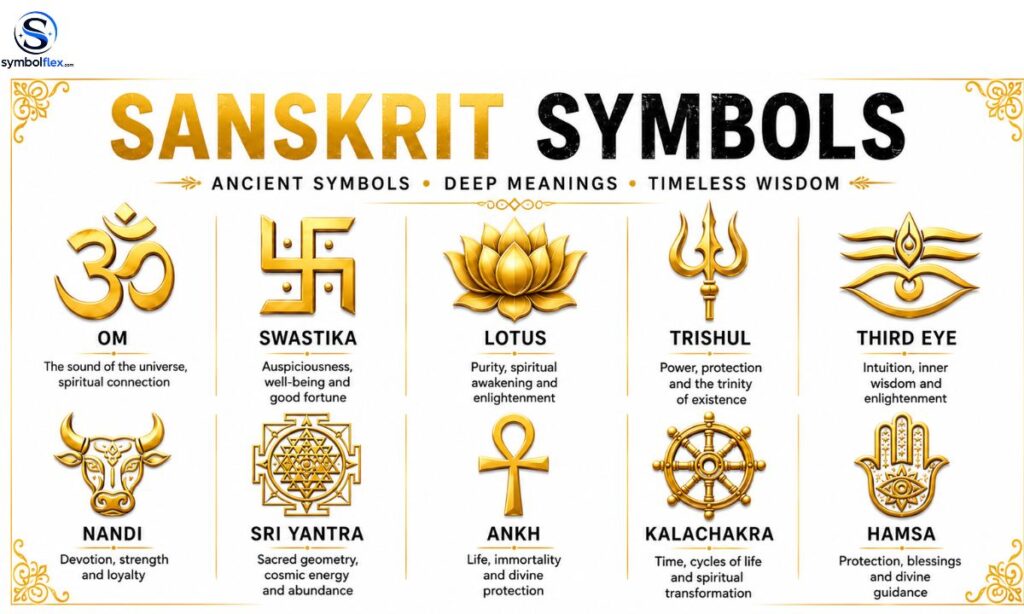
Sanskrit symbols are ancient visual and phonetic signs, like Om, the Lotus, and the seven Chakras, representing spiritual ideas from Hindu, Buddhist, and Jain traditions that go back over 3,000 years. In 2026, they’re trending harder than ever, showing up in tattoos, meditation apps, and wellness branding across the US, yet most people using them have no idea what they actually mean.
This guide covers 95+ Sanskrit symbols and their meanings, broken down by category, from sacred spiritual icons to the most popular tattoo picks this year. By the end, you’ll know exactly which symbol fits you, and why it actually matters.
What Are Sanskrit Symbols?

Sanskrit symbols are images, marks, or written characters that carry spiritual, philosophical, or cultural meaning within traditions that used the Sanskrit language, primarily Hinduism, Buddhism, and Jainism.
Sanskrit itself is one of the oldest documented languages in the world. The earliest Sanskrit texts, known as the Vedas, date back to roughly 1500 BCE, according to linguistic scholars and sources like Britannica. That means the ideas behind many of these symbols have been around for over 3,000 years, long before English, French, or Spanish existed in any recognizable form.
It’s worth separating two things that often get mixed up. There’s the Sanskrit alphabet, written in the Devanagari script, and then there are Sanskrit symbols, which are often iconography rather than literal letters.
The Om symbol, for example, is technically a character in Devanagari, but it also functions as a standalone spiritual icon. Other symbols, like the Lotus or the Dharma Wheel, aren’t letters at all. They’re pictorial representations of ideas like purity or the teachings of the Buddha.
Ancient Sanskrit Symbols And Their Spiritual Meanings
Ancient Sanskrit symbols were originally used in temples, manuscripts, and rituals to represent divine energy, cosmic order, and philosophical teachings passed down through the Vedas and Upanishads.
These weren’t decorative choices. In ancient India, a symbol carved into a temple wall or drawn during a ceremony was believed to hold real spiritual power. Priests and scholars treated these sacred Sanskrit symbols as tools for connecting the physical world with something bigger, whether that was a god, a cosmic principle, or an internal state of consciousness.
What’s interesting is how consistent this symbolic system has stayed. A symbol used in a Vedic ritual thousands of years ago can still be found today in a modern yoga class, a wedding ceremony, or a piece of jewelry. That kind of staying power is rare, and it says something about how deeply these ideas are woven into South Asian culture and, increasingly, into global spiritual practice.
Sanskrit Symbols And Meanings
Here’s a quick reference table covering some of the most searched Sanskrit symbols and meanings.
| Symbol | Sanskrit Name | Meaning |
| Om | Aum | The primordial sound of the universe |
| Lotus | Padma | Purity, enlightenment, spiritual growth |
| Swastika | Svastika | Well-being, auspiciousness, good fortune |
| Trident | Trishula | Balance of creation, preservation, destruction |
| Wheel | Chakra | Cycle of life, dharma, cosmic order |
| Endless Knot | Shrivatsa | Interconnection of all things |
| Conch Shell | Shankha | Victory, sacred sound, divine call |
| Lamp | Deepam | Knowledge dispelling ignorance |
This is just a sample. Throughout this guide, you’ll find dozens more grouped by category, including tattoo-friendly options and symbols tied to specific ideas like balance or breath.
Buddhist Sanskrit Symbols And Meanings
Buddhist Sanskrit symbols often overlap with Hindu ones, but they carry distinct meanings tied to the Buddha’s teachings, known as the Dharma.
The Dharmachakra, or Dharma Wheel, is probably the most recognized. It represents the Buddha’s first sermon and the eightfold path toward enlightenment. The Lotus also appears heavily in Buddhist iconography, symbolizing the way a person can rise above suffering, much like a lotus grows up through muddy water and blooms clean above the surface.
Another important one is the Endless Knot, which shows up in Tibetan Buddhist art and represents the interdependence of all phenomena, meaning nothing exists in isolation. You’ll also come across the mantra “Om Mani Padme Hum,” which isn’t a single symbol but a phrase often written in decorative Sanskrit or Tibetan script and associated with compassion. These Buddhist Sanskrit symbols are commonly seen in meditation spaces, prayer flags, and increasingly in Western tattoo culture, where people want a visual reminder of mindfulness or inner peace.
Ancient Sanskrit Symbols
Beyond the well-known icons, there’s a deeper layer of ancient Sanskrit symbols that most beginner guides skip over entirely.
Yantras, for instance, are geometric diagrams used in meditation and ritual worship. The Shri Yantra is considered one of the most powerful, made up of nine interlocking triangles that represent the union of masculine and feminine cosmic energy. Navagraha symbols represent the nine celestial bodies in Vedic astrology and were used in ancient rituals meant to balance planetary influence on a person’s life.
The Swastika deserves special mention here because it’s one of the most misunderstood ancient Sanskrit symbols in the West. In its original Sanskrit context, “svastika” means well-being or good fortune, and it has been used for thousands of years in Hindu, Buddhist, and Jain traditions as a mark of auspiciousness.
Its modern association in the United States comes from a completely different historical event in 20th century Europe, and that context is worth knowing if you’re researching this symbol for personal or cultural reasons.
Sanskrit Symbol For Life

There isn’t one single universal “symbol for life” in Sanskrit the way there might be in some other traditions, but the concept closest to it is tied to Prana, meaning life force or vital breath.
In Hindu philosophy, life isn’t just biological existence. It’s animated by Prana, the same energy that yoga practices like pranayama are designed to cultivate. Some people use the Om symbol as a stand-in representation for life itself, since Om is considered the sound from which all existence originates.
Others look to the Lotus, since its life cycle, growing from mud into a clean flower, is often used as a metaphor for a soul’s journey through life. If you’re searching for a Sanskrit symbol for life for a tattoo or piece of jewelry, both Om and the Lotus are commonly chosen for this exact reason.
Sanskrit Symbols For Breathe
The Sanskrit word most closely tied to “breathe” is Prana, and its written form is sometimes used as a standalone symbol, particularly in yoga and wellness spaces.
Pranayama, a core practice in yoga, literally means “extension of life force” and is built entirely around controlling the breath. This is one of the more practical Sanskrit spiritual symbols for American audiences, since breathwork has become mainstream in fitness and wellness culture, often recommended for stress reduction and mental clarity.
Some people choose to have the word “Prana” written in Devanagari script as a tattoo, while others prefer a symbolic representation like a wave or spiral to represent breath moving in and out of the body. Either way, this concept ties directly into Sanskrit symbols for healing and Sanskrit symbols for inner peace, since breath control is considered foundational to both in Ayurvedic and yogic tradition.
Popular Sanskrit Symbols In Tattoos And Modern Design
Sanskrit symbols have become one of the most requested tattoo categories in the United States, largely because of their visual simplicity and deep spiritual weight.
That popularity comes with responsibility. There’s an ongoing conversation, especially on platforms like Reddit and Quora, about the line between cultural appreciation and cultural appropriation when it comes to religious symbols. The general consensus among practitioners is that understanding a symbol’s meaning and origin, rather than picking it purely for aesthetics, makes a real difference in how it’s used and perceived.
Getting the translation right matters just as much. There are well documented cases of people getting Sanskrit tattoos that were mistranslated or written with incorrect grammar, sometimes ending up with a phrase that means something entirely different from what they intended. If you’re considering a Sanskrit tattoo, working with someone fluent in the language, rather than relying on a random online translator, is the safer route.
Sanskrit Symbols Tattoos
The most requested Sanskrit symbols tattoos in the US include Om, the Lotus, the Trishula, and Ganesha’s symbol, often placed on the wrist, spine, forearm, or behind the ear.
Small, minimalist placements have become especially popular because Sanskrit characters and symbols tend to hold their clarity even at a smaller size, unlike more detailed illustrative tattoos. Wrist and ankle placements are common for first-timers, while spine placements tend to appeal to people who want a more private, personal piece.
Sanskrit Symbols And Meanings Tattoos
People often combine multiple Sanskrit symbols and meanings into a single tattoo design to represent a personal story, such as pairing the Lotus with a Chakra symbol to represent growth alongside balance.
A common combination is Om paired with a small mandala, representing both the cosmic sound of creation and wholeness. Another popular pairing is the Lotus with the word “Satya,” meaning truth, often chosen by people going through a major life transition. These combinations turn a single symbol into a more personalized piece of storytelling on skin.
Spiritual Sanskrit Symbols

Spiritual Sanskrit symbols chosen specifically for meditation or energy work include the Shri Yantra, the seven Chakra symbols, and the Om character.
These are less common as tattoos and more common in home altars, meditation cushions, and wall art. Many meditation apps and wellness brands in the US now use stylized versions of these symbols in their branding, which has helped introduce them to people who might never have encountered Sanskrit otherwise.
Sanskrit Symbols Text
Sanskrit symbols text refers to words or phrases written in the Devanagari script, often chosen for tattoos, jewelry engravings, or wall art.
The risk with Sanskrit symbols text is that Devanagari is a complex script with specific rules for connecting characters, called ligatures. A small error can completely change the meaning or make the phrase unreadable to a native speaker. If accuracy matters to you, it’s worth double checking any Sanskrit text with more than one qualified source before making it permanent.
Symbols Of Sanskrit
Beyond the most popular ones, there are dozens of lesser known symbols of Sanskrit still used today, including the Ankusha, a symbol of overcoming obstacles, and the Kalasha, a sacred pot representing abundance and fertility.
These symbols show up frequently during Hindu festivals and ceremonies but rarely make it into Western content about Sanskrit symbols, which tends to focus heavily on Om and the Lotus. Exploring these lesser known symbols gives a fuller picture of just how rich this symbolic tradition really is.
Sanskrit Symbols Meaning
To recap quickly, Sanskrit symbols meaning generally falls into a few broad categories: sound and creation (Om), purity and growth (Lotus), balance and cosmic order (Chakra, Trishula), and protection or good fortune (Swastika, Kalasha).
Keeping these categories in mind makes it much easier to choose a symbol that actually matches what you’re trying to express, rather than picking one just because it looks appealing.
Sanskrit Symbol For Balance
The concept of balance in Sanskrit tradition is most closely tied to the idea of equilibrium between opposing forces, something the Trishula and certain Yantras are designed to represent.
Yoga practitioners in the US often associate balance with the Chakra system as a whole, since a “balanced” person, in this framework, is someone whose seven energy centers are functioning in harmony rather than one being overactive or blocked.
Breathe Sanskrit Symbol

In modern design and typography, the word “Prana” is sometimes stylized into a minimalist symbol, often paired with a wave or spiral shape to visually suggest inhale and exhale.
This has become a popular choice for wellness brand logos and yoga studio signage, since it communicates the idea of breath and life force without requiring text at all.
Deep Symbolic Meaning
The deeper symbolic meaning behind most Sanskrit icons comes down to a few recurring themes: cyclical time, the balance of opposing cosmic forces, and the idea that the physical world is a reflection of something unseen.
Where Western audiences sometimes interpret these symbols on a surface level, purely as aesthetic or “good vibes” imagery, the traditional interpretation goes much deeper. Om, for example, isn’t just a pretty character. In Hindu philosophy, it’s considered the sound that existed before creation itself, sometimes compared to how physicists describe the universe beginning from a single point.
One clear factual distinction worth noting: the Swastika’s original Sanskrit meaning is entirely about well-being and good fortune, and this meaning predates its unrelated 20th century European usage by thousands of years. That single fact clears up a huge amount of confusion for people encountering the symbol for the first time.
Types / Variations of Sanskrit Symbols
Om Symbol
Om is considered the most sacred sound in Hindu and Buddhist tradition, representing the vibration from which the entire universe is believed to have originated.
It’s chanted at the start and end of yoga classes across the US, typically in three parts representing creation, preservation, and destruction. Many people wear Om as jewelry or get it tattooed simply because it functions almost like a universal symbol for spirituality itself, even among people who aren’t specifically Hindu or Buddhist.
Lotus Symbol

Different colored lotuses carry different meanings. A white lotus typically represents spiritual perfection, a pink lotus is associated with the historical Buddha, and a blue lotus often symbolizes wisdom and knowledge. This is one of the most popular symbols in the wellness and yoga branding space in the United States.
Swastika Symbol
The Lotus, or Padma, represents purity, enlightenment, and the ability to rise above difficult circumstances, since the flower grows through mud yet blooms clean and untouched.
In its original Sanskrit context, the Swastika represents auspiciousness and well-being, and it remains a common symbol in Hindu, Buddhist, and Jain ceremonies today, particularly in India and Southeast Asia.
Because of its unrelated 20th century association in the West, this symbol requires more context and sensitivity when discussed with American audiences, and it’s rarely used in Western tattoos or design for that reason, even though its Sanskrit meaning remains entirely positive.
Chakra Symbols
The seven chakras represent energy centers in the body, each associated with a specific color, element, and area of life, from survival instincts at the base of the spine to spiritual connection at the crown of the head.
| Chakra | Location | Color | Represents |
| Root | Base of spine | Red | Security, stability |
| Sacral | Lower abdomen | Orange | Creativity, emotion |
| Solar Plexus | Upper stomach | Yellow | Confidence, willpower |
| Heart | Center of chest | Green | Love, compassion |
| Throat | Throat | Blue | Communication, truth |
| Third Eye | Between eyebrows | Indigo | Intuition, insight |
| Crown | Top of head | Violet | Spiritual connection |
Chakra symbols have become widely used in American wellness apps, jewelry, and yoga studio branding, often as a shorthand for balance and mind body alignment.
Mandala
A Mandala is a geometric diagram representing wholeness, unity, and the structure of the cosmos, often used as a focal point during meditation.
Mandala coloring books became a major trend in the US, partly because the repetitive, symmetrical patterns are associated with stress relief and mindfulness, echoing the same meditative purpose mandalas have served in Hindu and Buddhist practice for centuries.
Sanskrit Symbols Across Cultures
Sanskrit symbols didn’t stay confined to India. Through trade, migration, and religious spread, versions of these symbols appear across Southeast Asia, Tibet, Nepal, and parts of East Asia, adapted slightly by each culture that adopted them.
The Lotus, for example, appears in Egyptian symbolism as well, though with a somewhat different meaning tied to the sun and rebirth rather than Buddhist enlightenment specifically. The Dharma Wheel spread through Buddhist migration into Thailand, Sri Lanka, and Japan, each region adding its own artistic style while keeping the core meaning intact.
This cross-cultural spread is part of why Sanskrit symbols feel so universally recognizable today. They’ve had thousands of years and multiple civilizations to become woven into a shared visual language of spirituality.
Sanskrit Symbols in Art, Movies & Pop Culture
Sanskrit symbols show up frequently in Western film, fashion, and music, often used to signal spirituality, mysticism, or an Eastern aesthetic.
Yoga and wellness brands across the US have leaned heavily on Om, Lotus, and Chakra imagery in their logos and packaging. Music festivals, particularly those with a wellness or bohemian theme, often feature large scale mandala and Om artwork as part of their visual branding. This mainstream exposure is a big part of why so many Americans recognize these symbols even without knowing their formal religious background.
Spiritual & Dream Meaning of Sanskrit Symbols
Within spiritual and dream interpretation traditions, seeing symbols like Om, the Lotus, or a Chakra in a dream is often interpreted as a sign of internal transformation, awakening awareness, or a call toward inner peace.
This isn’t a scientifically established phenomenon, but rather a belief system connected to meditation and spiritual practice. Practitioners who meditate regularly sometimes report visualizing these symbols during deep meditation states, which is often interpreted within the tradition as a sign of progress along a spiritual path.
Positive vs Negative Meaning
Most Sanskrit symbols carry a positive, protective, or auspicious meaning in their original context, though a few, like the Swastika, carry a completely different and negative association in modern Western culture due to unrelated historical events.
This is exactly why context matters so much. A symbol’s meaning isn’t fixed. It shifts depending on the history, region, and community using it. Understanding both the traditional Sanskrit meaning and the modern Western perception of a symbol helps avoid unintentional offense or confusion, especially for anyone getting a tattoo or using a symbol publicly.
Why Humans Are Attracted to This Symbol
People are drawn to Sanskrit symbols because they represent something bigger than daily life, connecting the wearer to a sense of ancient wisdom, spiritual identity, and personal transformation.Psychologically, humans tend to gravitate toward symbols that feel meaningful and timeless, especially during periods of stress or major life change.
The rise of yoga, mindfulness apps, and wellness culture across the United States has only accelerated this, giving people an accessible entry point into a symbolic tradition that used to feel distant or purely academic.
There’s also a simple aesthetic appeal. Sanskrit symbols tend to be visually clean, geometric, and elegant, which makes them work well in tattoos, jewelry, and modern minimalist design.
Frequently Asked Questions
What is the most powerful Sanskrit symbol?
Om is considered the most powerful Sanskrit symbol, representing the primordial sound of universal creation and existence.
What Sanskrit symbol means strength?
The Trishula, associated with Lord Shiva, symbolizes strength, power, and the ability to overcome obstacles.
Is it disrespectful to get a Sanskrit tattoo if you’re not Hindu?
Not inherently, but respectful use means understanding the symbol’s true meaning and translation first. (14 words)
What is the Sanskrit symbol for love?
No single symbol exists, though the Lotus often represents compassion, purity, and unconditional love.
Are Sanskrit symbols and Hindi symbols the same thing?
No, Sanskrit and Hindi are different languages, though both share the same Devanagari script.
Conclusion
Sanskrit symbols carry thousands of years of spiritual and cultural weight, from the cosmic sound of Om to the quiet symbolism of the Lotus rising through mud. Whether you’re drawn to these symbols for meditation, tattoo inspiration, or simple curiosity, understanding their real meaning and origin makes the connection far more meaningful than picking one for looks alone.
If you’re planning to use one of these symbols, whether for a tattoo, jewelry, or your meditation practice, take the time to learn its full story first. That’s really the difference between borrowing a symbol and genuinely understanding it.
