
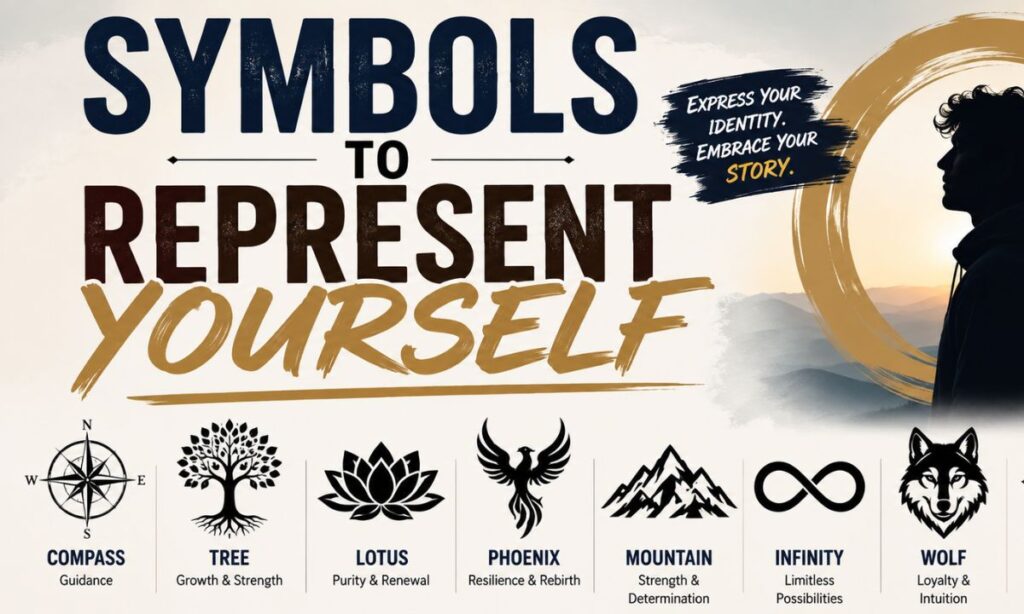
Symbols to represent yourself are more than just pretty images, they’re visual declarations of who you truly are. In 2026, people across the USA are moving away from generic aesthetics and turning toward meaningful personal symbols that capture their values, personality, and life journey. Whether it’s a phoenix tattoo, a wolf spirit animal, or a lotus flower on a vision board, the right symbol speaks when words simply fall short.
From ancient Egyptian Ankhs to modern minimalist tattoos, the world of personal identity symbols has never been more relevant or more searched. Millions of people are now asking “what symbol represents me?” because they want something real, something rooted, something that reflects their inner strength, transformation, and individuality. This guide covers 100+ powerful symbols, their deep meanings, cultural roots, and exactly how to find the one that truly represents you.
What Are Symbols To Represent Yourself?

Symbols to represent yourself are images, objects, or icons that carry personal meaning and communicate your identity to yourself and others. They go far beyond decoration. A personal symbol is a compressed story. It holds your values, your experiences, your hopes, and your sense of self in a single visual form.
The concept isn’t new. Ancient Egyptians used personal cartouches to represent individual souls. Viking warriors carved personal runes into their weapons and armor. Medieval knights wore heraldic symbols on their shields that told the world exactly who they were and what they stood for. The practice is woven into the fabric of human civilization.
What makes a symbol personal rather than generic comes down to resonance. You don’t choose a symbol because it looks cool, though that helps. You choose it because something about it feels true. Psychologists describe this as symbolic identification, the process by which an external image becomes emotionally fused with your inner sense of self. When that happens, the symbol stops being just an image. It becomes an anchor.
Symbols To Represent Yourself And Identity Meanings
Your identity is made up of your values, personality traits, life experiences, beliefs, and relationships. Personal symbols give all of that invisible inner material a visible outer form. They’re the bridge between who you are inside and how you show up in the world.
Spiritual Symbols To Represent Yourself
Spiritual symbols are among the oldest and most emotionally powerful tools for self-representation. The Om symbol from Hindu and Buddhist traditions represents the vibration of universal consciousness, and people who identify with mindfulness, meditation, or spiritual seeking often feel deeply connected to it.
The Hamsa hand, common in Middle Eastern and North African cultures, represents protection and is used by people who identify as guardians or nurturers. The Ankh from ancient Egypt represents the key to eternal life and is chosen by people drawn to questions of legacy and purpose.
What makes spiritual symbols so effective for personal representation is that they carry centuries of collective meaning while still leaving room for individual interpretation. When you wear an Ankh or tattoo an Om on your wrist, you’re plugging into something much larger than yourself while still making a deeply personal statement.
If you’re drawn to spiritual symbols, consider what spiritual quality feels most central to your identity. Is it peace? Wisdom? Protection? Connection? Your answer will point you toward the right symbol naturally.
Symbols To Represent Yourself Tattoos
Tattoos are the most permanent and visible form of personal symbolic expression humans have developed. In the United States alone, roughly 32% of adults have at least one tattoo, and surveys consistently show that most people choose their tattoo designs because they “mean something personal” rather than for purely aesthetic reasons.
The semicolon tattoo, popularized by the mental health awareness movement Project Semicolon, is one of the most powerful modern examples of a personal identity symbol. It represents the choice to continue your story when you could have ended it. People who wear it aren’t just making a fashion statement. They’re declaring something about their survival and resilience.
Other powerful tattoo symbols for self-representation include the unalome, a Buddhist symbol representing the journey to enlightenment with all its twists, turns, and eventual clarity. The compass rose is popular among people who define themselves by their sense of direction and purpose. The arrow, which must be pulled back before it can fly forward, resonates with anyone who’s gone through a period of being held back before launching into something new.
Ancient Symbols To Represent Yourself
Long before written language, humans used symbols to assert identity. Viking runes weren’t just an alphabet. Each rune carried a symbolic meaning that warriors and poets used to represent personal qualities. Algiz, which looks like an upward-reaching hand, represented protection and higher connection. Sowilo, resembling a lightning bolt, represented the sun, success, and vital energy.
In ancient Greece, personal symbols were embedded into coins, pottery, and architecture. The Greek key pattern, sometimes called the meander, represented the infinite flow of life and was used to symbolize the eternal nature of the self. The labyrinth appeared in Cretan mythology not just as a maze but as a symbol of the complex inner journey of self-discovery.
The reason ancient symbols still resonate today is that they were built around universal human experiences: strength, fear, love, death, rebirth, and purpose. Those experiences haven’t changed. Which is exactly why a symbol carved into stone 3,000 years ago can still feel completely personal in 2026.
Symbols That Represent Personality

Personality and symbol selection are closely linked. Research in symbolic psychology suggests that the symbols people choose most consistently reflect their dominant personality traits and core values.
Here’s a practical guide:
- Eagle: ambition, vision, leadership, independence
- Owl: wisdom, introspection, night-thinking, patience
- Anchor: stability, loyalty, groundedness, reliability
- Flame: passion, creativity, intensity, transformation
- Mountain: resilience, challenge-seeking, patience, determination
- River: adaptability, flow, persistence, constant movement
The key is to choose a symbol not for what you wish you were, but for what you genuinely are. That kind of honest symbolic self-representation is far more powerful and lasting.
Life Symbols And Meanings
Life symbols capture the big themes of human experience rather than specific personality traits. They work as personal symbols when a particular life theme feels central to your story.
The hourglass represents the passage of time and is often chosen by people who’ve had a wake-up moment about life’s brevity. The broken chain represents freedom from something that once held you captive, whether that’s addiction, an abusive relationship, or a limiting belief system.
The spiral represents growth and the journey inward, appearing in everything from Celtic art to nautilus shells, and it speaks to people who see life as a continuous process of becoming rather than a destination to reach.
10 Items That Describe Yourself

Sometimes the most powerful personal symbol isn’t a mythological creature or ancient rune. It’s an everyday object that quietly captures your essence:
- Compass: You’re a direction-finder. You live with intention.
- Book: You’re a lifelong learner who finds meaning through knowledge.
- Candle: You light up rooms and give your energy to others.
- Key: You’re a problem-solver who unlocks potential.
- Seed: You’re always planting something for the future.
- Camera: You’re a storyteller who captures what others miss.
- Bridge: You connect people and ideas that would otherwise stay separate.
- Mirror: You’re deeply self-aware and value honest reflection.
- Clock: Time and purpose matter to you deeply.
- Paintbrush: You see the world as something to be shaped by creativity.
Which one stopped you? That’s worth paying attention to.
Personal Symbolism
Personal symbolism, as a deliberate practice, was brought into mainstream psychology by Carl Jung, the Swiss psychiatrist who studied under Sigmund Freud before developing his own framework. Jung believed that the unconscious mind communicates through symbols, and that identifying your personal symbols is a form of deep self-knowledge.
In Jungian analysis, patients are often asked to draw or describe recurring images from their dreams and waking imagination. Those images are then explored as personal symbols that reveal hidden aspects of identity, what Jung called the shadow self, the anima or animus, and the Self (the unified whole personality).
You don’t need a therapist to practice personal symbolism. Keeping a symbol journal, where you note images that draw your attention repeatedly, is a powerful practice. Over time, patterns emerge that reveal something true about who you are beneath the surface.
Identity Symbols And Meanings
An identity symbol is any image, object, or sign that represents a person’s sense of self to themselves or to others.
What Is A Symbol Of Identity?
A symbol of identity is something that communicates who you are without requiring explanation. It’s shorthand for your values, your history, and your sense of self. Identity symbols exist on a spectrum from the deeply personal (a tattoo only you understand) to the broadly cultural (a national flag or religious symbol that millions share).
The key distinction between a generic symbol and a true identity symbol is personal ownership. A lotus flower becomes your identity symbol not because it’s beautiful, but because it captures something specific about your journey through difficulty toward peace.
Symbols Of Identity
Across cultures and history, certain symbols have served as powerful markers of personal and collective identity:
| Symbol | Core Identity Meaning |
| Lion | Strength, leadership, courage |
| Lotus | Resilience, spiritual growth, purity |
| Phoenix | Rebirth, transformation, survival |
| Compass | Direction, purpose, clarity |
| Wolf | Loyalty, independence, intuition |
| Tree of Life | Roots, growth, connection |
| Anchor | Stability, devotion, steadfastness |
| Butterfly | Change, freedom, becoming |
Examples Of Things That Represent A Person’s Identity
Identity isn’t always represented by a single bold symbol. Sometimes it’s a collection of smaller things that together paint a portrait of who you are. A grandmother’s ring. A specific book you read at age 16 that changed everything. The city you grew up in. A scar from an old adventure. A recurring dream image. A color you’re always drawn to without knowing why.
The anthropologist and symbol theorist Victor Turner described these kinds of personal meaningful objects as condensation symbols, things that compress a complex web of meanings, memories, and emotions into a single touchstone. Your condensation symbol might be a symbol others recognize, or it might be something entirely private.
Deep Symbolic Meaning
Every powerful symbol carries meaning on three distinct levels — spiritual, psychological, and cultural — and understanding all three is what separates a decoration from a true personal identity symbol.
The most transformative symbols, like the lotus, the phoenix, and the wolf, don’t just look meaningful; they feel meaningful because they speak directly to your unconscious mind, your life experiences, and your deepest values. When a symbol resonates with you on all three levels at once, it stops being just an image and becomes a living reflection of who you truly are.
Spiritual Meaning
At the spiritual level, personal symbols function as anchors between the visible world and something larger. In shamanic traditions practiced across Siberia, the Americas, and Africa, every individual has a spirit helper that takes symbolic form, often an animal or natural element, that represents their soul’s essential nature. Choosing a personal symbol in this tradition isn’t decorative. It’s considered a form of spiritual recognition.
The lotus rising clean from muddy water is one of the most spiritually layered symbols in human history. In Buddhism it represents the possibility of enlightenment within ordinary human life. In Hinduism it represents divine beauty and purity. For the individual, it speaks to the experience of becoming your best self despite difficult circumstances.
Psychological Meaning
Carl Jung wrote extensively about what he called archetypes, universal symbolic figures that appear across cultures and in individual dreams. The Hero, the Shadow, the Anima, the Wise Old Man, the Trickster. These archetypes have visual symbols associated with them, and people often find themselves drawn to the symbols that correspond to the archetype most active in their own psychological life.
Someone drawn to the wolf might be working through themes of independence versus belonging. Someone drawn to the phoenix is likely processing a major life transformation. Someone drawn to the labyrinth might be in a period of deep inner searching. The symbol doesn’t cause these experiences. It reflects them, and reflecting them back to yourself is part of how you integrate them.
Cultural Meaning
The same symbol can carry opposite meanings depending on cultural context, and this matters when choosing a personal symbol. The snake represents wisdom and healing in ancient Greek culture (it appears on the Rod of Asclepius, the symbol of medicine used to this day) but represents temptation and deception in Judeo-Christian tradition. The color red represents good fortune and celebration in Chinese culture but danger and passion in Western contexts.
Understanding the cultural meaning of your chosen symbol doesn’t mean you have to accept every interpretation. But it does mean being informed, especially if you’re choosing a symbol from a culture other than your own.
Types And Variations Of Symbols To Represent Yourself
Not every symbol speaks to every person, and that’s exactly the point — the right personal symbol finds you just as much as you find it. From the fierce resilience of the phoenix to the quiet wisdom of the lotus flower, every symbol carries a distinct energy and a deep layer of meaning built across centuries of human experience.
Whether you’re drawn to animal symbols, nature symbols, or transformation symbols, this section breaks each one down so you can find the one that truly feels like you.
Phoenix
Visual Description: A bird of brilliant red, orange, and gold plumage, typically shown rising from flames or ash with wings fully spread.
Meaning: Rebirth, resilience, transformation, and the power to rise after complete destruction. The phoenix is the ultimate symbol for anyone who has rebuilt themselves from the ground up after loss, failure, illness, or trauma.
Where It Appears: Greek mythology, Chinese mythology (as the Fenghuang), Egyptian tradition (the Bennu bird), heraldry, sports team logos, and modern tattoos. The city of Atlanta, Georgia uses the phoenix as its official symbol, referencing its literal rebuilding after being burned during the Civil War.
Butterfly
Visual Description: A delicate winged insect with colorful, symmetrical wings, often depicted mid-flight or emerging from a chrysalis.
Meaning: Transformation, personal growth, the soul, freedom, and the beauty that emerges from a period of quiet struggle. The butterfly’s life cycle, from caterpillar to chrysalis to winged creature, is one of nature’s most perfect metaphors for human change.
Where It Appears: Spiritual art across cultures, mental health awareness campaigns, fashion, literature, and tattoos worldwide.
Lotus Flower
Visual Description: A multi-petaled flower, typically pink or white, rising open and clean above dark, murky water.
Meaning: Purity rising from difficulty, spiritual enlightenment, inner peace, and the capacity for beauty within ordinary life. The lotus is particularly meaningful for people on an active spiritual path or those who have found clarity after chaos.
Where It Appears: Buddhist temples, Hindu iconography, yoga and wellness branding, fine art, and tattoos.
Wolf
Visual Description: A powerful canine with a direct, intelligent gaze, often depicted howling at the moon or moving through a winter forest.
Meaning: Loyalty to your inner circle combined with fierce independence from the crowd. The wolf doesn’t follow the pack mindlessly; it leads it or runs alone. This symbol resonates deeply with people who walk their own path without abandoning the people they love.
Where It Appears: Norse mythology, Native American spiritual tradition, fantasy literature, team mascots, and tattoos.
Compass
Visual Description: A circular navigational instrument with four clear directional points, often styled with intricate detailing or a decorative compass rose design.
Meaning: Direction, purpose, staying true to your path even in unfamiliar territory. The compass doesn’t tell you where to go. It helps you figure out where you are so you can choose your direction with clarity. It’s a perfect symbol for people who live intentionally.
Where It Appears: Maritime culture, military insignia, adventure travel branding, personal jewelry, and tattoos.
Symbols To Represent Yourself Across Cultures

Personal symbols aren’t just a modern trend — every major culture in human history has used powerful symbols to express individual and collective identity. From ancient Egyptian Ankhs to Japanese Enso circles and Celtic knots, discovering these cultural symbols can help you find one that connects deeply with your roots, values, and sense of self.
Ancient Egypt
Egyptian personal symbols were tied directly to concepts of the soul. The Ankh represented life itself and was carried by gods and pharaohs as a marker of divine identity. The Scarab beetle represented personal transformation and regenerative power. The Eye of Horus represented protection, clear perception, and the ability to see truth in both the physical and spiritual worlds.
Native American Traditions
In many Native American traditions, personal symbols are revealed rather than chosen. Vision quests, periods of fasting and solitude undertaken at key life transitions, were designed to allow a person’s guiding symbol or spirit animal to make itself known. The eagle feather represents spiritual connection and honor. The bear paw represents strength and a guiding path forward.
It’s essential to approach Native American symbols with cultural respect. Many of these symbols hold deep sacred significance within specific nations and are not intended for casual adoption outside their cultural context.
Japanese Culture
The Enso circle, drawn in a single brushstroke, represents enlightenment, wholeness, and the beauty of imperfection. It’s central to Zen Buddhist practice and speaks to anyone who values presence over perfection.
The Koi fish, swimming upstream against the current, represents perseverance and transformation. Japanese culture as a whole uses the concept of Ikigai (your reason for being) as a kind of invisible personal symbol that shapes all life decisions.
Positive Vs Negative Meaning
Every powerful symbol carries both a light side and a dark side, and understanding that duality is what makes your chosen symbol truly meaningful. From the transformative snake to the passionate fire and the mysterious moon, knowing the full range of a symbol’s meaning helps you choose one that honestly reflects every dimension of who you are.
Snake
Positive: Transformation, wisdom, healing, and renewal. The snake sheds its skin and continues living, making it one of nature’s most powerful symbols of rebirth. Negative: Deception, temptation, and hidden danger in Judeo-Christian and some Western folk traditions.
Fire
Positive: Passion, creative energy, transformation, and purification. Fire destroys what’s old to make way for what’s new. Negative: Uncontrolled destruction, rage, and consuming everything it touches without discrimination.
Moon
Positive: Intuition, emotional depth, cycles of change, and the power of the inner world. The moon rules the tides and the unconscious mind alike. Negative: Instability, moodiness, and illusion. The word “lunacy” literally comes from the Latin word for moon.
Why Humans Are Attracted To Symbols

Humans are the only species that uses symbols to understand themselves, and this capacity is directly linked to the evolution of the prefrontal cortex and language centers of the brain. Symbolic thinking isn’t a luxury. It’s one of the core cognitive abilities that separates human consciousness from that of other animals.
Neuroscience research shows that the brain processes symbols through emotional pathways before logical ones. When you see a symbol that resonates with your identity, your limbic system responds before your rational mind does. That gut-level recognition is genuine data about who you are.
There’s also a social function. Personal symbols communicate identity to others instantly and without words. In a world where first impressions happen in milliseconds, a meaningful tattoo, a piece of symbolic jewelry, or even a recurring visual motif in your home or clothing tells people something true about you before you’ve said a word.
Frequently Asked Questions
What is the best symbol to represent yourself?
The best symbol reflects your core values, life journey, and personality traits most honestly and powerfully.
What symbol represents strength and personal identity?
The lion, phoenix, oak tree, and mountain are universally recognized symbols of strength and personal identity.
Can I create my own personal symbol to represent myself?
Absolutely. Many people design custom sigils by combining existing symbols that reflect their unique personal identity.
What tattoo symbol best represents who you are?
Popular meaningful tattoo choices include the phoenix, compass, unalome, semicolon, and butterfly for personal self-expression.
How do I find a symbol that represents my personality?
Reflect on your core values, recurring dreams, and natural imagery that consistently feels emotionally true to you.
Conclusion
The right symbol to represent yourself isn’t the most beautiful one or the most popular one. It’s the one that makes you feel most clearly seen, most fully yourself, when you look at it.
You might find it immediately in this guide. Or it might be something you’ll recognize slowly, a recurring image in your dreams, an animal that keeps crossing your path, a shape you’ve been unconsciously drawing in the margins of notebooks for years.
Start paying attention to what draws you. Your personal symbol is already there. You’re just learning to read the language you’ve always been speaking.
